Kenai Fjords National Park is one of Alaska’s strongest places for wildlife viewing because mountains, glaciers, forests, and coastal waters meet in one protected landscape. Visitors may see sea otters, humpback whales, orcas, seals, sea lions, puffins, eagles, mountain goats, bears, and other wildlife. The best viewing approach depends on the habitat, season, weather, and your distance from the animals.
Quick Answer
The best wildlife viewing in Kenai Fjords National Park is along its coastal waters, where boat trips and careful kayaking can reveal sea otters, whales, seals, sea lions, puffins, and other seabirds. The Exit Glacier area is better for land-based wildlife and bird sightings. Summer offers many wildlife opportunities, but conditions and animal sightings can change.
Key Takeaways
- Coastal waters are the main place to look for marine mammals and seabirds.
- Sea otters are commonly associated with shallow coastal water and kelp beds.
- Humpback whales, orcas, seals, and sea lions may be seen from boats in the fjords.
- Two puffin species, horned and tufted, nest in the park.
- The Exit Glacier area provides the park’s maintained trails and is the easiest area to visit by road.
- Keep at least 300 yards from bears, at least 25 yards from other wildlife, and generally 100 yards from marine mammals.
- Check current conditions before traveling because weather, road access, and trail conditions can change quickly.
Overview of Kenai Fjords National Park
Kenai Fjords National Park covers about 669,650 acres and protects a landscape shaped by the Harding Icefield, glaciers, mountains, forests, and coastal waters. The National Park Service lists 191 bird species, around 10 marine mammal species, close to 30 land mammal species, and 40 fish species in the park. :contentReference[oaicite:27]{index=27}
The park has three main areas: the Exit Glacier area, the coastal fjords, and the Harding Icefield. These areas offer very different wildlife-viewing opportunities. The coastal environment is especially important for marine mammals and seabirds, while the Exit Glacier area provides the main maintained trail network for visitors on land. :contentReference[oaicite:28]{index=28}
Exit Glacier is the only part of the park accessible by road. The area has several maintained trails, including short routes to glacier viewpoints and the strenuous Harding Icefield Trail. :contentReference[oaicite:29]{index=29}
Note: Kenai Fjords is a remote park with limited cell service. Check current road, trail, weather, and wildlife information before leaving Seward. Conditions can change during the day, especially in the backcountry and along the coast.
Best Locations for Wildlife Viewing
Wildlife viewing in Kenai Fjords is easiest when you match the animal you want to see with the right habitat. Coastal waters are the main setting for marine mammals and seabirds. The Exit Glacier area is the practical choice for visitors who want land-based trails.
Coastal Areas and Fjords
The coastal fjords are among the best places to look for marine wildlife. Boat trips from Seward can travel through Resurrection Bay and into the fjords, giving visitors access to habitats that cannot be reached by road.
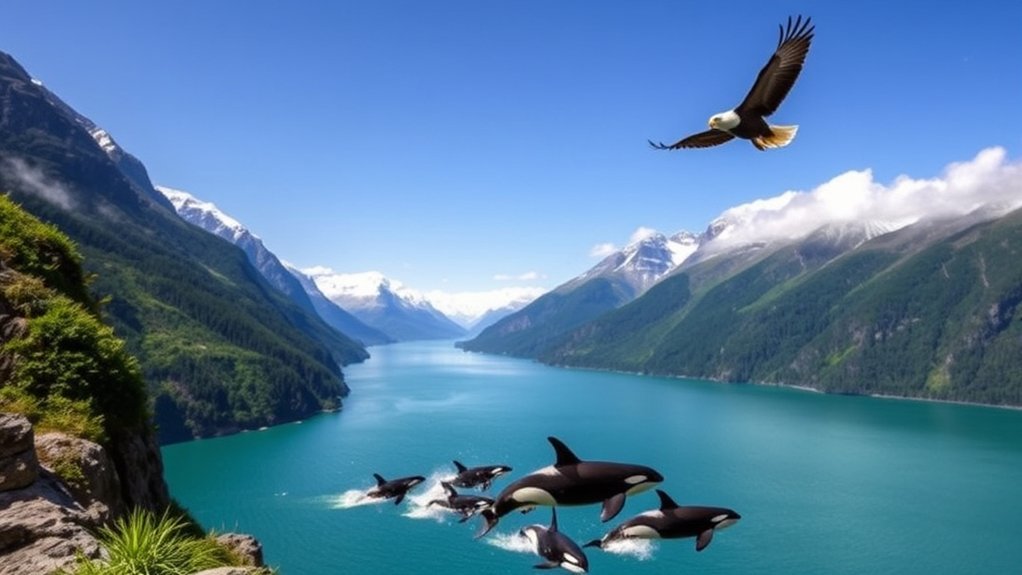
Sea otters may be seen floating or feeding in coastal waters. Seals, sea lions, humpback whales, orcas, and other marine species can also occur in the region. Seabirds gather around rocky islands and cliffs, especially during the breeding season. NPS identifies the coastal waters as important habitat for a wide range of marine mammals and birds. :contentReference[oaicite:30]{index=30}
Resurrection Bay is a useful starting area because it is close to Seward and provides access to the broader coastal environment. Farther into the fjords, steep cliffs, islands, tidewater glaciers, and productive marine waters create additional opportunities for wildlife sightings.
Kayaking can provide a quieter way to experience the coast, but it requires careful planning. Keep well away from marine mammals and do not paddle toward animals. Kayakers should also understand the risks around tidewater glaciers because waves caused by calving ice can reach beaches with surprising force. :contentReference[oaicite:31]{index=31}
Exit Glacier Area
The Exit Glacier area is the most accessible land-based section of Kenai Fjords National Park. It has maintained trails, a nature center, picnic tables, restrooms, and seasonal ranger programs. The area also provides views of the glacier and the surrounding valley. :contentReference[oaicite:32]{index=32}
Wildlife sightings here are less predictable than coastal marine-mammal viewing. Visitors may encounter birds and land mammals, including bears or moose, but there is no guarantee of seeing a particular species.
The Harding Icefield Trail can provide a very different setting. It is a strenuous hike with significant elevation gain and changing weather conditions. Treat it as a wilderness hike rather than a dedicated wildlife trail. Bring enough food, water, warm clothing, rain gear, and appropriate footwear, and check current conditions before starting. :contentReference[oaicite:33]{index=33}
Trails and Land Wildlife
The park’s maintained trails are concentrated in the Exit Glacier area. This is important when planning a wildlife-focused trip because much of the park’s coastline does not have a trail system. The park has more than 545 miles of coastline, while the maintained trails are located in the Exit Glacier area. :contentReference[oaicite:34]{index=34}
Mountain goats can occur on steep mountain terrain, while black bears, brown bears, moose, and other land mammals use forest and valley habitats. Keep your attention on the trail and surrounding terrain rather than walking toward an animal for a better photograph.
Pro Tip: Carry binoculars instead of trying to move closer to wildlife. If an animal changes its behavior because of your presence, you are already too close. :contentReference[oaicite:35]{index=35}
Sea Otters and Their Habitats
Sea otters are one of the most recognizable animals in Kenai Fjords’ coastal waters. NPS notes that they are seen in Resurrection Bay and the fjords and that they favor shallow coastal water, especially around kelp beds. :contentReference[oaicite:36]{index=36}
Sea Otter Feeding Habits
Sea otters feed on marine invertebrates such as clams, mussels, crabs, and sea urchins. They commonly forage in shallow water, although they are capable of much deeper dives. They can also use rocks as tools to open hard-shelled prey. :contentReference[oaicite:37]{index=37}
Their feeding behavior has an important ecological effect. Sea otters can reduce sea urchin numbers, which reduces grazing pressure on kelp in suitable habitats. This makes them a keystone species in nearshore marine ecosystems. NPS monitoring work at Kenai Fjords also examines sea otters and their prey as part of long-term study of the nearshore environment. :contentReference[oaicite:38]{index=38}
Where to Look for Sea Otters
Sea otters can be seen in coastal waters around the park, including Resurrection Bay and the fjords. Because they move and forage naturally, no location can guarantee a sighting.
- Resurrection Bay: A convenient coastal area where sea otters may be seen in the water.
- Coastal fjords: Boat trips can reach deeper into the park’s marine habitat.
- Kelp-rich shallow water: These habitats are important feeding areas for sea otters.
- From boats or shore: Use binoculars or a long lens rather than moving closer.
Sea otters may spend time floating, grooming, diving, or feeding. Watching these natural behaviors from a respectful distance is more useful than trying to obtain a close encounter.
Conservation and Protection
Kenai Fjords was established in part to protect marine mammals and birds and to keep important breeding and hauling areas free from disruptive human activity. Wildlife protection is therefore part of the park’s core purpose, not simply a visitor guideline. :contentReference[oaicite:39]{index=39}
Visitors help by keeping their distance, avoiding food and garbage that could attract wildlife, and following park rules. Researchers also monitor marine ecosystems, including sea otters, seabirds, kelp, and nearshore invertebrates, to understand changes in the coastal environment. :contentReference[oaicite:40]{index=40}
Spotting Humpback Whales
Humpback whales are among the marine mammals visitors may encounter in the waters around Kenai Fjords. The park’s productive fjord ecosystem supports a wide range of marine life, and humpback whales travel to Alaskan waters to feed. :contentReference[oaicite:41]{index=41}
The best wildlife encounter is one that lets the animal continue feeding, resting, traveling, or caring for its young without changing its behavior.
When looking for whales, scan the water for blows, dorsal surfaces, tail flukes, or splashes. A good pair of binoculars can make distant animals easier to identify without requiring a closer approach.
- Watch the water: Look for blows and repeated surfacing patterns.
- Use binoculars: They provide a closer view without reducing the animal’s space.
- Stay patient: Whales can remain underwater between sightings.
- Follow vessel rules: Never chase, pursue, surround, or cut across the path of a marine mammal.
- Leave an escape route: If a whale approaches your vessel, allow it to pass rather than moving toward it.
NPS guidance calls for vessels to remain at least 100 yards from whales, dolphins, porpoises, and seals or sea lions hauled out on land, rock, or ice. If a whale approaches within that distance, vessels should not move toward it. :contentReference[oaicite:42]{index=42}
Observing Puffins and Other Birds
Kenai Fjords is a strong destination for seabird viewing. NPS documents 191 bird species in the park, including bald eagles, murres, marbled murrelets, peregrine falcons, black oystercatchers, and both horned and tufted puffins. :contentReference[oaicite:43]{index=43}
Two puffin species nest in Kenai Fjords: horned puffins and tufted puffins. NPS identifies the Chiswell Islands as an important nesting area, with other nesting sites around the coast. Tufted puffins generally arrive at the rookery islands around mid-May, followed by horned puffins about a week later. :contentReference[oaicite:44]{index=44}
Boat trips can be especially useful for seabird viewing because many colonies are located on steep coastal cliffs and offshore islands. Look for puffins, murres, kittiwakes, and other birds on cliffs, rock ledges, and the water.
Do not approach nesting colonies or try to get closer to a bird that appears disturbed. NPS guidance applies distance rules to animals, dens, and nests, and breeding areas may receive additional protection. :contentReference[oaicite:45]{index=45}
Other Wildlife You May See
Marine mammals receive much of the attention in Kenai Fjords, but the park also supports a diverse land-animal community. NPS lists black bears, brown bears, mountain goats, moose, wolves, wolverines, beavers, river otters, porcupines, and other mammals among the park’s terrestrial wildlife. :contentReference[oaicite:46]{index=46}
Birds can be easier to encounter during a land-based visit because they use forests, shorelines, cliffs, and open water. Bald eagles are among the notable species, and NPS notes that they feed on fish, birds, and mammals and may also scavenge. :contentReference[oaicite:47]{index=47}
Remember that seeing wildlife is never guaranteed. Habitat, weather, season, food availability, animal movement, and visitor activity all affect what you see on a particular day.
Best Time of Year for Wildlife Viewing
Summer is the most popular period for visiting Kenai Fjords and offers strong opportunities for coastal wildlife and seabird viewing. Puffins return to nesting areas in spring, and summer brings many visitors to the coastal fjords. :contentReference[oaicite:48]{index=48}
Late spring through summer can be particularly rewarding for visitors interested in seabirds and marine mammals. However, wildlife remains present outside the peak summer period, and different species use the park differently through the year.
Winter offers a different experience. The Exit Glacier area remains open year-round, but the road is generally inaccessible to cars during part of the winter because of snow. Winter conditions require different transportation, clothing, equipment, and planning. :contentReference[oaicite:49]{index=49}
For any season, check current conditions before traveling. Road access, trail conditions, weather, snow, and avalanche hazards can change quickly. :contentReference[oaicite:50]{index=50}
Safety Tips for Wildlife Encounters
Kenai Fjords is a remote and rugged Alaska park. Wildlife encounters are only one part of the risk. Weather can change quickly, cell service is limited, and some areas require visitors to be responsible for their own navigation and emergency planning. :contentReference[oaicite:51]{index=51}
- Stay 300 yards from bears: This is the current NPS wildlife-distance guidance.
- Stay at least 25 yards from other animals, dens, and nests: Give animals room and avoid approaching them.
- Stay generally 100 yards from marine mammals: This applies to whales, seals, sea lions, and other marine mammals under the park’s general guidance.
- Never feed wildlife: Human food can change animal behavior and create dangerous encounters.
- Do not follow wildlife: If an animal moves away because of you, increase your distance.
- Carry bear spray when appropriate: NPS recommends bear spray for visitors in the park and emphasizes knowing how to use it.
- Secure food and garbage: Keep food and scented items away from wildlife.
- Check conditions: Review current alerts, road status, weather, and trail conditions before leaving.
Warning: Do not approach wildlife for a photograph. If an animal reacts to your presence, backs away, changes direction, becomes agitated, or changes its normal behavior, increase your distance immediately. NPS specifically advises visitors not to approach or follow wildlife. :contentReference[oaicite:52]{index=52}
Responsible Wildlife Viewing Practices
Responsible wildlife viewing means observing animals without changing what they are doing. That includes feeding, approaching, following, blocking escape routes, crowding nesting areas, or making repeated attempts to get closer.
For land wildlife, follow NPS distance guidance and stay on appropriate routes. For marine mammals, maintain a general distance of at least 100 yards and never pursue an animal. Boat operators should avoid sudden changes in speed or direction near whales and should leave animals a clear escape route. :contentReference[oaicite:53]{index=53}
Keep food, wrappers, crumbs, and other waste under control. When camping, cook and eat away from sleeping areas and store food securely. Proper food storage is especially important in bear country. :contentReference[oaicite:54]{index=54}
Photography should follow the same rule. A long lens and binoculars are better choices than moving closer. A photograph is not worth disturbing an animal or creating a safety problem for yourself, other visitors, or the wildlife.
Planning Your Wildlife Viewing Trip
Start by deciding what type of wildlife you want to see. If marine mammals and seabirds are your priority, plan around the coastal fjords. If you want a land-based visit, the Exit Glacier area provides the park’s maintained trails and the easiest road access. :contentReference[oaicite:55]{index=55}
Bring binoculars, weather-resistant clothing, sturdy footwear, water, food, and a way to communicate in an emergency. Cell phone service is not available throughout the park, so do not rely on a phone as your only emergency option. :contentReference[oaicite:56]{index=56}
If you plan to kayak or travel into the coastal backcountry, prepare for changing marine and weather conditions. Avoid landing close to tidewater glaciers because waves from calving ice can be dangerous. :contentReference[oaicite:57]{index=57}
Before departure, check current park alerts and conditions. This is particularly important if your trip depends on the Exit Glacier road, the Harding Icefield Trail, or remote coastal travel.
Pets and Visitor Facilities
Pets are allowed only in limited areas of Kenai Fjords National Park. Leashed pets are allowed on the road to Exit Glacier and in the Exit Glacier parking lot. Pets are not allowed on park trails, including the Exit Glacier trails and Harding Icefield Trail, or in several other areas such as the coastal backcountry. :contentReference[oaicite:58]{index=58}
At the Exit Glacier area, the nature center provides exhibits and ranger assistance. Seasonal facilities include flush toilets, potable water, picnic tables, bear-resistant trash and recycling containers, and a 12-site tent-only campground. Facility availability can change with the season, so check current information before your visit. :contentReference[oaicite:59]{index=59}
Frequently Asked Questions
What time of year is best for wildlife viewing in Kenai Fjords?
Summer is the most popular period for wildlife viewing, especially for coastal trips and seabirds. Puffins return to nesting areas in spring, with tufted puffins generally arriving around mid-May and horned puffins following about a week later. Wildlife remains present outside summer, but access and conditions vary by season.
Are there guided tours for wildlife viewing?
Yes. Guided boat trips are a practical way to reach the coastal fjords, where visitors may see marine mammals, seabirds, and glaciers. A guide can also help identify wildlife and explain safe viewing practices. Sightings are never guaranteed.
Can I bring my pet to Kenai Fjords National Park?
Only in limited areas. Leashed pets are allowed on the road to Exit Glacier and in the Exit Glacier parking lot. They are not allowed on park trails, in the coastal backcountry, or in several other restricted areas. Service animals have broader access under applicable rules. Check current NPS pet regulations before visiting.
What photography equipment is useful for wildlife?
Binoculars and a telephoto or long-zoom lens are useful because wildlife should be viewed from a safe distance. A fast shutter speed can help freeze moving animals, while weather protection is useful in the park’s wet and changeable conditions. Do not move closer to an animal to improve a photograph.
How far away should I stay from wildlife?
NPS advises visitors to stay 300 yards from bears and at least 25 yards from other animals, dens, and nests. As a general rule, remain at least 100 yards from marine mammals. If your presence changes an animal’s behavior, increase your distance.
Is Exit Glacier a good place for wildlife viewing?
Exit Glacier is the easiest part of the park to reach by road and is useful for land-based wildlife and bird sightings. However, it is not a dedicated wildlife-viewing area. Coastal trips are generally better suited to visitors whose main goal is seeing marine mammals and seabirds.
Conclusion
Kenai Fjords National Park offers wildlife viewing across two very different settings: the coastal fjords and the land-based Exit Glacier area. Coastal waters provide opportunities to see sea otters, whales, seals, sea lions, puffins, and other seabirds, while the park’s land habitats support bears, mountain goats, moose, eagles, and many other species. NPS currently documents 191 bird species in the park. :contentReference[oaicite:60]{index=60}
The most important part of the experience is responsible viewing. Stay 300 yards from bears, at least 25 yards from other wildlife, and generally 100 yards from marine mammals. Never feed, chase, follow, or crowd an animal. Check current conditions before your trip, prepare for Alaska’s changing weather, and use binoculars or a long lens instead of approaching wildlife. :contentReference[oaicite:61]{index=61}
With those precautions, you can enjoy Kenai Fjords’ wildlife while helping protect the animals and habitats that make the park special.
Sources
- National Park Service — Wildlife Safety: current wildlife-distance, feeding, food-storage, and behavior guidance. :contentReference[oaicite:62]{index=62}
- National Park Service — Exit Glacier Area: road access, trails, facilities, seasonal information, and pet restrictions. :contentReference[oaicite:63]{index=63}
- National Park Service — Birds: current bird-species information and species checklist. :contentReference[oaicite:64]{index=64}
- National Park Service — Sea Otter: habitat, diet, diving, tool use, and ecological role. :contentReference[oaicite:65]{index=65}
- National Park Service — Kenai Fjords National Park Fact Sheet: park size, wildlife totals, trails, coastline, facilities, and current park facts. :contentReference[oaicite:66]{index=66}
- National Park Service — Kayak and Boat Safety: marine-mammal distances and tidewater-glacier safety. :contentReference[oaicite:67]{index=67}