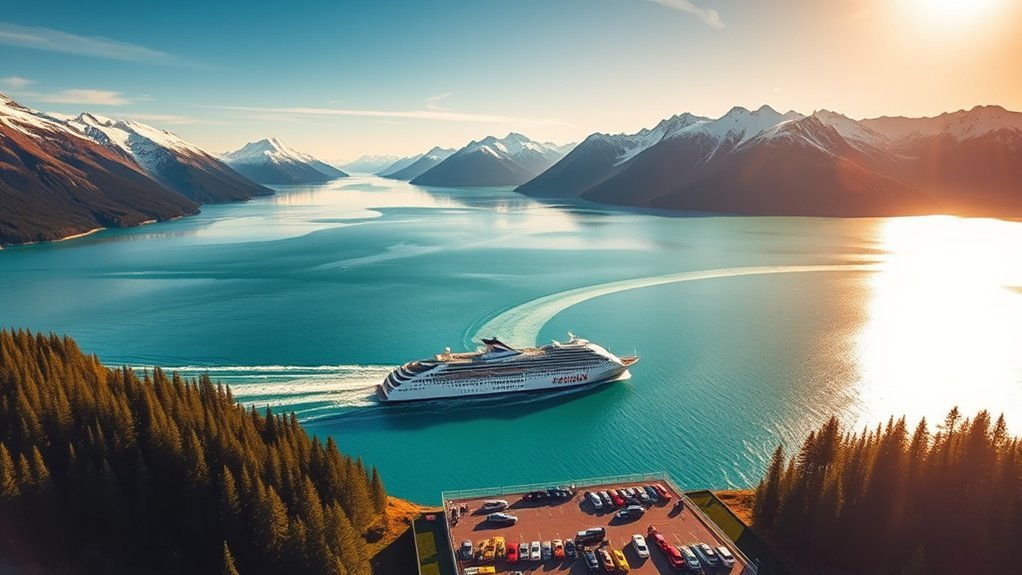
The Alaska Marine Highway System, or AMHS, is Alaska’s state ferry network for passengers, vehicles, and freight. It covers about 3,500 marine miles and serves 35 communities, stretching from Bellingham, Washington, through coastal Alaska to Dutch Harbor in the Aleutian Chain. A successful trip starts with choosing an available route, checking the date-specific schedule, and reserving every passenger, vehicle, pet, and cabin correctly.
Last updated: July 23, 2026. AMHS schedules, vessels, routes, fares, and policies can change, so confirm your sailing in the official search before making nonrefundable travel plans.
Quick Answer
Search your exact ports and dates in the official AMHS Sailing Search, then reserve passenger, vehicle, pet, and cabin space together. Measure your complete vehicle, follow the correct terminal check-in time, carry proper identification, and recheck service notices before traveling because routes and departure times can change.
Key Takeaways
- Use the official Sailing Search to check both availability and current fares.
- Do not assume that Cross-Gulf, Yakutat, Prince Rupert, or remote Aleutian service is available during every season.
- Vehicle travelers must reserve the full length from the furthest front extension to the furthest rear extension.
- Walk-on and vehicle check-in deadlines vary by port and route, and late vehicle space may be released to standby travelers.
- Standard pets remain on the car deck, while service animals follow separate AMHS rules.
- Leave time between the ferry and flights, tours, hotels, buses, or other ferries because weather and mechanical changes can disrupt service.
At a Glance
| Time Required | About 30–60 minutes for a simple trip; longer for multi-port, vehicle, RV, pet, or cabin itineraries |
| Difficulty | Easy for a direct walk-on trip; moderate for vehicles, remote routes, and multiple connections |
| Tools Needed | Official Sailing Search, exact vehicle measurements, passenger details, identification, and current contact information |
| Cost | Varies by route, passenger count, vehicle dimensions, cabin type, and current availability |
Overview of the Alaska Marine Highway System
The Alaska Marine Highway System connects coastal communities that may be difficult or impossible to reach by road. Ferries can carry walk-on passengers, cars, motorcycles, RVs, trailers, freight, bicycles, kayaks, canoes, and other wheeled conveyances when vessel and terminal restrictions allow.
The system operates across three broad travel areas: Southeast Alaska, schedule-dependent Cross-Gulf connections, and Southcentral or Southwest Alaska. Mainline vessels handle longer trips with multiple stops, while day boats and shuttle ferries connect nearby communities.
Alaska DOT&PF describes the current marine highway network as nine ferries serving 35 communities across about 3,500 marine miles.
For official planning, use the Alaska Marine Highway System website, the AMHS schedules page, the AMHS route guide, and the date-specific Sailing Search.
Which Alaska Ferry Route Should You Choose?
Your best route depends on whether you want an Inside Passage journey, a road-and-ferry connection, access to Kodiak Island, or travel through remote Southwest Alaska. Use the table as an orientation guide, not as proof that every connection operates on your dates.
| Route area | Common ports and route examples | Best for |
|---|---|---|
| Southeast Alaska | Bellingham, Ketchikan, Wrangell, Petersburg, Juneau, Haines, Skagway, Sitka, Hoonah, Angoon, Gustavus, Kake, Pelican, Tenakee, and Metlakatla | First-time ferry travelers, Inside Passage scenery, short regional trips, and communities with established visitor services |
| Cross-Gulf connections | When scheduled, itineraries may connect Southeast Alaska with Yakutat, Whittier, Chenega Bay, Kodiak, or Homer | Longer journeys between Southeast and road-connected Southcentral Alaska |
| Southcentral and Southwest Alaska | Homer, Seldovia, Kodiak, Ouzinkie, Port Lions, Chignik, Sand Point, King Cove, Cold Bay, False Pass, Akutan, Dutch Harbor, Valdez, Cordova, Chenega Bay, Tatitlek, and Whittier | Kodiak Island, Prince William Sound, Aleutian Chain travel, remote communities, and flexible itineraries |
Note: Cross-Gulf, Yakutat, Prince Rupert, and remote Southwest service can disappear from an entire seasonal schedule. The proposed winter 2026/27 schedule did not include Cross-Gulf, Yakutat, or Prince Rupert sailings. Confirm your complete itinerary in the live Sailing Search.
Typical Alaska Ferry Running Times
Travel time depends on the vessel, tide, weather, route, and number of port calls. The following official route-guide examples help you understand the scale of an AMHS trip, but your reservation is the authority for your sailing.
| Example route | Sample running time |
|---|---|
| Bellingham to Ketchikan | About 38 hours |
| Juneau to Haines | About 4 hours 30 minutes |
| Ketchikan to Metlakatla | About 45 minutes |
| Homer to Kodiak | About 9 hours |
| Whittier to Cordova | About 6 hours 45 minutes |
| Akutan to Dutch Harbor | About 3 hours 30 minutes |
How to Book Your Ferry Tickets
You can book through the official AMHS Sailing Search, by calling reservations, or through a local ferry terminal. The online tool shows date-specific sailings, availability, and current fares for passengers, vehicles, cabins, pets, bicycles, kayaks, and other travel items.
- Choose your departure and arrival ports: Search the complete trip before booking hotels, flights, or tours.
- Select your date: Compare nearby dates when vehicle or cabin space is unavailable.
- Add every passenger: Use each traveler’s legal information and include children in the passenger count.
- Add the complete vehicle: Enter its actual overall length, height, width, powertrain, trailer, racks, and overhangs.
- Add pets and special items: Include pets, motorcycles, bicycles, kayaks, canoes, trailers, or other conveyances.
- Choose a cabin when available: Cabins are optional and are sold separately from passenger passage.
- Save your booking details: Keep the confirmation, booking number, terminal contact information, and schedule offline.
Before reserving, write down your departure port, arrival port, date, passenger count, vehicle dimensions, cabin preference, pet needs, and accurate email and phone information. AMHS uses the contact details in the reservation to send schedule-change notices.
Pro Tip: Take a photo of your vehicle from the side after measuring it. Include the trailer tongue, spare tire, bike rack, cargo carrier, grill guard, kayak, or anything else that extends beyond the normal body.
Online Booking Cutoffs
Online reservations for sailings departing from staffed terminals close four hours before departure. Reservations from unmanned ports may remain available until 15 minutes before departure. Contact the departing terminal directly when the online system is closed or when you need help with a last-minute booking.
When Online Booking Is Not Enough
Contact AMHS reservations or a terminal instead of relying on the website when:
- Your vehicle and connected trailer are longer than 30 feet.
- Your vehicle is more than eight feet wide.
- You are booking an unaccompanied or commercial vehicle.
- You need an accessible cabin.
- You have ten or more passengers.
- You are transporting a damaged, recalled, or unusually configured alternative-energy vehicle.
- The website does not accept your vehicle, cabin, or itinerary.
Current web-booking rules limit electric vehicles and plug-in hybrid electric vehicles to two per vessel per sailing. You must accurately disclose the make, model, powertrain, and length. Incorrect information can lead to an adjusted reservation, cancellation, or denial of boarding.
What if Vehicle or Cabin Space Is Sold Out?
Call the AMHS reservations center and ask whether a waitlist is available. Waitlisted vehicle or cabin requests may be confirmed when another customer cancels, and availability may be monitored until departure day. A waitlist is not a confirmed reservation, so keep a backup date or route.
Understanding the Ferry Schedule
The Alaska Marine Highway schedule is not the same on every route. Some communities receive frequent service during busy periods, while remote routes may have limited, seasonal, whistle-stop, or weather-dependent service.
Current Schedule Note: AMHS opened its summer 2026 schedule for travel from May 1 through September 30, 2026. As of this article’s update, the October 2026 through April 2027 winter schedule had been released as a proposed schedule for review. Use the finalized live schedule for travel after September 2026.
Departure and Arrival Times
Review departure and arrival times carefully and build extra time into both ends of the trip. Weather, tides, vessel maintenance, loading needs, and operational changes can affect a sailing. Avoid a tight same-day flight, tour, bus, hotel transfer, or onward ferry connection.
The official tools let you search by date, port, vessel, or route. Use the Sailing Search for bookable date-specific travel and the published schedule grids to understand broader route patterns.
Warning: AMHS may alter, delay, or cancel schedules and does not guarantee reimbursement for hotels, flights, tours, rental cars, or other expenses caused by a disruption. Avoid nonrefundable connections when possible.
Seasonal Schedule Variations
Service can change significantly between summer and winter. Do not build a new trip from an old blog post, a previous year’s schedule, or a route map without checking the actual sailing calendar.
| Season | What to expect | Planning tip |
|---|---|---|
| Winter | More limited service and fewer long-distance options on some routes | Confirm every connection before buying flights or hotels |
| Spring | Transition between seasonal schedules | Watch for schedule releases, revisions, and vessel changes |
| Summer | Higher passenger demand and stronger competition for vehicle and cabin space | Reserve early when traveling with a car, RV, trailer, pet, or cabin requirement |
| Fall | Some service begins tapering toward the winter schedule | Build extra flexibility into remote-community travel |
Route Options and Connectivity
Many ferry routes connect with roads, buses, local flights, rental vehicles, tours, or another ferry. If one sailing arrives after your next connection has departed, you may need to stay overnight in port.
- Choose the route first: Decide whether you need Southeast Alaska, Prince William Sound, Kodiak, or Southwest Alaska.
- Check frequency: Some routes operate regularly, while others may have long gaps between sailings.
- Check the entire journey: A map connection does not guarantee a practical same-day transfer.
- Confirm onward transportation: Match the ferry arrival with hotels, rental cars, road travel, tours, buses, or local flights.
- Allow disruption time: Add at least an overnight buffer before a critical flight or nonrefundable activity when practical.
Whittier Tunnel Planning
Travelers driving to or from Whittier must also plan around the Anton Anderson Memorial Tunnel schedule. The one-lane tunnel alternates direction and shares access with rail traffic. Foot and bicycle traffic is prohibited, and vehicle restrictions apply. Check the official Whittier Tunnel schedule before deciding when to leave Anchorage or another road-connected location.
When Should You Check In for the Alaska Ferry?
Check-in rules matter because reserved space can be lost when you arrive late. Walk-on passengers and vehicle travelers follow different deadlines.
Walk-On Passenger Check-In
| Requirement | Official guidance |
|---|---|
| Bellingham or Juneau departure | Check in two hours before departure |
| Other ports | Check in one hour before departure |
| Security inspection | Complete screening at least 30 minutes before boarding |
| Final boarding | Be aboard at least 15 minutes before departure |
Vehicle Check-In
| Check-in time | Ports or routes |
|---|---|
| 3 hours before departure | Bellingham to Alaska; Homer on an Aleutian Chain route; Juneau to Cross-Gulf ports; Whittier on a Cross-Gulf route |
| 2 hours before departure | Juneau, Haines, Ketchikan, Sitka, Homer, and Kodiak |
| 1.5 hours before departure | Skagway, Valdez, Cordova, and Whittier |
| 1 hour before departure | All other ports not listed above |
Vehicle check-in lets terminal staff arrange boarding lanes for safe loading and security screening. When a reserved vehicle misses its deadline, AMHS may release that car-deck space to a standby traveler.
Sitka departure times can vary with tides and currents. AMHS advises travelers to call the Sitka terminal one hour before the scheduled vessel arrival time for a confirmed check-in and departure time.
Identification, Security, and Baggage
Identification Requirements
Travelers must be prepared to show government-issued photo identification when accepting tickets and before boarding. AMHS contract terms specifically require passengers age 18 or older to present valid government-issued photo ID.
A state or provincial driver’s license, passport, or military identification may qualify. Travelers going directly between Bellingham and an Alaska port without disembarking in Canada generally do not need a passport for that ferry trip. Passengers entering or leaving Canada must follow current border-document requirements.
Motorists may also be asked for vehicle registration, proof of title, or liability insurance. Carry additional consent or custody documents when traveling internationally with a child who is not in your full legal custody.
Security Screening
Passengers, vehicles, baggage, and property may be screened or inspected at an AMHS terminal or before boarding. Refusing required screening can result in denial of boarding or removal from the terminal or vessel.
Baggage Limits
Walk-on passengers may bring up to 100 pounds of hand-carried baggage. You are responsible for handling and protecting your own belongings, and all baggage is subject to screening. Unaccompanied baggage is treated as freight and cannot travel as ordinary passenger luggage.
Small lockers may be available on certain larger vessels, but availability differs by vessel. Keep medication, identification, chargers, jackets, pet supplies, and other essential items in a bag you can access after boarding.
Accessibility and Special Assistance
AMHS states that its vessels have elevator access, and vessels with cabins provide at least one wheelchair-accessible cabin. Accessible cabins are limited and may not appear in online sales, so call reservations to check availability.
Tell AMHS about a wheelchair, mobility device, or emergency accommodation when making the reservation, and notify the purser after boarding. Crew members cannot provide personal-care assistance such as eating, dressing, hygiene, transfers, or toileting, so arrange a traveling companion when that support is needed.
What to Expect Onboard
Onboard facilities depend on the vessel and route length. Mainline vessels may offer cabins, lounges, showers, food service, outdoor viewing areas, and covered solariums. Day boats and shuttle vessels are usually more basic.
Cabins and Sleeping
Cabins are sold per trip, not per day or per passenger. They contain bunk-style berths, and most include private bathroom facilities. Cabin types, window arrangements, and accessible options vary by vessel.
Housekeeping is not provided during the trip. Trash may be collected, and fresh linens, pillows, or blankets may be available from the purser for a fee. The day boats MV Tazlina and MV Hubbard do not have cabins or public showers.
If you travel without a cabin, recliner lounges may be used as sleeping areas, and passengers can roll out sleeping bags in approved spaces. Covered upper-deck solariums are popular sleeping areas, and small tents may be permitted on upper decks. Bring warm layers, a sleeping pad, earplugs, and a compact blanket because comfort and temperature vary.
Food and Drinks
AMHS currently states that all vessels except the MV Lituya offer food and beverage service. Available meals, menus, locations, and hours vary. Vending machines provide snacks, and passengers may bring coolers or picnic food.
Passenger refrigeration is not available. Mainline vessels may have coin-operated ice machines, and vessels provide access to microwaves. Bring enough suitable food for the trip when you have allergies, medical dietary needs, or strict food preferences.
Wi-Fi, Electrical Power, and Phones
Complimentary AMHS Public Wi-Fi is available as a pilot service on select vessels. It is intended for messaging, email, browsing, and light internet use. Shared bandwidth, vessel movement, weather, remote waters, and steel construction can create slow speeds or dead zones.
Download tickets, maps, hotel information, transportation details, and entertainment before boarding. Do not depend on ferry Wi-Fi for an urgent work meeting, large upload, high-definition streaming, or a time-sensitive transaction.
AMHS vessels use 110-volt, 60-cycle AC electricity. The power is not protected from surges or brownouts, so use a surge protector for valuable electronics. Ship-to-shore telephone service is reserved for emergencies.
Tips for Traveling With Vehicles
A vehicle gives you flexibility after reaching port, but car-deck space can sell out before passenger space. Reserve as early as practical when you need a specific summer date, long-distance itinerary, RV space, trailer space, or cabin.
- Measure accurately: Measure from the furthest forward extension to the furthest rear extension.
- Include all attachments: Count trailers, racks, bicycles, kayaks, cargo carriers, spare tires, grill guards, and overhangs.
- Report width and height: Nonstandard vehicles may face vessel or terminal restrictions.
- Arrive at the correct time: Late arrival can put your reserved space at risk.
- Prepare before loading: Remove medication, tickets, identification, jackets, food, pet supplies, and overnight items you will need.
- Follow crew directions: Loading order depends on vessel balance, dimensions, destination, and safe access.
Vehicles that reserve insufficient space may face additional charges, standby status, or movement to a later sailing. Long vehicles and RVs can also have clearance problems on steep transfer ramps during extreme tides.
Car-Deck Access
U.S. Coast Guard rules restrict passenger access to the car deck while the vessel is underway. Prepare everything you need before leaving the vehicle. Access may be allowed during an announced pet call or while the vessel is stopped in port, subject to crew instructions.
RVs and Motorhomes
RVs and motorhomes cannot be used for sleeping or dining while underway. Electrical hookups for vehicle refrigeration units are not available. Propane and other bottled-gas containers must be turned off and sealed by an AMHS employee during boarding.
Motorcycles
Motorcycle owners must bring appropriate tie-downs and secure the motorcycle on the car deck. The booked length must include a trailer or other attachment.
Electric and Plug-In Hybrid Vehicles
EVs and PHEVs are currently limited to two per vessel per sailing. Accurately declare the vehicle’s make, model, powertrain, and complete dimensions. Additional documentation and inspection requirements apply to damaged, recalled, towed, or potentially unsafe alternative-energy vehicles.
Can You Bring Pets on the Alaska Marine Highway?
Yes. Standard pets may travel on AMHS ferries, but they are restricted to the car deck. They must remain in an approved carrier or inside your vehicle and must be accompanied by an adult passenger.
On certain extended sailings, AMHS may provide a 15-minute pet call approximately every eight hours. Owners are escorted to the car deck to feed, water, exercise, or clean up after their pets. Pet calls are made at the captain’s discretion and may occur during the day or night. You may also be able to attend to your pet while the vessel is stopped in port.
Vehicles are parked close together. A large dog, elderly animal, swinging rear door, or pet ramp may be difficult to manage after loading. Pack water, food, medication, waste bags, absorbent bedding, cleaning supplies, and a secure carrier before entering the staging lane.
Pet Health Documents
Animals entering Alaska must meet current state import requirements. Dogs, cats, and ferrets generally need a qualifying Certificate of Veterinary Inspection issued by an accredited veterinarian within 30 days of import. Animals old enough for rabies vaccination must also meet the current rabies-document requirements.
Check the Alaska Office of the State Veterinarian’s dog, cat, and ferret guidance before travel. Other species may require additional testing, identification, permits, or approvals.
If your itinerary crosses Canada or your dog is entering the United States from another country, also check current Canadian and U.S. import rules. Requirements depend on the animal’s species, age, health, vaccination history, country history, and travel route.
Service Animals
Service animals follow separate AMHS rules and may accompany a traveler on passenger decks. Notify reservations when booking so terminal and vessel staff can prepare. Emotional-support, comfort, and therapy animals follow the standard pet policy and remain restricted to the car deck.
Changes, Cancellations, and Refunds
You can change or cancel an itinerary through the online booking system when available, by calling the reservations center, or through a local ferry terminal. Fees depend on when the request is made and whether the booking value decreases.
Customer Cancellation Penalties
| When you cancel or reduce the booking value | Penalty |
|---|---|
| Within 24 hours of making the booking | No penalty |
| More than 30 days before sailing | 5% |
| 15–30 days before sailing | 10% |
| 7–14 days before sailing | 20% |
| 1–6 days before sailing | 30% |
| Within 24 hours or a no-show | 40% |
Reservation Change Fees
| When the change is made | Change fee |
|---|---|
| More than 28 days before departure | No fee |
| Between 3 and 28 days before departure | 3% |
| Less than 3 days before departure | 6% |
Increasing the value of a reservation while keeping the same sailing does not carry a change fee. Certain changes that do not affect the sailing date or booking value, such as a name correction or adding a pet to an Alaska inter-port trip, may also have no fee.
AMHS-Canceled Sailings
If AMHS cancels a sailing, the ticket purchaser may request a refund for the full ticket price or the unused portion. The current policy requires the request within one year of the ticketed sailing date, proof of identity, and proof that the requester is the ticket purchaser.
When a credit card was used, AMHS normally returns the money to the same card when the card issuer permits it. Tickets bought through a travel agent or another seller must generally be refunded through that seller.
AMHS may offer replacement service when operationally practical, but it cannot guarantee an immediate alternate sailing. Consider travel insurance when the trip includes expensive, nonrefundable arrangements.
Recommended Destinations Along the Route
The best stops depend on your route, available schedule, and travel style. Some communities are easier for first-time visitors, while others require more time, lodging research, and transportation planning.
- Ketchikan: A practical first stop for totem parks, Alaska Native culture, fishing history, and Inside Passage access.
- Juneau: Alaska’s capital and an important hub for Mendenhall Glacier, whale watching, hiking, local flights, and onward ferries.
- Sitka: A scenic coastal community known for Tlingit culture, Russian history, wildlife tours, and nearby trails.
- Haines: A strong choice for mountain scenery, wildlife, road access through Canada, and a quieter small-town experience.
- Skagway: A popular stop for Klondike Gold Rush history and road access toward the Yukon.
- Wrangell and Petersburg: Smaller Southeast communities with fishing heritage, local character, and fewer large-city services.
- Whittier: A useful ferry, road, and rail connection for Southcentral Alaska, provided you plan around the tunnel schedule.
- Cordova and Valdez: Prince William Sound communities suited to travelers interested in glaciers, fishing, hiking, and coastal scenery.
- Kodiak: A good fit for travelers seeking a longer ferry trip, Kodiak Island communities, wildlife, and outdoor activities.
- Dutch Harbor and the Aleutian Chain: Best for experienced travelers with flexible dates, careful lodging plans, and realistic expectations about weather-related disruption.
Common Mistakes to Avoid
- Assuming daily service: Some routes are limited, seasonal, whistle-stop, or unavailable during an entire schedule period.
- Guessing vehicle dimensions: Incorrect length, height, width, trailer, or powertrain information can cause extra charges or denial of boarding.
- Booking separate vehicle and trailer entries: A connected vehicle and trailer must be booked using the complete connected dimensions.
- Arriving at the wrong check-in time: Vehicle requirements vary from one to three hours before departure.
- Planning tight onward connections: Weather, tides, loading, and mechanical problems can cause delays or cancellations.
- Expecting cruise-style service: AMHS is public transportation first, and amenities depend on the vessel.
- Depending on Wi-Fi: Download essential documents and entertainment before boarding.
- Leaving pet planning until departure: Car-deck restrictions, pet calls, health documents, and carrier requirements need advance preparation.
- Leaving essential items in the vehicle: Car-deck access is restricted while underway.
- Assuming terminal parking is available: AMHS terminals do not provide overnight or long-term parking, so contact the departure terminal for local options.
- Forgetting the Whittier Tunnel: Missing the correct tunnel opening can make you miss a Whittier sailing.
- Using an old schedule: Route patterns and vessels can change from one season or year to the next.
Sources and Official Planning Links
- AMHS schedules and sailing tools — current sailing calendars and schedule resources
- AMHS Sailing Search — date-specific availability, fares, and reservations
- AMHS route guide — service regions, route examples, and sample running times
- AMHS travel policies — check-in, baggage, cabins, pets, identification, vehicles, cancellations, and onboard services
- AMHS web-booking restrictions — oversized vehicles, EVs, groups, accessible cabins, and online limitations
- Alaska Office of the State Veterinarian — current animal import and health-document requirements
Frequently Asked Questions
Are there age restrictions for traveling alone on the ferry?
Yes. Children under age 12 cannot travel unless accompanied by someone age 19 or older. Travelers ages 12 through 15 must either travel with someone age 19 or older or carry written permission from a parent or guardian using the required AMHS unaccompanied-minor form.
Can I bring my pet on the ferry?
Yes. Standard pets remain on the car deck in an approved carrier or inside your vehicle and must be accompanied by an adult passenger. Extended sailings may include 15-minute pet calls approximately every eight hours at the captain’s discretion. Animals entering Alaska must meet current health-document requirements.
What happens if the ferry is canceled?
AMHS attempts to contact affected travelers and may offer replacement service when operationally practical. The ticket purchaser can request a refund for an AMHS-canceled sailing under the current refund policy. Keep your email address, SMS number, and phone number current and check service notices before leaving for the terminal.
Is Wi-Fi available onboard AMHS ferries?
Complimentary public Wi-Fi is available as a pilot service on select vessels. It is suitable for messaging, email, and light browsing, but shared bandwidth, remote waters, weather, and the vessel’s steel construction can affect coverage. Download critical information before boarding.
Are food options available for special dietary needs?
Food service varies by vessel and route, and passenger refrigeration is unavailable. Bring enough appropriate food when you have allergies, a medical diet, or strict preferences. Coolers and picnic food are allowed, and vessels provide access to microwaves.
Can I sleep in my RV on the ferry?
No. Passenger access to the car deck is restricted while the ferry is underway, so RVs and motorhomes cannot be used for sleeping or dining. Book a cabin when available or sleep in an approved passenger lounge, solarium, or upper-deck area.
How early should I book the Alaska ferry?
Reserve as early as practical when you need vehicle space, a cabin, a summer date, an RV or trailer space, or a specific connection. Walk-on passage may remain available longer than vehicle or cabin space, but availability depends on the route and vessel.
How much baggage can a walk-on passenger bring?
A walk-on passenger may bring up to 100 pounds of hand-carried baggage. You are responsible for handling and protecting your belongings, and all bags are subject to security screening.
Do I need a passport for the Alaska ferry?
Passengers age 18 or older need valid government-issued photo identification. A passport is generally not required for direct travel between Bellingham and Alaska when you do not disembark in Canada. A passport or other approved border document is required when your itinerary enters Canada.
Can I sleep on the ferry without booking a cabin?
Yes. Depending on the vessel, passengers without cabins may sleep in recliner lounges, use a sleeping bag in an approved area, or use a covered upper-deck solarium. Small tents may be allowed on upper decks. Bring warm layers and a sleeping pad.
What should I do if vehicle or cabin space is unavailable?
Search nearby dates and call AMHS reservations to ask about a waitlist. Waitlisted requests may be confirmed after another traveler cancels, but waitlist placement does not guarantee space. Keep a backup date, route, or lodging plan.
Final Tips for Planning Your Trip
The Alaska Marine Highway System can be one of the most memorable ways to travel through coastal Alaska, but it rewards careful preparation. Confirm that your full route exists on your dates, book limited vehicle and cabin space early, measure your vehicle correctly, and understand the check-in, identification, baggage, pet, and cancellation rules.
Before leaving for the terminal, check the AMHS service notices, save your reservation offline, carry government-issued photo identification, prepare anything you need outside the vehicle, and arrive before the required check-in deadline. A realistic schedule and a backup plan can make the difference between a stressful transfer and a smooth Alaska ferry trip.