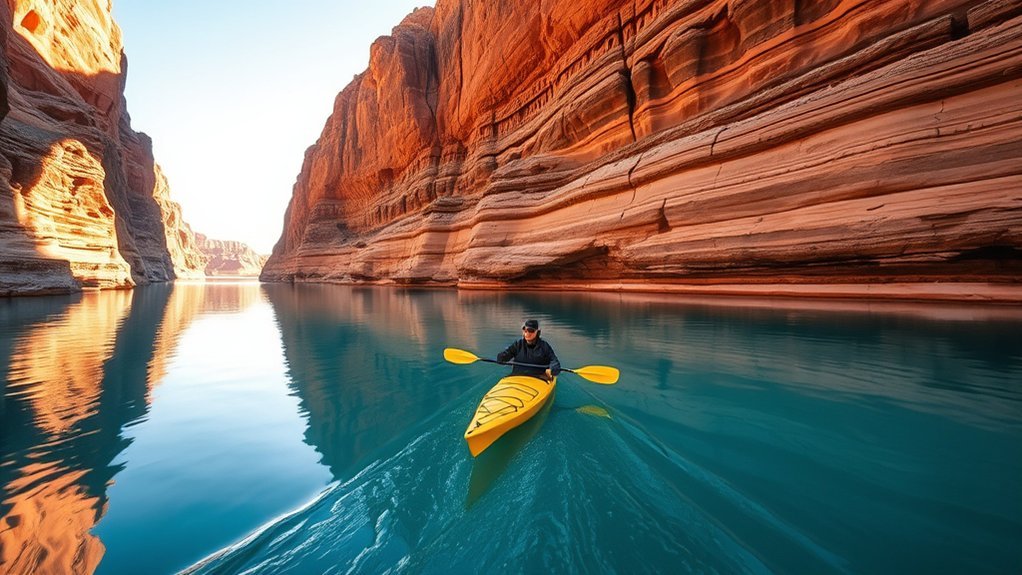
Paddling through Lake Powell’s towering Navajo sandstone canyons offers an unmatched blend of desert wilderness and deep-water exploration. Whether you are gliding beneath the 400-foot vertical walls of Labyrinth Canyon, scouting secluded side arms near Bullfrog, or setting up a backcountry beach camp under the desert stars, a successful Lake Powell kayak trip requires meticulous logistical planning. Because Lake Powell is a massive 186-mile-long desert reservoir with fluctuating water levels, extreme weather shifts, and heavy recreational boat traffic, knowing where to launch, how to navigate turbulent narrows, and what safety regulations apply is essential before pushing off the ramp.
Quick Answer
To kayak Lake Powell, launch from Wahweap or Antelope Point for southern canyons, or Bullfrog Marina for northern routes. Use a 14-to-17-foot touring sea kayak with a spray skirt, carry at least 1 gallon of drinking water per person daily, and pack an EPA-approved portable toilet system (mandatory under federal park rules). Always plan paddling crossings before midday to avoid dangerous wind-driven waves and heavy motorized boat wakes.
Key Takeaways
- Human Waste Mandate: Glen Canyon National Recreation Area requires all overnight paddlers to carry an approved solid human waste containment system (WAG bag or portable toilet); burial is illegal.
- Boat Wake Safety: Sheer canyon walls cause boat wakes to rebound continuously (the “bathtub effect”), requiring active bracing and perpendicular wave alignment.
- Weather Windows: Early mornings offer calm water; high winds, microbursts, and summer monsoon flash floods typically strike between 1:00 PM and 6:00 PM.
- Hydration Protocol: Silt in lake water rapidly clogs standard microfilters; bring extra settling containers or pack your full potable water supply.
At a Glance: Lake Powell Kayaking Logistics
| Best Season | April to May (mild temps, lower boat traffic) & September to October (warm water, low wind) |
| Skill Level | Beginner (sheltered day coves) to Advanced (multi-day touring, open-bay crossings) |
| Recommended Boat | 14–17 ft Sit-Inside Touring Kayak with bulkheads and rudder/skeg (Day-use: Stable Sit-on-Top) |
| Mandatory Gear | USCG-Approved PFD, whistle, WAG bag toilet system, paddle float, bilge pump, signaling device |
| Permits & Fees | Glen Canyon NRA Vehicle Entrance Fee ($30/7-days or Interagency Pass); no paddlecraft launch fee |
Planning Your Lake Powell Kayak Trip
Executing a safe, rewarding Lake Powell paddling adventure requires matching your itinerary to current lake conditions, season, and physical stamina. Lake Powell covers more than 1.25 million acres within Glen Canyon National Recreation Area, straddling the Utah-Arizona border. While short day trips into narrow side canyons require minimal logistical overhead, multi-day self-supported journeys demand detailed navigation plans, conservative mileage targets, and strict water conservation.
Daily mileage should be calculated around Lake Powell’s predictable wind cycles. Mornings typically offer glassy, calm conditions ideal for making distance across wide, exposed bays such as Wahweap Bay, Padre Bay, or Bullfrog Bay. By early afternoon, thermal heating and surface pressure differentials routinely generate crosswinds exceeding 20 to 30 knots. Plan to complete the bulk of your open-water paddling before 1:00 PM, reserving afternoons for exploring sheltered canyon arms or setting camp.
Pro Tip: Download offline topographic maps on a GPS device or carry physical NOAA/waterproof recreation charts. Sheer canyon walls block cellular signals entirely, and identical sandstone promontories can make identifying your target side canyon disorienting from water level.
Best Launch Points and Marinas
Choosing your launch point establishes which portion of Lake Powell’s 1,900-plus miles of shoreline you can explore. The lake is functionally split into the South Lake (accessed near Page, Arizona) and the North Lake (accessed near Bullfrog and Halls Crossing, Utah). Driving between the northern and southern marinas requires a 4- to 6-hour overland detour around the canyon rim, making your initial launch selection vital to your route plan.
Wahweap and Stateline Launch Ramps (South Lake)
Located just outside Page, Arizona, Wahweap Marina and the adjacent Stateline Auxiliary Ramp represent the primary launch hubs for southern Lake Powell. Wahweap provides full marina amenities: kayak rentals, staging areas, marine supply stores, public restrooms, and gear shops. Launching from Wahweap places you within striking distance of Lone Rock Canyon and the wide expanses of Wahweap Bay. Because water levels fluctuate significantly year-over-year, always verify which ramp is active before arriving.
Antelope Point Public Launch (Slot Canyon Access)
Situated northeast of Page, the Antelope Point Public Launch Ramp (managed by the National Park Service, separate from the private marina) provides direct, immediate access to the flooded lower reaches of Antelope Canyon. Launching here eliminates miles of open-bay paddling, allowing day paddlers to access sheer, winding canyon corridors within minutes of leaving the shoreline.
Bullfrog and Halls Crossing (North Lake)
For paddlers seeking remote multi-day wilderness expeditions, Bullfrog Marina and Halls Crossing in Utah serve as the gateways to the northern lake. Clustered around a protected bay, Bullfrog offers launch ramps, gear rentals, fuel, camp stores, and vehicle parking. Launching from the north puts paddlers closer to scenic side canyons like Forgotten Canyon, Moqui Canyon, and Lost Eden, with substantially less motorized boat traffic than the southern hubs.
- Confirm Ramp Status: Check current water elevations via the NPS Glen Canyon Water Ramps Alert Page to verify motorized vs. non-motorized access points.
- Stage Deliberately: Unload gear efficiently in designated drop zones before moving your vehicle to long-term backcountry parking lots.
- File a Float Plan: Leave a printed itinerary and contact numbers on your vehicle dashboard and with a trusted contact ashore.
Choosing the Right Kayak and Gear
Lake Powell is deep, cold, and subject to rapid surface transitions from calm glass to steep, wind-driven chop. Matching your craft and outfitting to the specific demands of desert reservoir touring is critical for safety and comfort.
Kayak Types for Desert Reservoir Touring
Not all kayaks perform well in Lake Powell’s mixed environment of narrow slot canyons and massive open bays:
- Sea & Touring Kayaks (14–17 Feet): The gold standard for multi-day expeditions. Closed cockpits paired with dual sealed bulkheads provide essential buoyancy, internal gear storage, and tracking efficiency to cut through headwinds and crossing chop.
- Sit-on-Top Kayaks (10–13 Feet): Excellent for warm-weather day trips into calm canyons like Lower Antelope. They offer easy entry and exit for swimming, though their wider hulls create significant drag over long open-water crossings.
- Inflatable Touring Kayaks: Highly portable and durable against sandstone scrapes. However, inflatables sit high on the water and act as sails in sudden desert headwinds; choose high-pressure drop-stitch models equipped with a rigid tracking skeg.
- Tandem Kayaks: Excellent for sharing paddling effort and maximizing storage capacity on extended journeys between remote camps.
Essential Safety and Navigation Gear
Operating in remote desert waters requires self-rescue readiness. Federal and state laws enforced by the NPS Boating Safety Branch require every paddler to carry specific life-saving equipment.
Warning: Lake Powell’s water depth often exceeds 100 to 400 feet just feet from vertical cliff walls. A properly fitted, inherently buoyant or USCG-approved Type III/V Personal Flotation Device (PFD) must be worn at all times while on the water. Inflatable waist-belt PFDs are not recommended during turbulent chop or unexpected wake strikes.
- Spray Skirt: Mandatory for sit-inside touring boats to prevent wake water from swamping the cockpit against vertical canyon walls.
- Self-Rescue Kit: Bilge pump, paddle float, and dual-blade spare paddle secured to deck bungees.
- Communication: Personal Locator Beacon (PLB) or satellite messenger (Garmin inReach / ZOLEO); standard cell phones lose signal immediately inside canyon mouths.
- Signaling & Sound: Pealess marine whistle attached to your PFD and a waterproof white LED navigation light for low-light emergencies.
Essential Safety Tips, Hazards, and Regulations
Paddling Lake Powell presents environmental hazards unique to flooded canyon landscapes. Understanding wave behavior, desert weather, and federal backcountry mandates will keep your expedition safe and legal.
Managing Boat Wakes and the “Bathtub Effect”
Lake Powell hosts heavy motorized vessel traffic, including wakeboard boats, large cabin cruisers, and houseboats. When these vessels produce deep 3- to 4-foot wakes in narrow, sheer-walled canyons, the energy cannot dissipate onto a sloping shore. Instead, waves strike vertical sandstone and reflect back across the channel, creating an unpredictable, chaotic cross-chop known as the “bathtub effect.”
- Point Your Bow: Turn your kayak into the primary oncoming wake at a 45- to 90-degree angle; never take steep wakes beam-on (broadside).
- Maintain Forward Momentum: Active paddling provides dynamic stability; stopping or freezing increases your likelihood of capsizing.
- Avoid Cliff Pinch-Points: Maintain a 15- to 20-foot buffer from vertical rock walls to give yourself room to brace and avoid secondary reflected wave crests.
Weather Hazards, Wind, and Flash Floods
Desert weather extremes demand constant vigilance. Sudden afternoon microbursts can generate 4-foot whitecaps on open bays within minutes. Monitor daily forecasts from the National Weather Service (NOAA) prior to launching. During the summer monsoon season (July through September), intense thunderstorms miles away can send catastrophic flash floods through narrow slot canyons. Never camp or anchor in dry wash exits, low delta zones, or under active drainage pour-offs.
Mandatory Human Waste Disposal (WAG Bag Regulations)
Under Glen Canyon National Recreation Area regulations (36 CFR § 2.14), all solid human waste must be carried out when camping within 1/4 mile of Lake Powell’s shoreline. Because the reservoir is bordered by solid rock and thin sand, burying waste creates severe sanitation and environmental hazards. You must carry an EPA-approved waste containment system—such as commercially manufactured WAG bags (Restop II / Cleanwaste) or a dedicated sealed portable cassette toilet.
Water Filtration and Hydration Strategies
Desert paddling requires a baseline water intake of 1 gallon (4 liters) per person per day. While Lake Powell is freshwater, it contains high levels of suspended sandstone silt, agricultural runoff, and biological pathogens. Standard 0.1-micron hollow-fiber filters will clog almost instantly if used directly on silty lake water. Settle turbid water in a collapsible bucket or gravity bag for 2 to 4 hours using a pinch of powdered alum before filtering, or carry your full potable water supply in internal dromedary bags.
Top Day Trips and Route Ideas
For paddlers seeking world-class scenery without the logistics of overnight camping, Lake Powell offers several premier day routes:
Lower Antelope Canyon (Water Route)
Distance: ~5 to 6 miles round-trip | Launch: Antelope Point Public Launch Ramp
Paddling into Lower Antelope Canyon allows you to experience this world-famous geological formation from the water. Launching from Antelope Point, paddle 1.5 miles east along the main channel before turning south into the narrow mouth of Antelope Canyon. As you paddle deeper, 300-foot red-rock walls close in until the water terminates at a sandy delta. From there, secure your kayak above the waterline and hike up into the winding, dry slot canyon.
Lone Rock Canyon and Wahweap Bay
Distance: ~4 to 8 miles round-trip | Launch: Stateline Ramp or Wahweap Main Ramp
This route skirts the open expanse of Wahweap Bay toward Lone Rock, a towering monolithic sandstone formation rising dramatically from the water. Explore the protected cove behind Lone Rock or continue west into Lone Rock Canyon, which features calm side arms sheltered from main-channel cruiser wakes.
Labyrinth Canyon (Day or Overnight)
Distance: ~12 miles round-trip | Launch: Antelope Point Marina / Launch
Located near Mile Marker 16, Labyrinth Canyon is one of the most celebrated slot canyons on Lake Powell. The entrance twists into an extraordinarily narrow, shaded corridor where sheer Navajo sandstone rises vertically from emerald water. The waterway narrows until it becomes paddle-width, requiring short strokes and rudders to navigate the twisting slot.
“In the narrow slots of Lake Powell, the echo of your paddle stroke against 300-foot sandstone is often the only sound for miles—provided you navigate before the afternoon winds awake.”
Multi-Day Paddle Routes and Camping Spots
Multi-day self-supported kayak touring on Lake Powell allows you to venture deep into Glen Canyon’s remote labyrinth of side arms, finding solitude far removed from day-use motorized boat zones.
Route Planning Essentials
When mapping an expedition, design your itinerary around safe daily distances of 8 to 12 miles. This accounts for headwinds, exploratory side-canyon detours, and finding suitable campsites before late-afternoon winds peak.
- Waypoints & Mile Markers: Lake Powell features navigational buoys with mile markers measuring distance up-lake from Glen Canyon Dam (Mile 0). Use these as navigational check-ins.
- Bailout Locations: Identify wide sandy beaches or protected coves every 3 to 4 miles along your route where your group can shelter if unexpected gale-force winds arise.
- Weight Distribution: Pack heavy items (water bladders, food, canned provisions) low in the hull along the centerline directly against the bulkheads to optimize secondary boat stability.
Campsite Selection and Sandstone Anchoring
Camping on Lake Powell is open and unrestricted along most of the shoreline, provided you follow federal backcountry regulations. Finding a quality site requires evaluating wind exposure, ground stability, and flash flood potential.
- Wind Shelters: Seek out deep coves that face away from prevailing southwest winds. Avoid camping directly at the mouth of large canyons, which funnel thermal wind gusts.
- Slickrock Anchoring: Standard tent stakes are useless on solid sandstone ledges. Pack specialized sandbags, or use the “big rock, little rock” method (wrapping your tent guyline around a small rock and anchoring it behind a heavy boulder).
- Waterline Fluctuations: Secure all kayaks well above the current water line and tie bowlines to solid rock features. Nighttime water releases from upstream dams and distant cruiser wakes can easily wash an unsecured kayak away from shore.
Wildlife, Conservation, and Leave No Trace
Glen Canyon supports a fragile desert riparian ecosystem. Desert bighorn sheep frequently navigate sheer cliff ledges, while peregrine falcons, ospreys, and blue herons nest in high sandstone alcoves.
Adhere strictly to Leave No Trace Principles to preserve Lake Powell’s backcountry:
- Pack It In, Pack It Out: Carry out 100% of your trash, food scraps, and micro-refuse. Food scraps decompose slowly in arid environments and attract rodents.
- Campfire Restrictions: Open ground fires on beaches must be contained in a raised metal fire pan. Ash must be packed out; never bury charcoal in the sand.
- Cultural Artifact Protection: Glen Canyon contains numerous ancestral Puebloan petroglyphs and ruin sites. It is a federal crime under the Archaeological Resources Protection Act to touch, deface, or remove any archaeological artifact.
Permits, Fees, and Invasive Species Compliance
Understanding the jurisdictional fee structure and aquatic invasive species regulations ensures a smooth start at the ramp:
- National Park Entrance Fees: Glen Canyon National Recreation Area charges a standard vehicle entrance fee ($30 for a 7-day vehicle pass) or accepts the America the Beautiful Interagency Pass. Non-motorized paddlecraft (kayaks, SUPs, canoes) are not subject to motorized vessel lake use fees.
- Quagga Mussel Certification: Lake Powell is heavily infested with invasive quagga mussels. Paddlers transporting craft into or out of Utah and Arizona waterways must comply with state aquatic invasive species (AIS) regulations. Complete a self-certification form and ensure your kayak and gear are clean, drained, and completely dry before launching in other bodies of water.
- Navajo Nation Jurisdictions: If you pull ashore and hike onto tribal land on the southern and eastern shores of Lake Powell, a separate Navajo Nation Backcountry Hiking Permit is required.
Photography Tips for Capturing Lake Powell
Photographing Lake Powell from a kayak requires balancing equipment protection with opportunistic timing:
- Manage Reflections with a Polarizer: A circular polarizing filter (CPL) is essential for cutting harsh surface glare on the water, revealing submerged sandstone formations and deepening the turquoise hues of deep canyon channels.
- Protect Your Optics: Keep your camera in a quick-release Pelican hard case or double-sealed dry bag mounted on the deck between your knees for fast access.
- Capture Golden Hour Wall Glow: The most dramatic light occurs 30 minutes after sunrise and before sunset, when low-angle sunlight reflects off opposite red-rock walls, creating an intense orange under-glow beneath shadowed overhangs.
- Low-Angle Composition: Lower your shooting angle close to the water’s surface to exaggerate the scale of 400-foot sandstone cliffs relative to your kayak’s bow.
Frequently Asked Questions
Can I paddle Lake Powell at night or during a full moon?
Yes, night paddling and full-moon kayaking are legal on Lake Powell, but they require strict safety precautions. US Coast Guard regulations require non-motorized vessels to carry an efficient white light (such as a 360-degree white LED light or headlamp ready to display) to prevent collisions with powerboats. Stay close to canyon walls, avoid main navigation channels, wear your PFD at all times, and remain alert for submerged rock hazards and boat wakes that are difficult to see in the dark.
Are there kayak rental delivery services to remote coves?
No, standard rental outfitters do not deliver kayaks directly to remote coves via road drop-off. However, paddlers can rent equipment from local outfitters in Page, AZ, or Bullfrog, UT, and transport it on their own vehicle. Alternatively, private boat shuttle and water-taxi services can be chartered from licensed concessionaires (such as Antelope Point Marina or Lake Powell Resorts & Marinas) to transport your kayaks, gear, and group directly up-lake to remote canyon entry points.
What food, beverages, and waste rules apply at backcountry campsites?
You may bring standard food, coolers, and beverages (including commercially packaged canned beer), but glass containers are strictly prohibited on Lake Powell beaches and shorelines. All solid human waste must be collected and packed out using a portable toilet or EPA-approved WAG bag system; burying waste within 1/4 mile of the lake is illegal. All trash, food scraps, and micro-refuse must be secured in odor-proof dry bags or hard coolers to prevent habituating raven, ringtail, and rodent populations.
Do sunscreen and bug spray harm the lake’s water quality?
Yes, petroleum-based sunscreens and chemicals like oxybenzone, octinoxate, and concentrated DEET can accumulate in calm, low-flow side canyon pools, negatively impacting aquatic microorganisms and clarity. To protect water quality, use mineral-based (zinc oxide or titanium dioxide) non-nano sunscreens, wear UPF 50+ long-sleeve sun hoodies to reduce chemical use, and apply insect repellent sparingly away from the water’s edge.
Can I bring an inflatable SUP or non-kayak watercraft?
Yes, inflatable stand-up paddleboards (SUPs), packrafts, and folding canoes are permitted across Lake Powell. However, paddleboarders should exercise extreme caution on open bays where high afternoon crosswinds can easily blow high-profile boards off course. Inflatables must be constructed of heavy-duty, multi-chamber or drop-stitch PVC to withstand abrasive sandstone cliffs, and paddlers must carry a USCG-approved PFD, whistle, and ankle leash.
Conclusion
A Lake Powell kayak trip opens the door to some of the American Southwest’s most spectacular geological wonders. By selecting the appropriate touring kayak, preparing for boat wakes and desert weather windows, carrying mandatory human waste containment systems, and treating the delicate desert ecosystem with Leave No Trace stewardship, you can safely immerse yourself in the awe-inspiring red-rock corridors of Glen Canyon.
Sources
- National Park Service: Glen Canyon Boating Regulations & Safety — Official vessel requirements, life jacket rules, and navigation guidelines.
- NPS Glen Canyon Backcountry Management Plan — Federal mandates on human waste pack-out systems (WAG bags) and shoreline camping.
- National Oceanic and Atmospheric Administration (NOAA) / NWS — Regional desert weather forecasting, microburst data, and flash flood monitoring.
- Utah Division of Wildlife Resources: Aquatic Invasive Species — State compliance protocols for Quagga mussel self-certification and watercraft decontamination.