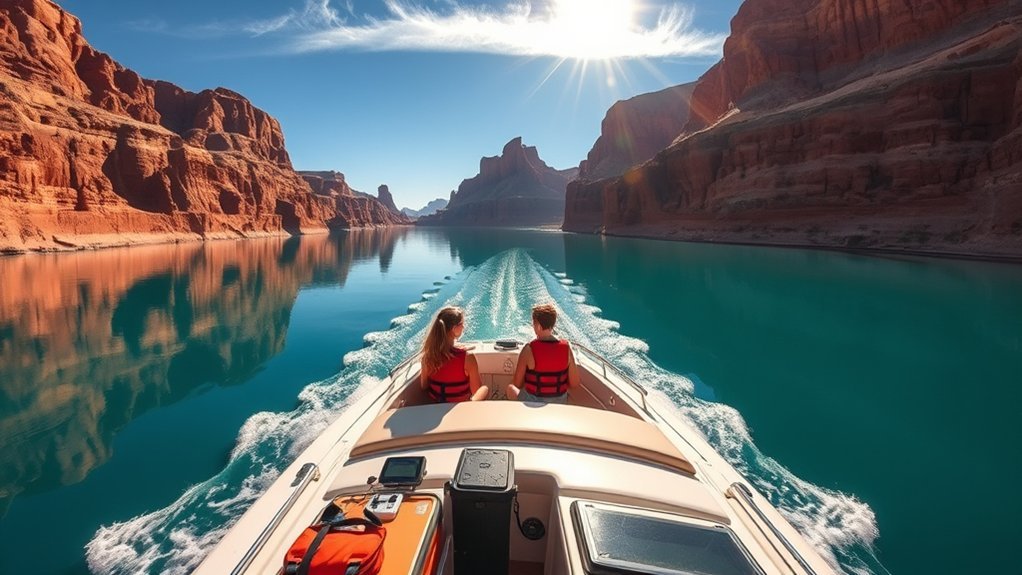
Navigating Lake Powell’s 186-mile expanse requires far more preparation than cruising an average inland reservoir. Because the lake’s water level fluctuates significantly based on seasonal Rocky Mountain runoff and Glen Canyon Dam releases, charted channels, submerged rock hazards, and shoreline access points change continuously. To navigate safely, boaters must account for extensive distances between fuel docks, dramatic afternoon wind shifts through narrow sandstone canyons, specialized rock-anchoring techniques, and strict federal sanitation laws within the Glen Canyon National Recreation Area.
Quick Answer
Safe navigation on Lake Powell requires monitoring real-time water elevations, carrying GPS charts with depth finders, and planning around a permanent 70-to-95-mile mid-lake fuel gap. Boaters must secure vessels using sand stakes or slickrock anchor pins rather than relying on standard fluke anchors, carry an approved portable toilet, and monitor marine VHF Channel 16 for sudden canyon wind gusts.
Key Takeaways
- Mind the Fuel Desert: Dangling Rope Marina is permanently closed; plan on a 70–95 mile stretch without fuel or supplies between South Lake (Wahweap/Antelope Point) and North Lake (Bullfrog/Halls Crossing).
- Use Specialized Anchoring: Traditional fluke anchors drag across submerged slickrock; use sand stakes on beaches or steel rock pins driven into sandstone fissures.
- Track Elevation Changes: Water levels fluctuate by dozens of feet annually, turning deep channels into impassable shallows and exposing unmarked rock pinnacles.
- Comply with Federal Regulations: All overnight vessels without built-in marine heads must carry an approved, self-contained Marine Sanitation Device (MSD) or portable toilet.
- Respect Canyon Weather: High sandstone walls amplify afternoon gusts and funnel storm fronts into violent microbursts across open bays like Padre Bay.
At a Glance
| Route Length | Main channel is 186 miles from Glen Canyon Dam to Hite; over 1,900 miles of total shoreline across 96 major side canyons. |
| Navigation Difficulty | Moderate to Advanced; requires active depth monitoring, GPS waypoint navigation, and canyon maneuvering skills. |
| Essential Gear | Digital depth sounder, marine GPS with current bathymetric contours, marine VHF radio, satellite communicator, slickrock anchor pins, 2-3 lb sledgehammer, sand stakes, certified portable toilet. |
| Required Permits & Fees | Glen Canyon National Recreation Area Entrance Pass + Vessel Boating Fee; Navajo Nation permits required if landing on tribal lands east of the main channel. |
Planning Your Route and Itinerary
Lake Powell extends roughly 186 miles along the old Colorado River bed, spanning northern Arizona and southeastern Utah. The reservoir is operationally divided into two main basins: South Lake (accessed via Wahweap Marina and Antelope Point Marina near Page, AZ) and North Lake (accessed via Bullfrog Marina and Halls Crossing Marina near Ticaboo, UT). Navigating between these sectors requires careful planning due to the vast, uninhabited terrain that separates them.
When mapping an itinerary, factor in cruising speeds, fuel burn rates, and daily distances. While cruising the open waters of Wahweap or Padre Bay is straightforward, navigating the reservoir’s 96 named side canyons slows travel to idle and no-wake speeds. Plan daily runs with conservative mileage buffers to ensure you reach a protected cove and secure anchors well before dusk.
Warning: The Mid-Lake Fuel Gap: Dangling Rope Marina (formerly located at buoy 64) was destroyed by severe storms and historic low water, and is permanently closed. There is zero fuel, water, or repair service between Antelope Point/Wahweap and Bullfrog/Halls Crossing—a distance of approximately 70 to 95 river miles depending on your route. Adhere strictly to the marine rule of thirds: use one-third of your fuel going out, one-third returning, and keep one-third in reserve for emergencies.
Understanding Water Levels and Navigation Hazards
Unlike natural lakes with static basins, Lake Powell’s surface elevation shifts dramatically based on annual snowpack melt, regional precipitation, and downstream water deliveries governed by the U.S. Bureau of Reclamation. Full pool elevation sits at 3,700 feet above sea level, but operational elevations in recent years have fluctuated substantially lower. These dynamic water levels continuously alter the physical shape of the shoreline, submerge previously dry mesas, and uncover hazardous sandstone spires.
Changing Water Levels and Elevation Gauges
Before launching, check the daily reservoir elevation reported by the National Park Service at Glen Canyon. Elevation determines which channels and shortcut cuts are passable. For instance, the popular Castle Rock Cut—a passage connecting Wahweap Bay to the main channel that saves roughly one hour of travel—requires a minimum lake elevation of approximately 3,580 feet to navigate safely. When water drops below that critical threshold, all vessels must detour south through the original Colorado River channel past Glen Canyon Dam.
Hidden Navigation Hazards and Canyon Narrowing
Dropping water levels expose navigation hazards that are invisible from the surface until you are directly on top of them. The primary hazards across Lake Powell include:
- Submerged Sandstone Pinnacles: Isolated rock spires rise vertically from deep canyon floors to within inches of the surface. Always run an active depth sounder with a shallow-water alarm.
- Silt Bars at River Inflows: Silt settles heavily at the heads of major side arms, particularly the San Juan River and Escalante River arms. Water depth can drop abruptly from 40 feet to 6 inches over a span of yards.
- Floating and Semi-Submerged Driftwood: Heavy runoff washes large trees and logs from the upper Colorado River into narrow canyon necks, presenting severe propeller and hull puncture risks.
- Propeller Strikes in Coves: Sandstone shelves often jut horizontally beneath the water line along canyon walls. Maintain at least 15 to 20 feet of clearance from sheer rock faces when moving at more than idle speed.
Pro Tip: Main channel navigation buoys on Lake Powell are numbered sequentially according to their approximate river-mile distance from Glen Canyon Dam (e.g., Buoy 1 begins near the dam; Buoy 100 is near the Escalante River confluence). Green buoys mark the port side and red buoys mark the starboard side when traveling up-lake (heading away from the dam).
Fueling, Provisioning, and Docking Tips
Operating a vessel in a remote desert environment requires thorough self-sufficiency. Fuel availability is confined entirely to the major marina hubs at the far southern and northern sectors of the lake:
- South Lake Marinas: Wahweap Marina (State Marina and Wahweap Docks) and Antelope Point Marina (floating facility).
- North Lake Marinas: Bullfrog Marina and Halls Crossing Marina.
When refueling at floating marina docks, observe all USCG safety protocols: turn off all engines, generators, and electronics; close all companionways and hatches; and extinguish any open flames or stoves. After fueling gasoline engines, run the bilge blower for at least four full minutes and perform a visual and sniff test in the engine compartment before restarting.
Note: Marina pump-out stations and freshwater fill hoses are available at Wahweap, Antelope Point, Bullfrog, and Halls Crossing. Never discharge marine holding tanks, bilge water, or chemical toilets into the lake; doing so violates federal law under 36 CFR and results in mandatory federal citations.
Anchoring, Mooring, and Overnight Etiquette
Anchoring on Lake Powell differs substantially from standard coastal or reservoir anchoring. Standard Danforth, fluke, or plow anchors cannot penetrate solid sandstone slickrock and will drag dangerously across smooth underwater stone shelves when exposed to canyon winds.
Choosing Legal Anchorage Spots
Shoreline camping is permitted throughout the vast majority of Glen Canyon National Recreation Area on a first-come, first-served basis. However, federal regulations establish strict no-camping and no-anchorage zones:
- Vessels may not tie up, anchor, or camp within one mile of any developed marina, public launch ramp, or commercial dock facility.
- Do not anchor across active navigation channels or obstruct entrance throats into narrow side canyons.
- Respect marked archaeological sites, biological soil crust restorations, and designated swim beaches where motorized watercraft are prohibited.
Lake Powell Anchoring: Sand Stakes vs. Slickrock Pins
Because side canyons do not feature public mooring buoys, boaters must secure their vessels directly to the shoreline using specialized desert anchoring techniques:
- Sandy Beaches (Bow-in, Stern-Staked): Approach sandy beaches slowly with trim raised. Set a light bow line ashore, then run two primary mooring lines from the port and starboard stern cleats at 45-degree angles toward the shore. Drive heavy-duty steel sand stakes (auger or t-post style) deep into dry, compacted sand above the waterline.
- Slickrock Anchoring (Rock Pins): In rocky alcoves with no sand, locate natural cracks, fissures, or shelf depressions in the sandstone above the high water mark. Drive forged steel rock pins into solid fissures using a 2.5 to 3 lb sledgehammer. Tie off with dynamic marine lines equipped with snubbers to absorb swell shocks.
- Deadman / Rock-Bag Anchors: Where rock lacks fissures, use heavy canvas rock bags filled with 60 to 80 pounds of loose sandstone, or wrap an anchor bridle securely around a massive, immovable boulder onshore.
Overnight Campground and Houseboat Etiquette
Quiet hours within Glen Canyon National Recreation Area run from 10:00 PM to 6:00 AM. Sound reflects and magnifies off sheer vertical canyon walls, carrying generator noise and loud music across entire bays. Position houseboats so that generator exhausts vent outward toward the open channel rather than against enclosed rock walls, which creates a deadly risk of carbon monoxide (CO) gas accumulating inside boat cabins and beach tents.
Managing Wind, Weather, and Afternoon Gusts
Weather conditions in the desert Southwest can change from dead calm to hazardous in minutes. Lake Powell’s complex canyon topography produces distinct localized meteorological phenomena:
- The Canyon Venturi Effect: When regional winds blow across the desert plateau, air is funneled down into narrow canyon throats, accelerating wind speeds by 15 to 25 knots above ambient forecasts.
- Open Bay Chop: Broad open expanses like Padre Bay, Wahweap Bay, and Warm Creek Bay develop steep, short-interval wind chop of 3 to 5 feet during sustained afternoon breezes.
- Summer Monsoon Microbursts: From early July through September, convective thunderstorms create powerful downdrafts (microbursts) capable of producing sudden gusts exceeding 50 mph, severe rain, and flash floods that discharge mud and debris into side canyon drainages.
“If caught in open bay chop during sudden wind shifts, throttle down to displacement speed, secure all loose deck cargo, trim the bow slightly up into the quartering waves, and seek immediate shelter inside the nearest leeward canyon wall.”
Safety Equipment, Communication, and Emergency Prep
Because cell service is nonexistent once you leave the immediate vicinity of Page, AZ, or Bullfrog, UT, boaters must carry redundant emergency signaling and communication equipment complying with U.S. Coast Guard safety regulations.
- Marine VHF Radio: Keep VHF radios tuned to Channel 16 (156.8 MHz), the international distress frequency monitored 24/7 by Glen Canyon National Park Service Dispatch and marina operators.
- Satellite Communication: Carry a two-way satellite messenger (such as a Garmin inReach or ZOLEO) or a 406 MHz Personal Locator Beacon (PLB) for backcountry medical emergencies.
- Life Jackets (PFDs): Federal and state regulations require one wearable, properly fitted, USCG-approved Type I, II, or III life jacket for every person on board. Children 12 and under must wear their PFD at all times while the vessel is underway.
- Fire Extinguishers: Carry the mandatory minimum of USCG-approved marine B-I or B-II fire extinguishers, readily accessible and fully charged.
Leave-No-Trace, Sanitation, and Invasive Species Prevention
Glen Canyon is a fragile desert ecosystem subjected to heavy visitor pressure. Environmental stewardship is both a personal responsibility and a matter of strict federal compliance under Title 36 of the Code of Federal Regulations.
- Mandatory Human Waste Disposal: All overnight boaters must carry and use a certified Marine Sanitation Device (MSD) or an approved self-contained portable toilet. Burying human waste or toilet paper in sand beaches or rock alcoves within 1/4 mile of the lake is strictly illegal. Waste must be disposed of at marina dump stations.
- Aquatic Invasive Species (AIS) Decontamination: Lake Powell is heavily infested with Quagga mussels. Utah and Arizona laws mandate that all motorized watercraft must complete an AIS inspection and decontamination protocol upon leaving the lake to prevent transferring mussels to uninfected water bodies. Drain all ballast tanks, live wells, bilges, and engines before departure.
- Cultural Site Protection: Historic structures, petroglyphs, and Ancestral Puebloan cliff dwellings are strictly protected under the Archaeological Resources Protection Act. Never touch, deface, or camp within 100 feet of rock art or ruins.
| Action / Regulation | Environmental Impact | Mandatory Protocol |
|---|---|---|
| Human Waste Disposal | Prevents toxic contamination of drinking water and beach campsites. | Must carry a self-contained portable toilet or vessel MSD; pack out all solid waste to marina pump stations. |
| Quagga Mussel Control | Stops catastrophic bio-fouling of regional water systems and dams. | Clean, Drain, and Dry vessel; complete mandatory state decontamination certification upon retrieval. |
| Campfire Management | Eliminates permanent rock scarring and hazardous charcoal debris on beaches. | Fires must be contained in portable fire pans or built on bare sand below the high-water line; pack out all ash. |
Frequently Asked Questions
Can I bring my dog on the boat and are there leash rules?
Yes, pets are allowed on boats and along most shorelines in Glen Canyon National Recreation Area. However, pets must be restrained on a physical leash no longer than 6 feet in developed areas, campgrounds, and designated public beaches. Provide a canine life jacket, ample shaded rest space, and plenty of fresh water to prevent heatstroke on hot slickrock.
What permits are required for specific coves or campgrounds?
There is no reservation system for individual coves or beach anchorages on Lake Powell; camping is first-come, first-served. You must pay standard Glen Canyon National Recreation Area vehicle entrance fees and motorized vessel recreation fees. If you plan to land, hike, or camp on Navajo Nation tribal lands along the southeastern shoreline (such as parts of Navajo Canyon or Antelope Canyon), you must purchase a separate Navajo Nation Backcountry Permit prior to landing.
Are there limits on personal watercraft (jet skis) in narrow canyons?
Yes. Personal Watercraft (PWCs) must adhere to all federal no-wake and flat-wake zone markers within marina harbors, developed coves, and designated narrow canyons. PWCs must maintain a safe distance from other craft, operate only between sunrise and sunset, and cannot be operated in certain restricted environmental study areas or above the Glen Canyon Dam security exclusion barrier.
Where can I get fuel or propane on Lake Powell?
Marine fuel docks and propane tank exchanges are available exclusively at South Lake (Wahweap Marina, Antelope Point Marina) and North Lake (Bullfrog Marina, Halls Crossing Marina). Propane and fuels are also sold in the nearby gateway towns of Page, AZ, and Ticaboo/Hanksville, UT. Dangling Rope Marina is permanently closed, meaning no mid-lake fuel is available.
Are there quiet hours enforced at popular anchorages?
Yes. Federal quiet hours are strictly enforced across Glen Canyon National Recreation Area between 10:00 PM and 6:00 AM. During these hours, generators must be shut down or run at whisper-quiet decibel levels, and music or loud deck noise must cease to respect neighboring vessels and prevent sound reverberation across canyon walls.
Conclusion
Successful boating and navigation on Lake Powell require balancing thorough preparation with constant situational awareness. By monitoring official water elevation gauges, planning around the mid-lake fuel gap, mastering slickrock anchoring, and carrying dedicated satellite comms, you can safely explore one of the world’s most spectacular canyon landscapes. Always adhere to Glen Canyon National Recreation Area sanitation rules and Leave No Trace principles to keep this unique desert reservoir pristine for future generations.
Sources
- National Park Service — Glen Canyon Boating Regulations & Water Safety — Official guidelines for vessel operations, sanitation requirements, and launch ramps.
- U.S. Bureau of Reclamation — Lake Powell Water Operations — Real-time reservoir water levels, storage elevation data, and release schedules.
- U.S. Coast Guard Boating Safety Division — Federal safety equipment mandates, PFD regulations, and marine communication standards.
- Utah Division of Wildlife Resources — Aquatic Invasive Species Program — Quagga mussel containment, mandatory decontamination procedures, and boater certification forms.