Sunrise at Cathedral Rock is one of Sedona’s most memorable early-morning hikes, but the short mileage can hide how demanding the route is. Cathedral Rock Trail No. 170 climbs steep exposed red rock to a saddle between two spires, with hands-on scrambling in places. A headlamp, grippy footwear, enough water, careful timing, and a clear parking plan make the experience far easier and safer.
Quick Answer
For a Cathedral Rock sunrise hike, plan on a strenuous 1.1-mile round trip with about 669 feet of elevation gain. Start well before sunrise if you want to reach the upper saddle for first light. Bring a headlamp, water, layers, and grippy shoes, and check current Forest Service, weather, parking, and Sedona Shuttle information before leaving.
Key Takeaways
- The U.S. Forest Service rates Cathedral Rock Trail No. 170 as strenuous, with a 1.1-mile round trip and 669 feet of elevation gain.
- The maintained route climbs to a saddle between two spires; it is not a conventional walk-up summit trail.
- For sunrise, allow enough time to hike the steep route in darkness rather than arriving at the trailhead only a few minutes before sunrise.
- Cathedral Rock trailhead parking closes during Sedona Shuttle operating hours. Outside shuttle hours, parking may be available, and a qualifying recreation pass is required at the trailhead.
- Do not attempt the exposed scramble when weather, ice, wet rock, lightning, heat, or your own comfort level make the route unsafe for you.
At a Glance
| Time Required | U.S. Forest Service estimate: about 1.5 hours round trip. Allow extra time for a dark pre-dawn ascent, photos, crowds, and careful scrambling. |
| Difficulty | Strenuous. The short trail gains about 669 feet and includes steep exposed rock and hands-on scrambling. |
| Tools Needed | Headlamp, grippy hiking shoes, water, weather-appropriate layers, charged phone with offline map, and a small first-aid kit. |
| Cost | No separate hiking ticket is listed for the trail. Parking at the trailhead requires a Red Rock Pass or America the Beautiful Pass. The current Red Rock daily pass is $5. Sedona Trailhead Shuttle rides and Park & Ride parking are free. |
Why Sunrise at Cathedral Rock Is Worth the Early Wake-Up
Cathedral Rock is impressive at almost any hour, but sunrise gives the landscape a quieter, softer character. Before direct sunlight reaches the red-rock formations, the sky changes gradually from deep blue to pink, orange, and gold. Once the sun rises, low-angle light reveals texture on the surrounding cliffs and spires.
An early start can also help you avoid some of the heat and daytime congestion that make this steep, exposed trail harder. The tradeoff is that you will be climbing in darkness or low light, so preparation matters more than it would on a normal daytime walk.
Cathedral Rock Trail No. 170 is only 1.1 miles round trip, but it gains about 669 feet and is officially rated strenuous.
The short distance is one reason hikers underestimate Cathedral Rock. The route becomes steep quickly and uses exposed rock rather than a conventional dirt trail for significant portions of the climb.
When to Go: Best Seasons and Timing
Spring and fall are usually the easiest seasons for balancing comfortable temperatures with long enough daylight for hiking and photography. They are also popular periods in Sedona, so expect other hikers even at an early hour.
Winter can bring cold mornings, snow, frost, or ice. Summer sunrise starts can avoid some daytime heat, but summer also overlaps with Arizona’s monsoon pattern, when thunderstorms can produce lightning, sudden wind, and heavy rain. Check current conditions rather than relying only on the season.
Peak Season Windows
If your schedule is flexible, a weekday morning outside holiday periods can reduce parking stress and trail congestion. Spring and fall often offer the most comfortable hiking weather, while winter mornings can be much colder and summer becomes hot quickly after sunrise.
There is no single “best month” that guarantees perfect conditions. Choose a date based on temperature, recent precipitation, wind, thunderstorm risk, and the experience you want.
Sunrise Timing Tips
Do not confuse the time you arrive at the trailhead with the time you want to reach the saddle. The U.S. Forest Service estimates about 1.5 hours for the complete round trip under normal conditions, and a first-time hiker moving in darkness may need extra time.
For a true sunrise experience from the upper portion of the route, check the exact sunrise time for your date and work backward. A conservative plan is to reach the trailhead roughly 60 to 90 minutes before sunrise, depending on your pace, experience, conditions, and how much time you want for setup.
You can check astronomical sunrise and sunset information through the NOAA Sunrise/Sunset Calculator. Remember that the surrounding terrain can block direct sunlight even after the official sunrise time.
Pro Tip: If Cathedral Rock is new to you, scout the first portion of the trail in daylight on another day or study the official route carefully before attempting a pre-dawn climb. Darkness makes route-finding and steep rock features feel very different.
Weather and Trail Conditions
Weather can change the difficulty of Cathedral Rock dramatically. Dry sandstone can provide useful friction, while moisture, frost, mud, or ice can make steep sections far less forgiving.
| Season | Typical Concern | Planning Tip |
|---|---|---|
| Winter | Cold, frost, occasional snow or ice | Check recent conditions and carry traction only when conditions call for it. |
| Spring | Crowds, wind, wet rock after storms | Choose a weekday and check recent rainfall. |
| Summer | Heat, sun exposure, monsoon storms | Start early, carry enough water, and avoid exposed terrain when thunderstorms threaten. |
| Fall | Crowds and large temperature swings | Pack layers and allow extra time for parking. |
Before leaving, check the National Weather Service Flagstaff forecast and the Coconino National Forest Cathedral Rock Trail page for current information.
Warning: Avoid the exposed upper route when thunderstorms threaten or when steep rock is wet, icy, or beyond your comfort level. Arizona monsoon storms can develop with lightning, strong wind, and heavy rain. Turning around is the correct choice when conditions deteriorate.
Getting There: Parking, Trailhead, and Shuttle Info
Cathedral Rock Trail No. 170 is in Coconino National Forest near Sedona. Access is commonly associated with the Cathedral Rock trailhead off Back O Beyond Road.
The parking situation deserves special attention because Sedona uses a trailhead-shuttle system to manage congestion. Cathedral Rock is served by Sedona Shuttle Route 15 from the North SR 179 Park & Ride.
Current Sedona Shuttle guidance says the Cathedral Rock trailhead parking lot is closed to private vehicles while the trailhead shuttle is operating. Outside shuttle operating hours, the trailhead lot is open. This matters for sunrise hikers because the current Route 15 schedule begins at 7:00 a.m., which is later than sunrise during much of the year.
When the shuttle is running, use the designated Park & Ride rather than driving to the closed trailhead lot. Trailhead shuttle rides and Park & Ride parking are free, and reservations are not required for the trailhead shuttle.
If you park at the Cathedral Rock trailhead outside shuttle hours, the Forest Service requires a Red Rock Pass or America the Beautiful Pass. The Red Rock Pass currently costs $5 for a daily pass, $15 for a weekly pass, or $20 for an annual pass.
Note: Shuttle schedules, operating days, road access, and parking rules can change. Check the official Sedona Shuttle and Forest Service pages shortly before your hike instead of relying on an old screenshot or travel blog.
What to Wear and Pack for Pre-Dawn Conditions
Pre-dawn temperatures can feel much cooler than the conditions you experience on the descent. Dress in layers that you can remove once the climb raises your body temperature.
A practical sunrise packing list includes:
- Headlamp: Use a real headlamp rather than relying only on a phone flashlight. Check the battery before leaving.
- Grippy hiking shoes: The route includes steep rock where traction matters.
- Water: Carry enough for the conditions, even on a short hike.
- Light insulating layer: Useful while waiting for sunrise at the saddle.
- Wind or weather shell: Conditions can feel colder when exposed.
- Small first-aid kit: Keep it accessible.
- Charged phone: Download an offline map before leaving.
- Sun protection: Bring sunglasses, sunscreen, and a hat for the descent.
- Snack: A small, easy-to-eat snack is useful if you spend extra time photographing sunrise.
Keep both hands available on the steepest scrambling sections. Secure cameras, loose bottles, and anything hanging from your pack before climbing.
Trail Overview: Route, Difficulty, and Key Landmarks
The official Cathedral Rock Trail No. 170 is approximately 1.1 miles round trip with about 669 feet of elevation gain. The Forest Service rates it strenuous and estimates approximately 1.5 hours for the round trip.
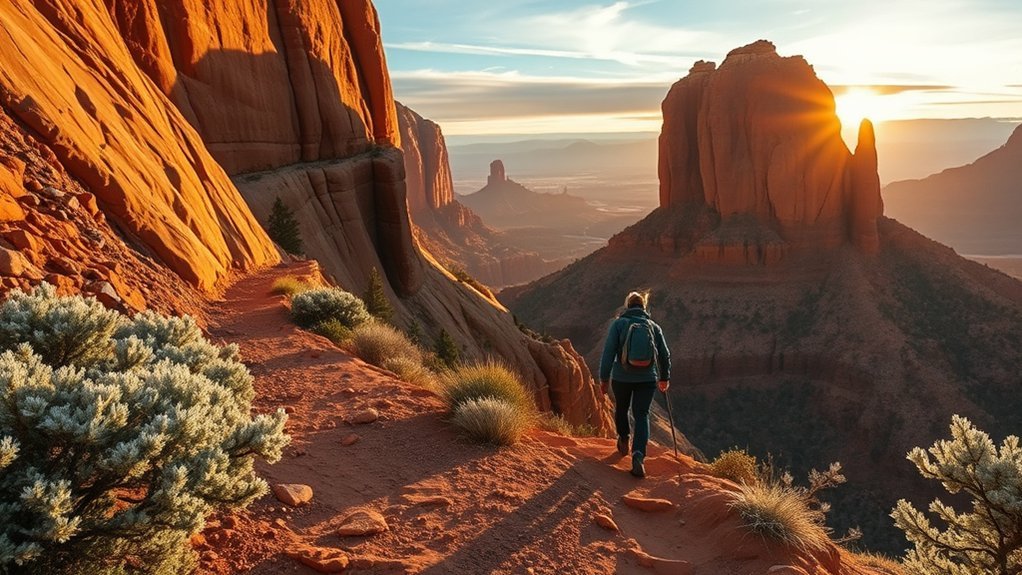
From the lower trail, follow the established route and basket cairns toward the rock formation. The climb begins more moderately before reaching exposed red-rock slabs. Higher up, the route becomes much steeper and uses natural ledges and a shallow cleft where footholds help hikers negotiate the rock.
The maintained route eventually reaches a wide saddle between two spires. That saddle is the main destination for most Cathedral Rock hikers and provides expansive views across the Sedona landscape.
Do not describe this as an ordinary summit trail. The Forest Service itself notes that Cathedral Rock is more like a rock climb than a typical hike. That distinction is especially important before sunrise, when depth perception and route-finding are harder.
Beyond the saddle, unmaintained paths may continue toward other rock features. Those extensions are not necessary for the standard Cathedral Rock hike and can involve additional exposure. Stay within your experience level and do not follow another group simply because they continue farther.
Safety Tips for Steep Scrambles and Changing Light
Cathedral Rock rewards careful movement. The safest pace is the one that lets you maintain balance and choose each step deliberately.
Before committing to a steep section, look at how you will descend it. A move that feels easy while climbing upward can feel much harder when you turn around.
Steep Scramble Techniques
- Keep your center of gravity controlled rather than lunging upward.
- Use secure hand contact when the terrain requires it.
- Test footholds and avoid stepping on loose gravel sitting on smooth rock.
- Maintain space between yourself and hikers above or below you.
- Do not climb directly underneath someone who may dislodge stones.
- Keep three points of contact when that technique improves stability.
- Turn around if you cannot confidently descend what you have climbed.
There is no prize for reaching the saddle when the route exceeds your comfort level. Cathedral Rock still offers excellent views from lower ledges and surrounding trails.
Adapting to Changing Light
Pre-dawn darkness, headlamp glare, and the sudden brightness after sunrise all affect what you can see. Slow down when transitioning between them.
Keep your headlamp easy to reach even after daylight begins. Deep shadows can remain on parts of the route. If you wear sunglasses, secure them so you can remove them quickly before a hands-on move.
Do not assume that brighter light automatically makes every foothold obvious. Low-angle sunlight can create harsh glare and deep shadows on uneven rock.
Photography Tips for Capturing the Sunrise
Sunrise changes quickly, so prepare your camera before the strongest color arrives. If you are carrying a tripod, choose a location that does not block the trail or force other hikers toward an exposed edge.
For broad scenes, a wide-angle lens can capture the surrounding rock formations and sky. A short telephoto lens can isolate distant ridges, spires, and layers of morning light.
Useful sunrise techniques include:
- Use a low ISO when your camera and support allow it.
- Watch the highlights around the brightest part of the sky.
- Bracket exposures if the sky is much brighter than the foreground.
- Use rock shapes as natural frames.
- Include a foreground element to create depth.
- Clean your lens before the climb so dust or fingerprints do not become obvious in backlit images.
Photography should never require standing somewhere you would not otherwise consider safe. Step away from the edge before changing lenses, digging through your bag, or looking down at a camera screen.
Leave No Trace and Respectful Trail Etiquette
Cathedral Rock receives heavy use, so small choices from individual hikers add up. Stay on the established route where possible, avoid creating new shortcuts, and pack out everything you bring.
- Carry out food wrappers, tissues, and other small trash.
- Do not carve, scratch, paint, or mark the rock.
- Avoid moving rocks to build new cairns.
- Keep music and voices low, especially during quiet sunrise hours.
- Give wildlife space.
- Yield thoughtfully on steep sections where passing is difficult.
- Keep dogs leashed and remove all pet waste.
The Coconino National Forest publishes additional guidance through its Safety and Outdoor Ethics resources.
Nearby Morning Coffee, Breakfast, and Recovery Options
After the descent, Sedona has many coffee and breakfast options along the SR 179 and central Sedona corridors. Sunrise can occur well before many kitchens open, so check current opening hours rather than assuming breakfast will be available immediately after your hike.
For recovery, start with water and a normal meal containing carbohydrates, protein, and some salt, especially after a warm-weather hike. If you have another activity planned later in the day, change out of sweaty layers and give your feet and legs time to recover before another strenuous outing.
If your sunrise start was very early, fatigue may be a bigger driving risk than the hike itself. Eat, hydrate, and make sure you feel alert before beginning a long drive.
Frequently Asked Questions
Can dogs go on the Cathedral Rock Trail at sunrise?
Dogs are generally allowed on Coconino National Forest trails but must be leashed, and owners must pack out pet waste. Cathedral Rock is steep and requires scrambling, so being legally allowed does not mean the route is suitable for every dog. Consider your dog’s footing, size, experience, heat tolerance, and ability to negotiate steep rock safely.
Is there cell service or an emergency signal at the Cathedral Rock saddle?
Cell reception can vary by carrier, device, terrain, and exact location, so do not rely on a specific coverage percentage. Download your map before leaving, keep your phone charged, tell someone your route and expected return time, and carry basic emergency gear appropriate for the conditions.
Are permits or reservations required for hiking Cathedral Rock at dawn?
The Forest Service does not list a separate hiking reservation for the standard Cathedral Rock Trail. However, parking at the trailhead requires a Red Rock Pass or America the Beautiful Pass. Sedona Trailhead Shuttle rides do not require reservations. Always check current Forest Service and Sedona Shuttle rules before your visit.
Can inexperienced hikers join guided sunrise climbs?
Some guided operators may accept beginners, but Cathedral Rock itself remains a strenuous scrambling route. Ask the operator about required fitness, exposure, scrambling experience, group pace, weather policies, and turnaround options before booking. A guide does not remove the physical difficulty of the trail.
Is night photography gear such as a headlamp allowed on the trail?
A headlamp is practical safety equipment for a pre-dawn hike. Use the lowest brightness that still lets you travel safely, avoid shining the beam directly into other hikers’ eyes, and keep tripods or camera bags out of the travel path. Check current Forest Service restrictions if you plan specialized or commercial photography.
How long does the Cathedral Rock hike take?
The U.S. Forest Service estimates about 1.5 hours for the 1.1-mile round trip. Sunrise hikers should budget additional time for darkness, route-finding, waiting for other hikers on steep sections, photography, and time at the saddle.
Is Cathedral Rock a good sunrise hike for beginners?
It can be too difficult for someone who is uncomfortable with steep rock, exposure, or hands-on scrambling. The Forest Service rates the trail strenuous. A beginner with good fitness and appropriate experience may still enjoy it, but there is nothing wrong with turning around at a lower viewpoint if the upper route feels unsafe.
Conclusion
A Cathedral Rock sunrise hike can be a spectacular way to begin a day in Sedona, but its short distance should not be mistaken for an easy walk. The official trail climbs about 669 feet in only 1.1 miles round trip and finishes at a saddle reached through steep, exposed scrambling.
Start early enough to account for the climb, carry a reliable headlamp and water, wear shoes with good traction, and check weather, trail conditions, parking rules, and shuttle information before leaving. If rock is wet or icy, thunderstorms threaten, or the scramble exceeds your comfort level, turn around and enjoy the lower views instead.
Sources
- U.S. Forest Service: Cathedral Rock Trail No. 170 — official trail distance, elevation gain, difficulty, route description, parking-pass requirement, and estimated hiking time.
- U.S. Forest Service: Red Rock & Coconino Passes Program — current Red Rock Pass rules and pricing.
- Sedona Shuttle: Route 15 Cathedral Rock / Little Horse — current Cathedral Rock shuttle route and schedule.
- Sedona Shuttle: How to Ride — trailhead parking closures during shuttle operations and access outside operating hours.
- National Weather Service Flagstaff: Monsoon Weather — lightning, heavy rain, and flash-flood weather information for northern Arizona.
- Coconino National Forest: Safety and Outdoor Ethics — Forest Service hiking safety and responsible-recreation guidance.