If most of your Arizona driving is on Phoenix streets, interstates, paved scenic roads, or maintained gravel, you probably do not need a 4×4. The answer changes when your route includes rough forest roads, deep loose sand, steep rocky grades, heavy snow, or other low-traction terrain. The best choice depends on more than the drivetrain: tires, ground clearance, weather, road conditions, and your experience all matter.
Quick Answer
No, most drivers do not need 4×4 for everyday driving in Arizona. Two-wheel drive is usually enough on dry paved roads. 4×4 becomes valuable on rough, loose, steep, or unmaintained routes and during some snow conditions. Tires, ground clearance, route status, and driver judgment matter as much as the drivetrain.
Key Takeaways
- You usually do not need 4×4 for Phoenix, interstate travel, or normal paved sightseeing routes.
- High-clearance 4×4 is much more useful on rocky, rutted, sandy, steep, or poorly maintained backcountry roads.
- AWD can be a good middle ground for pavement, gravel, rain, and light-to-moderate winter conditions.
- Four-wheel drive helps you move through low-traction terrain, but it does not replace appropriate tires or safe braking distances on snow and ice.
- Never drive into a flooded Arizona wash. Flash-flood water can rise quickly and make an otherwise passable road deadly.
- Check current road conditions, land-manager rules, and your vehicle or rental agreement before leaving pavement.
Understanding Arizona’s Varied Terrain and Climate
Arizona can take you from low-elevation desert pavement to rocky forest roads and snowy mountain highways in the same trip. That variety is why there is no single answer to whether you need 4×4.
In the Sonoran Desert, heat, loose sand, sharp rocks, dust, and remote distances can be bigger concerns than the number of driven wheels. In northern Arizona and other high-elevation areas, snow and ice can make tire choice and winter preparation much more important. Mountain roads may also include long descents, so controlling speed and avoiding excessive brake heat matter.
Before choosing a vehicle, think about four separate factors: traction, ground clearance, tires, and current road conditions. A low-clearance AWD crossover can still scrape or become stranded on a deeply rutted road, while a suitable high-clearance 2WD vehicle may handle an easy dry dirt road without trouble.
| Typical Arizona driving | Usually suitable | Main concern |
|---|---|---|
| Phoenix streets and dry highways | 2WD, AWD, or 4WD | Tire condition, heat, traffic |
| Maintained dirt or gravel roads | Often 2WD or AWD | Clearance, washboarding, potholes |
| Loose sand or deeply rutted roads | High-clearance 4×4 preferred | Traction and clearance |
| Rocky or steep technical trails | Appropriate high-clearance 4×4 | Gearing, clearance, tires, driver skill |
| Snow-covered high-country roads | Depends on restrictions and conditions | Winter traction, tires, chains, visibility |
When 4×4 Is Essential: Off-Road Trails, Wash Crossings, and Snow
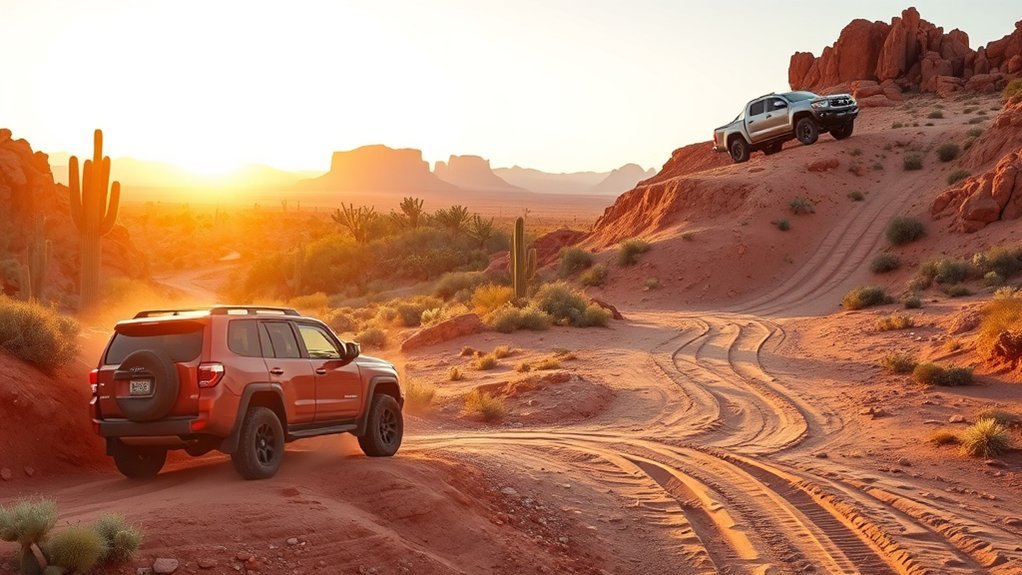
True 4×4 becomes most useful when you need controlled power at low speed on loose, steep, rocky, or deeply rutted terrain. Some rugged Arizona routes are intended for or strongly favor high-clearance four-wheel-drive vehicles, but the difficulty of individual roads can change after storms, erosion, snow, or heavy traffic.
On technical terrain, 4H can provide additional traction at normal low-to-moderate trail speeds, while 4L is intended for specific low-speed situations such as steep climbs, difficult descents, or obstacles when the vehicle manufacturer permits it. Because systems differ, follow your owner’s manual instead of treating 4H and 4L as universal settings.
Dry washes are another place where clearance and traction may matter. Inspect a dry crossing from safe ground for soft sand, erosion, ledges, and a usable exit before entering.
Warning: Never drive or walk into a flooded wash to test its depth. Arizona flash floods can develop quickly, including when rain falls upstream. If water is covering the road or flowing through a wash, turn around or wait in a safe location. The National Park Service specifically advises motorists not to cross flooded roads.
Winter is different. Four-wheel drive can help a vehicle accelerate or climb when the road is slippery, but it does not eliminate the need for appropriate tires or longer stopping distances. The Arizona Department of Transportation advises drivers to use snow tires, chains, or studded tires when recommended or required by conditions. NHTSA also notes that winter tires are more effective than all-season tires in deep snow.
When 4×4 Is Overkill: City Driving, Highways, and Maintained Parks
For routine city streets, dry interstates, and maintained paved recreation roads, 4×4 normally provides little practical advantage. A well-maintained 2WD vehicle with suitable tires can handle everyday Arizona pavement perfectly well.
The same is often true on maintained gravel roads. If the surface is firm, dry, reasonably smooth, and suitable for passenger vehicles, clearance and tire condition may matter more than having four driven wheels.
A 4WD version of a vehicle can also carry extra drivetrain components and weight. The fuel-economy difference varies by model, so compare the EPA figures or manufacturer specifications for the exact 2WD and 4WD versions you are considering rather than relying on a universal percentage.
If most of your driving is urban and you only encounter occasional rain, gravel, or light snow, AWD may provide the convenience you want without requiring the driver to select a traditional 4WD mode.
Choosing Between Part-Time, Full-Time, and AWD Systems
The labels can be confusing because manufacturers design these systems differently. In general, choose the drivetrain around the hardest conditions you realistically expect to encounter, not the most extreme trip you might someday take.
| System | Best fit | Important limitation |
|---|---|---|
| 2WD | City, highway, normal paved tourism, many maintained dirt roads | Less drive traction in deep sand, mud, steep loose terrain, or heavy snow |
| AWD | Mixed pavement, gravel, rain, changing traction, moderate winter use | Often lacks low-range gearing and the clearance of trail-focused 4×4 vehicles |
| Part-time 4WD | Backcountry roads, loose terrain, technical trail use | Many systems should not be locked in 4WD on dry, high-traction pavement; follow the owner’s manual |
| Full-time 4WD | Drivers wanting continuous four-wheel capability plus stronger off-road hardware | Design, controls, and capabilities vary widely by vehicle |
Note: AWD, 4WD, locking differentials, traction-control systems, and drive modes are not standardized across manufacturers. Your owner’s manual is the correct source for when each mode may be used.
Practical Gear and Driving Techniques for Tough Conditions
Good preparation often matters more than an extra drive mode. Arizona State Parks recommends carrying plenty of water, telling someone where you are going and when you expect to return, checking your vehicle before the trip, and carrying basic emergency supplies when traveling in the backcountry.
For remote trips, useful equipment can include drinking water, a shovel, traction boards, a tire-pressure gauge, a portable air compressor, navigation that works without cell service, a first-aid kit, flashlight, basic tools, and vehicle-compatible recovery equipment.
Sand Driving Basics
If you are heading into soft sand, avoid abrupt throttle changes and sharp steering that can dig the tires in. Maintain smooth momentum and choose firmer ground whenever possible.
Airing down tires can increase the tire footprint in some off-road situations, but there is no universal safe PSI. The correct pressure depends on the tire, wheel, vehicle weight, load, speed, and terrain. Excessively low pressure can damage a tire or allow it to unseat from the wheel.
| Action | Purpose |
|---|---|
| Use an appropriate reduced off-road pressure when suitable | Increase tire footprint on soft terrain |
| Apply smooth, steady throttle | Reduce unnecessary wheel spin and digging |
| Choose firmer lines | Reduce rolling resistance |
| Use gentle steering | Preserve momentum and traction |
| Reinflate before normal road speeds | Restore proper road-going tire pressure |
Pro Tip: Carry an air compressor if you intentionally reduce pressure for off-road sand. Before returning to highway speeds, reinflate the tires to the appropriate road pressure specified for your vehicle and load.
Recovery Gear Essentials
A practical recovery kit may include a shovel, traction boards, gloves, rated shackles or connectors, and a recovery strap or rope appropriate for the vehicle. A winch can also be useful on properly equipped vehicles.
Recovery gear must be matched to the load and connected only to suitable recovery points. Do not assume a bumper attachment, ordinary tie-down point, tow ball, or unknown anchor is safe for a high-load recovery. Winching and kinetic recoveries store substantial energy, so proper equipment and training are important.
Rather than buying advanced recovery equipment you have never used, practice with experienced instruction before relying on it in remote terrain. Travel with another capable vehicle when the route difficulty justifies it.
Check Road Conditions and Route Rules Before You Go
A road being shown on a map does not automatically mean it is open, passable, or suitable for your vehicle.
For Arizona highways, check AZ511 for current incidents, restrictions, and travel conditions before heading into winter weather or other disruptive conditions.
On National Forest land, check the current Motor Vehicle Use Map (MVUM) and local forest alerts. The U.S. Forest Service explains that MVUMs identify routes legally designated for motorized travel, but also warns that a route being legally open does not mean it is prudent for every type of vehicle. Some routes also have seasonal restrictions.
Conditions on dirt roads can change quickly after monsoon storms, snow, freeze-thaw cycles, wildfire, or maintenance work. A road that was easy last month may require much more clearance or may be closed today.
Renting, Modifying, or Borrowing: Costs, Liability, and Preparedness
If you need 4×4 only a few times each year, renting or borrowing may appear cheaper than buying and maintaining a trail-capable vehicle. The decision should include more than the advertised rental or purchase price.
Compare how often you will use the capability, the routes you want to drive, fuel and tire expenses, maintenance, insurance, storage, depreciation, and any modifications needed to make an owned vehicle suitable for those trips.
Rental vs. Ownership Costs
Renting can make sense when your normal vehicle meets your everyday needs and the occasional trip requires something more capable. However, renting an SUV with 4WD does not automatically give you permission to drive it on an off-road trail.
Read the actual rental agreement before planning the route. Rental-company rules differ, and prohibited use can affect your responsibility for damage or the protections you purchased. Some rental agreements expressly prohibit off-road use or roads considered unsuitable for the vehicle.
Ownership offers more control over tires, clearance, recovery equipment, and modifications, but you also accept the ongoing expense and maintenance responsibilities.
Liability and Insurance Risks
Insurance is policy-specific. Do not assume that a normal personal auto policy covers every vehicle, modification, trail, recovery bill, or type of off-road use. The National Association of Insurance Commissioners notes, for example, that standard auto policies do not automatically cover dedicated specialty vehicles such as ATVs and other off-road vehicles.
| Situation | What to verify |
|---|---|
| Rental | Permitted roads, prohibited uses, damage waivers, towing/recovery rules |
| Modified vehicle | Whether modifications must be disclosed and whether coverage changes |
| Borrowed vehicle | Owner permission, permitted drivers, coverage, and intended use |
| Off-road trip | Policy exclusions, roadside/recovery coverage, vehicle classification, route legality |
If you are unsure, describe the vehicle and intended use accurately to your insurer, rental company, or vehicle owner before the trip.
Winter Driving in Northern Arizona
Snow in northern Arizona is one of the strongest reasons to consider AWD or 4WD, but drivetrain choice is only part of winter preparation.
Check the forecast and AZ511 road conditions before departure. ADOT advises motorists to be prepared for winter restrictions and to use snow tires, chains, or studded tires when recommended or required.
Slow down, increase following distance, make smooth steering and braking inputs, and avoid assuming that four driven wheels make the vehicle immune to ice. Carry warm clothing, water, food, a phone charger, a shovel, and other winter emergency supplies on high-country trips.
Frequently Asked Questions
Can I get by with all-season tires instead of 4×4 in winter?
Sometimes, depending on the road and conditions, but 4×4 and tire type solve different problems. NHTSA says winter tires are more effective than all-season tires in deep snow. For Arizona winter travel, check ADOT restrictions and conditions and carry or use chains when required or recommended.
Does 4×4 reduce fuel economy significantly in Arizona?
It can, but there is no universal percentage. A 4WD model may carry additional drivetrain weight and components compared with a similar 2WD version. Compare the official fuel-economy figures for the exact vehicles you are considering rather than assuming a fixed penalty.
Are electric vehicles suitable for Arizona off-roading?
Some are, provided the specific EV has the ground clearance, tires, underbody protection, traction system, range, and route capability required for the trip. Remote Arizona travel also makes charging availability and the extra energy used by heat, climbing, difficult surfaces, and detours important planning factors.
Do car insurance rates change if I use my vehicle off-road?
Possibly, but there is no automatic rule that applies to every driver. Coverage and pricing depend on the insurer, policy, vehicle, modifications, claims history, and intended use. Ask your insurer whether the exact vehicle and type of off-road driving you plan are covered.
Can I tow a trailer safely with a 4×4 in desert terrain?
Yes, if the vehicle, hitch, trailer, tires, payload, and loaded trailer weight remain within the manufacturer’s ratings and the route is suitable. Heat, loose surfaces, grades, braking distances, and trailer sway all deserve extra attention. Use 4WD or low-range modes only as permitted by the vehicle manufacturer.
Is AWD the same as 4×4?
No. AWD usually manages power to multiple wheels automatically and works well for mixed on-road conditions. Traditional 4×4 systems are generally designed for more demanding low-traction terrain and may provide selectable modes or low-range gearing. Exact capabilities vary by model.
Do I need 4×4 for normal Arizona sightseeing?
Usually not when your itinerary stays on open, paved, maintained roads. The need changes if you choose remote forest roads, off-road trailheads, deep sand, technical routes, or snow-covered roads. Check current conditions for every unpaved or winter route instead of assuming yesterday’s access still applies.
Conclusion
You do not need 4×4 for most everyday driving in Arizona. For city streets, dry highways, maintained paved attractions, and many easy dirt roads, a suitable 2WD or AWD vehicle is often enough.
Choose true 4×4 when the actual route calls for its extra low-traction capability, such as rough backcountry roads, loose sand, steep technical terrain, or certain winter conditions. Even then, 4×4 is only part of the equation. Appropriate tires, adequate clearance, current road information, legal access, recovery preparation, and conservative judgment are what keep a difficult Arizona drive from becoming a preventable problem.
Sources
- Arizona Department of Transportation — Know Snow and Ice — winter-driving preparation, tires, and traction-device guidance.
- AZ511 — current Arizona highway incidents, restrictions, and travel conditions.
- National Highway Traffic Safety Administration — TireWise — tire selection, winter tires, traction, and tire safety.
- National Park Service — Monsoon Season — flash-flood and wash safety.
- U.S. Forest Service — Motor Vehicle Use Maps — designated motorized routes, seasonal allowances, and vehicle suitability considerations.
- Arizona State Parks — OHV Safety Tips — backcountry preparation, water, trip planning, and vehicle checks.