Loquat trees, scientifically known as Eriobotrya japonica, are evergreen fruit-bearing trees in the Rosaceae family. Native to southeastern and central China and cultivated in Japan for centuries, they now thrive in warm-temperate regions worldwide—including parts of Texas. Their glossy, deeply veined leaves and fragrant fall–winter blossoms make them ornamental standouts, while the fruit delivers a sweet-tangy flavor with notes of peach and citrus.[1][6]
The fruit is typically yellow to orange, with a flavor that can vary by cultivar. Loquat trees are relatively low-maintenance and adaptable to many Texas soils when drainage is good. Fruiting is most reliable in the state’s milder winter areas (e.g., Gulf Coast and South Texas) and in Central Texas after mild winters; hard freezes during bloom can reduce or eliminate crops that season.[5][3]
Key Takeaways
- Loquat trees are popular in Texas for their sweet, tangy fruit and attractive evergreen foliage. Note that seeds are not edible and contain cyanogenic compounds; discard seeds and young leaves when preparing fruit.[7]
- They perform best in Texas locations with mild winters (USDA 8b–10) and well-drained soils; flowers and fruit are often damaged around 27°F, while trees can survive brief colder periods.[1][5]
- When selecting a variety in Texas, consider early ripening and cold tolerance; commonly available U.S. cultivars include ‘Champagne’ and ‘Gold Nugget’, among others.[1]
- Proper planting and spacing are essential. Leave 25–30 ft for unpruned trees; closer spacing is possible if routinely pruned.[1]
- Follow a stage-based watering and fertilizing schedule, especially during establishment and fruit development, and avoid overwatering to prevent decline.[1]
Climate and Soil Requirements for Loquat Trees in Texas
Loquats prefer subtropical to warm-temperate climates with fall–winter bloom and spring harvest. In Texas, that aligns with the Gulf Coast, South Texas, and protected microclimates farther north. Flowers and developing fruit are vulnerable near or below 27°F, though mature trees may withstand much lower air temperatures. Placing trees on the south or east side of buildings and away from low, frost-prone spots improves fruiting odds.[1][5][4]
Loquats tolerate a range of well-drained soils, from sandy loam to clay with slope, and are not flood tolerant. A slightly acidic to neutral pH (≈6.0–7.5) is fine, and the species also tolerates higher pH soils common in parts of Texas. Incorporating compost improves structure and drainage but avoid planting into a waterlogged site.[1][6]
Selecting the Right Variety of Loquat Trees for Texas

Choose cultivars for flavor, ripening window, and cold sensitivity. Widely available U.S. selections include ‘Champagne’ (excellent flavor, mid to late season) and ‘Gold Nugget’ (mid to late season). Other named cultivars—such as ‘Wolfe’, ‘Advance’, ‘Bradenton’, and ‘Tanaka’ (Florida selection)—may also be encountered. Availability varies by nursery and region.[1]
Texas tip: Because freezes can coincide with bloom, lean toward earlier or mid-season cultivars and plant in the warmer microclimates of your site (south-facing walls, courtyards, or urban heat islands).[3]
Products Worth Considering

Loquat Starter Plant: Grow your own luscious loquat fruits with this starter plant featuring a healthy seedling and nutrient-rich soil mix

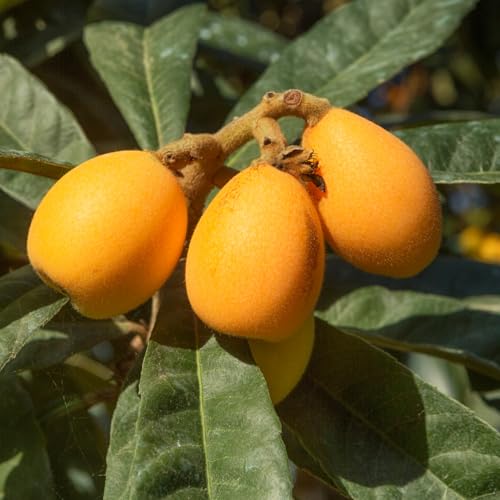
The loquat tree produces sweet, golden orange fruits, with fruit ripening in late winter to early spring
Planting and Spacing Loquat Trees in Texas
| Planting and Spacing Loquat Trees in Texas | Recommendation |
|---|---|
| Optimal planting time | Early spring or fall (avoid hard-freeze windows) |
| Spacing between trees | 25–30 ft for unpruned trees; closer (≈15–20 ft) if maintained at 6–12 ft tall with regular pruning.[1] |
| Spacing between rows | Match tree spacing (≈25–30 ft) for equipment and canopy light. |
| Depth of planting hole | Set the root ball level with—or slightly above—the surrounding soil; dig a wide hole to loosen adjacent soil.[1] |
| Soil requirements | Well-drained soil; slightly acidic to neutral is ideal, but loquat tolerates higher pH in Texas limy soils.[6] |
Plant during milder weather so roots establish before summer heat or winter freezes. Create a broad planting hole to encourage lateral root expansion, backfill with native soil (avoid “bathtubs” of amended soil), and water in well.[1]
Products Worth Considering

The planting auger for drill designed with new model upgraded bit and more spirals on the solid shaft, ensures digging holes 10 times working efficiency, extremely increase your planting efficiency and you have more time enjoy the planting season.

🌻 Built to Last (Drill Not Included): Let this heavy-duty spiral auger drill bit do the work for you. Our drill augers for digging holes are built with premium alloy steel, expertly welded, and coated with high-quality paint to prevent rust and bending. Get ready to dig with ease and enjoy effortless planting.

BUILT TO LAST A LIFETIME WITH FULL STAINLESS STEEL: Crafted from a single piece of high-quality, rust-resistant stainless steel. Unlike tools with weak wooden handles, the Gardmate hand dibber is built for a lifetime of use, bending and wear in all weather conditions.
Watering and Fertilizing Loquat Trees in Texas
Watering (UF/IFAS guidance): Newly planted loquats should be watered at planting and then every other day for the first week or so; reduce to 1–2×/week for the first couple of months. For the first three years, water about once a week during prolonged dry periods (5+ rain-free days). For mature trees (≥4 years), irrigate during fruit development and extended drought; avoid chronic overwatering to prevent decline.[1]
Fertilizing: In year one, UF/IFAS suggests small, repeated applications of a complete fertilizer (e.g., 6-6-6 with minors), then gradually increasing rates as trees grow; avoid nitrogen after late summer to prevent winter-tender growth. Mature trees generally receive 2–3 dry applications per year, plus optional nutritional sprays, with schedules adjusted by soil tests and leaf color/growth.[1]
If leaves pale or growth stalls, consider a soil test and adjust nutrients; avoid excessive nitrogen, which can increase fire blight susceptibility.[1]
Products Worth Considering

🌱 Ideal Nutrition for Abundant Plant Life: Balanced nutrition of 6% fast-release nitrogen, 6% phosphorus and 6% potassium, Gardenwise’s nourishing All-Purpose Professional Fertilizer is a versatile nitrogen-based fertilizer for most indoor and outdoor plants, like grass, flowers, vegetables, shrubs and evergreen trees. Help them flourish year round!

Balanced Organic Nutrition – Supplies a 6‑3‑3 NPK ratio along with calcium, sulfur, iron, and zinc to foster healthy foliage, flowering, and fruit.

Down To Earth Citrus Mix is a five pound box of all natural fertilizer with 6-3-3 formula and is listed by the Organic Materials Review Institute (OMRI) for use in organic production
Pruning and Training Loquat Trees for Optimal Growth

Train young trees to a central leader or open-center scaffold and maintain a convenient height (≈6–12 ft). In Texas, a practical window is to prune after harvest (often April–May) to avoid removing the fall flower buds that produce next spring’s crop. Light sanitation pruning (dead, crossing, or diseased wood) can be done anytime during dry weather.[1][4]
Protecting Loquat Trees from Pests and Diseases in Texas
Common pests include aphids, scale insects, and spider mites. Monitor foliage and treat early with cultural controls or targeted, label-compliant products when needed. Loquat can also suffer from fire blight (bacterial) and scab or leaf spot (fungal). Prune out infected wood well below symptoms, disinfect tools between cuts, improve airflow, and avoid excessive nitrogen.[2][1]
Harvesting and Storing Loquats in Texas
Depending on winter weather and cultivar, Texas harvest typically runs late winter through spring—often March–April along the Gulf Coast and March–May around Central Texas. Pick when fruit reaches full color and softens slightly; harvest by cutting clusters and then snipping individual fruits to reduce bruising. Refrigerated ripe fruit keeps for several weeks when bagged.[1][3]
Propagating Loquat Trees in Texas
Seedlings do not come true to type and often take 6–8 years to fruit. For predictable fruit quality and earlier bearing (≈1–2 years after planting), use grafted trees of named cultivars. Air layering and cuttings are possible but less common commercially.[1]
Tips for Success in Growing Loquat Trees in Texas
- Provide at least 6 hours of sun and a wind-sheltered, warm microclimate to reduce freeze injury.
- Mulch (2–6 in) to conserve moisture and suppress weeds, keeping mulch 8–12 in from the trunk.[1]
- Use integrated pest management; encourage beneficial insects and monitor frequently.[2]
- Protect blossoms and fruit during freeze events when feasible (covers on small trees, site selection for larger trees).[4][5]
Conclusion and Additional Resources for Growing Loquat Trees in Texas
With the right site, cultivar choice, and care, loquats can reward Texas gardeners with beautiful foliage and flavorful fruit. Check local extension resources for region-specific advice and cultivars currently available in your area.
FAQs
What is a loquat tree?
A loquat is an evergreen fruit tree (Eriobotrya japonica) in the rose family. The edible fruits range from yellow to orange and are used fresh or in jams; do not eat the seeds.[7]
Can loquat trees grow in Texas?
Yes. They’re widely planted in the southern half of the state and protected spots elsewhere. Fruiting is most reliable where winters are mild; freezes during bloom may limit crops farther north.[5]
What are the ideal growing conditions for loquat trees in Texas?
Full sun, well-drained soil, and protection from hard freezes and cold winds. The species tolerates a range of soils—including higher pH soils common in Texas—provided drainage is good.[6]
When do loquat trees bear fruit in Texas?
Generally late winter through spring. Along the Gulf Coast, harvest is often March–April; in Central Texas, March–May in years with mild winters.[1][3]
Are there any pests or diseases that affect loquat trees in Texas?
Yes—watch for aphids, scale insects, spider mites, and diseases like fire blight, scab, and leaf spots. Manage with monitoring, sanitation, balanced nutrition, and targeted treatments as needed.[2]
References
- UF/IFAS Extension. Loquat Growing in the Florida Home Landscape (HS5/MG050). Climate, cold thresholds, spacing, irrigation, fertilization, diseases, harvest. Reviewed 2019; PDF refreshed 2023–2024. https://edis.ifas.ufl.edu/publication/MG050.
- University of California IPM. Loquat—How to Manage Pests. Pests (aphids, mites), diseases (fire blight, scab), cultural tips. https://ipm.ucanr.edu/PMG/GARDEN/PLANTS/loquat.html.
- City of Austin. Loquats in Central Texas: A Sweet Springtime Treat. Typical Central Texas harvest window and uses. (2025). https://www.austintexas.gov/blog/loquats-central-texas-sweet-springtime-treat.
- Urban Harvest (Houston). Loquat one-pager. Local cold thresholds (bud/flower/fruit), pruning after harvest, storage note. (2020). https://www.urbanharvest.org/wp-content/uploads/2020/02/Loquat-2020.pdf.
- Extension (Ask Extension archive). Loquat or Crabapple? Cold/flower thresholds and Texas fruiting reliability notes. https://ask.extension.org/kb/faq.php?id=329524.
- UC ANR Fruit & Nut Research and Information Center. Loquat Fact Sheet. Origin (native to China) and general background. https://ucanr.edu/site/fruit-nut-research-information-center/loquat-fact-sheet.
- North Carolina State Extension Plants Database. Eriobotrya japonica (loquat). Edibility note (low-severity poison characteristics of seeds), general culture. https://plants.ces.ncsu.edu/plants/eriobotrya-japonica/.
- Bugwood / Invasive.org image (ripe fruit). Image source.
- Bugwood / IPM Images (developing fruit cluster). Image source.