Disclosure: As an Amazon Associate, we earn from qualifying purchases. If you click a link on this page and make a purchase, we may receive a small commission at no extra cost to you.
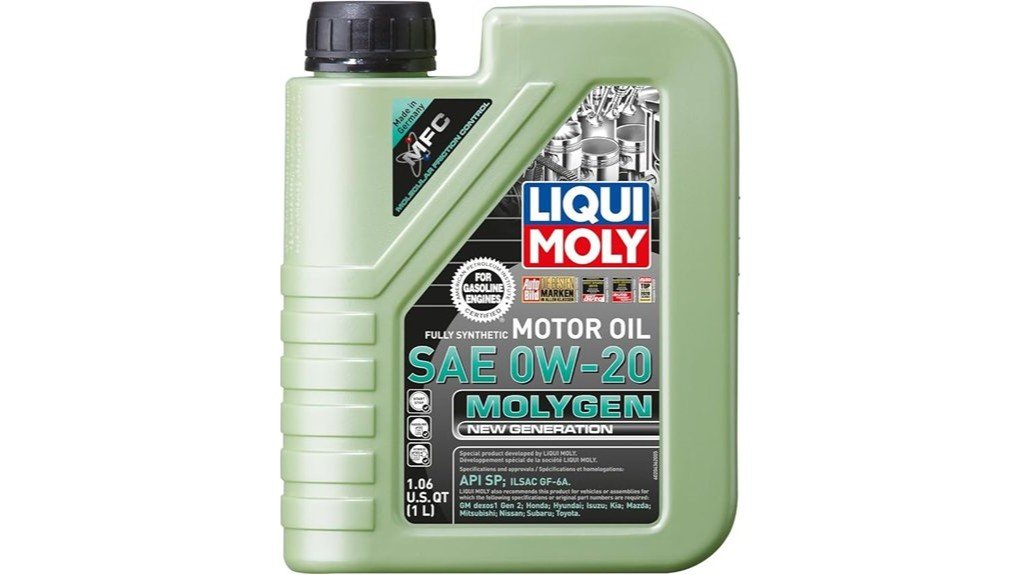
Choosing a 0W-20 oil is not just about matching the viscosity printed on the bottle. You also need the correct specifications for your engine, a dependable additive package, and a container size that covers your oil change. LIQUI MOLY Molygen New Generation SAE 0W-20 is a fully synthetic motor oil made for many modern Asian and American gasoline engines, with MFC friction-control technology as its main selling point. It offers strong cold-start flow and wear protection, but it is a premium option and it is not suitable for every engine that happens to use 0W-20.
Quick Verdict
Rating: 8.5/10, recommended with caveats
Best For: Drivers whose gasoline engine specifies 0W-20 and matches the listed API, ILSAC, or manufacturer requirements.
Bottom Line: Molygen 0W-20 combines a modern full-synthetic base with LIQUI MOLY’s MFC additive technology for cold-start flow, deposit control, and wear protection. Its main tradeoffs are the premium positioning and the need to confirm exact compatibility before pouring it into your engine.
| Specification | Detail |
|---|---|
| Brand | LIQUI MOLY |
| Product | Molygen New Generation SAE 0W-20 |
| Amazon model / SKU | 20436 |
| Product type | Fully synthetic gasoline engine oil |
| SAE viscosity grade | 0W-20 |
| Container in this listing | 1-liter plastic bottle, about 33.81 fluid ounces |
| Core technology | MFC, or Molecular Friction Control, additive technology |
| Specifications / approvals | API SQ and ILSAC GF-7A |
| Manufacturer recommendations | Includes Chrysler MS-6395, Fiat 9.55535-CR1, Ford WSS-M2C 947-A, 947-B1, 962-A1 and 972-A1, GM 6094 M, and GM dexos1 Gen 3 |
| Vehicle focus | Many Asian and American gasoline engines, including compatible turbocharged and multi-valve applications |
| Emissions equipment | Tested for use with catalytic converters when the vehicle specification matches |
| Oil color | Fluorescent green, a normal feature of the MFC formulation |
| Mixing note | Miscible with commercially available motor oils, though the manufacturer says effectiveness is best when used unmixed |
Before You Buy: Do not choose this oil by viscosity alone. Confirm that your owner’s manual calls for SAE 0W-20 and that the required API, ILSAC, or automaker specification appears on the current bottle label.
What Is LIQUI MOLY Molygen SAE 0W-20?
LIQUI MOLY Molygen New Generation SAE 0W-20 is a low-viscosity, fully synthetic motor oil. The Amazon listing reviewed here is the 1-liter bottle with model number 20436. It is intended mainly for modern Asian and American gasoline engines that require a compatible 0W-20 oil.
The product’s defining feature is MFC, or Molecular Friction Control. LIQUI MOLY says this additive system helps reduce frictional losses, limit deposits, support clean engine operation, and protect moving parts from wear. The oil is also formulated to circulate quickly at low temperatures, which matters during startup before the engine reaches normal operating temperature.
This is not a universal oil for every gasoline, hybrid, turbocharged, or diesel vehicle. Your engine’s required viscosity and specifications take priority over the brand, marketing name, or general vehicle category.
Who Should Buy It?
Best For
- Drivers whose owner’s manual requires SAE 0W-20 and a matching API, ILSAC, or automaker specification.
- Owners of compatible Asian or American gasoline vehicles who want LIQUI MOLY’s MFC additive package.
- DIY buyers who need a one-liter bottle for topping off or want to combine multiple bottles for a measured oil change.
Skip If
- Your manual calls for a different viscosity or a specification not shown on this oil’s current label.
- You need a diesel-specific oil or an oil approved for a European engine standard not listed for this product.
- You want the lowest-cost full-synthetic 0W-20 and do not value the MFC formulation enough to pay more.
MFC Technology and Wear Protection
MFC is the main reason to choose Molygen over a basic full-synthetic 0W-20. The formulation is designed to reduce friction where metal surfaces move against each other and to support a protective lubricating film under demanding operating conditions.
For you, the practical benefit is not an instant power increase. It is a focus on smoother operation, controlled friction, deposit prevention, and long-term wear protection. Those benefits still depend on correct oil level, a suitable filter, a healthy engine, and oil-change intervals that match the vehicle maker’s instructions.
The oil’s fluorescent green appearance is normal and comes from the MFC formulation. It is not a sign of coolant contamination or a defective bottle.
Cold Starts, Oil Pressure, and Daily Performance
The 0W portion of the viscosity grade describes low-temperature behavior. LIQUI MOLY promotes quick oil delivery after a cold start and stable oil pressure across operating conditions. Faster circulation at startup helps oil reach critical components during a period when lubrication demand is high.
The 20-grade operating viscosity is intended for engines designed around this thinner oil. You should not assume that a lower-viscosity oil is better for every engine. Using 0W-20 where the manufacturer calls for a heavier grade can reduce the protection the engine was designed to receive.
Molygen 0W-20 is tested for compatible turbochargers and catalytic converters. That makes it relevant to many modern gasoline vehicles, but the presence of a turbocharger does not confirm compatibility by itself. Check the exact oil requirement for your year, make, model, and engine.
Engine Cleanliness and Fuel-Economy Potential
LIQUI MOLY says the formulation helps prevent deposits and reduce frictional losses. Cleaner internal surfaces and lower friction can support efficient operation, especially when compared with old, contaminated, or incorrect oil.
You should keep fuel-economy expectations realistic. Tire pressure, driving style, weather, trip length, engine condition, and the viscosity you used before can have a larger effect on mileage than changing brands within the same viscosity grade. Treat improved fuel consumption as a possible supporting benefit, not a guaranteed savings figure.
Compatibility and Specifications
The current manufacturer information lists API SQ and ILSAC GF-7A. It also recommends the oil for several automaker requirements, including Chrysler MS-6395, Fiat 9.55535-CR1, Ford WSS-M2C 947-A, 947-B1, 962-A1 and 972-A1, GM 6094 M, and GM dexos1 Gen 3.
Brand names such as Honda, Hyundai, Kia, Mazda, Mitsubishi, Nissan, Subaru, and Toyota also appear in LIQUI MOLY’s recommendation list. That does not mean every vehicle from those brands can use this oil. The requirement printed in your manual or oil-fill information remains the deciding factor.
Pro Tip: Before ordering, note your engine’s total oil capacity. This listing contains one liter, so most full oil changes will require several bottles and a small amount may remain for future top-offs.
How It Performs in Real Use
Cold Morning Starts
In a vehicle that correctly specifies 0W-20, the low-temperature grade supports fast circulation after startup. You may notice a quieter or smoother start compared with old or incorrect oil, but a persistent rattle, knock, or warning light needs diagnosis rather than a different oil brand.
Stop-and-Go Commuting
Frequent short trips create repeated warm-up cycles and can be hard on oil. Molygen’s deposit-control and wear-protection focus suits this pattern, but short-trip driving may place your vehicle under a severe-service schedule. Follow the shorter interval when your manual requires it.
Highway and Turbocharged Driving
The oil is intended to maintain lubrication and resist aging under normal and demanding operation in compatible engines. Turbocharged applications can place extra heat and stress on oil, so correct specification, oil level, and change timing matter as much as the brand.
Top-Offs Between Services
The one-liter bottle is convenient when your engine needs a small top-off. LIQUI MOLY states that the oil can mix with commercially available motor oils, but using the same product and grade keeps the additive package more consistent. Never overfill the crankcase.
How to Use It Correctly
- Check the manual first. Confirm SAE 0W-20 and the required specification for your exact engine.
- Buy enough oil. Compare the engine’s fill capacity with the one-liter container size.
- Use the correct filter. Choose a filter listed for your vehicle and replace it according to the service procedure.
- Measure the final level. After filling, run the engine only as directed, wait for the oil to settle, and check the dipstick or electronic level system on level ground.
- Record the service. Note the date, mileage, oil used, and filter used for warranty and maintenance records.
If you are not comfortable lifting the vehicle, removing the drain plug, tightening parts to the correct torque, or disposing of used oil, have a qualified technician complete the service.
Safety, Handling, and Storage
Motor oil is a chemical product, so avoid prolonged skin contact and breathing oil mist, vapor, or spray. Keep the bottle closed when stored, protect it from direct sunlight and extreme heat, and follow the safety instructions printed on the container.
Clean spills promptly because oil creates a slipping hazard and can damage surfaces. Take used oil and the old filter to an approved recycling or collection location. Do not pour used oil onto the ground, into drains, or into household trash where local rules prohibit it.
The U.S. product page and Amazon listing carry a California Proposition 65 warning. California buyers should review the current label and warning details before use.
What Owners Tend to Notice
Buyer feedback often mentions smooth engine operation, quieter starts, and fuel-economy improvements. These reports can help you understand what owners watch for, but they do not prove that every engine will produce the same result.
Oil alone cannot repair worn bearings, piston rings, seals, a failing timing system, or low oil pressure caused by a mechanical fault. If your engine has abnormal noise, rapid oil loss, smoke, or an oil-pressure warning, diagnose the cause instead of relying on a premium lubricant to hide it.
Pros and Cons
Pros
- Fully synthetic 0W-20 formulation for compatible modern gasoline engines.
- MFC technology targets friction reduction, deposit control, and wear protection.
- API SQ and ILSAC GF-7A specifications support many current applications.
- Quick low-temperature oil delivery helps protect during cold starts.
- One-liter bottle is convenient for measured filling and top-offs.
Cons
- Premium positioning may cost more than common full-synthetic 0W-20 alternatives.
- The one-liter bottle is not enough for most complete oil changes.
- Compatibility must be checked by specification, not only by viscosity or vehicle brand.
Is It Worth the Price?
Molygen New Generation SAE 0W-20 sits in the premium part of the full-synthetic oil market. Its value comes from LIQUI MOLY’s MFC additive technology, current API and ILSAC specifications, and the focus on cold-start lubrication, cleanliness, and wear protection.
It is worth considering if your engine requires a matching 0W-20 oil and you specifically want the Molygen formulation. It is less compelling when your main goal is simply to buy the least expensive oil that meets the manual’s requirements, especially because a full change usually needs several one-liter bottles.
How It Compares to Alternatives
LIQUI MOLY Special Tec AA SAE 0W-20 is a logical same-brand comparison when you want a 0W-20 oil aimed at Asian and American vehicles but do not specifically need the Molygen MFC formulation. Mobil 1 Advanced Fuel Economy 0W-20 and Valvoline Advanced Full Synthetic 0W-20 are widely available alternatives that may be easier to find in larger retail containers.
Compare the current bottle labels rather than choosing by reputation alone. Molygen makes the most sense when its listed specifications match your engine and you value the MFC additive package; another oil may be the better buy when it carries a required approval that Molygen does not list.
Frequently Asked Questions
Is LIQUI MOLY Molygen SAE 0W-20 suitable for my car?
It may be suitable when your gasoline engine requires SAE 0W-20 and a specification shown on the current product label. Match the manual’s exact requirement rather than relying only on vehicle brand, model year, or engine type.
Is it suitable for diesel engines?
This product is presented for compatible gasoline engines, not as a general diesel-engine oil. Use it in a diesel only when the vehicle manufacturer specifically allows the viscosity and every required oil specification shown on the bottle.
How often should I change this oil?
Follow the oil-change interval in your owner’s manual or maintenance system. Severe service, frequent short trips, towing, heavy idling, dust, and extreme temperatures may require a shorter interval, so a universal mileage number is not reliable.
Can I mix Molygen 0W-20 with another motor oil?
LIQUI MOLY says it is miscible with commercially available motor oils. For the most consistent performance, use the same correct grade and specification, and use Molygen unmixed when practical.
Why is the oil fluorescent green?
The green color is a normal feature of LIQUI MOLY’s MFC formulation. It does not by itself indicate coolant contamination, but any unexplained milky appearance or abnormal fluid level should still be checked.
Is one liter enough for an oil change?
Usually not. Most passenger-vehicle engines require several liters, so check the refill capacity in your manual and account for the filter change before ordering.
Can it fix engine noise or low oil pressure?
No motor oil should be treated as a repair for a mechanical problem. A new oil may change sound or smoothness, but knocking, persistent ticking, rapid oil loss, or a pressure warning needs proper diagnosis.
How should I store an unopened bottle?
Keep it upright, sealed, and in a cool, dry place away from direct sunlight and extreme heat. Protect the bottle from damage and follow any storage or safety directions printed on the label.
The Bottom Line
LIQUI MOLY Molygen New Generation SAE 0W-20 is a strong premium choice for a compatible gasoline engine when you want modern API SQ and ILSAC GF-7A performance plus the brand’s MFC friction-control technology. Buy it only after matching the oil to your manual, and skip it when your engine needs another viscosity or approval.
Ready to Buy?
Check the latest price, bottle size, and product details before you decide.