Disclosure: As an Amazon Associate, we earn from qualifying purchases. If you click a link on this page and make a purchase, we may receive a small commission at no extra cost to you.
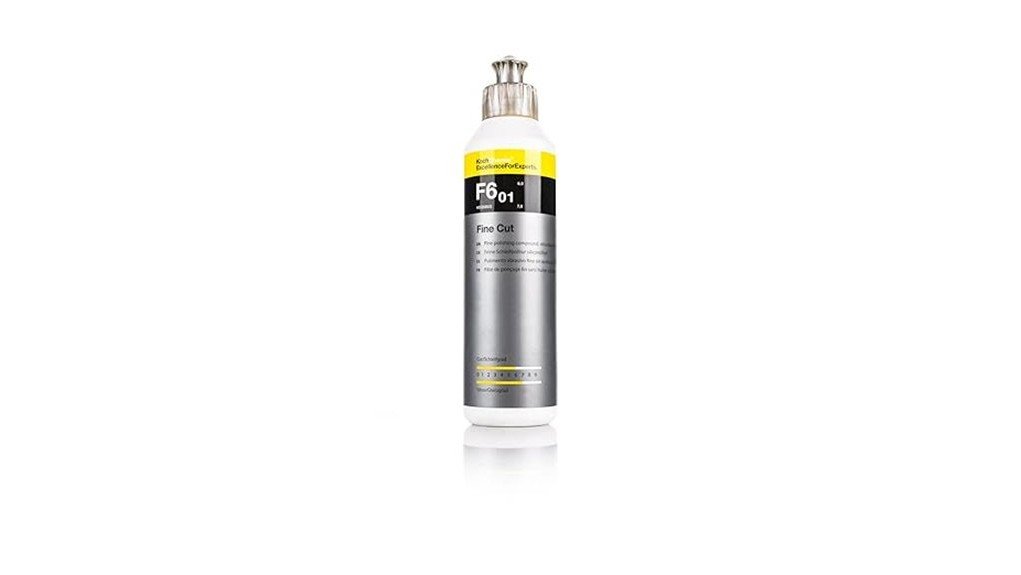
Paint correction gets difficult when a finishing polish is too mild but a heavy compound feels more aggressive than the job requires. The KOCHCHEMIE Fine Cut F6.01 Polishing Compound fills that middle step with a cut rating of 6 and a gloss rating of 7. It is designed for wash-induced swirls, marring, weathered clear coat, and sanding marks left by 2500-grit media. This review explains where F6.01 fits, how to use it safely, and why your pad, machine, paint type, and test spot still matter.
Quick Verdict
Rating: 8/10, recommended with caveats
Best For: Detailers and careful DIY users correcting moderate defects on compatible gloss automotive paint.
Bottom Line: KOCHCHEMIE Fine Cut F6.01 offers useful mid-level correction with an aluminum-oxide, silicone-oil-free formula that can finish with strong gloss. It is not a universal one-step polish, and soft paint may still need a finer follow-up polish.
| Specification | Detail |
|---|---|
| Brand | KOCHCHEMIE |
| Product | Fine Cut F6.01 |
| Linked Amazon variant | 250 ml (8.45 fl oz) |
| Model / part number | 405250US |
| Product type | Silicone-oil-free fine polishing compound |
| Abrasive | Aluminum oxide |
| Cut / gloss rating | Cut 6.0 / Gloss 7.0 |
| Target defects | Wash swirls, marring, medium defects, weathering, and 2500-grit sanding marks |
| Recommended machine | Orbital polisher; manufacturer guidance also covers machine polishing at up to 2,000 rpm |
| Recommended pad | Yellow Fine Cut foam pad or a suitable lambswool pad |
| Suitable surfaces | Compatible automotive paint on cars, commercial vehicles, and motorcycles |
| Working traits | Long working time, low dust, and a glossy finish |
| Key warnings | Shake first, test compatibility, do not use on hot surfaces, and protect from frost or excessive heat |
What Is the KOCHCHEMIE Fine Cut F6.01?
KOCHCHEMIE Fine Cut F6.01 is a machine polishing compound for paint defects that sit between light finishing work and heavy correction. The linked Amazon listing is the 250 ml bottle, model 405250US, although the product is also sold in larger containers through some sellers.
Its aluminum-oxide abrasive has an official cut rating of 6.0 and gloss rating of 7.0. That combination makes F6.01 useful when you need visible defect removal without starting with KOCHCHEMIE’s most aggressive compound. The manufacturer also describes it as suitable for medium to heavily weathered paint and scratch-resistant clear coat.
The formula is silicone-oil-free. That does not remove the need for a proper inspection wipe, but it reduces reliance on silicone oils that can make paint look temporarily improved before the panel is fully checked.
Who Should Buy It?
Best For
- You need more correction than a finishing polish can provide.
- You are removing wash swirls, marring, moderate scratches, oxidation, or 2500-grit sanding marks.
- You already have an orbital polisher, a suitable pad, clean microfiber towels, and time to test the paint.
Skip If
- You only need a final-gloss polish for faint haze or light holograms.
- You are working on matte paint, vinyl wrap, unpainted plastic, or another surface not approved by the label.
- Your clear coat is thin, damaged, freshly repaired, or too uncertain to polish safely.
Before You Buy: F6.01 removes a measurable amount of paint or clear coat as it corrects defects. A scratch that catches your fingernail may be too deep to chase safely, and no compound can replace missing paint.
Cutting Performance and Finish Quality
The cut 6 and gloss 7 ratings explain the product’s role better than the general term “fine cut.” It has enough bite for wash-induced swirls, marring, moderate weathering, and sanding marks from 2500-grit media. At the same time, it aims to leave a cleaner finish than a heavy-cut compound.
On harder or scratch-resistant clear coat, F6.01 may correct and finish well in one stage. On softer, dark paint, the same pad and compound can leave faint haze or micro-marring. In that case, follow with a finishing polish rather than adding more F6.01 passes.
Do not judge the panel under weak garage lighting. Use a bright inspection light after wiping the residue, then check from more than one angle. This shows whether the defect is removed, reduced, or simply harder to see.
Abrasive Formula and Working Behavior
F6.01 uses aluminum-oxide abrasives with what KOCHCHEMIE calls an intelligent grain size. In practical use, the compound is designed to provide a useful work cycle rather than cutting hard for only a few seconds. KOCHCHEMIE USA also describes it as low-dusting with a long working time.
Those traits can make panel work cleaner, but pad condition still changes the result. A saturated pad can reduce cut, create uneven residue, and add heat. Clean the pad regularly and switch to a fresh pad when it no longer releases spent product well.
Paint Compatibility and Surface Limits
Use F6.01 on compatible gloss automotive paint. The manufacturer lists paintwork on cars, commercial vehicles, and motorcycles, and specifically notes scratch-resistant paint as a suitable application.
Do not assume that every painted surface reacts the same way. Refinished panels, soft clear coat, sharp edges, raised body lines, and thin areas can correct faster than the surrounding panel. Matte and satin finishes should not be polished unless the paint maker or product instructions explicitly approve it, because polishing can create permanent shiny spots.
Mask textured plastic, rubber seals, badges, and porous trim before machine polishing. F6.01 is a paint compound, not a dedicated plastic, glass, wheel, or trim polish.
Formula, Storage, and Safety Notes
Shake the bottle before use so the abrasive and liquid components are evenly mixed. Work on a clean, cool surface, and do not polish a hot panel. Store the bottle where it will not freeze or face excessive heat.
Follow the product label and safety data sheet. Keep the compound away from children and pets, avoid eye contact, and use suitable eye protection when machine polishing. Secure loose clothing and cords before starting the polisher.
Pro Tip: Start with the yellow Fine Cut foam pad on a small test section. Move to a more aggressive pad only when the first combination cannot reach your correction goal safely.
How to Use KOCHCHEMIE F6.01 for Best Results
Preparation and repeatable technique matter as much as the compound. The safest process is to prove one pad-and-polish combination on a small area before touching the rest of the vehicle.
| Step | Action | Why It Matters |
|---|---|---|
| 1. Wash and decontaminate | Remove loose dirt, bonded contamination, and old residue as needed. | Contamination under the pad can create new scratches. |
| 2. Inspect and measure | Check the panel under strong light. Use a paint-depth gauge when the job or paint history calls for one. | You need to know which defects are safe to reduce and which should remain. |
| 3. Mask sensitive areas | Protect textured trim, rubber, badges, edges, and sharp body lines. | These areas can stain, heat up, or lose clear coat faster. |
| 4. Prime the pad | Apply a controlled amount of F6.01 to a clean Fine Cut pad or suitable lambswool pad. | Even product coverage helps prevent dry spots and uneven correction. |
| 5. Polish a test section | Work crosswise over a small section. Start with controlled speed and pressure, then reduce pressure as you refine the finish. | A test spot confirms the minimum process needed for that paint. |
| 6. Follow machine limits | The manufacturer lists a maximum of 2,000 rpm for its machine-polishing guidance. Follow your polisher and pad instructions. | Rotary rpm and orbital speed settings are not interchangeable. |
| 7. Wipe and inspect | Remove residue with a clean microfiber towel and inspect under direct light. | This shows the true correction level before you repeat a pass. |
| 8. Refine and protect | Use a finishing polish if needed, then prepare the paint for your chosen wax, sealant, or coating. | Correction leaves the paint unprotected and may need a finer final step. |
Common Mistakes to Avoid
- Using too much product: Excess compound can slow wipe-off, load the pad, and make inspection harder.
- Working a large area: Small sections give you better control over heat, residue, and correction.
- Polishing hot paint: Heat can shorten the work cycle and increase the chance of residue or surface problems.
- Keeping a dirty pad in service: Spent residue reduces consistency and can add haze.
- Chasing every scratch: Deep defects may require paint repair, not more clear-coat removal.
How It Performs in Real Use
For Wash Swirls and Marring
F6.01 is well matched to visible wash damage that a finishing polish cannot remove efficiently. On harder paint, an orbital polisher and yellow Fine Cut pad may provide useful correction while leaving a strong gloss. Check the test section before deciding that one step is enough.
For Weathered or Oxidized Gloss Paint
The compound is designed for medium to heavily weathered paint, but oxidation can hide uneven paint thickness or past repairs. Clean the panel thoroughly, work conservatively, and stop if the paint shows instability, color transfer that should not occur, or signs of clear-coat failure.
For 2500-Grit Sanding Marks
KOCHCHEMIE supports removal of sanding marks left by 2500-grit media. This does not make wet sanding beginner-friendly. Sanding and compounding both remove clear coat, so use controlled sections and professional guidance when you cannot confirm paint thickness.
For Coating or Sealant Preparation
The silicone-oil-free formula is useful before paint protection because it avoids adding silicone oil during correction. You still need to remove polishing residue and follow the surface-preparation instructions for the wax, sealant, or coating you plan to apply.
Where It Fits in a Correction System
F6.01 makes the most sense as a middle correction product. It can follow a heavier compound when the first step leaves haze, or it can serve as the starting compound when the defects do not justify heavy cut.
It can also be the only correction step on harder paint when the test spot finishes clearly. On dark or soft paint, expect that a fine polish such as KOCHCHEMIE Micro Cut M3.02 may improve the final clarity.
Pros and Cons
Pros
- Verified cut 6 and gloss 7 balance for mid-level correction.
- Removes wash swirls, marring, weathering, and 2500-grit sanding marks.
- Aluminum-oxide abrasive offers a long working time with low dust.
- Silicone-oil-free formula suits correction before paint protection.
- Works well within KOCHCHEMIE’s heavy-cut, fine-cut, and finishing system.
Cons
- Soft or dark paint may need a separate finishing-polish step.
- Results depend heavily on pad choice, machine control, and paint hardness.
- Not suitable as a general polish for matte finishes, wraps, textured trim, glass, or unpainted plastic.
What Do Users Say About KOCHCHEMIE F6.01?
The Amazon listing is consistently well-reviewed, and buyer feedback commonly focuses on its correction ability and glossy finish. Those reports fit the product’s stated role, but they do not guarantee the same result on every vehicle.
Paint hardness, previous repairs, pad type, machine movement, pressure, and residue removal can all change the outcome. Treat customer feedback as context, then let your test spot decide whether the product is right for your paint.
Is It Worth the Price?
F6.01 sits in the professional-detailing category rather than the basic cleaner-wax category. It offers strong value for the price when you need repeatable mid-level correction and already own the correct machine, pads, towels, and inspection light.
The 250 ml bottle is practical for occasional correction or testing the system without buying a large container. Frequent detailers may find larger sizes more economical, but you should confirm the exact seller, quantity, and variant before ordering.
It is not the best value when your paint only needs a mild finishing polish. In that case, buying a less aggressive product can save time and preserve more clear coat.
How It Compares to Alternatives
Within the KOCHCHEMIE system, Heavy Cut H9.02 is the stronger option for deeper defects, while Micro Cut M3.02 is the finer choice for holograms, faint haze, and final refinement. One Cut & Finish P6.02 is a different option for buyers who want correction plus a sealant in one process.
Fine Cut F6.01 makes the most sense when you want more cut than M3.02 but do not need the aggressiveness of H9.02. It also gives you more control than a correction-and-sealant product when you plan to apply a separate wax, sealant, or coating afterward.
Frequently Asked Questions
What defects can KOCHCHEMIE Fine Cut F6.01 remove?
It is designed for wash-induced swirls, marring, medium defects, weathered paint, and sanding marks left by 2500-grit media. Deep scratches that catch your fingernail may be unsafe or impossible to remove fully with polishing.
What size is the linked Amazon product?
The linked ASIN is the 250 ml bottle, equal to 8.45 fluid ounces. The model or part number shown on the listing is 405250US.
Can I use F6.01 with a dual-action polisher?
Yes. KOCHCHEMIE USA says it works best with an orbital polisher and a yellow Fine Cut foam pad. Follow the polisher and pad instructions because orbital speed settings are not the same as rotary rpm.
Can I use it on matte or satin paint?
Do not polish matte or satin paint unless the finish manufacturer specifically approves the process. Abrasive polishing can create a permanent glossy patch and change the surface texture.
Is F6.01 safe for plastic trim?
It is intended for automotive paint, not as a general plastic polish. Mask textured plastic, rubber, and porous trim before polishing so residue and pad contact do not stain or damage those areas.
Do I need to follow F6.01 with a finishing polish?
Not always. Hard paint may finish clearly after one step, while dark or soft paint may show faint haze that improves with a finer polish such as Micro Cut M3.02.
Does silicone-oil-free mean the paint is ready for coating?
No. Silicone-oil-free describes the polish formula, but you still need to remove residue and follow the coating maker’s preparation steps. A dedicated panel wipe may be required.
What is the biggest mistake to avoid?
Do not polish the whole vehicle before testing one small section. A test spot helps you confirm the pad, speed, pressure, number of passes, finish quality, and whether a finer follow-up step is needed.
The Bottom Line
KOCHCHEMIE Fine Cut F6.01 is a strong choice when you need a middle correction step for wash swirls, marring, weathering, or 2500-grit sanding marks on compatible gloss automotive paint. Skip it when you only need light finishing, when the surface is matte or unsupported, or when the defect is too deep to correct safely.
Its main strengths are the verified cut 6/gloss 7 balance, aluminum-oxide abrasive, long work cycle, and silicone-oil-free formula. Its main limitation is that the finish still depends on paint hardness, pad choice, machine control, and your willingness to test before polishing the full panel.
Ready to Buy?
Check the latest price, seller, and 250 ml product details before you decide.