Disclosure: As an Amazon Associate, we earn from qualifying purchases. If you click a link on this page and make a purchase, we may receive a small commission at no extra cost to you.
Schumacher SC1359 Battery Charger Review: 15A 6V/12V Charger and Maintainer
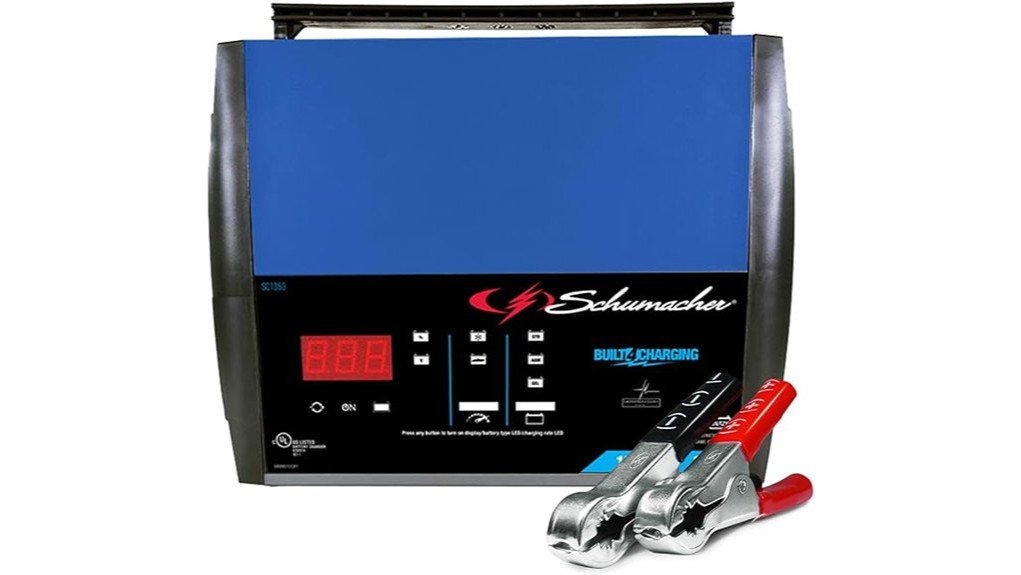
A weak battery can leave your car, truck, boat, mower, or motorcycle sitting when you need it. The Schumacher SC1359 gives you 15A charging for 12V lead-acid batteries, a lower 3A charge and maintain setting, automatic voltage detection, and a digital display in a compact home-garage unit.
This review helps you decide whether that mix is right for your batteries. The SC1359 is useful for routine charging and seasonal maintenance, but it does not support lithium batteries, provide engine-start power, or replace a professional battery load test.
Quick Verdict
Rating: 8/10
Best For: You need one portable charger for common 6V and 12V lead-acid batteries in cars, trucks, motorcycles, lawn equipment, boats, or RVs.
Bottom Line: The SC1359 combines strong 15A 12V charging with automatic maintenance, voltage testing, and clear controls. Its main limits are no lithium mode, no jump-start function, and consumer-grade construction rather than heavy shop-duty hardware.
Key Takeaways
- The SC1359 charges 6V batteries at up to 2A and 12V batteries at up to 15A.
- Its lower 3A setting is intended for small batteries and maintaining fully charged larger batteries.
- It works with rechargeable lead-acid batteries, including standard, AGM, gel, and deep-cycle types listed in the official manual.
- Automatic charging switches to maintain mode after the battery reaches full charge.
- The digital display shows voltage and an estimated charge percentage during charging, but it is not a full battery health or load tester.
- It is a charger and maintainer, not an engine-start charger or portable jump starter.
| Specification | Detail |
|---|---|
| Brand | Schumacher Electric |
| Model | SC1359 |
| Product Type | Fully automatic battery charger, maintainer, desulfation-capable charger, and voltage tester |
| Battery Voltage | 6V and 12V with automatic voltage detection |
| Output Current | 2A DC at 6V; up to 15A DC at 12V; 3A small-battery and maintain setting |
| AC Input | 120V AC, 60Hz, 3.6A |
| Battery Chemistry | Rechargeable lead-acid: standard, AGM, gel, and deep-cycle |
| Not Compatible With | Lithium-ion or LiFePO4 batteries; dry-cell household batteries |
| Display | Digital voltage and estimated charge-percentage display with LED status indicators |
| Charging Features | Microprocessor control, multi-stage charging, automatic maintain mode, and desulfation mode |
| Safety Features | Reverse hook-up protection, auto-start output control, and non-sparking clamp behavior when not connected correctly |
| Weight | 3.59 lb |
| Dimensions | 10.5 in wide x 3.63 in deep x 7.75 in high |
| Certifications | UL and ULC; manufacturer also lists DOE compliance |
| Warranty Note | The current product page lists one year, while official manual 0099001910-R1 states two years. Confirm the paperwork supplied with your unit. |
What Is the Schumacher SC1359?
The Schumacher SC1359 is a consumer battery charger and maintainer for rechargeable 6V and 12V lead-acid batteries. It is designed for home garages, driveways, sheds, and seasonal equipment storage rather than constant commercial shop use.
Its main advantage is flexibility. You can use the 15A setting for automotive, marine, and light-truck batteries, then switch to the lower setting for motorcycle, garden tractor, snowmobile, or maintenance duty. The charger automatically adjusts current as the battery charges and moves into float-style maintain mode when charging is complete.
The built-in voltage display adds a basic testing function. It can show battery voltage and an estimated charge percentage during charging, but it cannot measure cold-cranking performance or replace a professional conductance or load test.
Key Features of the Schumacher SC1359 Charger
15A Charging for 12V Batteries
The higher charge setting supplies up to 15A to compatible 12V batteries. That output is better suited to car, SUV, light-truck, boat, and RV batteries than a 1A or 2A maintainer, especially when a healthy battery has discharged during storage.
The charger still controls the current automatically. It does not force 15A into the battery for the entire cycle, and actual charging speed changes with battery capacity, state of charge, temperature, age, and condition.
3A Small-Battery and Maintain Setting
The lower setting is intended for smaller batteries used in motorcycles, garden tractors, snowmobiles, and similar equipment. Schumacher also allows this setting to maintain fully charged larger batteries.
This gives the SC1359 more range than a dedicated high-current charger. You can use one unit for a car battery in winter and a lawn-equipment battery during off-season storage.
Automatic Charging and Maintain Mode
The microprocessor adjusts charging current and automatically switches to maintain mode after the battery reaches full charge. In maintain mode, the charger adds a small amount of current when needed rather than continuously applying the full charging rate.
That reduces the manual work needed for seasonal storage, but it does not mean you should ignore the setup indefinitely. The manual recommends checking the battery and charging process occasionally because battery faults, vehicle electrical drains, or poor connections can still cause problems.
Digital Display and Battery Voltage Testing
The display shows clamp voltage when the charger is connected but not actively charging. During charging, it can show an estimated charge percentage and the detected 6V or 12V battery voltage.
This is useful for a quick check, but surface charge can make voltage readings look better than the battery’s true condition. A battery that repeatedly goes flat, aborts charging, or fails to start the vehicle should be tested with proper diagnostic equipment.
Who Should Buy It?
Best For
- You own several 6V or 12V lead-acid batteries and want one portable charger for them.
- You need faster charging than a low-amp maintainer provides for a healthy 12V vehicle battery.
- You store motorcycles, lawn equipment, boats, RVs, or seasonal vehicles and want automatic maintenance.
Skip If
- Your battery is lithium-ion or LiFePO4.
- You need emergency engine-start power or a portable jump pack.
- You need a rugged metal charger for daily fleet or repair-shop use.
Before You Buy: Confirm the battery voltage and chemistry on the battery label or vehicle manual. The SC1359 is for rechargeable lead-acid batteries and must not be used as a lithium charger or jump starter.
How Fast Does the SC1359 Charge?
The SC1359 can charge a compatible 12V battery at up to 15A, but there is no single charge time that applies to every battery. A half-discharged compact-car battery may finish much sooner than a large deep-cycle battery, while an old, cold, sulfated, or deeply discharged battery may take far longer.
The manual bases its charging guidance on batteries that are about 50% discharged. In practice, the charger tapers current as the battery fills, so dividing amp-hour capacity by 15A gives only a rough starting estimate, not a promised completion time.
The 6V output is limited to 2A, which means 6V batteries charge more gently. For small 12V powersport or garden-equipment batteries, use the lower charge setting recommended by the manual rather than choosing the highest rate by default.
The SC1359 is built for controlled charging and maintenance, not instant engine-start power.
Design and Build Quality
The charger measures 10.5 inches wide, 3.63 inches deep, and 7.75 inches high. At 3.59 pounds, it is easy to carry between a shelf, vehicle, shed, or storage area without taking up the space of a wheeled shop charger.
The digital display, LED indicators, and push-button controls are easier to read than a basic analog meter. Status lights show reversed clamps, active charging, and charged or maintaining conditions.
The lightweight housing is practical for occasional home use, but it is not designed like a heavy metal commercial charger. Store it upright, unplugged, dry, and protected from impact, rain, snow, and battery acid.
Charging Technology and Battery Compatibility
The SC1359 uses automatic voltage detection for 6V and 12V batteries. You still select the proper battery type and charge rate, so you must identify the battery chemistry before starting.
The official R1 manual lists standard, AGM, gel, and deep-cycle rechargeable lead-acid batteries. The current Schumacher product page lists standard, AGM, and deep-cycle batteries but does not show gel in its shorter compatibility field. Because the official manual includes a gel setting and specific gel guidance, use the manual supplied with your unit and follow the battery maker’s charging instructions.
Desulfation mode can activate when the charger detects a sulfated battery. This feature may help with some recoverable lead-acid batteries, but it cannot repair internal damage, shorted cells, severe plate loss, or a battery that no longer holds a charge.
How to Use It Correctly
- Identify the battery: Check that it is a rechargeable 6V or 12V lead-acid battery and confirm whether it is standard, AGM, gel, or deep-cycle.
- Prepare the area: Turn off vehicle accessories, keep the area ventilated, clean the terminals, and place the charger on a dry, nonflammable surface.
- Route the cables safely: Keep cords away from the hood, doors, fans, belts, pulleys, fuel lines, and other moving or hot parts.
- Connect before plugging in: Follow the manual’s procedure for an installed or removed battery. On most negative-ground vehicles, connect red to the positive post and black to a solid chassis or engine ground away from the battery.
- Select battery type and rate: Use the setting that matches the battery label and size.
- Disconnect in the correct order: Unplug AC power first, remove the chassis or negative connection, and then remove the positive clamp.
Pro Tip: Clean and dry the clamps after each use, then coil the AC and DC cords loosely before storage. This helps limit corrosion and cable damage.
Compatibility and Safety
Reverse hook-up protection stops charging when the clamps are connected backward. The auto-start design also prevents current from reaching the clamps until the charger detects a proper battery connection.
Those protections do not remove the risks of working near lead-acid batteries. Wear eye and clothing protection, keep flames and sparks away, remove metal jewelry, provide ventilation, and never charge a frozen battery. Do not place the charger directly above the battery because battery gases can damage it.
Do not start the vehicle while the charger is connected to AC power. For a removable marine battery, the manual says to remove it from the boat and charge it on shore unless you use equipment specifically designed for onboard marine charging.
The manual discourages extension-cord use. When an extension cord is unavoidable, use a properly wired grounded cord with the gauge specified for its length in the manual.
How It Performs in Real Use
For a Car, SUV, or Light-Truck Battery
The 15A setting is the SC1359’s strongest use case. It can restore a healthy but discharged 12V starting battery faster than a low-amp maintainer, while the automatic control reduces the need to watch and adjust current through the cycle.
For Motorcycles and Lawn Equipment
The lower setting suits smaller lead-acid batteries in motorcycles, garden tractors, snowmobiles, and similar equipment. It also lowers the risk of choosing an unnecessarily aggressive rate for a small battery.
For Boats and RVs
Deep-cycle compatibility makes the charger useful for many marine and RV batteries. Large batteries can still require long charging periods, and a boat battery should be charged ashore unless the charging equipment is specifically approved for onboard use.
For Seasonal Storage
Automatic maintain mode is helpful for equipment that sits for weeks or months. The charger can add current when needed after full charge, but you should still inspect the battery, cables, charger, and storage area from time to time.
What Buyers Should Know
The SC1359 is easy to understand once you identify the correct battery type and charge rate. The display and status LEDs provide more information than a basic trickle charger, and its low weight makes it easy to move between batteries.
The main expectation to manage is battery recovery. A smart charger can charge and maintain a serviceable battery, but it cannot make a worn-out battery reliable again. Repeated error codes, charging that aborts, rapid self-discharge, swelling, leaking, or failure to start the vehicle are reasons to stop and have the battery checked.
Pros and Cons
Pros
- Up to 15A charging for common 12V automotive and marine batteries.
- Lower setting for small batteries and maintenance duty.
- Supports 6V and 12V standard, AGM, gel, and deep-cycle lead-acid batteries.
- Automatic voltage detection, multi-stage charging, desulfation, and maintain mode.
- Compact 3.59 lb design with digital display and clear LED indicators.
Cons
- No lithium-ion or LiFePO4 charging mode.
- No engine-start or portable jump-start function.
- Warranty length is inconsistent between the current product page and the official R1 manual, so you need to verify the paperwork supplied with the unit.
Is It Worth the Price?
The Schumacher SC1359 offers strong value for the price when you need one charger for several lead-acid batteries. Its 15A 12V output, lower small-battery setting, automatic maintenance, voltage display, and compact size cover more jobs than a basic maintainer.
You get the most value if you own a car plus seasonal equipment, a motorcycle, a boat, or an RV. It is less compelling if all you need is a low-amp maintainer for one small battery.
It is not the best fit when lithium compatibility, engine-start power, weather-resistant mounting, or daily commercial durability matters more than maximum 12V charging current.
How It Compares to Alternatives
The NOCO GENIUS10 is the stronger alternative when you need a dedicated lithium mode, wider 100V to 240V AC input support, or a weather-resistant IP65 housing. Its charging output is 10A rather than the SC1359’s 15A maximum for 12V batteries.
The Schumacher SC1280 is a close same-brand alternative with 15A charging, a 3A maintain setting, digital controls, and similar lead-acid compatibility. The SC1359 makes the most sense when its compact layout and verified feature set match your needs, while the SC1280 is worth comparing when availability or included controls differ.
Where to Buy the SC1359 Charger
You can check Amazon, Schumacher’s listed sellers, and automotive retailers that carry battery chargers. Compare the exact model number, included manual, seller return terms, and warranty paperwork before placing an order.
Online prices and stock can change. Avoid choosing a listing only because it uses a similar product photo, since Schumacher sells several chargers with similar 15A and 6V/12V descriptions.
Warranty and Support
Warranty information needs a careful check. Schumacher’s current SC1359 product page lists a one-year warranty, while official owner’s manual 0099001910-R1 states a two-year limited warranty for the original retail purchaser.
Because those official sources conflict, keep your receipt and confirm the warranty document included with the exact unit you receive. Warranty coverage may also depend on normal use, proof of purchase, seller authorization, and following the claim process.
For troubleshooting, use model number SC1359 and the manual version printed on your copy. Do not ship the charger for repair until Schumacher support provides the required return instructions.
Frequently Asked Questions
Can the Schumacher SC1359 charge lithium batteries?
No. The SC1359 is designed for rechargeable lead-acid batteries, not lithium-ion or LiFePO4 batteries. Use a charger that specifically lists your lithium chemistry and battery-management requirements.
Does the SC1359 support gel batteries?
Official manual 0099001910-R1 lists gel batteries and includes a gel battery-type setting. Follow the manual supplied with your unit and confirm the battery maker’s recommended charging voltage and rate.
Can you leave the SC1359 connected in maintain mode?
Maintain mode is designed to keep a healthy 6V or 12V battery charged for extended periods. The manual still advises occasional monitoring because a bad battery, vehicle drain, poor connection, or other fault can cause excessive current demand.
Does the SC1359 work as a jump starter?
No. It does not provide an engine-start setting or store power like a portable jump pack. Charge the battery first, then unplug and disconnect the charger before starting the vehicle.
Can the SC1359 charge deep-cycle marine and RV batteries?
Yes, it supports compatible 6V and 12V deep-cycle lead-acid batteries. Large-capacity batteries may take longer, and removable boat batteries should be charged on shore unless you use equipment made for onboard marine charging.
What do the SUL and bad battery messages mean?
SUL means the charger detected sulfation and entered desulfation mode. A bad battery message or error code means charging could not finish normally, so stop repeated attempts and have the battery checked or replaced.
Is the voltage display a complete battery test?
No. It shows voltage at the clamps and an estimated charge percentage during charging. Surface charge can affect the reading, and the display does not measure cold-cranking ability or battery capacity under load.
How long is the SC1359 warranty?
The current manufacturer product page lists one year, while official manual 0099001910-R1 states two years. Check the warranty paperwork included with your charger and keep your original proof of purchase.
The Bottom Line
The Schumacher SC1359 earns an 8/10 for its useful 15A 12V output, small-battery setting, automatic maintenance, voltage display, and broad lead-acid compatibility. It is a practical choice for home users with cars, motorcycles, lawn equipment, boats, or RVs.
Skip it if you need lithium charging, emergency jump-start power, or heavy commercial construction. Its biggest strength is flexible charging and maintenance in a compact unit, while its main buying caution is the conflicting warranty information across official sources.
Ready to Buy?
Check the latest seller details, included manual, and warranty information before you decide.