Air duct cleaning in Tulsa can be worthwhile when your HVAC system has a specific contamination problem, but it is not routine maintenance every home needs on a fixed schedule. The most useful approach is to inspect first, identify the source of dust, moisture, pests, or debris, and clean the system only when conditions justify it.
Quick Answer
Consider air duct cleaning when you have substantial visible mold in hard-surface ducts, vermin, heavy debris, or particles blowing from supply registers. EPA does not recommend routine cleaning on a fixed timetable. Before hiring anyone, get an inspection, written scope, and several estimates.
Key Takeaways
- Dust on a return grille alone does not prove the ducts need professional cleaning.
- A proper job should address the HVAC system as a whole, not simply vacuum the visible registers.
- Chemical sanitizers are not automatically needed and must be used according to their EPA-approved label.
- Oklahoma does not currently require a state mechanical license solely to perform air duct cleaning.
- Written estimates and before-and-after visual evidence make it easier to avoid unnecessary work and low-price bait-and-switch offers.
When Air Duct Cleaning Can Help Your Home
)
Air duct cleaning is most useful when there is a documented contamination problem rather than ordinary household dust. The EPA’s residential air-duct guidance says cleaning should be considered when ducts contain substantial visible mold, vermin, excessive dust and debris, or particles that are actually being released through supply registers.
That is different from saying every dusty HVAC system is unhealthy. EPA notes that much of the dirt inside ducts sticks to duct surfaces, and studies have not conclusively shown that routine duct cleaning prevents health problems or consistently lowers particle levels inside a home.
Cleaning may still be valuable when contamination is severe. If moisture caused mold, pests entered the system, or construction debris accumulated inside the ductwork, correcting the underlying cause and then cleaning affected components can prevent the problem from simply returning.
Common Signs You May Need Air Duct Cleaning
The strongest signs are conditions you can actually see or document inside the HVAC system. Dust elsewhere in the home, an odor, or allergy symptoms can justify an inspection, but they do not prove the ducts themselves are the source.
- Debris blowing from supply registers: Visible particles coming out while the system runs are a stronger reason to investigate than normal dust sitting on a grille.
- Substantial visible mold: Mold-like growth on hard duct surfaces or HVAC components should be evaluated, and the moisture source must be corrected.
- Rodents or insects: Evidence of vermin inside ducts calls for pest control and assessment of contaminated ductwork.
- Heavy construction debris: Renovation dust can enter an HVAC system, particularly if registers were left open while dusty work was underway.
- Persistent musty odors: An odor warrants inspection for moisture, drain-pan problems, dirty coils, filters, or other HVAC sources rather than assuming the ducts are responsible.
A coating of dust on a return register is not enough by itself. Return grilles naturally collect some dust as air moves toward the system, and they can often be cleaned with ordinary household vacuuming.
Duct Cleaning vs. Regular HVAC Maintenance
Routine HVAC maintenance is valuable, but routine duct cleaning is a separate decision. Filters, coils, drain pans, blower components, moisture control, and duct leakage can have a more direct effect on system operation than lightly dusty duct surfaces.
A scientific review of duct-cleaning research found insufficient evidence for broad claims that duct cleaning consistently improves indoor air quality, health symptoms, airflow, or energy use. EPA likewise says some research supports efficiency improvements from cleaning dirty coils, fans, and heat exchangers, while evidence for efficiency gains from cleaning ducts alone is limited.
For prevention, use the highest-efficiency filter your HVAC manufacturer recommends, replace clogged filters, keep water out of the system, maintain condensate drainage, and keep supply and return registers covered during dusty renovation work.
Note: If people in your household have unexplained respiratory symptoms, persistent allergies, or other health concerns, discuss them with a healthcare professional. Duct cleaning should not be treated as a medical treatment.
What to Expect During an Air Duct Cleaning Service
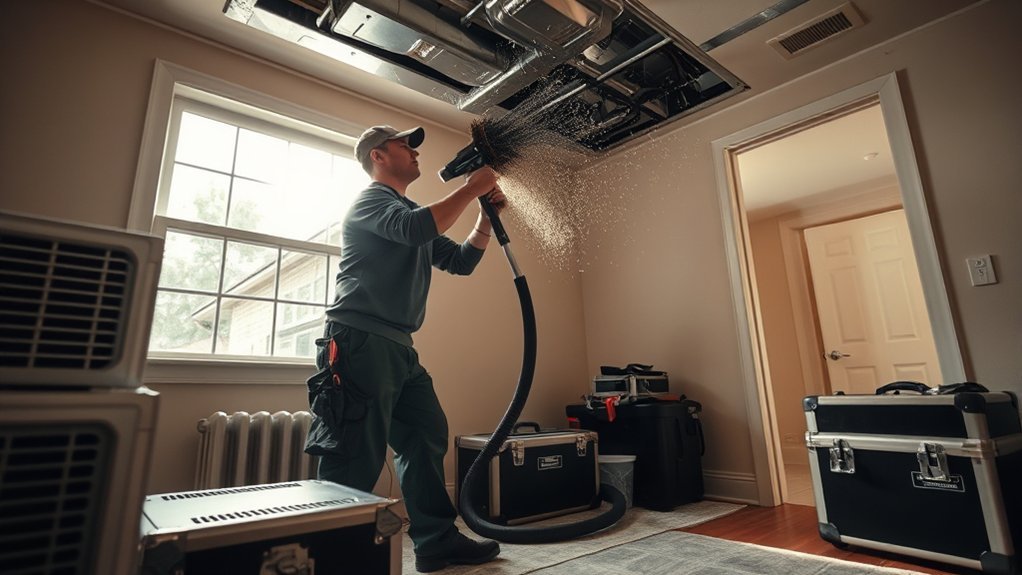
A professional job should begin with an assessment and should clean more than the visible vent openings. The goal is source removal: loosening contamination from accessible HVAC surfaces while collecting it so debris is not released into the living space.
NADCA’s cleaning guidance treats air-duct cleaning as whole-system HVAC cleaning. Depending on the agreed scope, this can include supply and return ducts, registers, grilles, plenums, blower components, coils, drain pans, and other accessible parts.
- Inspect the system. The technician should identify contamination, duct type, access points, damaged material, moisture problems, and areas that need special handling.
- Protect the home. Furnishings and floors near work areas should be protected, and the collection system should prevent loosened debris from spreading indoors.
- Create vacuum collection. Professional equipment maintains suction while brushes, air tools, or other agitation devices loosen deposits.
- Clean accessible HVAC components. A contaminated component left untreated can recontaminate cleaned parts of the system.
- Close access openings properly. Any service openings created for cleaning should be securely sealed after the work.
- Verify the result. Ask to see cleaned components, including representative supply and return areas, rather than relying only on a verbal assurance.
There is no reliable universal promise that every house takes two to four hours. Job length depends on the number of HVAC systems, system size, accessibility, duct material, contamination level, and crew size.
Warning: Do not automatically approve an antimicrobial, biocide, sealant, or ozone treatment. EPA says these treatments have important limitations. Any pesticide product used inside ductwork must be registered for that specific use and applied strictly according to its label.
How Often Should You Schedule Air Duct Cleaning?
There is no evidence-based rule saying every Tulsa home needs duct cleaning every three, five, or seven years. EPA recommends cleaning as needed, based on actual system conditions rather than the calendar.
Inspection is especially sensible after water damage, pest activity, major dusty renovation work, or when you see substantial debris inside the system. Homes with pets or occupants who have allergies may accumulate more dust and dander, but those factors alone do not establish that cleaning is required.
| Situation | Why It Matters | Recommended Action |
|---|---|---|
| Normal household dust | Some dust in registers and ducts is expected | Maintain filters and inspect before paying for cleaning |
| Visible mold, pests, or heavy debris | Indicates a specific contamination problem | Correct the cause and assess the system for cleaning |
| After dusty renovation or water damage | Debris or moisture may have entered HVAC components | Inspect affected components and clean as needed |
What Dust and Allergy Symptoms Do—and Don’t—Tell You
Dust and allergy symptoms can signal an indoor-air problem, but they cannot identify dirty ducts as the cause by themselves. Indoor particles also come from outdoor air, cooking, cleaning, pets, fabrics, carpets, smoking, and other household activities.
Increased Allergy Symptoms
Sneezing, coughing, irritated eyes, or worsening asthma symptoms deserve attention, particularly if they improve when you leave the home. However, routine duct cleaning has not been proven to prevent health problems, so investigate other sources at the same time.
Start with moisture, visible mold, filtration, pests, tobacco smoke, pet dander, and other likely indoor pollutants. If symptoms are persistent or severe, seek medical advice rather than relying on duct cleaning as the solution.
Visible Dust Accumulation
Dust around a vent does not necessarily mean the entire duct system is heavily contaminated. Return registers commonly become dusty because they pull room air toward the HVAC filter.
Cleaning becomes more compelling when you can see substantial deposits deeper inside accessible ducts or when debris is actually discharged from supply registers. Ask a contractor to show you the condition that justifies the work before approving a whole-system cleaning.
How to Choose an Air Duct Cleaning Service in Tulsa
Choose a contractor based on documented qualifications, inspection quality, scope of work, and cleaning method rather than years in business alone. A trustworthy company should be willing to show you why cleaning is needed and explain exactly what the quoted price includes.
Use the NADCA professional directory to verify current membership and certified personnel rather than relying only on a company logo or advertising claim. EPA also recommends talking with several providers and obtaining written estimates before choosing one.
Ask each company:
- What evidence shows my system needs cleaning?
- Are both supply and return sides included?
- Which HVAC components are included beyond the ducts?
- Will agitation and vacuum collection be used together?
- How will you prevent loosened debris from entering my home?
- Will you provide before-and-after visual documentation?
- Are chemicals included, and if so, why are they necessary?
- Are repairs, mold remediation, or dryer-vent cleaning separate charges?
Do not assume an Oklahoma mechanical license proves duct-cleaning qualifications. The Oklahoma Construction Industries Board currently states that performing air-duct cleaning itself does not require a state mechanical license. Work that goes beyond cleaning and involves installation, alteration, repair, or other regulated mechanical work can be different.
What Should You Expect to Pay for Air Duct Cleaning?
A reasonable planning figure is broader than the original $300–$500 estimate. EPA guidance and NADCA consumer material cite roughly $450 to $1,000 per heating and cooling system for a properly cleaned average-sized home, although your Tulsa quote may be higher or lower.
The final price depends on the number and size of systems, accessibility, duct configuration, contamination level, and exactly which HVAC components the contractor includes. Large homes, multiple systems, difficult access, or extensive contamination require more labor.
Be cautious with a very low advertised whole-house price if the company has not inspected the system. Ask for a written scope showing what is included, what can trigger extra charges, and whether dryer-vent cleaning, mold work, duct repair, chemical treatment, or camera inspection is priced separately.
Pro Tip: Compare the scope, not just the total price. A quote covering the complete contaminated HVAC system is not directly comparable with a cheaper service that cleans only registers or a few duct runs.
DIY vs. Professional Air Duct Cleaning: What’s Best?
DIY maintenance is appropriate for accessible registers and normal household dust, but deep whole-system cleaning requires equipment and access that most homeowners do not have. Trying to aggressively brush fragile flex duct or fiberglass-lined material can cause damage.
You can safely vacuum removable grilles, keep the filter area clean, replace filters as recommended for your system, and inspect visible openings with a flashlight. Stop if you find wet insulation, suspected mold, pest contamination, damaged duct material, or an inaccessible buildup that requires professional equipment.
Professional cleaning has another advantage: a qualified technician can identify problems that cleaning alone will not fix, such as duct leakage, moisture intrusion, damaged insulation, disconnected runs, dirty coils, or an overflowing condensate pan.
Frequently Asked Questions
Do I Need to Do Anything to Prepare for Duct Cleaning?
Yes. Clear access to supply registers, return grilles, the furnace or air handler, and other areas the crew needs to reach. Secure pets, move fragile items, and tell the contractor about damaged ducts, suspected asbestos-containing materials, allergies, or other concerns before work starts.
What Is the 2 Foot Rule for Ducts?
The “2-foot rule” is not an EPA or NADCA requirement for duct cleaning, and it does not simply mean ducts must stay two feet from walls. The phrase is used informally in some airflow and takeoff-layout discussions; proper residential duct design should follow ACCA Manual D and applicable codes.
What Are the Drawbacks of Duct Cleaning?
The main drawbacks are unnecessary expense, possible duct or HVAC damage from poor workmanship, and the risk of releasing more dust if inadequate collection equipment is used. Cleaning also will not correct leaks, moisture sources, damaged insulation, pest entry points, or unrelated indoor-air problems.
Can Dirty Air Ducts Cause Eczema?
Dirty air ducts have not been established as a direct cause of eczema. Environmental factors such as dust mites, pet dander, dry air, heat, humidity, and tobacco smoke can trigger flares in some people, according to the American Academy of Dermatology; persistent eczema should be discussed with a healthcare professional.
Conclusion
Air duct cleaning in Tulsa is most useful when an inspection finds a real contamination problem, not simply because several years have passed. EPA reports that indoor levels of some pollutants can be two to five times higher than outdoor levels, but ducts are only one possible source. Focus on evidence, moisture control, filtration, complete HVAC maintenance, and a clearly defined cleaning scope before you spend money.
Sources
- U.S. Environmental Protection Agency: When duct cleaning is appropriate, health evidence, cleaning procedures, chemical treatments, costs, and contractor selection.
- National Air Duct Cleaners Association: Whole-system cleaning, source removal, agitation, and vacuum collection practices.
- NADCA Find a Professional: Verification of member companies and certified personnel.
- Oklahoma Construction Industries Board: State licensing requirements for air-duct cleaning.
- PubMed / Indoor Air: Scientific review of evidence for duct cleaning, indoor-air quality, health, airflow, and energy benefits.
- American Academy of Dermatology: Indoor environmental triggers associated with eczema flares.
- Air Conditioning Contractors of America: Manual D residential duct-system design standard.
- U.S. Environmental Protection Agency Indoor Air Quality: Indoor-versus-outdoor pollutant-level context.