Affiliate Disclosure: As an Amazon Associate, we may earn a commission from qualifying purchases made through links on this page at no extra cost to you.
Evaluating the DJI Mavic 3 Enterprise price breakdown requires looking beyond the base aircraft to RTK modules, extra Intelligent Flight Batteries, and mapping software. Per DJI's specifications, the Mavic 3E combines a 915 g folding airframe with a 20MP 4/3 CMOS mechanical-shutter wide camera, a 12MP 56× hybrid zoom lens, and up to 45 minutes of flight time. Here is how total ownership costs, hardware tiers, and alternatives compare. For related tips and details, explore our DJI Avata 2 Review: Specs, Combos & FPV Buying Guide.
DJI Mavic 3 Enterprise Cost Factors & Verified Specs
Unlike consumer Mavic models, the Mavic 3 Enterprise is priced for commercial photogrammetry, corridor mapping, and site inspection. Total investment depends on whether you purchase the base aircraft bundle (with DJI RC Pro Enterprise and 1 battery) or add the snap-on RTK module, multi-battery kit, and DJI Terra mapping licenses. For related tips and details, explore our 6 Best Budget Camera Drones: Sub-250g 4K Buying Guide.
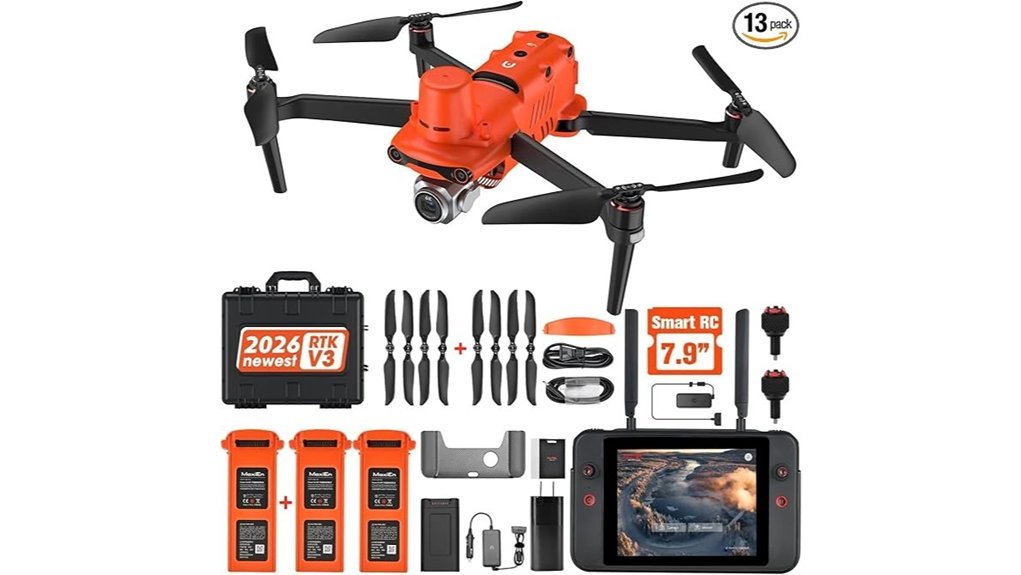
Note: The two Amazon product links preserved from the original article point to comparison models—the Autel Robotics EVO II PRO RTK V3 and the consumer DJI Mavic 3 Pro—rather than a factory Mavic 3E Enterprise SKU. For related tips and details, explore our 6 Best Drones Under 0: 4K & Budget Camera Guide.
| Cost / Spec Component | Details (Per Manufacturer & Enterprise Listing Info) |
|---|---|
| Base Airframe Weight & Endurance | 915 g takeoff weight; up to 45 min max flight time (no wind) |
| Primary Mapping Camera | 20MP 4/3 CMOS, 24mm equiv., f/2.8–f/11, mechanical shutter (1/2000 s) to prevent rolling-shutter blur |
| Zoom Inspection Camera | 12MP 1/2" CMOS, 162mm equiv., 56× max hybrid zoom |
| RTK Module & Network Access | Optional top-mounted RTK module for centimeter-level positioning + NTRIP/D-RTK 2 base station costs |
| Recurring Operational Costs | Additional 5000mAh batteries, 100W charging hub, DJI Care Enterprise, and photogrammetry software |
Enterprise Drone ROI & Budgeting Checklist
- Calculate whether a mechanical shutter and RTK module will eliminate ground control point (GCP) labor on your survey sites.
- Budget for at least 3–4 Intelligent Flight Batteries and a 100W charging hub to sustain full-day field operations.
- Account for recurring software subscriptions (such as DJI Terra or cloud photogrammetry processing) and NTRIP RTK corrections.
- Confirm authorized enterprise dealer support, spare propeller availability, and local import/tariff taxes.
How to Assess Total Cost of Ownership Before Buying
- Define your primary deliverable—2D orthomosaics/3D terrain models (Mavic 3E) vs. thermal inspections (Mavic 3T) vs. visual media (Mavic 3 Pro).
- Request itemized quotes from authorized enterprise dealers separating the base kit, RTK module, and care plan.
- Estimate annual flight hours and compare contractor survey fees against in-house equipment amortization.
- Verify Part 107 pilot certification, airspace authorization workflows, and hull/liability insurance.
Frequently Asked Questions
Why does the DJI Mavic 3 Enterprise have a mechanical shutter?
A mechanical shutter prevents rolling-shutter distortion when capturing overlapping mapping photos while the drone is moving rapidly, improving photogrammetry accuracy.
Does the base DJI Mavic 3 Enterprise include the RTK module?
No. The RTK module is typically sold separately or as part of a specific dealer survey bundle rather than inside the standard base box.
Can the DJI Mavic 3 Pro replace the Mavic 3 Enterprise for mapping?
While the Mavic 3 Pro has strong cameras for photography, it lacks a mechanical shutter, an RTK module port, and DJI Pilot 2 enterprise mapping workflows.
What batteries does the DJI Mavic 3 Enterprise use?
It uses DJI Mavic 3 Series Intelligent Flight Batteries (5000 mAh, 15.4 V), providing up to 45 minutes of rated flight time under windless test conditions.