Bern, the federal city (Bundesstadt) and de facto capital of Switzerland, is one of Europe’s most remarkably preserved medieval treasures. Built on a narrow sandstone peninsula encircled by the turquoise loop of the Aare River, the city seamlessly weaves 800 years of living history into everyday Swiss urban life. Whether you are pausing on a Swiss rail journey or making a dedicated day trip, one well-planned day is the ideal amount of time to explore its UNESCO-listed Old Town, historic astronomical clock, scenic riverfront, and vibrant culinary scene entirely on foot.
Quick Answer
To see Bern in one day, start at the central train station and walk east down the 6-kilometer covered arcade route through the UNESCO Old Town. Watch the Zytglogge astronomical clock chime four minutes before the hour, climb the 312 steps of Bern Cathedral for Alpine views, visit the bears at the riverside BärenPark, and hike up to the Rosengarten for lunch. Finish your day touring the Federal Palace (Bundeshaus) and sampling traditional rösti or fondue.
Key Takeaways
- Walkable Layout: Bern’s historic center is compact and pedestrian-friendly, sheltered by 6 kilometers of medieval weather-proof arcades (Lauben).
- Iconic Highlights: The Zytglogge clock tower, Bern Minster (Switzerland’s tallest church spire), and the riverside BärenPark can easily be experienced in a single 6- to 8-hour visit.
- Best Viewpoints: The elevated Rosengarten (Rose Garden) and the Bern Cathedral tower offer panoramic vistas of the Old Town peninsula and the Bernese Alps.
- Free Transit: Anyone staying at least one night in commercial accommodation receives the complimentary Bern Ticket, valid for unlimited local tram and bus travel.
At a Glance
| Time Required | 1 Full Day (7 to 9 hours) |
| Difficulty | Easy (gentle walking across cobblestones with one short uphill incline to Rosengarten) |
| Tools Needed | Comfortable walking shoes, Swiss Francs (CHF) or contactless card, reusable water bottle, Bern Ticket or SBB Swiss Travel Pass |
| Estimated Cost | CHF 45 – CHF 95 per person (covers cathedral tower admission, museum entry, sit-down lunch, and coffee/pastries; public walking areas are free) |
The Ideal 1-Day Bern Itinerary Timeline
Because the historic peninsula is only about 1.5 kilometers long from the central railway station (Bahnhof Bern) to the eastern bend of the Aare River, you can walk the entire circuit comfortably without rushing. Here is how to sequence your day for maximum efficiency:
- 08:30 AM – 10:00 AM: Arrive at Bern Main Station, stroll through the Spitalgasse and Marktgasse arcades, and admire the Renaissance fountain sculptures.
- 10:00 AM – 11:30 AM: Watch the mechanical figurine performance at the Zytglogge (arrive at 10:55 AM for the 11:00 AM strike), then tour Kramgasse and the Einstein House.
- 11:30 AM – 01:00 PM: Tour the Bern Cathedral (Berner Münster), climb the tower platform, and relax on the Münsterplattform terrace.
- 01:00 PM – 03:00 PM: Cross the Nydeggbrücke to observe the bears at BärenPark, then walk up to the Rosengarten for lunch with panoramic skyline views.
- 03:00 PM – 05:00 PM: Walk down to the Matte district, cross the historic Untertorbrücke, and stroll along the emerald Aare riverbank.
- 05:00 PM – 07:00 PM: Explore the Federal Palace (Bundeshaus) at Bundesplatz, watch the evening fountains, and enjoy an authentic Swiss dinner featuring fondue or rösti.
Exploring the Old Town (Altstadt)
Bern’s Old Town was recognized as a UNESCO World Heritage site in 1983, celebrated for its cohesive medieval townscape that has survived largely intact since a massive rebuilding effort following the Great Fire of 1405. Walking along the cobblestone main thoroughfares—Spitalgasse, Marktgasse, Kramgasse, and Gerechtigkeitsgasse—you are flanked on both sides by 6 kilometers of continuous covered limestone arcades known locally as Lauben. Originally designed to shelter medieval traders, these arcades now house an eclectic mix of contemporary boutiques, subterranean cellar bars, and artisanal coffee shops.
As you stroll down the center of the streets, look for the vibrant 16th-century Renaissance public fountains designed by Swiss sculptor Hans Gieng. These colorful allegorical figures depict biblical scenes and historical folklore:
- Zähringerbrunnen: Depicts a crowned bear in full armor holding the banner of the House of Zähringen, commemorating Duke Berthold V of Zähringen, who founded Bern in 1191.
- Kindlifresserbrunnen (Ogre Fountain): Located near Kornhausplatz, this striking and eerie sculpture portrays a seated ogre devouring a child, intended historically as a cautionary warning for local children.
- Gerechtigkeitsbrunnen (Fountain of Justice): Displays the blindfolded goddess of Justice holding a sword and scales, with the severed heads of the Pope, the Emperor, the Sultan, and the Mayor below her pedestal, symbolizing the rule of law over earthly powers.
Pro Tip: Do not buy bottled water in Bern. The water flowing continuously from all historic city fountains is pure, cold, mountain-fed drinking water that is tested constantly by municipal authorities. Bring a refillable bottle and drink freely from the spouts.
Further down towards the river stands the Bern Cathedral (Berner Münster), the largest and most architecturally significant late-medieval ecclesiastical structure in Switzerland. Construction began in 1421 and took over four centuries to finish. Above the main portal is an extraordinary stone sculpture depicting the Last Judgment, featuring 294 intricately carved figures. Inside, visitors can marvel at 15th-century stained-glass windows, while ambitious travelers can climb the 312 stone spiral steps of the cathedral’s 100.6-meter spire—the highest in Switzerland—for an unmatched view of the Old Town and the snow-dusted Bernese Oberland peaks.
Visiting the Zytglogge Clock Tower
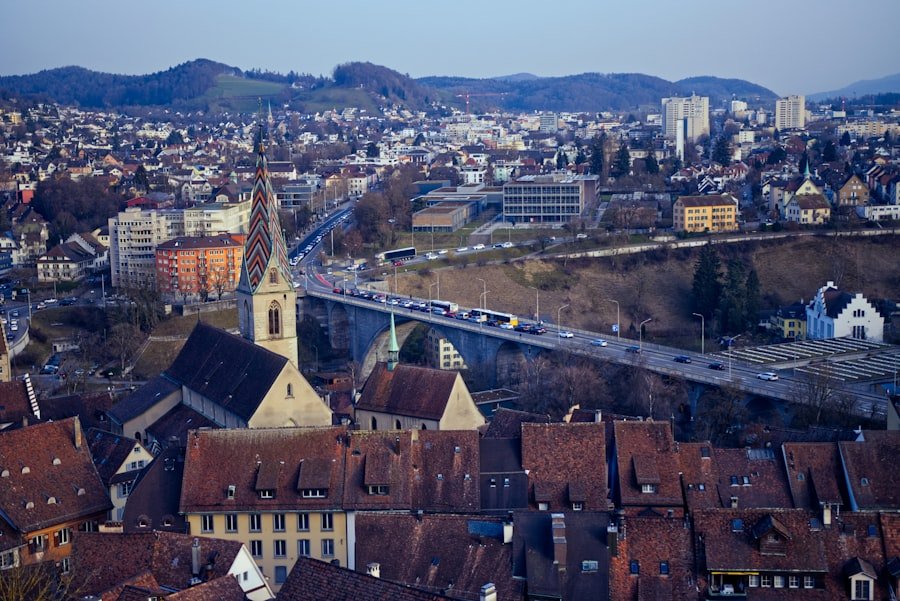
Standing guard over the central artery of the Old Town is the Zytglogge (Bernese German for “time bell”). Originally constructed between 1218 and 1220 as the western gate tower of Bern’s earliest urban fortification, the structure later functioned as a guardhouse and a women’s prison before being transformed into the city’s civic timepiece following the 1405 fire.
The eastern face features an elaborate astronomical clock mechanism crafted by master clockmaker Kaspar Brunner in 1530. The multi-tiered dial illustrates the movements of the sun through the zodiac constellations, the 24-hour solar day, the lunar phase, the day of the week, and the leap-year cycle. Every hour, precisely four minutes before the hour strikes, a crowd gathers underneath the archway to witness its mechanical theater:
- A mechanical rooster crows and flaps its wings.
- A seated bearded figure (Chronos, the god of time) turns an hourglass upside down.
- A procession of armed, performing bears parading out of the tower wall circles around Chronos.
- A golden figure at the very top of the tower, known as the Hans von Thann, strikes the large bronze bell with a hammer to sound the full hour.
Just two blocks east of the Zytglogge at Kramgasse 49 is the Einstein House (Einsteinhaus). It was on the second floor of this modest rented apartment that Albert Einstein lived with his wife Mileva Marić between 1903 and 1905 while working as a patent clerk at the Federal Patent Office. It was in this very room that he authored his famous Annus Mirabilis papers, formulating the Special Theory of Relativity and changing modern physics forever.
Discovering the Bear Park (BärenPark) and Rosengarten
The bear has stood as the proud heraldic emblem and mascot of Bern since at least the early 13th century. According to local founding legend, Duke Berthold V of Zähringen vowed to name his new fortress settlement after the very first wild animal he encountered on the hunt in the surrounding oak forests—which happened to be a bear (Bär in German).
For centuries, bears were kept in cramped concrete pits (Bärengraben) near the river. In 2009, the city completely replaced that antiquated facility by opening the modern BärenPark, a 6,000-square-meter naturalized hillside enclosure that slopes directly down into the Aare River. Here, resident brown bears (including Finn and Björk) can forage, climb woodland slopes, hibernate in caves, and swim in a private, segregated side-current of the river.
| Visitor Feature | Details & Practical Tips |
|---|---|
| Admission & Hours | Free admission; open outdoor viewing paths accessible 24 hours a day, 365 days a year. |
| Best Time to Visit | Mornings (09:00 AM – 11:00 AM) and late afternoons when the bears are feeding and active. Note that bears hibernate during the coldest winter months (typically November through March). |
| Accessibility | An inclined elevator connects the upper plateau and the Aare riverfront promenade, offering step-free access for strollers and wheelchairs. |
| Combined Attraction | Walk directly across to the historic Bärengraben (preserved as an architectural monument) or ascend the walking trail to the Rosengarten. |
Immediately behind the Bear Park, follow the marked walking path up the switchback hill to the Rosengarten (Rose Garden). This elevated public park houses hundreds of varieties of roses, irises, and rhododendrons, and provides the definitive postcard view of Bern: the turquoise loop of the Aare framing the red-tiled roofs of the medieval Old Town. The on-site restaurant makes an exceptional stop for an outdoor midday lunch or espresso overlooking the city.
Exploring the Aare River and its Historic Bridges
Fed by glacial meltwater from the Bernese Alps, the Aare River loops tightly around three sides of Bern’s historic center. The river is not merely a scenic backdrop; it forms the cultural heartbeat of the city during the warmer months, when thousands of locals leap into the clean current to drift effortlessly downstream from the Marzili public lido.
Warning: The Aare River is powerful, deep, and fast-flowing with chilly glacial water. Swimming and floating down the river is strictly recommended for confident, experienced swimmers. First-time visitors should enjoy the riverside paths or bathe in the protected swimming pools at the free Marzilibad complex.
Bern’s topography is defined by its historic bridges, which connect the high ridge of the old city to the modern residential quarters:
- Untertorbrücke (Lower Gate Bridge): Completed in 1489, this stone arch bridge is the oldest surviving river crossing in Bern. Walking across it brings you into the peaceful Matte district, a quiet enclave of working-class roots that once had its own distinct local dialect (Mattenenglisch).
- Nydeggbrücke: Built between 1840 and 1844 alongside the old castle grounds, this massive sandstone arch bridge stands 25 meters above the water, linking the lower Old Town directly to the Bear Park.
- Kirchenfeldbrücke: A dramatic 1883 iron-truss bridge soaring high above the river plain, carrying pedestrians and trams from Casinoplatz across to the Bern Historical Museum and Helvetiaplatz.
To ascend from the riverside Matte district back to the cathedral terrace without climbing the steep stairways, take the Mattelift (often called the Senkeltram), a heritage electric passenger elevator that whisks you up the cliff face to the Münsterplattform in 30 seconds for a nominal fee.
Visiting the Federal Palace of Switzerland (Bundeshaus)
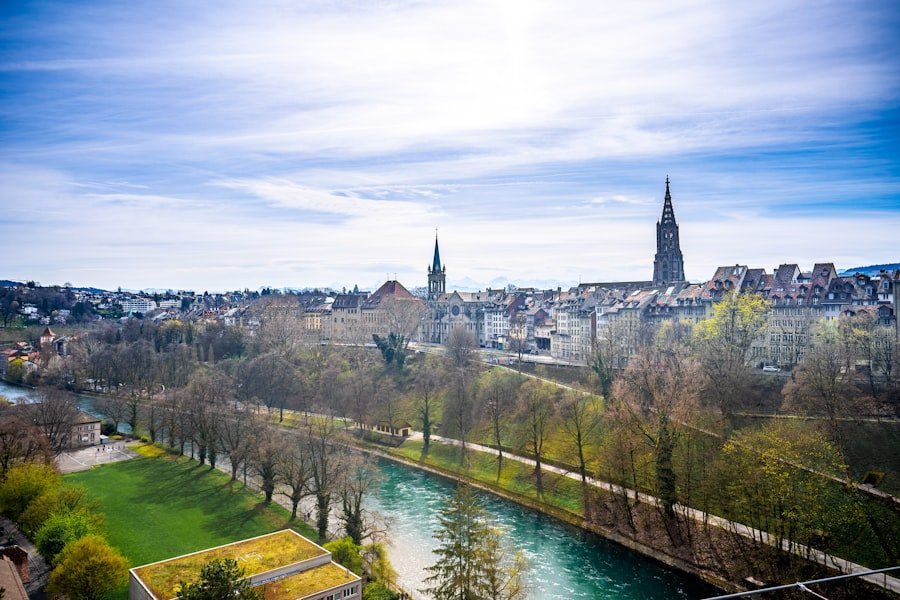
The Federal Palace (Bundeshaus) serves as the seat of the Swiss federal government (the Federal Council) and the bicameral Federal Assembly (the National Council and the Council of States). Completed between 1852 and 1902 in the Florentine Renaissance Revival style, the grand domed building anchors the southern edge of the peninsula.
The central dome rises 64 meters and is adorned inside with stained-glass depictions of the 22 historic cantonal coats of arms (the half-canton of Jura was added later). Free 45-minute guided tours are conducted regularly in multiple languages on days when Parliament is not in active legislative session; reservations can be booked through the official Swiss Parliament portal.
In front of the palace lies the spacious Bundesplatz (Parliament Square). Paved with refined Vals quartzite, the square features a synchronized water display composed of 26 water jets, each representing one of the 26 Swiss cantons. On Tuesday and Saturday mornings, the square hosts a bustling farmers’ market filled with local cheeses, fresh mountain flowers, and seasonal produce.
Note: Walk around to the terrace behind the Federal Palace (Bundesterrasse) for a wonderful south-facing view across the Aare river plain towards Mount Gurten and the snowcapped Alps.
Enjoying Swiss Cuisine in Bern
No 1-day visit to Bern is complete without savoring the culinary specialties of the Canton of Bern and broader Swiss culinary heritage. Because the canton borders both French- and German-speaking regions, its cuisine is hearty, cheese-forward, and deeply rooted in alpine agriculture.
- Berner Platte: The city’s signature historic dish, originating from a victory celebration over French troops in 1798. It consists of a lavish platter of boiled meats (smoked pork loin, bacon, beef tongue, and marrow sausages) served on a bed of juniper-spiced sauerkraut and boiled potatoes.
- Rösti: The quintessential Swiss potato cake, made from coarsely grated potatoes pan-fried in generous amounts of clarified butter until golden and crisp. In Bern, it is frequently topped with fried eggs, melted raclette cheese, or sliced bacon.
- Fondue & Raclette: Even in warmer months, classic melted Gruyère and Emmentaler fondue is served with crusty bread cubes in traditional taverns such as Restaurant Harmonie (serving authentic fondue since 1915).
- Bernese Hazelnut Gingerbread (Haselnusslebkuchen): A sweet, chewy pastry crafted from ground hazelnuts, honey, and winter spices—traditionally decorated with a marzipan bear. Pick one up at historic bakeries or local chocolatiers such as Confiserie Tschirren on Kramgasse.
“The most memorable way to conclude a day in Bern is at the Altes Tramdepot, perched just above the Bear Park, enjoying house-brewed craft beer and hot rösti as the sun sets over the river bend.”
Conclusion and Final Recommendations
Bern is one of Europe’s most rewarding day-trip destinations because its most celebrated treasures—the UNESCO-listed arcade network, the Zytglogge mechanical pageant, the cathedral spire, and the riverside Bear Park—are all clustered along a clean, scenic, and walkable horseshoe peninsula. By following a structured morning-to-evening route, you can absorb the architecture, culture, and culinary highlights of the Swiss federal city without feeling pressed for time.
If your schedule allows for additional time, consider taking the funicular railway up to Mount Gurten (Bern’s local mountain) for sweeping 360-degree vistas across the Alps, or visit the Zentrum Paul Klee, an architectural marvel designed by Renzo Piano that houses the world’s largest collection of works by painter Paul Klee. Whether explored in the crisp snows of winter or the sunlit river days of midsummer, Bern delivers an authentic Swiss experience that balances old-world dignity with effortless charm.
Frequently Asked Questions
What is the best way to get around Bern in 1 day?
The best way to get around Bern in one day is entirely on foot. The Old Town peninsula is compact (roughly 1.5 km long) and mostly closed to private vehicle traffic. If you need to travel to destinations slightly outside the center (such as the Rosengarten or Mount Gurten), Bern’s public transport network of trams and buses is exceptionally reliable. If you stay overnight at any hotel, hostel, or campsite in Bern, you will receive the free Bern Ticket for unlimited travel within zones 100 and 101.
What are the must-see attractions in Bern for a 1-day itinerary?
The non-negotiable attractions for a single-day visit include: the Zytglogge clock tower for its hourly mechanical performance, the Bern Cathedral (Berner Münster) and its observation tower, the BärenPark (Bear Park) along the Aare River, the panoramic viewpoint at Rosengarten (Rose Garden), the covered medieval shopping arcades along Kramgasse, and the Federal Palace (Bundeshaus) at Bundesplatz.
Where can I find the best views of Bern in 1 day?
The two premier vantage points are the Rosengarten and the tower of the Bern Cathedral. The Rosengarten offers the classic elevated panoramic postcard view showing the Aare River curving completely around the red roofs of the Old Town. Climbing the 312 steps to the top platform of the Bern Cathedral spire provides an unrivaled 360-degree aerial view of the city streets and the Bernese Alps.
What are some recommended dining options for a 1-day visit to Bern?
For traditional Swiss cheese dishes (fondue and raclette), visit Restaurant Harmonie or Kornhauskeller, an opulent former granary turned vaulted restaurant. For casual dining with river and bear enclosure views, dine at Altes Tramdepot, which features house-brewed craft beers and traditional rösti. For coffee and pastries, stop at Confiserie Tschirren on Kramgasse.
Is it possible to visit the Bernese Alps on a 1-day itinerary in Bern?
Attempting to explore both the city of Bern and high alpine summits (such as Jungfraujoch or Schilthorn) in a single calendar day is not recommended, as travel and mountain railway transit require at least 4 to 6 hours round-trip. However, you can easily combine a half-day in Bern with a 20-minute train ride to the lakeside town of Thun or a 45-minute ride to Interlaken for immediate alpine views.
Sources
- Bern Welcome (Official Tourism Portal) — Architectural specifications, Old Town arcades, and Bern Ticket transit regulations.
- UNESCO World Heritage Centre — Official criteria and historical inscription data for the Old City of Bern.
- The Swiss Parliament (Federal Assembly) — Guided tours, architectural history, and visitor access to the Federal Palace (Bundeshaus).
- SBB Swiss Federal Railways — Rail transit schedules, connections between Bern Main Station, and regional connections to the Bernese Oberland.