Seeing the Northern Lights in Alaska is largely a matter of combining darkness, clear weather, favorable aurora activity, and enough time to wait for those conditions to come together. Alaska’s useful aurora-viewing season stretches roughly from late August through late April. Fairbanks is one of the easiest bases for serious aurora watching, while Anchorage, Denali, Coldfoot, and Wiseman offer different combinations of access, darkness, scenery, and services.
Quick Answer
The best time to see the Northern Lights in Alaska is generally from late August through late April, when skies become dark enough for aurora viewing. Fairbanks offers one of the best combinations of location, tours, lodging, and dark skies. Plan several nights, watch both cloud and aurora forecasts, and look mainly between late evening and early morning.
Key Takeaways
- Alaska’s practical aurora-viewing season is roughly late August through late April, although the exact amount of darkness varies by latitude.
- Fairbanks is one of the most convenient bases because it lies near the auroral oval and has extensive tours and aurora-focused lodging.
- Clear skies are just as important as geomagnetic activity. A strong aurora forecast cannot overcome thick cloud cover.
- The hours around midnight are often productive. Roughly 10 p.m. to 2 a.m. is a useful planning window, but aurora can appear earlier or later.
- If seeing the lights is a major reason for your trip, give yourself several nights rather than relying on a single evening.
Understanding the Northern Lights: What Causes the Aurora Borealis
The Northern Lights, or Aurora Borealis, begin with activity from the sun and its interaction with Earth’s magnetic environment. The simple version is that energy from the solar wind enters Earth’s magnetosphere and helps accelerate charged particles, especially electrons, along magnetic field lines toward the polar regions.
According to the NOAA Space Weather Prediction Center, those accelerated electrons collide with oxygen and nitrogen atoms and molecules high in Earth’s atmosphere. The collisions transfer energy to the gases. When the gases return to lower-energy states, they release that energy as visible light.
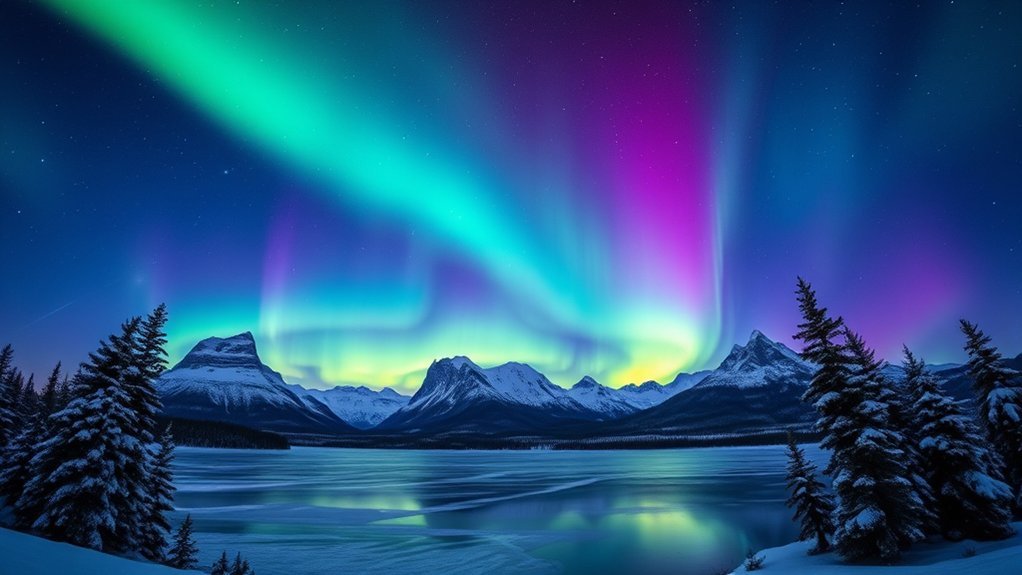
Different gases and altitudes help create different colors. Green is the color most commonly associated with aurora, while red, purple, and other shades can appear under suitable conditions. Aurora can form arcs, curtains, rays, bands, and diffuse patches that change as geomagnetic conditions evolve.
The display may look different to your eyes than it does in photographs. Long camera exposures collect light for several seconds and can reveal stronger color and detail than human night vision. A faint aurora may initially look grayish or whitish to the eye, while a stronger display can show obvious green and, less commonly, other colors.
Note: Give your eyes time to adapt to darkness. Avoid repeatedly looking at a bright phone screen or white flashlight while waiting for faint aurora to become visible.
Best Time of Year to See the Northern Lights in Alaska
If you’re hoping to see the Northern Lights in Alaska, darkness is the first requirement. Official Alaska travel guidance places the practical viewing season at roughly late August through late April, when nights are dark enough for aurora to stand out. Summer at high northern latitudes is generally too bright for dependable viewing.
There is no guaranteed single “best month.” Midwinter provides the longest nights, while periods around the spring and fall equinoxes can also produce excellent aurora opportunities. Weather, cloud cover, solar activity, and your location ultimately matter more than choosing one supposedly perfect date.
Optimal Months for Viewing
Use the seasons below to match darkness, temperature, and daytime activities to your travel style:
| Period | What to Expect | Best For |
|---|---|---|
| Late August–September | Darkness returns while temperatures are generally milder than midwinter. September is near the fall equinox. | Travelers combining aurora viewing with fall scenery and outdoor activities. |
| October–November | Nights lengthen quickly and winter conditions become more established in the Interior. | A balance between substantial darkness and earlier-season travel. |
| December–February | The longest nights provide many hours of darkness, but temperatures can be severe. | Travelers who want deep-winter scenery and activities such as dog sledding or snowshoeing. |
| March | Still dark enough for strong viewing opportunities, with the spring equinox occurring during the month. | Travelers seeking a popular mix of aurora potential, winter scenery, and increasing daylight. |
| April | Aurora viewing remains possible early and into mid-to-late April in some northern locations, but nights rapidly become brighter. | Late-season visitors who understand that the viewing window is shrinking. |
Weather Considerations and Impact
Cloud cover can hide the aurora completely, even when geomagnetic activity is excellent. That makes an ordinary local weather forecast just as important as an aurora forecast. Look for low cloud cover and a clear view of the sky rather than focusing only on a high aurora number.
Interior Alaska, including Fairbanks, is particularly popular because of its latitude, location relative to the auroral oval, tourism infrastructure, and opportunities to reach darker areas outside city lights. No destination, however, can guarantee clear weather.
Cold also affects how long you’ll comfortably remain outside. Dress in layers, protect exposed skin, use insulated footwear and gloves, and make sure you have a warm place or vehicle available when temperatures are severe.
Solar Activity Influence
Solar activity plays an important role in the strength and geographic reach of aurora. The sun goes through an activity cycle lasting roughly 11 years. More active phases tend to produce more solar eruptions capable of causing significant geomagnetic disturbances, but the solar cycle alone cannot tell you whether the aurora will appear on a particular night.
Coronal mass ejections and high-speed solar-wind streams can trigger stronger geomagnetic activity. When conditions are favorable, aurora may brighten, become more active, or extend farther from the polar regions.
For practical trip planning, check the University of Alaska Fairbanks Geophysical Institute Aurora Forecast close to your viewing dates rather than relying on the general solar cycle.
Pro Tip: Do not cancel a night solely because an aurora forecast looks modest. At high-latitude locations such as Fairbanks, worthwhile aurora can occur without an extreme geomagnetic storm. Clear skies, patience, and darkness still matter.
Ideal Locations for Northern Lights Viewing
Alaska offers aurora viewing across a huge geographic area, but the most practical destinations differ in accessibility, darkness, weather, and visitor services. The official Travel Alaska aurora guide highlights Interior, Arctic, and Southcentral Alaska as important viewing regions.
Best Viewing Spots
- Fairbanks: One of Alaska’s best-known aurora bases. Its position near the auroral oval, extensive tour network, accommodations, and easy access to darker areas outside town make it a strong choice for first-time visitors.
- Anchorage: A practical choice for travelers who want a major-city base. Aurora can appear over Anchorage when activity and weather cooperate, although city light means you’ll often get better contrast from darker viewpoints away from central development.
- Denali National Park: The park’s northern latitude and limited artificial light can produce excellent night skies. Winter access and services are much more limited than in summer, however, so check current National Park Service conditions before planning a dedicated aurora trip.
- Coldfoot and Wiseman: These remote Arctic communities lie along the Dalton Highway north of Fairbanks and offer exceptionally dark surroundings. They are better suited to travelers prepared for remote conditions or those using guided transportation.
Accessibility and Amenities
Fairbanks offers the easiest combination of flights, hotels, rental vehicles, guided tours, specialty aurora lodges, and nearby dark-sky areas. You may see aurora from town, including areas such as Creamer’s Field, but moving away from bright urban lighting usually improves contrast.
Chena Hot Springs, about 60 miles from Fairbanks, combines lodging, hot springs, and aurora viewing away from much of the city’s light pollution. It is a popular option for travelers who prefer to wait for the aurora from a dedicated destination rather than drive around throughout the night.
Denali provides much darker surroundings, but winter access is different from summer. The National Park Service’s Denali aurora guidance confirms the value of its northern latitude and limited light pollution. Much of the Denali Park Road is inaccessible to ordinary vehicles during midwinter, so check current conditions before going.
For a more remote adventure, Coldfoot and Wiseman provide access to Arctic skies along the Dalton Highway. This route should not be treated like an ordinary city-to-city drive. Services are limited, winter weather can be severe, and some rental agreements restrict Dalton Highway travel.
Warning: If your aurora plan involves the Dalton Highway or another remote winter route, check road conditions, your rental agreement, fuel availability, emergency supplies, and your own winter-driving experience. A guided Arctic tour is the safer and easier option for many visitors.
How Many Nights Should You Plan?
A single clear night can produce an incredible display, but it can also produce nothing if clouds or geomagnetic conditions do not cooperate. If seeing the aurora is one of the main reasons for your Alaska trip, build in three to five nights of potential viewing rather than betting everything on one evening.
That extra time protects you from one cloudy night, a weak forecast, or a display that develops while you’re asleep. It also lets you enjoy Alaska during the day without feeling that every evening must be perfect.
Factors That Affect Aurora Visibility
Several conditions must come together for a satisfying aurora experience. A powerful geomagnetic event does not help much if thick clouds cover the entire sky, while a dark and clear night can make even a more modest display enjoyable.
The best aurora night is not simply the night with the highest forecast number. You need darkness, a reasonably clear sky, a good viewing location, and enough patience to be outside when the display develops.
- Solar and geomagnetic activity: Stronger activity can brighten the aurora and expand the auroral oval.
- Weather conditions: Thick clouds can completely block the view, so always check a local cloud forecast.
- Light pollution: Darker locations improve contrast and make faint aurora easier to see.
- Time of year: Alaska needs sufficient nighttime darkness. Summer’s long daylight makes aurora viewing impractical in most high-latitude destinations.
- Time of night: Activity can occur whenever skies are dark, but the hours around midnight are often especially productive.
- Your view of the sky: Trees, buildings, mountains, and bright parking-lot lights can reduce visibility. Choose an open, safe viewing location when possible.
How to Check the Aurora Forecast
Use two different types of forecast before heading outside:
- Check the aurora forecast. The UAF Geophysical Institute provides Alaska-focused aurora forecasts that help estimate expected activity.
- Check the local weather forecast. Look specifically at cloud cover, precipitation, temperature, wind, and changing conditions.
- Recheck shortly before leaving. Forecasts change, and an opening in the clouds can matter more than an earlier prediction.
- Keep watching the sky. Aurora can strengthen or fade quickly, so a forecast should guide you rather than replace observation.
You may also encounter the Kp index, which measures planetary geomagnetic disturbance on a scale from 0 to 9. A higher Kp generally means the auroral oval can expand farther toward lower latitudes. However, visitors in Interior or Arctic Alaska do not need an extreme Kp value to see aurora because they are already much closer to the normal auroral zone.
For near-real-time space-weather information, NOAA’s Space Weather Prediction Center is another authoritative source. Avoid treating any app’s percentage or Kp prediction as a guarantee.
Planning Your Trip: What to Bring
You’ll often spend long stretches standing still at night, which can feel much colder than an active daytime outing. Pack for the actual forecast at your destination, not for a generic idea of “winter.”
| Item | Why It Helps |
|---|---|
| Warm base and insulating layers | Lets you adjust insulation while staying warm during long periods outdoors. |
| Weather-resistant outer layer | Helps block wind, snow, and moisture. |
| Insulated sturdy boots | Protects your feet while standing on cold or snowy ground. |
| Warm hat, gloves or mittens, and thick socks | Protects exposed areas and extremities during extended cold exposure. |
| Flashlight or headlamp | Helps you navigate dark areas. Use the dimmest practical setting to preserve night vision. |
| Snacks and water | Useful when waiting several hours or traveling away from services. |
| Phone and portable battery | Cold can reduce battery performance, and forecasts may need to be checked repeatedly. |
| Camera and tripod | Allows stable long-exposure photography. |
If you’re driving, preparation matters just as much as clothing. The Alaska Department of Transportation’s winter-driving guidance recommends preparing your vehicle, carrying emergency provisions, reducing speed for conditions, allowing extra stopping distance, watching for wildlife, and staying alert for ice and snow-removal equipment.
Tips for Photographing the Northern Lights
Capturing the Northern Lights requires experimentation because brightness and movement can change from one minute to the next. Treat camera settings as starting points rather than rigid rules.
- Use a tripod: Stable support is essential when exposures last several seconds.
- Open the aperture: Use a wide aperture when your lens allows it so the camera can collect more light.
- Adjust ISO to the scene: ISO 800–1600 may work for a bright display, while a darker scene may require a higher ISO. Raise it only as much as needed because very high ISO settings can introduce more visible noise.
- Match shutter speed to movement: Several seconds is a useful starting point. Around 5–15 seconds can work for many displays, but shorten the exposure when the aurora moves quickly if you want to preserve fine structure. Longer exposures can make faint aurora brighter but may also blur its shape.
- Focus manually: Autofocus often struggles in darkness. Use a bright star or distant light to confirm focus, then avoid accidentally changing it.
- Shoot RAW when available: RAW files preserve more editing flexibility for exposure, highlights, shadows, noise, and color.
These principles are consistent with Canon’s Northern Lights photography guidance, which also emphasizes wide apertures, tripod stability, manual focusing, RAW capture, and adjusting shutter speed according to how quickly the aurora moves.
Photographing the Aurora With a Phone
Modern phones can photograph surprisingly strong aurora when they offer Night mode or manual camera controls. Brace the phone against something stable or use a small tripod, disable flash, avoid digital zoom, and use a timer so pressing the shutter does not shake the device.
If your phone lets you control exposure manually, experiment with several-second exposures. When the aurora is bright and moving quickly, a shorter exposure can preserve more shape. When it is faint, the phone may need a longer exposure to record color that is difficult to see with your eyes.
Guided Tours vs. DIY Aurora Viewing
Both approaches can work well. The right choice depends on your winter-driving experience, transportation, photography goals, budget, and desire for flexibility.
| Option | Advantages | Tradeoffs |
|---|---|---|
| Guided Tour | Transportation, local knowledge, established viewing areas, forecast monitoring, and sometimes warming shelters or photography help. | Higher cost and less control over schedule or location. |
| DIY Viewing | Maximum flexibility, freedom to stay longer, and the ability to change locations independently. | You handle forecasts, driving, route selection, safety, parking, and cold-weather preparation yourself. |
A guided tour makes particular sense if you are visiting Alaska for the first time, do not routinely drive on snow and ice, lack a rental vehicle, want photography coaching, or plan to travel toward remote Arctic areas.
DIY viewing works well for confident winter travelers based in places such as Fairbanks or Anchorage, provided you choose legal and safe viewing locations and check weather and road conditions before leaving.
Warning: Never stop in an active traffic lane or on an unsafe shoulder because you suddenly see the aurora. Continue to a safe, legal parking area before getting out of the vehicle.
Other Winter Activities to Enjoy in Alaska
Chasing the Northern Lights does not have to consume your entire Alaska trip. Because serious aurora viewing happens at night, you can use daylight hours for other winter activities.
- Dog Sledding: Ride behind a team of sled dogs through snowy landscapes or choose a tour that introduces Alaska’s long mushing tradition.
- Snowshoeing: Explore winter trails at a slower pace while taking in forests, mountains, and snow-covered scenery.
- Ice Fishing: Guided trips can provide equipment, local knowledge, and access to frozen lakes while you experience another side of an Alaska winter.
- Skiing or Snowboarding: Depending on your destination and conditions, downhill and cross-country skiing can add active daytime adventure to an aurora-focused trip.
Keep your daytime schedule realistic if you expect to stay outside until 1 or 2 a.m. for several nights. An afternoon nap can be more valuable to an aurora trip than squeezing in one additional activity.
Frequently Asked Questions
Are there specific times of night best for viewing the Northern Lights?
The hours around midnight are often productive. Roughly 10 p.m. to 2 a.m. is a useful general viewing window, and Interior Alaska forecasts often emphasize a somewhat broader period around midnight. Aurora can still appear earlier in the evening or later in the morning, so do not treat those hours as a strict rule.
What should I wear to stay warm while viewing?
Wear several warm layers plus a weather-resistant outer layer, insulated boots, thick socks, a warm hat, and insulated gloves or mittens. Standing still outdoors can feel much colder than hiking, so dress for the actual overnight temperature and wind rather than the daytime forecast.
Can I see the Northern Lights from Fairbanks?
Yes. Fairbanks is one of Alaska’s strongest aurora-viewing bases because of its latitude and position near the auroral oval. Aurora can be visible from town, but darker locations outside strong city lighting usually provide better contrast when conditions are favorable.
Is it safe to drive at night while chasing the aurora?
It depends on the weather, road conditions, route, vehicle, and your winter-driving experience. Alaska roads can involve snow, ice, wildlife, poor visibility, and limited cellular service. Check Alaska 511 and local forecasts, prepare the vehicle for winter, carry emergency supplies, reduce speed, and use a guided tour if you are uncomfortable driving in severe winter conditions.
How do solar cycles affect Northern Lights visibility?
Solar activity rises and falls over a cycle of roughly 11 years. More active phases can produce more frequent strong solar events and geomagnetic storms, increasing opportunities for intense or unusually widespread aurora. The cycle does not predict a specific night’s conditions, so short-term aurora forecasts remain more useful when planning an outing.
How many nights should I stay in Alaska to see the Northern Lights?
If aurora viewing is a major goal, try to give yourself three to five potential viewing nights. More nights improve your chances of getting a useful combination of clear weather, darkness, and favorable geomagnetic activity.
Can I see the Northern Lights from Anchorage?
Yes, aurora can be visible from Anchorage when activity, darkness, and weather cooperate. City lighting reduces contrast, so travelers often improve their view by moving to a darker, unobstructed location outside the brightest developed areas.
Is seeing the Northern Lights in Alaska guaranteed?
No. Alaska offers excellent aurora opportunities, but no trip can guarantee a display. Cloud cover, geomagnetic activity, darkness, location, and timing all matter. Staying several nights and checking both aurora and weather forecasts gives you a better chance than relying on a single evening.
Sources
- University of Alaska Fairbanks Geophysical Institute — Aurora Forecast — aurora timing, forecasts, geomagnetic activity, and Alaska viewing conditions.
- NOAA Space Weather Prediction Center — Aurora — scientific explanation of aurora formation, atmospheric collisions, darkness, and cloud requirements.
- Travel Alaska — How to See Alaska’s Northern Lights — Alaska viewing season, regions, viewing hours, trip length, tours, and locations.
- National Park Service — Aurora Borealis & the Night Sky at Denali — Denali’s dark skies, light pollution, visual expectations, and aurora viewing.
- Alaska Department of Transportation & Public Facilities — Winter Driving Tips — winter-road preparation, stopping distance, wildlife, ice, emergency supplies, and road safety.
- Canon — How to Photograph the Northern Lights — tripod use, shutter speed, aperture, focusing, and RAW photography guidance.