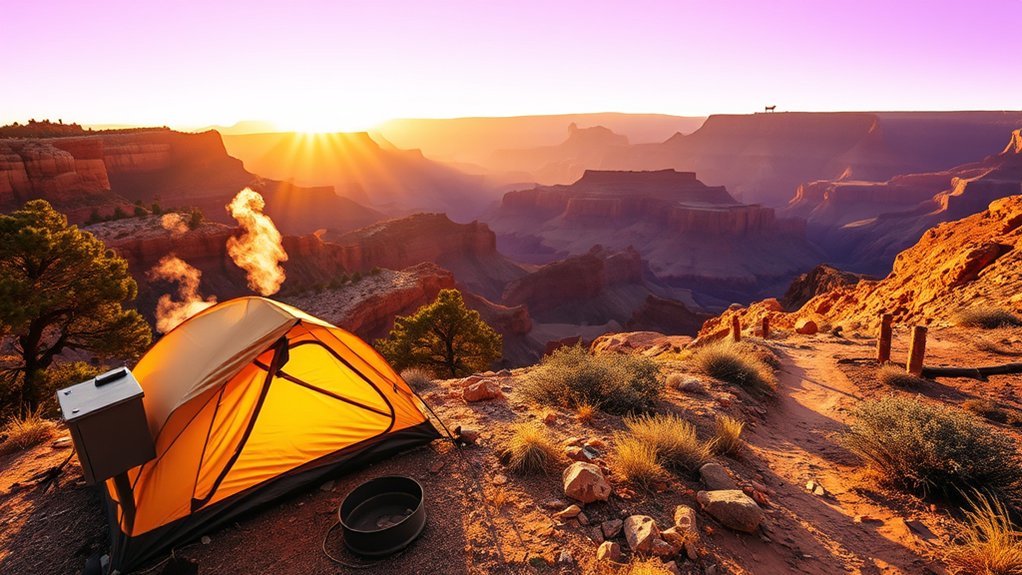
Camping at Grand Canyon can mean parking an RV with full hookups, sleeping among ponderosa pines on the South Rim, or carrying everything you need thousands of feet below the rim. The best option depends on your rig, reservation window, season, and hiking ability. South Rim camping is easier to organize than backcountry camping, but current water, fire, and trail conditions can change what services are available, so check official park updates before you leave.
Quick Answer
For most Grand Canyon campers, Mather Campground is the best South Rim base, while Trailer Village suits larger RVs needing full hookups and Desert View offers a quieter seasonal setting. Overnight camping below the rim requires a backcountry permit. Reserve early, check current water and fire restrictions, and never rely on a trail water source without confirming its status.
Key Takeaways
- Mather Campground is open year-round, has 327 campsites, and accepts reservations up to six months ahead.
- Desert View Campground has 50 sites and is open seasonally; its 2026 season runs from April 11 through October 18.
- Trailer Village is the South Rim choice for RVs needing full water, sewer, and electrical hookups.
- Backcountry camping below the rim requires a permit, with a $10 basic permit charge plus $15 per person per night for below-rim use.
- Water availability can change suddenly, and summer inner-canyon heat can be dangerous even for experienced hikers.
- Current campground, trail, fire, and water restrictions should be checked immediately before every trip.
Current 2026 Alert: Beginning August 13, 2026, Grand Canyon National Park turned off drinking-water spigots at Mather and Desert View Campgrounds, closed Camper Services at Mather, and prohibited fires at both campgrounds because of reduced water reserves. Restrooms remain open, and the RV dump and water station at Mather remain available. Conditions can change, so check the latest NPS water restriction update before arrival.
At a Glance
| Time Required | Frontcountry reservations can open six months ahead; backcountry lottery planning begins roughly five months before the desired start month. |
| Difficulty | Easy to moderate for developed South Rim camping; strenuous to extremely strenuous for below-rim backpacking. |
| Tools Needed | Camping equipment, adequate water capacity, food storage, sun protection, layers, headlamp, first-aid supplies, map, and water-treatment equipment for backcountry trips. |
| Cost | Standard Mather and Desert View sites are $30 per night. Below-rim backcountry permits cost $10 plus $15 per person per night. Trailer Village rates vary. Park entrance fees are separate. |
Why Choose the South Rim for Your Grand Canyon Camping Trip
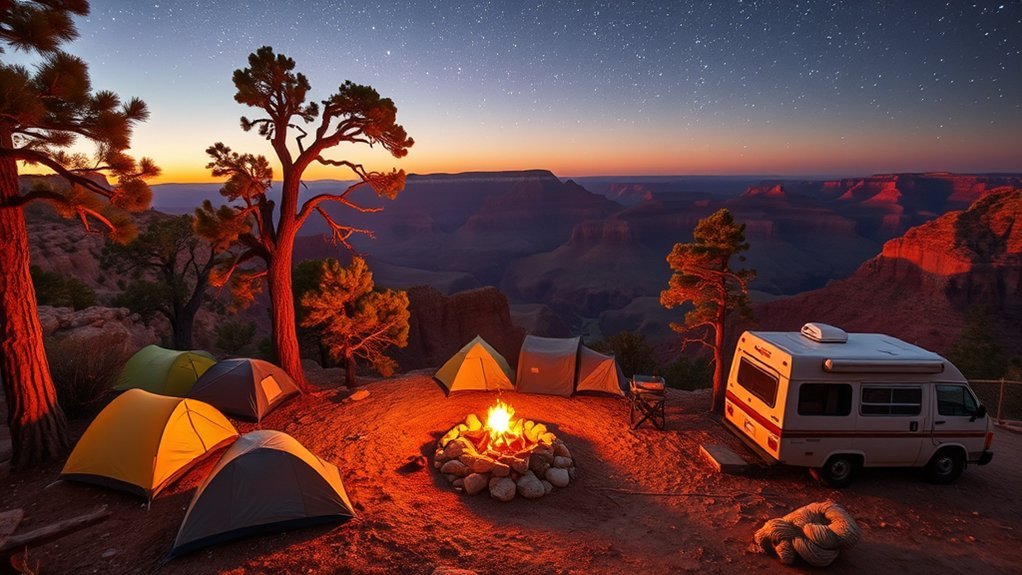
The South Rim is the most practical Grand Canyon base for many campers because it is open year-round and concentrates campgrounds, shuttle service, viewpoints, stores, restaurants, visitor information, and major trailheads in one area. The Bright Angel and South Kaibab trailheads also provide the primary South Rim access into the inner canyon.
Mather Campground is the main tent and dry-RV campground in Grand Canyon Village. It has 327 campsites and can accommodate standard campsites for up to six people, with RV length restrictions that vary by site. Trailer Village RV Campground is better for RV travelers needing full hookups and can accommodate rigs up to 50 feet. Desert View Campground, about 23 miles east of Grand Canyon Village, provides a quieter seasonal alternative near Desert View Watchtower.
Backcountry hikers use a separate system. Overnight camping anywhere outside the developed rim campgrounds normally requires a Grand Canyon backcountry permit. Reservations, campground bookings, and backcountry permits should therefore be treated as separate parts of your trip plan.
South Rim Campgrounds Compared
| Campground | Best For | Season | Key Details |
|---|---|---|---|
| Mather | Tents, small and mid-size RVs, first visits | Year-round | 327 sites, no hookups, reservations up to six months ahead, limited day-of inventory |
| Desert View | Quieter tent camping and smaller RVs | Seasonal | 50 sites, no hookups, 30-foot maximum vehicle/RV length, reservations required |
| Trailer Village | RVs needing hookups | Year-round | Full water, sewer, and 30/50-amp electrical hookups; RVs up to 50 feet |
Reserve or Walk Up: How to Secure a South Rim Campsite
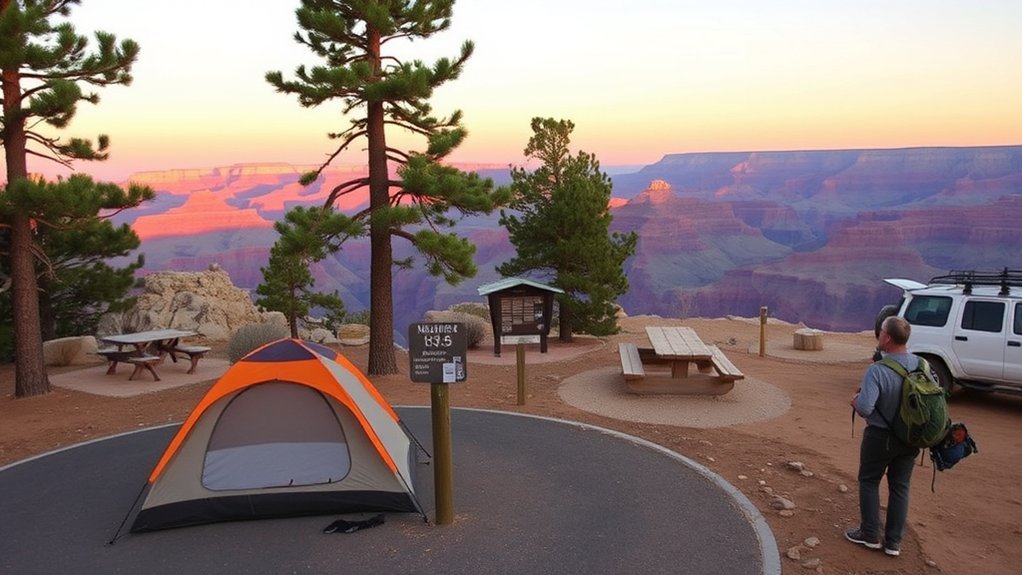
For the most reliable South Rim camping plan, reserve ahead. Mather and Desert View reservations are handled through Recreation.gov, while Trailer Village reservations are handled by the official Grand Canyon lodging concessioner.
Mather reservations can be made up to six months ahead. During peak season, Recreation.gov currently says approximately 20 first-come, first-served campsites may be sold in person for one night at a time. These sites usually sell out quickly, so arriving near the start of kiosk operations gives you a better chance. Do not occupy an apparently empty campsite without authorization because it may already belong to a camper who has not arrived.
Desert View works differently. It does not hold back campsites for first-come, first-served camping during its main season. If a site remains available, you may be able to make a same-day reservation through Recreation.gov or the reservation call center.
Pro Tip: If your dates are flexible, check Recreation.gov repeatedly for cancellations instead of assuming a sold-out campground will remain sold out. For RVs that require hookups, prioritize Trailer Village first because Mather and Desert View do not provide individual campsite hookups.
Reserve Online Early
Reservations for Mather Campground and Desert View Campground can open up to six months before your stay. Holidays, school breaks, and mild-weather periods can fill quickly. Trailer Village reservations can be made farther ahead through the concessioner, with reservations generally accepted up to 13 months in advance.
If you need a particular RV length, loop, generator rule, or accessibility feature, read the individual site description before booking. Mather’s RV limit is generally 30 feet, and only selected sites can accommodate vehicles near that maximum. Desert View also has a 30-foot maximum, but Recreation.gov warns that some longer vehicle combinations can have difficulty negotiating campground turns.
Try Same-Day Walk-up
Mather is the main South Rim option for campers hoping to find limited same-day first-come inventory. During peak season, approximately 20 sites may be sold in person, one night at a time. They commonly sell out during the morning.
| Option | Same-Day Strategy |
|---|---|
| Mather Campground | Limited first-come inventory may be sold in person; arrive early |
| Desert View | No held-back walk-up inventory; check Recreation.gov for same-day availability |
| Trailer Village | Check the concessioner’s live reservation inventory |
| Backcountry camping | Uses a separate permit system with only very limited last-minute options |
Mather Campground: What to Expect and Practical Details
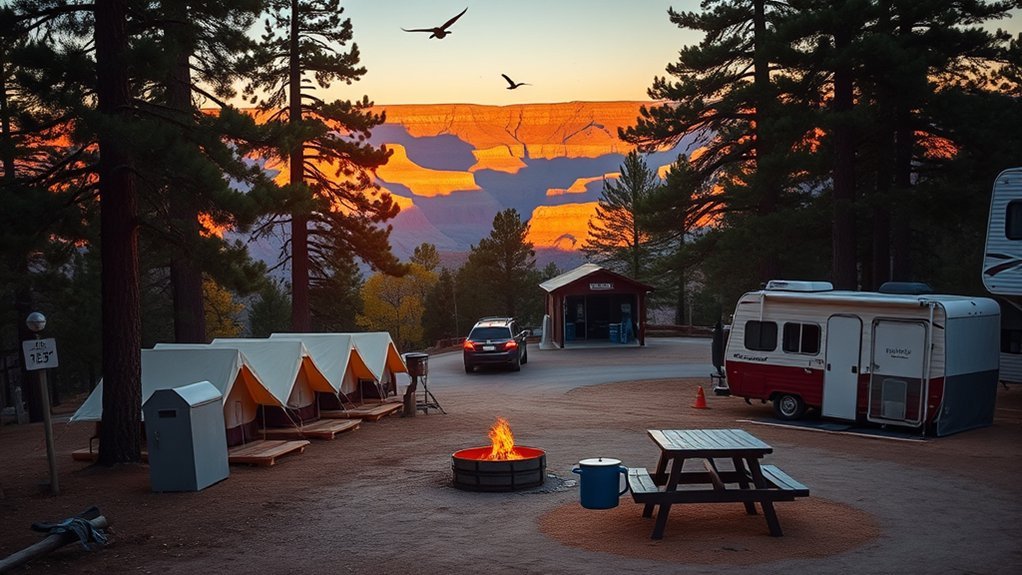
Mather Campground sits in Grand Canyon Village among ponderosa pine, pinyon, and juniper. It is open year-round and has 327 campsites, including standard, group, hiker/biker, and equine sites. Standard sites accommodate up to six people and normally include a picnic table, campfire ring with cooking grate, parking area, and space for up to three tents.
Check-in begins at noon and checkout is by 11 a.m. Quiet hours run from 10 p.m. to 6 a.m. Generator use is limited to designated morning and evening hours, and Pine Loop is generator-free during much of the year.
Mather does not provide water, sewer, or electrical hookups at individual campsites. A dump and water-fill station is available nearby. Under normal operations, drinking-water spigots are distributed throughout the campground and Camper Services provides showers and laundry nearby, but the August 13, 2026 water restrictions have temporarily shut campground drinking-water spigots and Camper Services. Restrooms remain functional, and the RV dump and water station remain open.
Pets must remain leashed and under physical control. They may not be left unattended, including inside vehicles. Food should be stored inside a vehicle or hard-sided container rather than left outside where ravens, squirrels, or other wildlife can reach it.
Campfire rings are present, but their existence does not mean fires are always permitted. Current restrictions prohibit fires at Mather. When restrictions eventually allow fires again, collecting wood inside the park remains prohibited. Obtain firewood locally rather than transporting it long distances.
Desert View Campground: Location, Rules, and Best Uses
Located about 23 miles east of Grand Canyon Village along Desert View Drive, Desert View Campground has 50 campsites beneath pinyon and juniper trees. It is a good choice when you want a quieter setting and easy access to Desert View Watchtower, eastern South Rim viewpoints, and sunrise or sunset scenery away from the busiest parts of Grand Canyon Village.
For 2026, the campground season runs from April 11 through October 18. Reservations are required and may be made up to six months ahead through Recreation.gov.
Most sites accommodate tents or smaller RVs and travel trailers. The maximum vehicle or RV length is 30 feet, but some sites accommodate considerably less, and Recreation.gov warns that longer combinations may have difficulty with campground turns.
Each site normally has a picnic table and campfire grill. There are no electrical, water, or sewer hookups. Restrooms have flush toilets and sinks. The campground normally has two drinking-water faucets, but those campground spigots are currently turned off under the August 2026 water restrictions. Fires are also currently prohibited.
Desert View has no showers, laundry, or dump station. Do not plan on driving to Mather solely for showers or laundry without first checking current operations because Camper Services there can close during water restrictions.
Trailer Village RV Campground: Hookups, Size Limits, and Reservations
If you need full RV hookups, Trailer Village RV Campground is the most suitable campground inside the South Rim developed area. It offers paved pull-through sites with water, sewer, and 30/50-amp electrical service and accommodates RVs up to 50 feet long.
Trailer Village is open year-round and concessioner-operated. Reservations can generally be made up to 13 months ahead through the official Trailer Village reservation page. Confirm your exact vehicle length and current operating conditions when booking.
| Feature | Notes |
|---|---|
| Hookups | Water, sewer, and 30/50-amp electrical service |
| Site type | Paved pull-through RV sites |
| Maximum RV length | Up to 50 feet |
| Availability | Open year-round; advance reservations recommended |
Trailer Village is close to Grand Canyon Village services and the park shuttle system. Because temporary water restrictions can affect facilities across the South Rim, verify the campground’s current service status shortly before arrival rather than relying on older amenity descriptions.
Backcountry Camping Below the Rim: Permits, Limits, and Strategy
Overnight camping below the rim requires a backcountry permit. Grand Canyon National Park now processes these reservations through Recreation.gov, not through the older fax-and-mail request system.
The most competitive itineraries are released through the Early Access Lottery. For a particular start month, the lottery generally opens on the 16th about five months before that month and closes at 5 p.m. MST on the first, four months before the desired start month. Successful lottery applicants receive an early-access time slot during which they can view remaining space and reserve an itinerary.
The lottery application charge is $10. If you successfully reserve during your Early Access month, that $10 counts as the basic permit charge. If you reserve later outside the Early Access process, the basic permit charge is $10. Below-rim use then costs $15 per person or stock animal per night.
After the Early Access month ends, remaining availability and cancellations can be booked through Recreation.gov. New reservations may be available until several days before the hike if space opens.
Last-Minute Backcountry Permits
A very small amount of last-minute space is held for specific Corridor campgrounds. Havasupai Gardens has limited South Rim waitlist inventory, and Cottonwood has limited North Rim waitlist inventory during part of the year. These permits are issued in person and generally cannot be purchased more than one day before starting the hike.
Bright Angel Campground does not have held-back last-minute waitlist space. If your Bright Angel itinerary is sold out, watch Recreation.gov for cancellations rather than assuming the Backcountry Information Center can issue a walk-up site.
- Enter the Early Access Lottery when your trip month is competitive.
- Prepare several acceptable start dates and itineraries.
- Watch Recreation.gov for availability after the Early Access month.
- Check for cancellations again roughly a month before your trip.
- Use the limited in-person waitlist only as a backup, not your main plan.
Bright Angel, Havasupai Gardens, and Cottonwood Campgrounds Explained
The three principal Corridor campgrounds are Havasupai Gardens, Bright Angel Campground, and Cottonwood Campground. All require a backcountry permit.
Havasupai Gardens, formerly called Indian Garden, is about 4.5 to 4.8 miles down the Bright Angel Trail from the South Rim. It has toilets, an emergency phone, a ranger station, picnic tables, and metal food-storage containers. Potable water is normally available and is currently on, but water status should still be checked before departure.
Bright Angel Campground is roughly 9.5 miles from the South Rim when approached via the Bright Angel Trail or about 7 miles from the South Kaibab Trailhead. It sits approximately half a mile north of the Colorado River near Phantom Ranch and has toilets, an emergency phone, picnic tables, metal food-storage containers, and potable water. Current water service is on.
Cottonwood Campground lies about 6.8 miles down the North Kaibab Trail from the North Rim. It has toilets, an emergency phone, picnic tables, and metal food-storage containers. Water is usually seasonal, and current NPS updates show water on at Cottonwood.
Camping at designated Corridor campgrounds is generally limited to two nights per campground per hike, whether those nights are consecutive or not. One important winter exception applies: from November 15 through February 28, campers may stay up to four nights per campground per hike.
2026 North Kaibab Note: The North Kaibab Trail is currently open, but beginning October 15, 2026 at 11:59 p.m., the section between Redwall Bridge and the northern end of Cottonwood Campground is scheduled to close for Transcanyon Waterline work. Traditional rim-to-rim hiking will not be possible beginning October 16. Check NPS Key Hiking Messages before starting your trip.
Packing, Water, Food Storage, and Safety for Rim-to-River Trips
Below-rim camping is not simply regular campground camping without a car. You descend thousands of vertical feet into a hotter environment and must later climb back out carrying your equipment. Your packing plan needs to account for heat, water interruptions, food, changing weather, and limited cell service.
Warning: During hot weather, NPS advises hikers to avoid exposed inner-canyon travel during the hottest part of the day, roughly 10 a.m. to 4 p.m. Do not attempt a rim-to-river-and-back day hike in summer. Heat illness can develop rapidly, and rescue may take significant time.
Water and Hydration
Do not rely on a fixed rule such as carrying exactly three or four liters for every trip. Your required capacity depends on distance, temperature, pace, planned water sources, and the possibility that a pipeline faucet may fail. Check the current NPS water-status page immediately before hiking.
Carry enough water to reach the next confirmed source with a safety margin. Drink when thirsty rather than forcing excessive amounts of plain water, and eat salty, calorie-dense foods to help replace electrolytes during strenuous hot-weather travel.
Any natural water source should be treated. NPS guidance explains that filtration alone does not guarantee safe drinking water. Where appropriate, filter cloudy or untreated water with suitable equipment and then disinfect it according to official guidance or the treatment manufacturer’s instructions. Boiling is another option.
Food Storage
Havasupai Gardens, Bright Angel, and Cottonwood provide large metal animal-proof storage boxes at campsites, and using them is mandatory. Put food, toiletries, plastics, and other scented items inside.
At other backcountry locations, you must bring your own critter-resistant storage system. Suitable options can include approved hard containers, locking cooking pots, bear canisters, or other methods that meet park guidance. Never leave food in or beside an unattended backpack where rodents, ravens, or ringtails can reach it.
Essential Gear
- Water capacity and treatment: enough capacity for your route plus a reliable treatment method.
- Food: high-energy meals plus salty snacks and extra food for delays.
- Layers: temperatures can change dramatically between the rim and river.
- Footwear: broken-in hiking shoes or boots with good traction.
- Sun protection: hat, sunscreen, sunglasses, and protective clothing.
- Headlamp: carry a dedicated light plus spare batteries rather than relying on a phone.
- First-aid and blister care: include supplies appropriate to a multi-day hike.
- Map: carry offline or paper navigation suitable for the route.
- Emergency plan: tell a trusted person your itinerary, permit holder’s name, destination, and expected return date.
Grand Canyon’s NPS hiking guidance reports more than 300 rescues from the canyon in a typical year. Your itinerary, heat strategy, food, water, and turnaround decisions matter as much as your gear.
Nearby Private and Forest Service Campgrounds as Backup Options
If South Rim campgrounds are full, nearby private and Forest Service sites can keep you close enough for an early park entrance. The most useful alternatives are in Tusayan and Kaibab National Forest south of the park.
Private Campground Options
Grand Canyon Camper Village in Tusayan is a verified private campground approximately one mile south of the park entrance. It accommodates tents, trailers, and RVs and offers services that can include hookups, showers, laundry, and a dump station. Check current operating dates and availability through the official Grand Canyon Camper Village website.
Tusayan also provides restaurants, fuel, groceries, lodging, and other visitor services, making it a practical fallback when an in-park campsite is unavailable.
Forest Service Sites
The former Ten-X Campground is now called Tusayan-Montane Campground. It is in Kaibab National Forest south of Tusayan and is substantially larger than older descriptions suggest. Recreation.gov currently lists 142 single campsites and 18 double campsites, plus group facilities. Thirty sites are normally non-reservable and available first-come, first-served.
Tusayan-Montane has picnic tables, fire pits or grills, parking, and nearby pit toilets, but no utility hookups. Water supplies are limited, and RVs cannot rely on the campground for filling tanks. Individual RV and trailer length limits vary by site.
Use Recreation.gov’s Tusayan-Montane page for current reservations, site limits, and campground alerts.
Dispersed Camping Tips
Dispersed camping on Kaibab National Forest land can provide a primitive backup when developed campgrounds are unavailable. Areas associated with roads such as Long Jim Loop, Forest Road 688, and Coconino Rim Road have historically been used by dispersed campers, but legal camping areas, road conditions, closures, and fire restrictions can change.
- Long Jim Loop area: close to Tusayan and convenient for South Rim access, but expect primitive conditions and no hookups.
- Forest Road 688: dispersed opportunities may be available depending on current forest orders and road conditions; do not expect developed services.
- Coconino Rim Road / FR 310: another primitive forest-road option where access conditions should be checked before taking a low-clearance vehicle or large RV.
- Saddle Mountain area: a North Rim-area dispersed option, but 2026 North Rim conditions are unusually limited after the Dragon Bravo Fire. Do not assume roads, water, or large-rig access are available without checking current conditions.
For dispersed camping, bring all needed water, pack out trash, camp only where allowed, and follow current fire restrictions. The Kaibab National Forest website provides current forest alerts, fire restrictions, recreation information, and road-related updates.
Frequently Asked Questions
How to Prepare for Backcountry Camping?
Start with a realistic itinerary and secure your backcountry permit. Check trail closures, weather, heat risk, and current water status before leaving. Carry enough water capacity, treatment equipment, calorie-dense food, salty snacks, layers, sun protection, sturdy footwear, a headlamp, first-aid supplies, and a map. Tell someone your itinerary and expected return date.
What Is the #1 Rule of Grand Canyon Hiking?
There is no official single numbered rule that applies to every hike. The safest principle is to respect the canyon’s heat, elevation change, and difficulty. In hot weather, avoid exposed inner-canyon hiking from roughly 10 a.m. to 4 p.m., eat and drink appropriately, and turn around before exhaustion becomes an emergency.
What Is the Best Grand Canyon Campground?
Mather Campground is the strongest all-around choice for many first-time South Rim campers because it is open year-round and close to Grand Canyon Village services and shuttle stops. Trailer Village is better for RV travelers who need full hookups, while Desert View is better for a quieter seasonal stay.
How to Get a Backcountry Camping Permit in Grand Canyon?
Use Recreation.gov. Competitive itineraries begin with the monthly Early Access Lottery. The lottery generally opens on the 16th about five months before the desired trip month and closes at 5 p.m. MST on the first, four months before the trip month. Remaining inventory and later cancellations can then be booked online.
Can You Get a Same-Day Campsite at Mather Campground?
Sometimes. During peak season, Mather currently has approximately 20 first-come, first-served campsites that may be sold in person for one night at a time. They often sell out during the morning. Do not occupy an apparently empty site without checking with campground staff.
Does Desert View Campground Have Walk-Up Sites?
Desert View does not hold campsites back specifically for first-come, first-served camping during its regular season. If inventory remains, same-day reservations may be available through Recreation.gov or its reservation call center.
Are Campfires Allowed at Grand Canyon Campgrounds?
Fire rules change with conditions. As of August 13, 2026, fires are prohibited at Mather and Desert View Campgrounds because of water restrictions. Open fires are never allowed below the rim. Check current NPS fire restrictions before cooking or building any fire, and use gas or propane equipment only where it is permitted.
Conclusion
Grand Canyon camping ranges from convenient South Rim sites to demanding backcountry camps thousands of feet below the rim. For most visitors, Mather Campground offers the best mix of location and flexibility, Trailer Village is the practical choice for full-hookup RV camping, and Desert View provides a quieter seasonal setting.
Below the rim, preparation becomes much more important. Secure the correct permit, understand your campground limits, store food properly, carry enough water capacity, know how to treat natural water, and plan around extreme heat. Current restrictions matter too. Water systems, campground services, fire rules, and trail access can change quickly, so make the official NPS conditions page one of your final checks before leaving home.
Sources
- Grand Canyon National Park: August 2026 Water Restrictions — current Mather and Desert View water, fire, restroom, and Camper Services status.
- Recreation.gov: Mather Campground — campsite count, reservation window, RV limits, day-of camping, pets, and campground rules.
- Recreation.gov: Desert View Campground — campsite count, reservation requirements, facilities, and RV limits.
- Recreation.gov: Grand Canyon Backcountry Permits — current backcountry fees, cancellations, reservations, and last-minute permit rules.
- National Park Service: Key Hiking Messages — current trail status, water availability, heat risk, and 2026 North Kaibab closure information.
- National Park Service: Backcountry Trails and Use Areas — Havasupai Gardens, Bright Angel, Cottonwood, campground limits, facilities, and required food storage.