Booking a Grand Canyon helicopter tour requires understanding the critical differences between rim departure points, aircraft models, and landing restrictions. National Park Service regulations prohibit commercial helicopters from landing on the canyon floor within Grand Canyon National Park; however, private operators can touch down 4,000 feet below the rim at Grand Canyon West on Hualapai Tribal land. Choosing the right flight involves balancing flight duration, departure hubs, seasonal weather patterns, and strict FAA weight-and-balance requirements to secure the best views and value.
Quick Answer
For pure scenery, book a 45-to-50-minute South Rim flight departing from Tusayan, Arizona, over the Dragon Corridor. For landing on the canyon floor with champagne or a river boat combo, book a Grand Canyon West tour departing from Las Vegas or Boulder City. Book early-morning departures (8:00 AM–10:00 AM) for the calmest air and optimal lighting.
Key Takeaways
- Landing Rules: Helicopter landings inside the canyon bottom occur exclusively at Grand Canyon West, outside the National Park boundaries.
- Departure Hubs: Choose Tusayan (South Rim) if you are already road-tripping to the park, or Las Vegas/Boulder City for full-day packaged landing excursions.
- Weight & Balance: FAA rules mandate strict weigh-ins; seat assignments are computerized based on weight distribution, not personal preference.
- Flight Timing: Morning flights minimize thermal turbulence and convective summer storm delays.
At a Glance
| Flight Duration | 25–30 mins (Basic Loop), 45–50 mins (Extended Rim-to-Rim), 3.5–4 hrs (Vegas Landing Excursions) |
| Average Price Range | $220–$350 per person (Air-only); $450–$650+ (Canyon floor landings from Vegas) |
| Primary Departure Hubs | Grand Canyon National Park Airport (Tusayan/South Rim), Las Vegas/Boulder City, Grand Canyon West |
| Aircraft Types | Airbus EC130 / H130 EcoStar (Quiet, stadium seating, wide glass) or Bell 206/407 |
Choosing the Right Helicopter Tour for Your Visit
Selecting the right tour comes down to location logistics: are you visiting the National Park directly, or are you looking for a day trip from Las Vegas?
Flights departing from Tusayan (Grand Canyon National Park Airport) focus entirely on aerial sight lines over the deepest and widest sections of the canyon. The two primary routes here are the 25-to-30-minute overview and the 45-to-50-minute extended flight. The extended route crosses the Kaibab National Forest, traverses the Dragon Corridor—the widest and deepest section of the canyon—and flies over to the forested North Rim before looping back. Because these flights operate under National Park Service environmental restrictions, aircraft maintain designated minimum flight altitudes to preserve natural quiet, and no landings take place below the rim.
If your goal is to descend to the base of the canyon, you must book an itinerary operating at Grand Canyon West. Located on Hualapai Tribal land outside national park jurisdiction, Grand Canyon West permits helicopters to descend 4,000 feet to private bluffs near the Colorado River. These excursions often depart from Las Vegas or Boulder City, Nevada, flying over the Hoover Dam and Lake Mead en route, and frequently package the flight with pontoon boat rides or access to the Grand Canyon Skywalk.
Note: When comparing aircraft, prioritize operators flying the Airbus EC130 (EcoStar). Engineered specifically for aerial tourism, the EC130 features a cabin 23% larger than standard light helicopters, forward-facing stadium seating, wraparound glass, and an enclosed Fenestron tail rotor that significantly reduces external noise and internal cabin vibration.
Pricing, Schedules, and Booking Tips
Helicopter tour pricing is shaped by route distance, landing access fees, fuel surcharges, and departure points. Base air-only rim flights from Tusayan typically range from $220 to $350 per passenger. Extensive landing packages departing from the Las Vegas strip range between $450 and $650+ per person, which includes hotel transfers, canyon landing permits, and champagne picnic service.
Pro Tip: Schedule your flight between 8:00 AM and 10:00 AM. Desert mornings feature cooler ground temperatures, meaning less thermal turbulence (bumps caused by rising hot air) and clearer air quality before afternoon summer thunderstorms or heat hazes develop.
Follow these structured booking practices to protect your itinerary:
- Compare Base Fares vs. Total Costs: Check whether quoted rates include fuel surcharges, booking processing fees, and tribal park entry permits (at Grand Canyon West).
- Book for the First Day of Your Trip: If high winds or monsoonal rain ground your flight, an early booking provides open backup windows across subsequent days.
- Verify the 24-to-48-Hour Cancellation Window: Reputable operators allow full refunds or fee-free rescheduling if you cancel at least 24 to 48 hours before scheduled check-in.
- Look for Direct-Operator Deals: Booking directly through certified operators like Papillon Grand Canyon Helicopters or Maverick Helicopters often provides flexible re-ticketing terms compared to third-party travel aggregator desks.
Safety, Weight Limits, and Operator Credentials
Grand Canyon air tour operators are held to stringent FAA Part 135 on-demand air carrier standards and must adhere to the Grand Canyon Special Flight Rules Area (SFRA) under 14 CFR Part 93. This federal framework dictates strictly regulated flight corridors, commercial altitude floors, and mandatory pilot canyon-qualification hours.
Warning: You must state your exact body weight during booking and step on a scale at check-in. Helicopters have strict center-of-gravity operating envelopes. Discrepancies between stated and actual weights can ground an aircraft or require purchasing an additional comfort seat (typically required for passengers weighing 250–275 lbs / 113–125 kg or more, depending on operator policy).
When reviewing tour company credentials, ensure the following safety protocols are met:
- FAA Air Carrier Certificate: Verify the company holds active FAA Part 135 certification and regular maintenance logs.
- TOPS Certification: Look for members of the Tour Operators Program of Safety (TOPS), which mandates safety standards exceeding baseline FAA requirements in maintenance, ground handling, and pilot flight training.
- Automated Seating Systems: Professional operators use software to calculate weight distribution across all passenger positions. Pilots make final seating assignments based strictly on weight and balance calculations to ensure aircraft stability.
What to Expect During the Flight and Landing Options
Your excursion follows a precise, professional timeline from the terminal to touchdown:
- Check-in and Weigh-in: You will arrive 30 to 45 minutes prior to departure, present a government-issued photo ID, receive a private weigh-in, and watch a brief FAA-mandated safety video detailing seatbelts, life vests, and emergency exits.
- Boarding & Headset Briefing: Ground crew escort you to the tarmac and assist with harness securement. Every passenger receives a noise-canceling aviation headset with two-way voice communication, allowing you to hear the pilot’s live narration and ambient musical score.
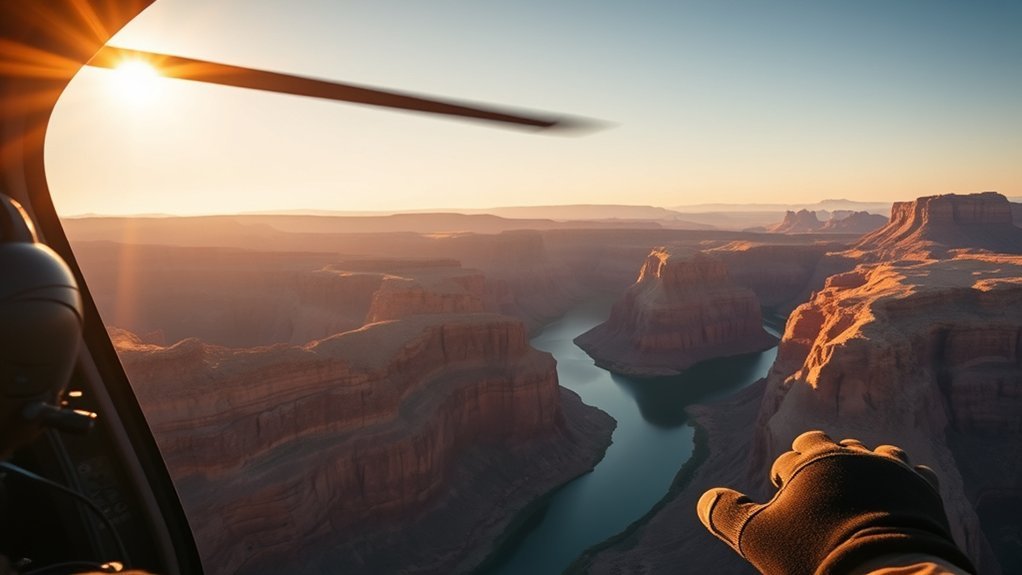
- The Flight: Lift-off is smooth. If departing the South Rim, the aircraft cruises over the flat pine trees of Kaibab National Forest until the ground suddenly drops 5,000 feet below as you cross the rim—a dramatic visual transition.
- Landing Operations (West Rim Itineraries): Helicopters make a controlled descent past layered sandstone cliffs, touching down on designated landing pads near the Colorado River for 30 to 45 minutes of ground exploration before ascending back out.
Photography, Gear, and Practical Packing Advice
Shooting through helicopter windows requires specific camera adjustments to avoid glass glare and rotor-induced motion blur. Heavy tripods, monopods, and selfie sticks are strictly prohibited in the cabin due to safety and space regulations.
| Equipment / Setting | Recommended Spec | Practical Purpose |
|---|---|---|
| Clothing Color | Solid Dark / Black | Prevents your shirt from reflecting off the plexiglass windows into your photos. |
| Lens Focal Length | 24–70mm equivalent | Captures wide canyon vistas while allowing you to zoom in on canyon buttes without hitting window frames. |
| Shutter Speed | 1/1000s or faster | Eliminates motion blur caused by helicopter rotor vibration and forward aircraft travel. |
| Filter Warning | Remove Polarizing Filters (CPL) | Circular polarizers interact with heat-treated aircraft plexiglass, creating rainbow artifacts (birefringence). |
Frequently Asked Questions
Are children allowed on Grand Canyon helicopter tours and ground excursions?
Yes. Children of all ages can fly. Under FAA regulations, children under two years of age (lap children) may sit on a parent’s lap at no additional cost (proof of age via birth certificate or passport required). Children two years and older must have their own booked seat and wear an individual safety restraint. On ground or river-level pontoon add-ons, life jackets are provided and mandatory for all children.
Can pets or emotional support animals accompany passengers on flights?
No. Pets and emotional support animals are not permitted on commercial helicopter tours due to tight cabin spaces, rotor noise hazards, and emergency egress safety protocols. Fully certified and trained service animals (as defined by the Americans with Disabilities Act) are accommodated under federal regulations, though you must notify the operator well in advance so appropriate space and safety accommodations can be arranged.
Are there combo packages that include Zion, Bryce, or Antelope Canyon?
Yes. Many tour operators based in Las Vegas and Page, Arizona, provide multi-attraction combo packages. Popular pairings include a fixed-wing flight to Page with a guided Antelope Canyon and Horseshoe Bend tour, followed by a helicopter flight over the Grand Canyon. Due to flight distance restrictions, Zion and Bryce Canyon pairings typically involve airplane transit or luxury coach transfers combined with a Grand Canyon aerial tour.
What accessibility services are available for passengers with disabilities?
Air tour terminals are fully ADA compliant with ramp access, and operators provide specialized hydraulic boarding lifts or boarding assistance for passengers with mobility impairments. Foldable wheelchairs can be stowed in the aircraft baggage compartment if space and weight permits allow. Passengers must be able to sit upright in an aircraft seat using the standard harness system.
What happens if a tour is canceled due to adverse weather?
If flight operations are suspended due to high winds, low cloud ceilings, or monsoonal storm activity, commercial operators offer passengers the choice between rescheduling to the next available flight window or receiving a 100% full refund. Weather calls are made by the chief pilot solely based on FAA visual flight rules (VFR) safety standards.
Conclusion
A Grand Canyon helicopter tour offers a perspective on one of the world’s greatest geological wonders that cannot be matched from ground lookouts. Ensuring a seamless experience comes down to practical preparation: choose the South Rim for pristine national park geology or Grand Canyon West if you want a canyon-floor landing; select an early-morning departure for the smoothest flying conditions; wear dark clothing to eliminate window glare; and ensure full transparency with passenger weights during booking. With the right tour selected and safety protocols understood, your flight over the canyon will be a highlight of your journey.
Sources
- National Park Service — Grand Canyon National Park Air Tour Management and Flight Regulations
- Federal Aviation Administration (FAA) — Grand Canyon Special Flight Rules Area (SFRA / 14 CFR Part 93)
- Grand Canyon West (Hualapai Tourism) — Canyon Floor Helicopter Landing Permits and Excursion Guidelines