Arizona’s wildflower season is not a single calendar event, but a rolling wave of color that shifts thousands of feet in elevation over six months. Because temperature and moisture change dramatically from desert basins to alpine peaks, timing your trip depends entirely on elevation, winter rainfall, and recent weather. Low deserts typically peak between late February and early April, mid-elevation foothills and grasslands burst into color from March through May, and high-elevation mountain meadows erupt from July through August following summer monsoon rains. Knowing where to look, how to track recent storms, and which trails to hike will ensure you catch the state’s most spectacular displays.
Quick Answer
Peak Arizona wildflower season runs from late February through April in the low deserts (Phoenix, Tucson, Picacho Peak), April through May in mid-elevation canyons and grasslands (Sedona, Prescott, Globe), and July through August in high-country mountain meadows (Flagstaff, White Mountains). Displays require consistent winter soaking rains (3–5 inches between October and February) without prolonged freezing temperatures.
Key Takeaways
- Elevation dictates the bloom: Low desert basins (1,000–3,000 ft) peak first in early spring, while high-altitude alpine areas (7,000–10,000+ ft) peak in mid-to-late summer.
- The winter rain formula: Low-desert superblooms depend on gentle, steady rainfall from October through January; dry autumns produce sparse spring annuals.
- Premier hotspots: Picacho Peak State Park, Lost Dutchman State Park, Bartlett Lake, Catalina State Park, and Flagstaff’s San Francisco Peaks host the most reliable floral diversity.
- Ethical field practice: Stay on marked trails to protect fragile cryptobiotic soil crusts and avoid trampling poppy rosettes before they seed.
When Wildflowers Bloom Across Arizona’s Elevation Zones
Arizona’s complex topography spans from near sea level along the Colorado River to over 12,600 feet at Humphreys Peak. This dramatic relief creates distinct ecological life zones, each with its own bloom window dictated by soil temperature, day length, and rainfall patterns.
In the low Sonoran Desert (1,000 to 3,000 feet), seeds of winter annuals germinate after autumn rains, overwinter as small basal rosettes, and burst into bloom as soon as daytime temperatures consistently reach the mid-70s. As spring heats up and low-elevation annuals set seed and wither, the bloom line climbs into the mid-elevation chaparral, interior chaparral, and upper Sonoran foothills (3,000 to 5,500 feet). Finally, high-country meadows across the Colorado Plateau and Mogollon Rim (6,500 to 9,500+ feet) remain dormant until late spring snowmelt and reach their absolute peak during the late-summer North American Monsoon.
Arizona Wildflower Season by Elevation Band
| Elevation Zone | Peak Window | Key Representative Species |
| Low Desert (1,000–3,000 ft) |
Late Feb – Early April | Mexican Gold Poppy, Purple Owl’s Clover, Desert Lupine, Brittlebush, Globe Mallow, Chuparosa |
| Mid-Elevation & Foothills (3,000–6,000 ft) |
Late March – May | Hedgehog Cactus, Firecracker Penstemon, Saguaro Blossom, Ocotillo, Desert Marigold |
| High Country & Sky Islands (6,500–10,000+ ft) |
July – August (Monsoon Peak) |
Rocky Mountain Iris, Silvery Lupine, Alpine Paintbrush, Golden Columbine, Sunflowers |
Best Low-Desert Hotspots and Timing (Late February – April)
When winter weather delivers consistent moisture, the low desert transforms into massive expanses of gold, purple, and orange. The key to exploring this zone is hitting the south- and west-facing slopes first in late February, before moving to flatter bajadas, north-facing washes, and protected canyon corridors in March.
Phoenix-Area Hotspots
The desert parks surrounding the Phoenix metropolitan area offer some of the most accessible and reliable viewing opportunities in the Southwest:
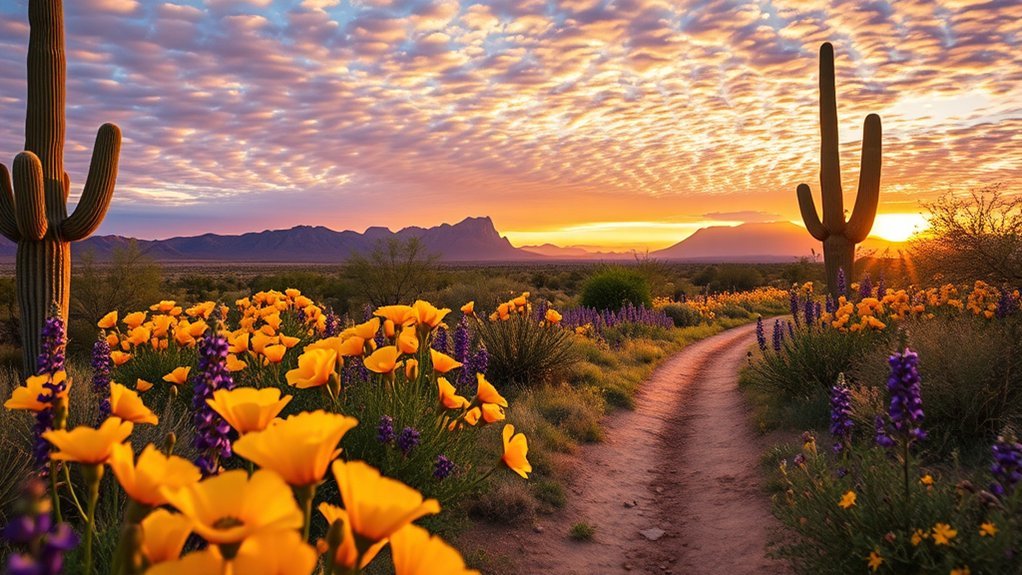
- Picacho Peak State Park: Located just south of the metro along I-10, the steep volcanic slopes of Hunter Trail and Calloway Trail offer Arizona’s most famous carpet of Mexican gold poppies (Eschscholzia californica ssp. mexicana) and purple lupine. Peak viewing usually happens from late February to mid-March.
- Lost Dutchman State Park & the Superstition Mountains: Beneath the sheer cliffs of the Superstitions, the Siphon Draw and Treasure Loop trails showcase dense stands of brittlebush (Encelia farinosa), blue phacelia, and fairy duster framed by towering saguaros.
- Bartlett Lake & Horseshoe Reservoir: Located northeast of Scottsdale in the Tonto National Forest, the road to Bartlett Lake cuts through rolling hills covered in yellow poppies, purple mat, and chicory.
- South Mountain Park and Preserve: The National and Mormon trails offer expansive fields of yellow brittlebush along south-facing rocky ridgelines starting in late February.
- McDowell Sonoran Conservancy & Phoenix Sonoran Preserve: Great for structured hikes along wide desert washes lined with bladderpod, desert marigold, and blooming ironwood trees.
Pro Tip: Mexican gold poppies require direct warmth and sunlight to open. Do not arrive at dawn for poppy photography; blossoms stay tightly closed until ambient temperatures warm up around 10:00 AM and begin closing by 4:00 PM.
Southern and Western Desert Destinations
Further south and west, where rainfall patterns differ and elevations drop lower, unique desert landscapes yield distinct blooms:
- Organ Pipe Cactus National Monument: Along the Mexican border, the Ajo Mountain Drive passes volcanic soils that ignite with desert chia, purple owl’s clover, and blooming senita and organ pipe cacti.
- Catalina State Park (Tucson): Nestled at the base of the Santa Catalina Mountains, the Romero Canyon and Canyon Loop trails boast robust displays of desert chicory, evening primrose, and Mexican gold poppies from early March to mid-April.
- Saguaro National Park (East and West Districts): While annual wildflowers appear in March, May through early June brings the crowning spectacle of the Sonoran Desert: thousands of creamy white blossoms opening atop giant saguaro crowns.
Mid-Elevation Grasslands, Canyons, and Sky Islands (March – May)
As the low-desert floor dries out under rising April temperatures, wildflower viewing moves up into the mid-elevation grasslands, interior canyons, and foothill scrub zones (3,500 to 6,000 feet).
Areas such as Sedona’s Red Rock State Park, the Verde Valley, and the Prescott National Forest experience a vibrant late-spring flush. Red sandstone formations contrast brilliantly against bright red firecracker penstemon (Penstemon eatonii), Palmer’s penstemon, golden desert marigolds, and scarlet hedgehog cactus (Echinocereus coccineus).
In southern Arizona, the Madrean Sky Islands—isolated mountain ranges rising out of desert basins—harbor unique microclimates. Canyons like Madera Canyon in the Santa Ritas and Ramsey Canyon in the Huachucas support mesic microclimates where rare columbines, coralbeans, and wild orchids thrive along cold running streams throughout April and May.
High Country Meadows and Late-Summer Displays (July – August)
Northern Arizona’s high-elevation plateau and volcanic peaks operate on an entirely different botanical calendar. While spring brings modest displays of wild iris following snowmelt in May and June, the true high-altitude bloom occurs during the monsoon season in July and August.
“High-country meadows above 7,000 feet rely on late summer convective storms—turning Flagstaff and the White Mountains into vast tapestries of sunflowers, paintbrush, and lupine when the low desert is at its hottest.”
Key high-elevation destinations include:
- San Francisco Peaks & Kachina Trail (Flagstaff): Winding through aspen groves and subalpine meadows at 9,000 feet, this trail bursts with silvery lupine, Rocky Mountain iris, red alpine paintbrush, and golden columbines through late summer.
- Mogollon Rim & Woods Canyon Lake: The pine-fringed meadows along Forest Road 300 support extensive fields of yellow composites, wild geranium, and purple aster from mid-July through August.
- The White Mountains (Greer & Big Lake): High-altitude riparian corridors and volcanic valleys fill with blue flax, Indian paintbrush, and native sunflowers following afternoon monsoon downpours.
What Drives a Spectacular Bloom? The Rain Formula
Spectacular Arizona “superblooms” are rare because they require a precise sequence of climatic events:
- Early Autumn Rain (October – December): At least 1 to 2 inches of gentle, widespread precipitation is critical to penetrate the soil seed bank and stimulate germination.
- Consistent Winter Moisture (January – February): Well-spaced storms delivering an additional 2 to 4 inches keep topsoil moist and prevent young seedlings from drying out under intense desert sun.
- Absence of Extended Hard Freezes: Unseasonal cold snaps can kill tender rosettes before they form buds.
- Moderate Spring Warmth: Gentle warming in February encourages rapid stem development. Excessive early heat spikes (90°F+ in March) scorch blooms and prematurely end the season.
Warning: Never step off designated trails to take photos in wildflower fields. Trampling crushes fragile root networks, compresses desert soils, and destroys next year’s seed crop. In arid regions, single footprints on living biocrust can take decades to recover.
Planning Your Wildflower Trip: Weather, Trails, and Etiquette
A successful wildflower outing in Arizona requires careful preparation and adherence to desert safety rules:
- Hydration and Sun Protection: Desert air accelerates dehydration even during mild spring mornings. Carry a minimum of 2 to 3 liters of water per person, apply broad-spectrum sunscreen, and wear a wide-brimmed hat.
- Watch for Wildlife: Warming spring temperatures coincide with the emergence of rattlesnakes, Africanized honeybees, and stinging desert insects. Keep your eyes on the trail and never place hands or feet into rocky crevices or dense brush where you cannot see.
- Legal Protection: Under the Arizona Native Plant Law (A.R.S. Title 3, Chapter 7), native desert plants are protected. Picking wildflowers, digging up cacti, or collecting seeds on public, state, or tribal lands without specific permits is illegal.
- Trail Etiquette: Always practice Leave No Trace principles. Pack out all trash, yield to uphill hikers, and keep pets strictly leashed on approved trails.
Resources for Current Bloom Reports and Photography Tips
Because local microclimates cause blooms to peak and fade rapidly within individual valleys, consult up-to-date regional trackers before heading out:
- State Park Ranger Bloom Reports: Check the official Arizona State Parks Wildflower Tracker for weekly field updates, park ranger photos, and trail conditions from Picacho Peak, Lost Dutchman, and Catalina State Parks.
- Desert Botanical Garden Tracker: The Desert Botanical Garden in Phoenix provides seasonal updates on native phenology and desert garden displays.
- Citizen-Science Networks: Use platforms like iNaturalist and community hiking groups to view geotagged, timestamped photo submissions from specific trailheads within the last 48 hours.
- Photography Field Tips: Use a polarizing filter to reduce glare off waxy desert leaves and enrich sky contrast. For detailed macro shots of delicate stamens and petals, bring a reflector and shoot during overcast mornings or use a handheld diffuser to soften harsh midday shadows.
Frequently Asked Questions
Are there toxic or poisonous wildflowers in Arizona to avoid touching?
Yes. Several native Arizona plants contain toxic alkaloids. Sacred Datura (Datura wrightii), also known as jimsonweed, features large white trumpet flowers but contains dangerous tropane alkaloids in all parts. Locoweed (Astragalus and Oxytropis species), Desert Tobacco (Nicotiana obtusifolia), and Larkspur (Delphinium species) are also toxic if ingested and can cause mild contact dermatitis. Teach children and keep pets from chewing on wild plants.
Can I forage or collect wildflower seeds or plants legally in Arizona?
No. Under the Arizona Native Plant Law and federal land regulations, collecting seeds, picking blossoms, or digging up wild plants on National Park, State Park, BLM, Forest Service, or tribal lands is strictly prohibited without specialized scientific collection permits. Always purchase native seeds from reputable certified nurseries.
Do dogs require special precautions around Arizona wildflower trails?
Yes. Dogs must remain leashed on permitted trails to prevent the destruction of wildflower beds and protect them from desert hazards. Wildflower season coincides with active rattlesnakes and abundant jumping cholla segments. Desert seed pods and grass awns (cheatgrass and foxtails) can also burrow into paws, ears, and nostrils. Always carry dedicated pliers and extra water for your dog.
What permits are needed for organized group hikes or commercial photo shoots?
Casual personal photography requires standard day-use park entry fees. However, commercial photographers, portrait shoots involving paid clients or elaborate props, and organized group gatherings exceeding standard trail limits require a Special Use Permit (SUP) or Commercial Activity Permit from the governing agency (e.g., Arizona State Parks, USFS, or municipal park departments).
Which native Arizona wildflowers are best suited for home desert gardens?
Desert Marigold (Baileya multiradiata), Mexican Gold Poppy (Eschscholzia californica ssp. mexicana), Parry’s Penstemon (Penstemon parryi), Globe Mallow (Sphaeralcea ambigua), and Fairy Duster (Calliandra eriophylla) are outstanding native species. Sow seeds in late autumn before winter rains on well-draining, unamended native soil for springtime blooms.
Conclusion
Experiencing Arizona’s wildflower season requires looking beyond the calendar and tracking elevation, temperature, and winter precipitation. Whether you are photographing golden poppy fields beneath Picacho Peak in March or exploring blooming alpine meadows in the San Francisco Peaks during August, timing your visit to the landscape’s natural rhythm guarantees unforgettable sightings. Plan ahead, stay on durable trails, and monitor live park bloom reports to enjoy the Southwest’s most vibrant natural spectacles responsibly.
Sources
- Arizona State Parks & Trails — Official Wildflower Season Forecasts and Park Bloom Reports
- Arizona Department of Agriculture — Arizona Native Plant Law (A.R.S. Title 3, Chapter 7) Guidelines
- National Park Service — Organ Pipe Cactus National Monument Wildflower Phenology
- U.S. Forest Service — Coconino National Forest High-Elevation Botany & Trail Guides
- University of Arizona Cooperative Extension — Sonoran Desert Native Plant Identification & Propagation