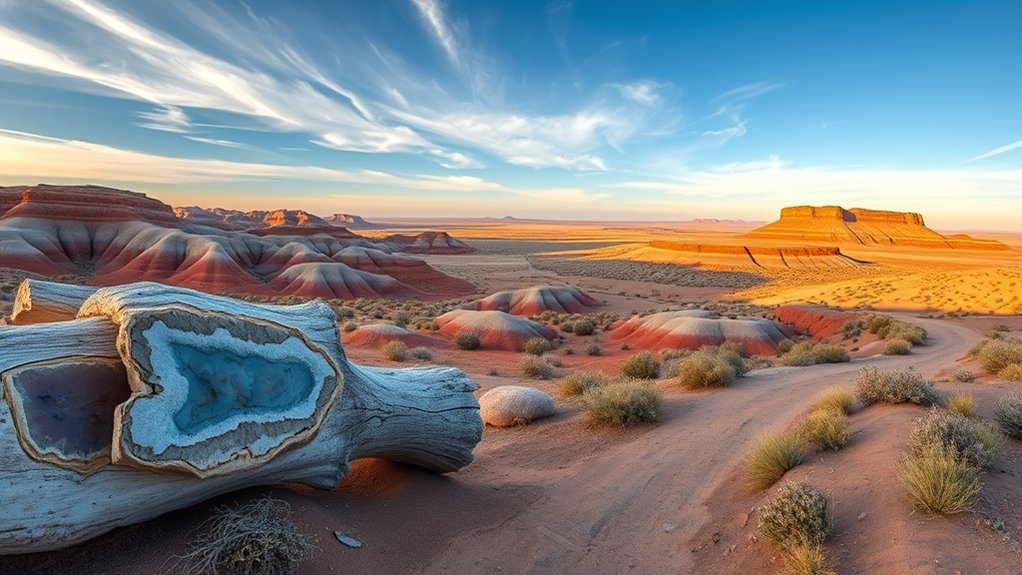
Petrified Forest National Park combines colorful badlands, extensive deposits of petrified wood, Late Triassic fossils, ancestral Puebloan sites, and a surviving piece of Historic Route 66. Because most attractions sit along one 28-mile park road, a good visit depends on choosing the right entrance, allowing enough time for stops, carrying water, and knowing which trails fit your mobility and schedule.
Quick Answer
A good first visit to Petrified Forest National Park takes about 3 to 5 hours, while a full day lets you add more trails and cultural stops. The park road is 28 miles long, there is no public transportation inside the park, and current standard hours are 8 a.m. to 5 p.m. MST.
Key Takeaways
- Drive through the park from one entrance to the other instead of backtracking when your road-trip direction allows it.
- Current standard park-road hours are 8 a.m. to 5 p.m. MST, and the standard private-vehicle entrance pass is $25 for seven days.
- For a short visit, prioritize Rainbow Forest, Crystal Forest, Blue Mesa, Puerco Pueblo, and Painted Desert viewpoints.
- Pets are unusually welcome for a national park and may use trails when leashed, but they may not enter public buildings.
- Carry water, protect yourself from sun and wind, watch summer storm forecasts, and never remove or relocate petrified wood, fossils, rocks, or artifacts.
At a Glance
| Time Required | About 3 to 5 hours for major highlights; 6 to 8 hours for a fuller day with several trails |
| Difficulty | Easy scenic driving to moderate hiking, depending on trail grades and weather |
| Tools Needed | Vehicle, water, walking shoes, sun protection, layers, snacks, and an offline map or downloaded NPS information |
| Cost | $25 per private vehicle for a standard seven-day pass; the park does not accept cash |
What You Need to Know Before You Go

Start with the current logistics. Petrified Forest National Park’s standard road hours are 8 a.m. to 5 p.m. Mountain Standard Time, and Arizona remains on MST year-round. The park is generally open throughout the year except Thanksgiving Day and Christmas Day. Winter weather can delay opening when roads are unsafe, so check the NPS current conditions page before a winter visit.
The current standard entrance fee is $25 per private, non-commercial vehicle and is valid for seven days. The park is cashless, so bring a credit or debit card or an accepted digital pass. The 28-mile main park road connects the north entrance at Interstate 40 with the south entrance near Highway 180.
Note: As of August 2026, the Painted Desert Visitor Center building is closed for construction. The surrounding Painted Desert Community Complex remains available with amenities, and Painted Desert Inn is serving as a north-side visitor contact location. Check the current NPS visitor-center page for operating updates.
Bring a car, dress in layers, and carry enough water for your planned activities. Drinking water is available at developed areas including Painted Desert Community Complex and Rainbow Forest Museum, but not at the scenic stops along the park road or in the backcountry. Park only in designated areas and give yourself enough time to return to your vehicle and exit by the posted closing time.
Petrified Forest is also unusually pet-friendly. Pets may accompany you on developed trails and in other areas open to the public, including wilderness, but they are not allowed inside public buildings. Keep pets physically restrained on a leash no longer than six feet, clean up after them, and keep them away from wildlife. The park’s BARK Ranger program provides an extra way to learn the rules with your pet.
Getting to Petrified Forest National Park

Petrified Forest National Park stretches between Interstate 40 and Highway 180 in northeastern Arizona. There are two entrances and no public transportation to or within the park, so most visitors need a vehicle. The best entrance depends on which direction you are traveling.
- Traveling west on I-40: take Exit 311 at the north entrance, drive south through the park, then use Highway 180 toward Holbrook.
- Traveling east on I-40: NPS recommends taking Exit 285 into Holbrook, following Highway 180 to the south entrance, and driving north through the park to I-40.
Pro Tip: Treat Petrified Forest as a one-way scenic drive when your road-trip direction allows it. Entering at one end and leaving at the other avoids unnecessary backtracking and makes it easier to fit more overlooks and short trails into the day.
The main park road runs about 28 miles between Interstate 40 and Highway 180, and the National Park Service states that there is no public transportation to or within the park.
If you fly into the region, Flagstaff, Phoenix, and Albuquerque are common air gateways for road trips that include Petrified Forest. Compare current flight schedules and rental-car rates rather than choosing solely by straight-line distance. Holbrook is the most practical nearby town for many visitors, while Winslow works well when combining the park with a Route 66 trip.
| Gateway | Relation to the Park | Planning Note |
|---|---|---|
| Winslow | West of the park on I-40 | Useful Route 66 stop with lodging and dining |
| Holbrook | Near the south approach | Convenient base via Highway 180 |
| Flagstaff | West on I-40 | Commercial-air gateway for northern Arizona trips |
| Phoenix | Southwest of the park | Major airport with a longer drive |
| Albuquerque | East of the park | Major airport with a direct I-40 approach |
When to Visit and Weather Tips

Petrified Forest’s high, exposed landscape can change quickly with the season. Spring and fall are appealing for hiking because temperatures are often more comfortable than in midsummer, but wind and sudden temperature changes are possible at any time. Summer can become very hot, while winter can bring freezing temperatures, snow, and delayed road openings.
The NPS lists the regional monsoon season as June 15 through September 30, with summer afternoon thunderstorms an important concern. Storms can bring lightning, strong winds, slick clay soils, and rapidly changing conditions in washes. Winter visitors should be ready for cold temperatures and possible snow.
Warning: If thunderstorms are developing, avoid exposed high points and low washes, and do not continue into terrain where flooding or slick clay could block your return. Check the weather and current park conditions before leaving a developed area.
- Spring: variable temperatures, frequent wind, and generally comfortable hiking periods.
- Summer: strong sun and heat, with afternoon storm risk during monsoon season.
- Fall: cooler walking weather and shorter daylight as the season progresses.
- Winter: cold mornings, possible snow, icy conditions, and occasional delayed openings.
Because ordinary day visitors cannot remain in the park after closing, plan photography around the park’s actual operating hours rather than assuming sunrise or sunset access will always be available. Permitted wilderness backpackers follow separate overnight rules.
One-Day and Half-Day Itineraries

A well-planned visit can cover the park’s main landscapes without feeling rushed. The itineraries below are written south-to-north. Reverse the order if you enter from Interstate 40 at the north entrance.
Half-Day Itinerary: About 3 to 4 Hours
- Rainbow Forest Museum: start with paleontology exhibits and orientation near the south entrance.
- Giant Logs or Crystal Forest: choose one short petrified-wood trail if time is tight.
- Blue Mesa: drive the side road and, if your schedule and mobility allow, walk the 1-mile loop through the badlands.
- Puerco Pueblo: take the short paved loop to see ancestral Puebloan remains and petroglyphs.
- Painted Desert viewpoints: finish with north-side overlooks and Painted Desert Inn before leaving toward I-40.
If cultural history matters more than Blue Mesa, you can substitute the Agate House trail. However, Agate House itself is currently closed to public access, and visitors must remain at least 15 feet from the structure.
One-Day Itinerary: About 6 to 8 Hours
With a full day, start at Rainbow Forest Museum and Giant Logs, then choose Long Logs and the Agate House area or Crystal Forest. Continue north to Jasper Forest, Agate Bridge, the Teepees, Blue Mesa, Newspaper Rock, and Puerco Pueblo. Add the Historic Route 66 alignment, Painted Desert Inn, and Painted Desert Rim Trail if daylight and closing time allow.
This longer plan gives you a better balance of petrified wood, badlands, archaeology, Route 66 history, and short hikes. Keep an eye on the time throughout the afternoon because park access ends at the posted closing time.
Top Trails and Points of Interest

The best trail depends on what you want to see and how comfortable you are with grades, stairs, and uneven surfaces. Check the current NPS trail descriptions before setting out.
- Crystal Forest: 0.75-mile loop with close views of colorful petrified logs. The trail is paved, but significant grades mean it should not be described as universally accessible.
- Blue Mesa: 1-mile loop through blue, purple, and gray badlands with scattered petrified wood. The beginning of the trail is steep.
- Giant Logs: 0.4-mile loop behind Rainbow Forest Museum featuring some of the park’s largest logs. The paved route includes several sets of stairs.
- Puerco Pueblo: 0.3-mile paved loop through the remains of a large ancestral Puebloan settlement, with petroglyph viewing near the trail.
- Painted Desert Rim Trail: 1-mile round trip between Tawa Point and Kachina Point with broad Painted Desert views. The trail is unpaved and has substantial grades in places.
- Long Logs: 1.6-mile loop through one of the park’s largest concentrations of petrified wood.
- Agate House: a 2-mile round-trip trail from the Rainbow Forest area. The archaeological structure is currently closed, and visitors must stay at least 15 feet away.
Accessibility and Mobility
Trail surfaces alone do not tell the full accessibility story. Several paved trails have grades or cross slopes that exceed common accessibility standards. Tawa Trail is one of the better documented options for mobility planning, while Puerco Pueblo’s main paved route can work for many visitors using strollers or mobility equipment. Crystal Forest is paved but has steep sections, Giant Logs includes stairs, and Painted Desert Rim is unpaved.
If walking distance or grade is a concern, you can still see much of the park from roadside overlooks and short developed stops. Review the NPS accessibility and trail information before choosing a route.
Scenic and Cultural Stops Worth Adding
- Painted Desert Inn: a National Historic Landmark near the north end with museum space, visitor information, and sweeping views.
- Historic Route 66 alignment: the park preserves part of the former highway corridor, adding a Route 66 history stop to the natural scenery.
- Newspaper Rock: an overlook where you can view a large concentration of petroglyphs. Do not touch rock art or enter closed areas.
- The Teepees: a quick roadside stop for strongly banded Chinle Formation badlands.
- Jasper Forest: a broad overlook across one of the park’s extensive petrified-wood areas.
- Agate Bridge: a short stop highlighting a large petrified log spanning an eroded gap.
Park Rules, Safety, and Permits

Petrified Forest protects fossils, petrified wood, archaeological sites, grasslands, wildlife habitat, and historic structures. Follow posted restrictions, park only in designated places, do not feed or approach wildlife, and never remove or relocate natural or cultural material.
Leave No Trace
In developed hiking areas, stay on designated trails and behind barriers so you do not create social trails or damage fragile soils and vegetation. The park also offers backcountry hiking opportunities where travel is not always confined to constructed trails, but you are still responsible for minimizing damage, avoiding fragile resources, and leaving fossils and artifacts exactly where you find them.
- Carry enough water for your entire hike because there is no backcountry drinking water.
- Pack out all trash and other waste required by park rules.
- Do not feed, approach, or disturb wildlife.
- Do not climb on archaeological walls or touch petroglyphs.
- Know your return route and allow enough time to reach your vehicle before closing.
Camping Permits Required
There is no RV camping, car camping, frontcountry campground, boondocking, or overnight parking for ordinary campers inside Petrified Forest National Park. Overnight stays are limited to backpacking into the designated Petrified Forest National Wilderness Area.
A free wilderness backpacking permit is required. Current NPS guidance says backpackers must travel at least half a mile from their vehicle before camping. Permits are issued in person on the day of the trip. Obtain yours early rather than waiting until closing time.
Group camping is limited, no bicycles or motorized vehicles are allowed in wilderness, and wood or charcoal fires are prohibited there. Carry all the water you will need. Review the current NPS backpacking rules before an overnight trip.
Petrified Wood Protection
The petrified wood is protected by federal law. Do not collect, remove, damage, or relocate petrified wood, fossils, rocks, plants, archaeological objects, or other natural and cultural material. According to the NPS, the minimum fine is $325 for removal or damage to petrified wood or other protected natural or cultural features.
- Leave petrified logs and fragments exactly where you find them.
- Photograph fossils and unusual objects rather than picking them up or moving them.
- Do not touch petroglyphs or make rubbings, tracings, or molds of rock art.
- Report active resource theft or damage to park staff.
You can learn more about the park’s fossil record through museum exhibits and science programming. Visitor programming may include a Museum Demonstration Lab where trained paleontologists prepare fossils while visitors observe the work. Check the current Things to Do page because locations and schedules can change.
Where to Stay and Eat Nearby

There is no conventional lodging or frontcountry campground inside Petrified Forest National Park, so most overnight visitors stay in a nearby community. Holbrook is the most convenient base for many trips because it offers hotels, motels, restaurants, fuel, and access to the south entrance by Highway 180. Winslow is another useful choice, especially for travelers following Historic Route 66.
The park itself has more services than the original article suggested, but they are concentrated in developed areas. The Painted Desert Community Complex has amenities including food service, a gift shop, gas, restrooms, and picnic facilities, while Rainbow Forest Museum has restrooms, picnic facilities, and limited snacks. Do not expect food or water at every overlook.
Nearby Holbrook Hotels
Holbrook offers both Route 66 properties and conventional chain hotels. Current examples include:
- Wigwam Village Motel #6: a historic Route 66 property listed in the National Register of Historic Places, known for its distinctive cone-shaped units.
- Brad’s Desert Inn: a local motel on Hopi Drive with Route 66 character.
- La Quinta Inn & Suites by Wyndham Holbrook Petrified Forest: a conventional hotel option near I-40.
- Days Inn by Wyndham Holbrook: another conventional chain option for travelers who prioritize familiar hotel amenities.
Hotel rates and amenities change by date, so compare the current cancellation policy, breakfast, pet policy, and room type before booking.
Route 66 Lodging Options
If the road-trip experience matters as much as proximity, the historic Wigwam Motel is the standout Route 66 choice in Holbrook. Its lodging units are part of a preserved roadside property with national historic significance. Brad’s Desert Inn offers another local alternative, while La Quinta and Days Inn suit travelers who prefer a more conventional hotel format.
Reserve early for busy travel periods, particularly if you want a specific historic property rather than simply the nearest available room.
Dining & Local Eats
Holbrook has enough dining options for breakfast, lunch, or dinner before and after a park visit. Current examples include:
- Bienvenidos Restaurant: a casual diner-style choice for breakfast and other familiar meals.
- Romo’s Restaurant: a Mexican restaurant in central Holbrook.
- Camaleon Cafe: a casual breakfast and meal stop on Navajo Boulevard.
- The Turquoise Room: a Southwestern restaurant at La Posada in Winslow for travelers who want to combine dinner with a Route 66 stop.
Inside the park, food options are useful but limited compared with a town. Carry snacks or a picnic lunch if your itinerary includes several hours away from the developed north and south areas.
Practical Tips and Packing List

Although many developed trails are short, the park’s exposure, elevation, wind, strong sun, changing temperatures, and limited mid-park services make basic preparation important. Bring more water than you expect to drink and do not depend on finding a refill point at a trailhead.
The NPS recommends carrying about one gallon of water per person per day during summer when hiking. Drinking water is available at Painted Desert Community Complex and Rainbow Forest Museum, but not in the backcountry or at scenic road stops.
- Water: enough for everyone in your group, plus a reserve.
- Walking shoes: choose footwear with traction for gravel, uneven pavement, stairs, and slick clay after rain.
- Sun protection: hat, sunscreen, and sunglasses.
- Layers: temperatures and wind can change quickly, especially outside midsummer.
- Rain protection: carry a lightweight shell during storm-prone periods.
- Food: snacks or a picnic lunch if you plan several hours between developed areas.
- Navigation: download the park map, NPS app information, or audio-tour material before arrival rather than relying on a continuous connection.
- Power: bring a charged phone and battery pack if you use your device for navigation or photography.
- Basic safety gear: a small first-aid kit is useful, especially for longer trails or backcountry travel.
Cellular coverage can vary, so do not make your itinerary dependent on having a live data connection. The NPS specifically offers downloadable audio-tour material for visitors who may not have a connection while traveling through the park.
Sources
- National Park Service: Operating Hours & Seasons – current park hours, holiday closures, and time-zone information.
- National Park Service: Fees & Passes – entrance fees, pass validity, and cashless payment policy.
- National Park Service: Visitor Centers – current facility status, amenities, and visitor services.
- National Park Service: Trails – trail distances, surfaces, grades, bicycle restrictions, and current Agate House information.
- National Park Service: Laws & Policies – resource protection, pet rules, drone restrictions, penalties, and visitor conduct.
- National Park Service: Backpacking – wilderness permits, camping restrictions, group limits, and backcountry safety.
Frequently Asked Questions
Are there guided fossil digs for visitors to participate in?
The park’s public visitor programming focuses on museum exhibits, science programs, ranger activities, and watching trained paleontologists prepare fossils rather than allowing ordinary visitors to excavate fossils. Current programming may include a Museum Demonstration Lab, so check the NPS Things to Do page for the latest location and schedule.
Can I fly drones inside the park boundaries?
Generally, no. Launching, landing, or operating an unmanned aircraft from lands or waters administered by Petrified Forest National Park is prohibited unless the superintendent has provided written approval.
Are pets allowed on trails or in park buildings?
Pets are allowed on developed trails and in other areas open to the public, including wilderness, but they are not allowed inside public buildings. Keep your pet physically restrained on a leash no longer than six feet, clean up after it, and keep it away from wildlife.
Is there cell phone or internet service within the park?
Do not assume you will have a dependable connection throughout the park. Download maps, NPS information, and any audio-tour material before your visit, and carry a charged battery pack if you rely on your phone for navigation.
Are bikes permitted on paved park roads or trails?
Bicycles and e-bikes are allowed on paved public park roads and parking areas. Most hiking trails and wilderness areas are closed to bicycles, although the Superintendent’s Compendium lists a small number of specifically designated exceptions. Follow posted signs rather than assuming an unpaved trail is open to bikes.
How long do you need at Petrified Forest National Park?
Allow about 3 to 5 hours for a first visit with major scenic stops and one or two short trails. A full 6 to 8 hour day gives you time for more hiking, cultural sites, Route 66 history, and additional overlooks.
Can you camp inside Petrified Forest National Park?
Yes, but only by backpacking into the designated wilderness with a free permit. There is no RV campground, car campground, boondocking, or ordinary overnight parking in the park. Current NPS guidance requires wilderness campers to travel at least half a mile from their vehicle.
Is food and drinking water available inside the park?
Some food, snacks, gas, restrooms, and drinking water are available in developed areas, but services are not spread along the entire 28-mile park road. Bring your own water and snacks, especially when hiking or spending several hours between the north and south developed areas.
Conclusion
Petrified Forest National Park is easy to underestimate because the main road is only 28 miles long, but a good visit includes much more than a quick drive past petrified logs. Give yourself time for the Painted Desert, Blue Mesa, fossil and archaeology exhibits, ancestral Puebloan sites, Route 66 history, and at least one close-up petrified-wood trail. Carry water, stay aware of weather and closing time, follow current trail and pet rules, and leave every fossil, rock, artifact, and piece of petrified wood exactly where you find it. With a little planning, even a half-day visit can cover several of the park’s defining landscapes, while a full day lets you explore them at a more comfortable pace.