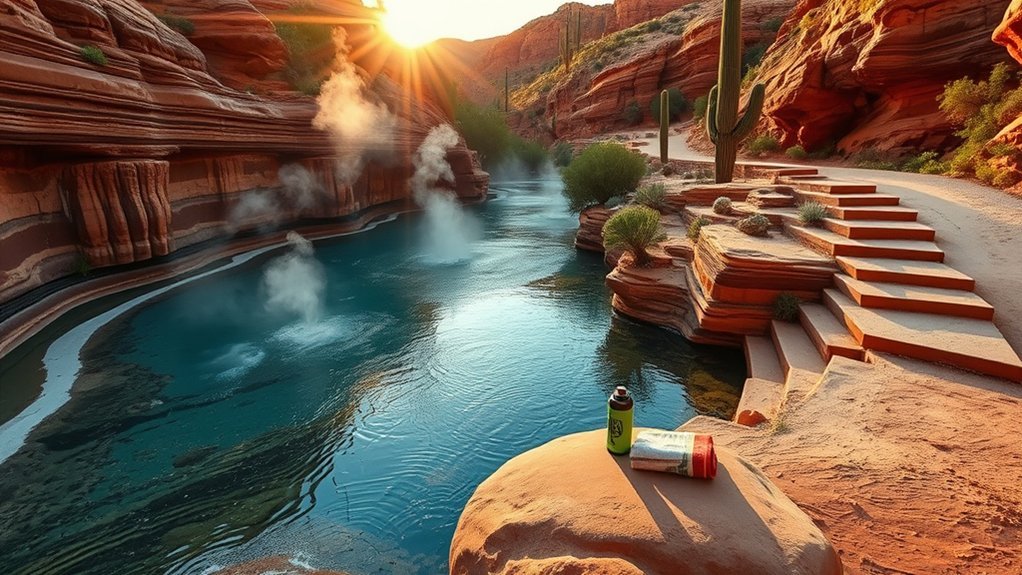
Arizona’s hot springs range from a demanding canyon hike to simple desert tubs and private resorts with controlled facilities. The right choice depends on your fitness, vehicle, budget, comfort with primitive conditions, and the current weather. Access rules can change quickly, so check the managing agency or operator before every trip.
Quick Answer
Arizona’s best-known soaking options include Arizona Hot Springs for a strenuous canyon hike, Hot Well Dunes for developed desert tubs, Verde Hot Springs for a remote primitive experience, El Dorado for bookable private soaking, and Castle Hot Springs for an adults-only luxury overnight stay.
Key Takeaways
- Check current access first. Heat closures, construction, rough roads, floods, and private-property rules can change your plan.
- Match the destination to your abilities. Arizona Hot Springs is a very strenuous hike, while developed private facilities require little or no hiking.
- Natural water is untreated. Keep your head above the water, avoid disturbing sediment, and do not soak with open wounds.
- Bring your own drinking water. Several public sites have no potable water, electricity, reliable phone service, or staffed facilities.
- Follow site-specific rules. Fees, pets, clothing, age limits, reservations, alcohol, fires, and operating hours vary by location.
Current closure: As of July 23, 2026, the Arizona Hot Springs hiking route is within its annual May 15 through September 30 heat closure. The National Park Service may also close the route outside those dates when the forecast at Willow Beach reaches 95°F or higher. The springs remain accessible by water on Lake Mohave. Check the current Lake Mead alerts before traveling.
Arizona Hot Springs at a Glance
| Location | Best For | Access | Cost | Facilities | Important Rule |
|---|---|---|---|---|---|
| Arizona Hot Springs | Experienced hikers seeking natural canyon pools | Very strenuous 5-mile out-and-back or 5.69-mile loop | Lake Mead entrance fee | No trailhead drinking water; pit toilets near the river | Trail closed May 15–September 30 |
| Hot Well Dunes | Developed public tubs, camping, and off-road recreation | Long desert drive; road can become rough | $3 per vehicle under current BLM information | Two tubs, vault toilets, campsites; no drinking water or electricity | Nudity prohibited; pets must be restrained |
| Verde Hot Springs | Remote, primitive soaking | Rough-road and river conditions may affect access | Confirm current land and parking requirements | Primitive; do not expect staffed facilities | Verify the legal route and never cross unsafe water |
| El Dorado Hot Spring | Private tubs, camping, and adult communal soaking | Drive-up private property near Tonopah | Paid; rates vary by area and stay type | Private areas, showers, restrooms, studios, and camping | Communal clothing-optional area is 21+ |
| Castle Hot Springs | Luxury overnight wellness trips | Remote resort; high-clearance vehicle recommended | Overnight resort rate | Lodging, meals, pools, spa services, and staff | Registered overnight guests age 18+ only |
Types of Hot Springs in Arizona
Arizona’s soaking spots generally fall into three groups:
- Primitive natural springs: Geothermal water flows into rock, sand, or basic constructed pools. Conditions, depth, temperature, and cleanliness can change after storms or heavy use.
- Developed public tubs: A public-land agency provides tubs or basic infrastructure, but drinking water, electricity, supervision, or regular tub availability may still be limited.
- Private hot-spring properties: An operator controls access, reservations, sanitation practices, age limits, clothing policies, and available services.
A spring’s appearance does not show whether its water is free of microorganisms. Treat all untreated natural water as a potential health risk, follow posted rules, and never use soap, shampoo, detergent, or bath products in a natural pool.
How to Choose a Hot Spring for Your Trip
Start with the experience you actually want. A quiet resort stay, a drive-up public tub, and a desert canyon hike require very different preparation. Compare access, current status, water conditions, facilities, and rules before deciding.
Location and Access
Check the full route, not just the final distance from the nearest town. Important questions include:
- Is the trail or road currently open?
- Does the approach require four-wheel drive or high clearance?
- Could rain make a wash, river crossing, or dirt road unsafe?
- Is parking legal and available?
- Will you have reliable cell service?
- Does the site require an entrance pass, day-use fee, or reservation?
Pro Tip: Download offline maps, save the managing agency’s phone number, and screenshot the latest closure notice before leaving service. A map pin alone may direct you onto a closed, private, flooded, or unsuitable road.
Water Temperature and Quality
Temperatures can differ between pools and within the same pool. Water is often hottest near the inflow. Test it before entering and move slowly, especially when the source temperature is unknown.
- Check the temperature with your hand or a small waterproof thermometer before sitting down.
- Stay away from a visibly hot inflow or any area that feels painful.
- Take regular cooling breaks and leave immediately if you feel dizzy, weak, nauseated, confused, or unusually tired.
- Do not soak with open wounds, draining skin infections, or uncovered cuts.
- Do not swallow the water.
- Keep your head above untreated geothermal water and avoid stirring bottom sediment.
The CDC advises keeping your head above water in hot springs because Naegleria fowleri can live in naturally warm freshwater. Infection is rare, but it can occur when contaminated water enters the nose.
Facilities and Rules
Primitive locations may have no toilets, trash collection, potable water, changing rooms, lights, or staff. Private properties may offer showers and reserved tubs but enforce age, clothing, device, alcohol, and conduct rules.
Confirm the following before you leave:
- Operating hours and reservation requirements
- Entrance, parking, camping, or soaking fees
- Swimwear or clothing-optional policies
- Pet rules
- Child and minimum-age rules
- Alcohol and glass-container restrictions
- Fire and camping restrictions
Popular Public Soaking Spots
Arizona has relatively few well-documented public soaking locations. The two clearest public options are Arizona Hot Springs inside Lake Mead National Recreation Area and the BLM-managed tubs at Hot Well Dunes. They offer very different experiences.
Arizona Hot Springs at Lake Mead
Arizona Hot Springs is the state’s best-known natural hot-spring hike. According to the National Park Service trail guide, the route is unmaintained and very strenuous.
- Distance: About 5 miles out and back, or approximately 5.69 miles when combined with White Rock Canyon as a loop
- Elevation change: Approximately 750 feet
- Estimated time: About 4–8 hours
- Terrain: Sand, gravel, boulders, rock ledges, scrambling, and a possible 20-foot ladder connection
- Spring temperature: Approximately 111–120°F at the source
- Drinking water: Not available at the trailhead
- Reservations: Not required
- Fee: A valid Lake Mead entrance pass is required
The park’s current standard entrance fees are listed on the Lake Mead fees and passes page. The park uses cashless fee collection, so plan your payment method before arriving.
Warning: Do not enter this canyon route during a closure or when thunderstorms threaten. Flash floods can move through narrow washes with little warning, and summer heat can become life-threatening before a hiker reaches the springs.
The springs are free-flowing. Do not build dams, place sandbags, block the flow, move rocks to reshape pools, or leave waste. The NPS states that altering the pools can change the spring system and create health risks.
Hot Well Dunes Recreation Area
Hot Well Dunes Recreation Area, about 35 miles from Safford, combines two developed soaking tubs with desert camping and off-highway vehicle recreation. The Bureau of Land Management states that the well water reaches approximately 106°F.
- Tubs: Two developed hot tubs
- Current fee: $3 per vehicle under the BLM’s published information
- Tub schedule: The solar-powered system typically fills the tubs about an hour after sunrise and again about an hour before sunset
- Overnight operation: The pump is off overnight, and the tubs drain nightly
- Facilities: Vault toilets, campsites, picnic tables, and fire rings in developed areas
- Not available: Drinking water, electricity, and dependable phone service
- Clothing rule: Public nudity is prohibited
- Pets: Pets must be leashed or otherwise physically restrained
Road conditions can become rough, even though the site is generally reachable by ordinary vehicles when conditions are good. Drive slowly, carry enough fuel and water for delays, and do not depend on phone service.
Construction notice: The BLM began work in June 2026 to improve roads, campsites, walkways, and other facilities and to relocate the tubs away from flood risk. Work is scheduled through January 26, 2027. The recreation area remains open, but visitors may encounter temporary impacts to tubs, toilets, campsites, trash service, roads, or other amenities. Check the official Hot Well Dunes page before visiting.
Accessibility and Easier Access
Arizona Hot Springs is not an accessible trail. Its unmaintained wash, loose rocks, ledges, steep grades, and ladder make it unsuitable for visitors who need a smooth or step-free route.
Hot Well Dunes offers drive-up access to a developed recreation area, but construction, unpaved surfaces, tub design, and changing road conditions may still create barriers. Contact the BLM Safford Field Office for current accessibility information before making the trip.
Private properties may provide the easiest physical access, but layouts vary. Ask the operator about parking surfaces, steps, handrails, tub entry, changing facilities, and accessible rooms before booking.
Public-Site Etiquette and Safety
- Follow every closure, sign, and land-manager instruction.
- Keep groups small and allow other visitors personal space.
- Pack out trash, food waste, and human waste where required.
- Do not use soap, shampoo, oils, or detergent in natural water.
- Do not alter pools, block water flow, move rocks, or damage vegetation.
- Avoid glass containers near water and rocky walking surfaces.
- Do not enter hot water while impaired by alcohol or drugs.
Remote and Primitive Hot Springs
Remote springs can provide solitude, but they offer the least predictable access and the fewest services. Bring more water than you expect to use, a first-aid kit, sun protection, a headlamp, offline navigation, food, and clothing for changing conditions.
Verde Hot Springs
Verde Hot Springs, near the Verde River and the historic Childs area, is commonly described as a primitive soaking destination. Reports often mention rough roads and river-dependent access, but reliable destination-specific government information is limited online.
Do not rely on an old blog post or map pin as proof that a road, parking area, river crossing, or footpath is currently legal and safe. Before traveling:
- Check current Forest Service maps and closure orders.
- Confirm which roads are open to your vehicle type.
- Check weather and river conditions.
- Do not cross flowing water that is deep, fast, muddy, rising, or difficult to judge.
- Respect private property and posted boundaries.
- Expect no staffed facilities, sanitation guarantee, or reliable emergency communication.
Turn back when the route, road surface, water level, or weather does not match your abilities. A soak is not worth a damaged vehicle, trespass, river rescue, or overnight emergency.
Resort and Developed Thermal Pools
Private facilities offer more predictable access, controlled guest numbers, changing areas, and on-site staff. They may also enforce stricter reservation, age, clothing, photography, and conduct policies.
Castle Hot Springs
Castle Hot Springs, near Morristown, is a private luxury resort built around natural geothermal pools.
- Access is limited to registered overnight guests.
- The resort does not currently offer hot-spring day passes.
- Guests must be at least 18 years old.
- Appropriate swimwear is required in the hot springs.
- Pets are not allowed, except qualified service animals.
- The final approach includes about seven miles of dirt road, and the resort recommends a high-clearance vehicle.
- Wi-Fi is available, but cell service is limited.
This option suits travelers who want lodging, meals, staff support, wellness activities, and hot-spring access in one reservation rather than a self-guided public-land trip.
El Dorado Hot Spring
El Dorado Hot Spring, near Tonopah, offers private soaking areas, overnight studios, primitive camping, and limited electric camping.
Private baths and overnight options can accommodate families under the property’s supervision rules. Its communal Desert Pete area is reserved for guests age 21 and older and is clothing optional. Phones and electronic devices are not permitted in that communal pool area.
Private soaking areas and studios should be booked through the operator. Review the latest rates, cancellation policy, conduct rules, age restrictions, and product restrictions before paying.
Health and Safety at Developed Facilities
A developed facility is not automatically risk-free. Inspect the water and surrounding area and ask staff how the tubs are maintained.
The CDC’s maintained-hot-tub guidance says hot-tub water should not exceed 104°F. It also recommends showering before entering and checking whether the operator monitors disinfectant and pH levels.
Avoid a developed tub when:
- The water has a strong chemical smell.
- Surfaces are unusually sticky or slippery.
- The water is cloudy or contains visible debris.
- Required maintenance information is unavailable.
- You have an open wound or active skin infection.
If you are pregnant, immunocompromised, have high blood pressure, have a heart or circulation condition, take medication that affects heat tolerance, or have another serious medical concern, ask a qualified clinician whether hot-water soaking is appropriate for you.
Best Seasons and Weather Considerations
Late fall, winter, and early spring are usually the most practical seasons for outdoor soaking in Arizona’s lower desert. Daytime heat can still be strong, while winter nights can become cold enough to make wet clothing and a delayed return uncomfortable.
Summer Heat
Do not treat an early start as permission to enter a closed trail. When a land manager closes a route for heat, the closure applies even if you plan to hike before sunrise.
Carry drinking water separately from soaking water. Hot water, dry air, exertion, and sun exposure can increase dehydration and heat stress.
Monsoon and Flash Floods
Arizona thunderstorms can form quickly and send water through a canyon or wash even when the storm is not directly overhead. Avoid narrow canyons, washes, river crossings, and low camps when thunderstorms are forecast.
If water begins rising, turns muddy, carries debris, or changes speed, move to higher ground immediately. Do not attempt to drive through a flooded road.
Cold Weather
Bring dry layers, a wind-resistant outer layer, and safe footwear. A warm soak can hide how quickly your body cools after you get out, especially after sunset or in windy conditions.
Safety, Health, and Environmental Risks
Untreated Water Risks
Natural hot springs are not disinfected swimming pools. They may contain bacteria, amebas, animal waste, sediment, and other contaminants that cannot be identified by sight or smell.
The CDC advises visitors to keep their heads above water in hot springs and other naturally hot geothermal water.
To reduce exposure:
- Keep untreated spring water out of your nose.
- Do not dive, jump, or fully submerge your head.
- Avoid digging or stirring sediment.
- Do not swallow the water.
- Cover minor cuts with waterproof dressings and skip the soak when wounds cannot be protected.
- Wash and dry your body and swimsuit after the visit.
Heat and Scalding
Some source water is hot enough to burn skin or cause rapid heat illness. Test each pool independently, since one pool may be much hotter than another. Children can overheat faster than adults and require constant supervision.
Leave the water immediately if you feel lightheaded, confused, weak, nauseated, short of breath, or unusually sleepy. Move to a cooler place, drink water if you can do so safely, and seek medical help when symptoms are severe or do not improve.
Slips, Falls, and Remote Emergencies
Wet rock, algae, loose sand, darkness, ladders, and steep canyon terrain can cause falls. Wear shoes with dependable traction and use a headlamp rather than a phone light for late exits.
Tell someone where you are going, which route you will use, your vehicle description, and when they should contact emergency services if you fail to return.
Legalities, Access, and Land-Management Rules
Arizona soaking sites may be managed by the National Park Service, Bureau of Land Management, Forest Service, tribal governments, local authorities, or private owners. A rule that applies at one site may not apply at another.
Always confirm:
- Whether the spring and approach are open to the public
- Where you may park or camp
- Whether a pass or fee is required
- Current fire restrictions
- Pet, alcohol, glass, and clothing rules
- Whether overnight use is allowed
- Whether motor vehicles are permitted on the access road
Do not cross gates, fences, closure signs, or posted private-property boundaries. Do not alter a natural spring or build a new pool.
Essential Gear and Packing List
- More drinking water than you expect to need
- Electrolyte drink or salty food for strenuous desert trips
- Offline map and backup navigation
- Sturdy closed-toe shoes
- Water shoes or traction sandals where appropriate
- Sun hat, sunscreen, and sunglasses
- Quick-dry clothing and warm dry layers
- Towel or changing poncho
- Headlamp with charged batteries
- Basic first-aid kit
- Waterproof dressings
- Trash bag and required human-waste supplies
- Small waterproof thermometer for unknown pools
- Vehicle recovery supplies for remote dirt-road trips
Note: A phone is not a substitute for offline navigation, a headlamp, sufficient water, or a shared trip plan. Remote springs may have weak or nonexistent service.
Hot Springs Etiquette and Leave No Trace Practices
- Keep voices and music low.
- Give other visitors space and do not photograph them without permission.
- Limit your time when others are waiting.
- Follow the site’s swimsuit or clothing policy.
- Keep food, glass, soap, shampoo, lotion, and oils out of natural pools.
- Do not carve, paint, write on, or damage rocks and ruins.
- Leave pool walls, rocks, pipes, and water channels unchanged.
- Pack out every item you bring.
- Use toilets when provided and follow the land manager’s human-waste rules elsewhere.
- Respect wildlife, cultural sites, neighboring landowners, and quiet hours.
Before You Go Checklist
- Check the official closure and alert page.
- Review the hourly weather forecast and thunderstorm risk.
- Confirm road, trail, river, and parking conditions.
- Check current entrance fees and payment methods.
- Verify reservation, age, clothing, pet, and camping rules.
- Download maps and save emergency contacts.
- Tell someone your route and return time.
- Pack drinking water, dry clothing, navigation, and a headlamp.
- Choose a backup activity in case the site is closed or unsafe.
Frequently Asked Questions
Is the Arizona Hot Springs trail open now?
As of July 23, 2026, the hiking route is closed under Lake Mead’s annual May 15 through September 30 heat closure. Temporary heat closures can also occur outside those dates when the Willow Beach forecast reaches 95°F or higher. Water access to the springs remains available during the trail closure.
Can I bring my dog to Arizona Hot Springs?
The National Park Service lists pets as allowed on the trail while it is open, but they must remain on a leash no longer than six feet, cannot be left unattended, and must have their waste removed. The route’s hot ground, rough terrain, ladder, and lack of water can make it unsuitable for many dogs. Do not encourage a dog to soak in hot water.
Are any Arizona hot springs easy to reach?
Hot Well Dunes and private properties such as El Dorado provide drive-up or near-drive-up access, although roads and surfaces may still be rough. Castle Hot Springs is reached by road but is available only to registered overnight guests. Arizona Hot Springs requires a strenuous hike when the trail is open.
Are Arizona hot springs accessible by public transit?
Most are not practical to reach by public transit. Trailheads, desert recreation areas, and private resorts usually require a vehicle, arranged transfer, or tour. Confirm the final transportation segment before booking lodging or paying for a soak.
Do Arizona hot springs have Wi-Fi or cell service?
Backcountry and desert sites may have weak or no cell service. Developed resorts may provide Wi-Fi, although Castle Hot Springs reports limited cellular coverage. Download maps and share your travel plan before leaving dependable service.
Can I cook or have a fire near a hot spring?
Only where the managing agency or property owner permits it. Fire restrictions can change quickly, and some locations allow fires only in established rings. Check the current rules on the day of your visit and use a stove only where stoves are allowed.
Are there clothing-optional hot springs in Arizona?
El Dorado Hot Spring operates a designated communal clothing-optional area for guests age 21 and older. Its private areas follow separate rules. Hot Well Dunes prohibits nudity, and Castle Hot Springs requires appropriate swimwear. Follow the exact policy of the site you visit.
Are natural hot springs safe for children?
Some natural springs may be too hot, too remote, or too difficult for children. Children overheat faster than adults and need constant supervision near hot water, slippery rocks, rivers, and canyon terrain. Ask a clinician about medical concerns and follow any facility age limits.
Conclusion
Arizona’s hot springs can provide a memorable desert soak, but each location demands a different level of preparation. Choose a destination that matches your fitness, vehicle, budget, and comfort with primitive conditions. Check current closures and operator rules, bring enough drinking water, protect yourself from heat and flash floods, and treat natural water as untreated.
Follow site-specific clothing, pet, fire, parking, and camping rules. Keep your head above untreated geothermal water, avoid changing natural pools, and pack out everything you bring so these fragile places remain available to future visitors.
Sources
- National Park Service: Arizona Hot Springs Trail — trail distance, difficulty, ladder, water temperature, fees, pets, seasonal use, and safety
- National Park Service: Lake Mead Alerts and Conditions — 2026 seasonal closure dates, heat threshold, and water access
- Bureau of Land Management: Hot Well Dunes Recreation Area — tubs, temperature, fees, facilities, rules, construction, and access
- CDC: Preventing Naegleria Infection When Swimming — untreated warm-freshwater and hot-spring precautions
- Castle Hot Springs: Official FAQ — guest age, overnight access, clothing, pets, transport, Wi-Fi, and road information
- El Dorado Hot Spring: Official Site — private soaking, communal adult area, age rules, camping, and booking information