Disclosure: As an Amazon Associate, we earn from qualifying purchases. If you click a link on this page and make a purchase, we may receive a small commission at no extra cost to you.
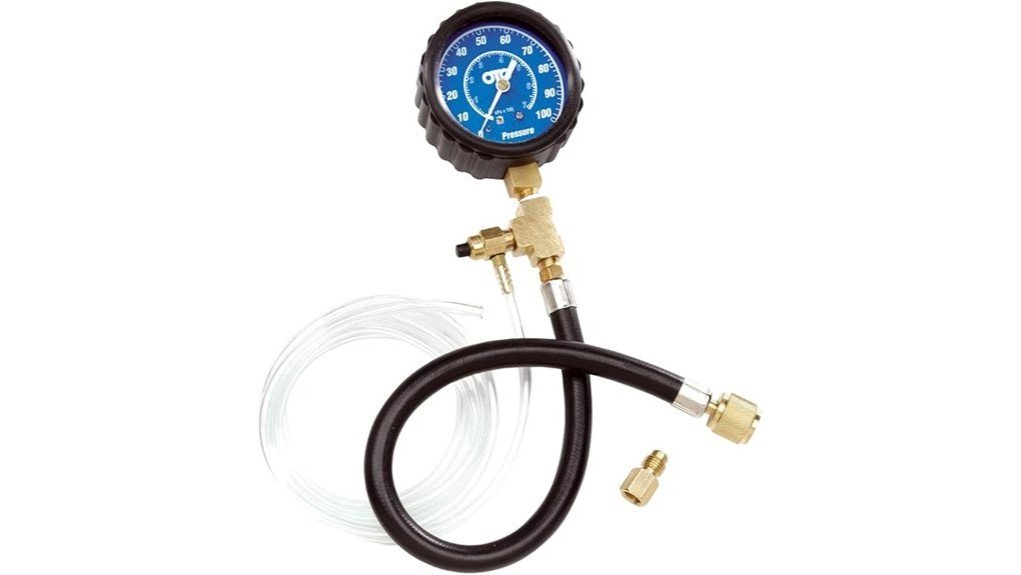
A weak fuel pump, restricted filter, faulty regulator, or leaking fuel line can create similar symptoms, so replacing parts without a pressure reading gets expensive fast. The OTC 5630 Fuel Pressure Test Kit gives you a large 0-100 psi gauge, solid brass fittings, attached hoses, an adapter fitting, and a pressure relief valve for common fuel-system checks. This review explains where the tool is useful, how to test more safely, and which compatibility limits you must check first. Its simple design is a strength, but it is not a universal master kit or a tester for high-pressure gasoline direct-injection and diesel common-rail systems.
Quick Verdict
Rating: 8.4/10, Recommended with compatibility caveats
Best For: DIY mechanics and technicians who need a straightforward 0-100 psi tester for a compatible conventional fuel system.
Bottom Line: The OTC 5630 combines a readable rubber-encased gauge, brass connections, and controlled pressure release in a compact tool. Its limited adapter coverage and 100 psi ceiling mean you must confirm the vehicle, test port, and required pressure range before buying.
| Specification | Detail |
|---|---|
| Brand | OTC |
| Model / part number | 5630 |
| Product type | Mechanical fuel pressure tester kit |
| Gauge range | 0-100 psi / 0-700 kPa |
| Gauge design | Large dial with impact-resistant rubber-encased housing |
| Materials | Solid brass fittings with rubber gauge protection |
| Included components | Tester with attached hoses and an adapter fitting |
| Safety feature | Pressure relief valve for controlled pressure release |
| Product dimensions | 11.7 × 4.7 × 1.7 in |
| Shipping weight | 1.05 lb |
| Warranty listing | Limited lifetime warranty; confirm current terms with the seller or manufacturer |
| Best use | Checking compatible fuel systems for pump, filter, regulator, and fuel-line problems |
| Compatibility limit | Not universal; the connector and 100 psi range must match the vehicle |
| Safety note | Use the vehicle service procedure, work in a ventilated area, avoid ignition sources, and release pressure before disconnecting. |
Key Takeaways
- The large gauge reads 0-100 psi and 0-700 kPa, which covers many conventional fuel-pressure checks.
- OTC uses solid brass fittings, attached hoses, an adapter fitting, and a rubber-encased gauge.
- The relief valve gives you a controlled way to release pressure after a test.
- The tool can help separate a pressure problem from other possible causes before you replace a pump, filter, regulator, or line.
- Vehicle fit is the main limitation. Confirm the test port, adapter, expected pressure, and test procedure for your exact engine.
What Is the OTC 5630 Fuel Pressure Test Kit?
The OTC 5630 is a mechanical fuel pressure tester for checking whether a compatible fuel system reaches and holds the pressure specified by the vehicle manufacturer. The gauge reads in both psi and kPa, so you can compare the result with service information that uses either unit.
The package is listed with the tester, attached hoses, and an adapter fitting. OTC also gives the gauge an impact-resistant rubber housing and uses solid brass fittings at the connections. The pressure relief valve helps you lower system pressure in a more controlled way when the test is complete.
This is a focused tester, not a large master kit. It makes the most sense when its adapter and 0-100 psi range match the vehicle you plan to diagnose.
Who Should Buy It?
Best For
- DIY mechanics who want a pressure reading before buying fuel-system parts.
- Technicians who need a compact 0-100 psi tester for compatible conventional systems.
- Owners troubleshooting no-start, hesitation, or pressure-hold problems with factory service information available.
Skip If
- Your vehicle needs a connector or adapter that is not included.
- You need to test a high-pressure gasoline direct-injection or diesel common-rail system.
- You regularly service many makes and need a master kit with broad adapter coverage and organized storage.
Before You Buy: Confirm four details for your exact year, make, model, and engine: the approved test point, required adapter, expected pressure range, and safe depressurizing procedure. A 100 psi gauge cannot safely replace equipment made for high-pressure direct-injection systems.
Key Features of the OTC 5630 Fuel Pressure Test Kit
Large 0-100 PSI Gauge
The dial reads from 0-100 psi and 0-700 kPa. The dual scale avoids unit conversion, and the large face helps you watch pressure during key-on, idle, and other service-manual tests.
The rubber housing protects against light bumps, but keep the gauge away from heat, moving belts, and cooling fans.
Solid Brass Fittings and Attached Hoses
OTC specifies solid brass fittings, and Amazon lists attached hoses with an adapter fitting. Brass connections give the tool a more substantial connection point than lightweight plastic parts, but a good seal still depends on clean threads, undamaged seals, and the correct adapter.
Inspect the hose for cracks, stiffness, swelling, or cuts before every test. Do not try to stop a leak by overtightening a mismatched fitting.
Pressure Relief Valve
The built-in relief valve is the kit’s most useful handling feature. It lets you lower pressure in a controlled way after testing instead of loosening a pressurized connection and risking a sudden spray.
The valve does not replace the vehicle’s service procedure. Keep absorbent material and an approved fuel container available when required, and never discharge fuel onto hot engine parts or the ground.
Compact, Focused Package
At 11.7 × 4.7 × 1.7 inches with a listed shipping weight of 1.05 pounds, the kit takes less storage space than a multi-adapter master set. That is convenient for a home toolbox or mobile diagnostic bag.
The tradeoff is limited coverage. Amazon lists an adapter fitting, not a broad assortment of vehicle-specific connections, and a carrying case is not listed among the included components.
Fit, Compatibility, and Safety
The OTC 5630 is designed to help locate problems involving fuel filters, pressure regulators, lines, and pumps without removing those components first. It can be useful only when the vehicle provides a compatible connection and its expected pressure stays within the gauge range.
Do not assume every gasoline vehicle uses a low-pressure rail test port. Many gasoline direct-injection systems have a low-pressure supply side and a much higher-pressure side. Use the OTC 5630 only at a connection and pressure range specifically approved by the vehicle manufacturer.
Wear eye protection and fuel-resistant gloves, work outdoors or in a well-ventilated shop, and keep sparks, cigarettes, heaters, and open flame away. OTC also publishes a California Proposition 65 warning for nickel and lead exposure. Wash your hands after handling the tool and follow all product and vehicle warnings.
Pro Tip: Write down the factory pressure specification and each test condition before you connect the gauge. A single number has little value unless you know whether it was taken key-on, at idle, under load, or during a pressure-hold test.
How to Use the OTC 5630 for Accurate Testing
Use the following sequence as a planning guide, not as a replacement for the service manual. Connection points and pressure-release steps vary by vehicle.
| Step | Action | Why It Matters |
|---|---|---|
| 1 | Find the factory pressure specification and approved test procedure. | Normal pressure and test conditions vary by engine. |
| 2 | Inspect the gauge, hose, fittings, seals, and relief valve. | Damage can create leaks or unreliable readings. |
| 3 | Relieve vehicle fuel pressure as directed before connecting. | This reduces the risk of pressurized fuel spray. |
| 4 | Attach the correct fitting to the approved test point and check for leaks. | A secure, compatible connection supports a safer and more accurate test. |
| 5 | Run the key-on, idle, load, or hold test specified by the manufacturer. | Different faults appear under different test conditions. |
| 6 | Record the reading and compare it with the factory range. | Low, high, unstable, or rapidly falling pressure can guide the next diagnostic step. |
| 7 | Shut down, use the relief valve, and disconnect according to the service procedure. | Controlled pressure release reduces spray and cleanup. |
Common Mistakes to Avoid
- Testing without the factory specification: The gauge cannot tell you whether a reading is normal without the correct target and test condition.
- Assuming the adapter fits: A forced or improvised connection can leak and damage threads or seals.
- Judging the pump from one reading: A complete diagnosis may require key-on pressure, running pressure, pressure hold, regulator response, voltage checks, or flow testing.
- Disconnecting under pressure: Shut down and use the approved pressure-release procedure before loosening any connection.
- Ignoring other causes: A low reading can involve the pump, filter, regulator, line restriction, leak, wiring, voltage supply, or test setup.
How It Performs in Real Use
For Crank-No-Start Diagnosis
When the engine cranks but does not start, the OTC 5630 can show whether a compatible fuel system builds pressure during the specified key-on or cranking test. A normal reading helps you move toward ignition, injector control, compression, or other checks instead of replacing the pump automatically.
For Rough Idle and Hesitation
A large dial makes it easier to watch pressure for drops or instability while you follow the service procedure. The result can support a diagnosis, but pressure alone does not prove which component has failed.
For Pressure-Hold Checks
Some service procedures ask you to watch how quickly pressure falls after shutdown. The 0-100 psi dial lets you record that change over time, which may point toward a leak, check valve, regulator, or injector issue when interpreted with factory information.
For Occasional DIY and Mobile Use
The compact body is easier to store than a large master kit, and the relief valve makes cleanup more manageable. For a shop that services many vehicle brands, limited adapter coverage may become frustrating faster than the tool’s compact size becomes helpful.
How the OTC 5630 Compares to Alternatives
The BETOOLL 0-140 PSI Master Kit is worth comparing when you need a wider pressure range and more adapter coverage. The Orion Motor Tech 0-140 PSI Fuel Injection Pressure Tester Kit is another option for buyers who want a broader range and quick-connect fittings.
The OTC 5630 makes more sense when you prefer a simpler 100 psi tester from an established automotive tool brand and have already confirmed that its connection fits your vehicle. A master kit may cover more vehicles, but it also gives you more fittings to organize, inspect, and match correctly.
Maintenance and Storage
Clean and inspect the kit after each use, then store it away from heat, sunlight, moisture, and sharp tools.
- Wipe the gauge and external fittings with a clean, soft cloth.
- Follow the product instructions for removing any fuel left in the hose or tubing.
- Inspect hoses for cracks, cuts, swelling, stiffness, or soft spots before storage and before the next test.
- Keep the brass threads and sealing surfaces clean.
- Do not store the gauge under heavy parts that can damage the dial or housing.
- Replace damaged hoses, seals, fittings, or valves instead of trying to patch a fuel leak.
Pros and Cons
Pros
- Large dual-scale 0-100 psi / 0-700 kPa gauge is easy to compare with factory specifications.
- Impact-resistant rubber housing gives the gauge useful protection in a toolbox or engine bay.
- Solid brass fittings and attached hoses create a more substantial setup than basic plastic connections.
- Pressure relief valve supports controlled depressurizing after a test.
- Compact dimensions make the tester easier to store than a large master set.
Cons
- The listed adapter setup is not universal, so fit must be confirmed before purchase.
- The 100 psi maximum is unsuitable for high-pressure gasoline direct-injection and diesel common-rail testing.
- A carrying case and broad vehicle-specific adapter assortment are not listed as included components.
Is It Worth the Price?
The OTC 5630 is worth considering when you need a focused mid-range tester. Its readable dial, brass fittings, attached hoses, relief valve, and listed limited lifetime warranty support repeat use.
You get the most value when one correct diagnosis prevents an unnecessary pump, regulator, or filter replacement. It is not the best fit if you need many adapters, pressure above 100 psi, or equipment for high-pressure direct-injection systems.
Customer Reviews: What to Check Before You Trust Them
The OTC 5630 is consistently well-reviewed on Amazon, but vehicle-specific comments are more useful than a general rating. Look for reviews that name the year, make, model, engine, connection point, and test performed.
Pay close attention to comments about gauge readability, leaks, damaged hoses, adapter fit, and pressure hold. A review saying the tool worked on one vehicle does not confirm that it will connect to yours.
Frequently Asked Questions
What pressure range does the OTC 5630 measure?
The gauge reads 0-100 psi and 0-700 kPa. Compare every reading with the factory specification for your exact engine and test condition.
Is the OTC 5630 compatible with every vehicle?
No. The vehicle must have an approved connection that matches the included fitting, and its test pressure must stay within the 100 psi gauge range.
What comes with the OTC 5630?
The current Amazon listing identifies a tester with attached hoses and an adapter fitting. It does not list a large vehicle-specific adapter assortment or carrying case, so check the current package details before ordering.
Can you use it on gasoline direct-injection or diesel common-rail systems?
Not on the high-pressure side. Those systems can operate far above this gauge’s 100 psi limit and require equipment approved for the exact system and pressure range.
Can the kit prove that a fuel pump is bad?
It can show whether pressure is low, high, unstable, or falling too quickly. You may still need flow, voltage, current, wiring, regulator, restriction, and leak checks before blaming the pump.
What tests can you perform besides an idle-pressure check?
Depending on the service manual, you may check key-on pressure, cranking pressure, pressure under load, regulator response, and pressure hold after shutdown. Perform only the tests approved for your vehicle.
Does the OTC 5630 have a warranty?
Amazon currently lists a limited lifetime warranty. Warranty coverage can depend on the seller, purchase channel, and claim terms, so confirm the current policy before you buy.
What safety steps matter most?
Work in a ventilated area, wear eye and hand protection, keep ignition sources away, inspect every connection, and follow the vehicle’s pressure-release procedure. Never loosen the tester while the system is pressurized.
The Bottom Line
The OTC 5630 Fuel Pressure Test Kit is a smart buy for a DIY mechanic or technician who needs a compact, readable 0-100 psi tester and has confirmed vehicle compatibility. Its brass fittings, rubber-encased gauge, and relief valve are meaningful strengths, while limited adapter coverage and the 100 psi ceiling are the main reasons to skip it.
Choose it for compatible conventional fuel-system diagnostics, not as a universal master kit or high-pressure direct-injection tester.
Ready to Buy?
Confirm your vehicle connection, pressure range, and current package details before you decide.