If you’re starting in Norman and want to explore Oklahoma’s ghost towns, think statewide road trip rather than local sightseeing. The places in this guide stretch from central Oklahoma to the southeast, northeast, north-central region, and Panhandle. Their stories include coal mining, railroads, the Choctaw Nation, frontier commerce, oil development, and Old West law enforcement.
Quick Answer
The ghost towns covered here are not in Norman itself. Fallis and Ingalls are in central Oklahoma, while Adamson, Beer City, Boggy Depot, Doaksville, Ingersoll, and Cayuga require longer trips. For easier historical sightseeing, prioritize places with established visitor access such as Boggy Depot Park, Doaksville and Fort Towson, Ingalls, and Cayuga’s Splitlog Church.
Key Takeaways
- None of the eight featured ghost towns is actually located in Norman, so plan them as Oklahoma road trips from Norman.
- Not every “ghost town” is completely abandoned; some have a few residents, active historic buildings, monuments, cemeteries, or park facilities.
- Ingersoll is primarily a railroad and agricultural story, while the famous Doolin-Dalton gunfight belongs to Ingalls.
- Never enter abandoned mines, unstable buildings, farm fields, cemeteries, or private property unless access is clearly allowed.
- Picher should not be treated as a casual sightseeing destination because Oklahoma Tourism currently describes it as inaccessible to tourists and the surrounding Tar Creek area remains an active Superfund cleanup site.
Discovering the Unique Experiences in Oklahoma’s Ghost Towns
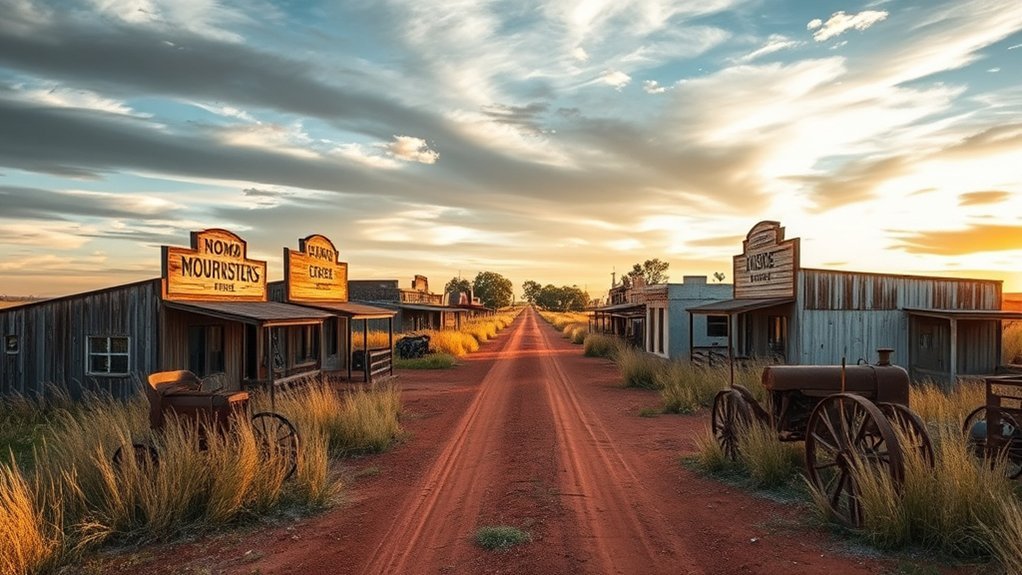
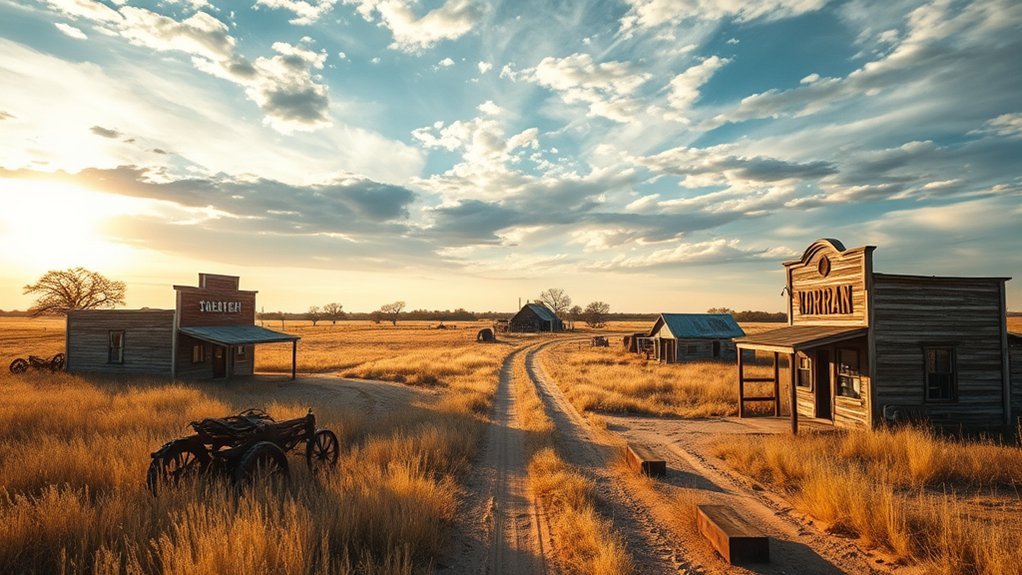
Oklahoma’s ghost towns are not all deserted movie-set-style settlements. The Oklahoma Historical Society uses a broad definition that can include vanished communities, settlements where old homes or businesses remain mostly unused, and places whose population fell at least 80 percent from its peak.
Oklahoma historian John W. Morris estimated that the state had roughly 2,000 ghost towns when communities with severe population decline and surviving but largely unused remnants are included.
That definition explains why the places in this guide look so different. Beer City has essentially disappeared into agricultural land. Adamson preserves traces of a coal-mining community. Boggy Depot and Doaksville connect visitors with nineteenth-century Choctaw and Chickasaw history. Ingersoll and Fallis survived as tiny communities after losing most of their former population. Cayuga is especially unusual because its historic Splitlog Church still survives.
The strongest ghost-town trip is therefore less about finding abandoned buildings and more about reading the landscape: cemeteries, foundations, monuments, railroad remnants, historic churches, and nearby museums can reveal why communities appeared and why they declined.
Are These Ghost Towns Actually Near Norman?
No. They are spread across Oklahoma. If you are leaving from Norman, treat this list as a collection of separate road-trip destinations rather than a single local ghost-town loop.
| Place | Part of Oklahoma | What Visitors Can Expect |
|---|---|---|
| Fallis | Lincoln County, central Oklahoma | A very small surviving community with railroad, oil, Black-history, and literary connections. |
| Ingalls | Payne County, north-central Oklahoma | Battle monument and replicas connected with the 1893 Battle of Ingalls. |
| Adamson | Pittsburg County, southeast Oklahoma | Scattered remains of a former coal-mining community and a miners’ memorial. |
| Boggy Depot | Atoka County, southeast Oklahoma | Historic cemetery, markers, and a developed public park. |
| Doaksville | Choctaw County, southeast Oklahoma | Cemetery and archaeological remnants beside the Fort Towson historic area. |
| Ingersoll | Alfalfa County, northwestern Oklahoma | A greatly reduced railroad-era community with an old grain elevator. |
| Cayuga | Delaware County, northeast Oklahoma | The surviving historic Splitlog/Cayuga Mission Church. |
| Beer City | Texas County, Oklahoma Panhandle | Former townsite now used primarily as agricultural land, with little conventional visitor infrastructure. |
Note: “Ghost town” does not automatically mean abandoned public property. Some townsites include private land, occupied homes, active churches, working farms, or cemeteries. Historical interest never gives visitors permission to enter restricted property.
Adamson: An Oklahoma Coal-Mining Ghost Town
Adamson sits in southeast Oklahoma between the McAlester and Wilburton areas, not in Norman. Its rise and decline were closely tied to coal. According to Oklahoma Tourism’s ghost-town history, the area once supported as many as 15 coal mines and became an important mining community during the early twentieth century.
Historical Significance of Adamson
Coal production drove Adamson’s economy, especially during an era when coal powered railroads and industry. The town’s best-known tragedy occurred on September 4, 1914, when Mine No. 1 collapsed after workers were ordered to evacuate. Fourteen miners were trapped underground and could not be recovered.
A memorial later honored the miners who died. The disaster became an important part of the area’s mining history and illustrates the serious risks faced by Oklahoma coal workers during the period.
Remnants of Old Structures
Adamson did not simply vanish overnight. Much of the former townsite was affected by the development and expansion of Lake Eufaula, while scattered houses, a cemetery, and the miners’ monument remained as reminders of the community.
The surviving landscape is more meaningful when you arrive expecting historical traces rather than a preserved downtown. Old structures should be viewed from safe, legal areas rather than entered.
Warning: Former mining areas can contain unstable ground, hidden shafts, deteriorated structures, and private property. Never explore a mine opening or enter abandoned buildings, and do not cross fences or leave public roads without permission.
Nearby Attractions and Activities
Adamson works best as a historical stop within a larger southeast Oklahoma trip. McAlester and Krebs provide more context for the region’s coal-mining and immigrant history, while the Wilburton area offers access to public outdoor recreation. If you want hiking or a longer nature stop, verify current information for nearby state parks before leaving.
Beer City: Secrets and Stories
Beer City was a short-lived settlement in what is now the Oklahoma Panhandle. The Oklahoma Historical Society dates it to 1888 and describes it as one of Oklahoma’s colorful “liquor towns,” serving cowboys and cattle dealers with saloons and dance halls.
Historical Significance
Beer City stood in the region then widely called No Man’s Land or the Public Land Strip. From 1850 until 1890, the strip was not attached to a U.S. state or organized territory. That unusual political situation helped give places such as Beer City their frontier reputation.
The town lasted only a short time. In 1890, the Oklahoma Organic Act made the Panhandle part of Oklahoma Territory. Oklahoma Historical Society records say Beer City’s liquor-town era ended as territorial government and law enforcement took hold.
Today, Oklahoma Tourism describes the former townsite as agricultural land rather than a preserved historical attraction. Visitors should not enter fields or other private property without permission.
Local Legends and Lore
Beer City’s reputation grew far beyond its physical size. Period accounts and later retellings gave it the nickname “Sodom and Gomorrah of the Plains,” and stories circulated about violence, saloons, and the absence of formal law.
Those stories are part of the town’s cultural memory, but folklore should not be presented as proof of paranormal activity. Claims that visitors can see “shadowy figures” or experience supernatural events cannot be verified. The documented history of an unusual settlement in No Man’s Land is interesting enough without turning legend into fact.
Boggy Depot: A Major Historic Crossroads
Boggy Depot is an important historic site in Atoka County, not part of Norman’s local history. The Oklahoma Historical Society identifies it as the location of the first Chickasaw agency in the West and notes that it also served at times as a capital of the Choctaw Nation.
The community became an important transportation and commercial point in Indian Territory. Its post office opened in 1849, and the site later became part of major overland travel networks. During the Civil War, Boggy Depot served as an important Confederate supply depot in Indian Territory.
| Feature | Verified Detail |
|---|---|
| Early Development | Established as an important settlement in the 1830s; OHS dates Boggy Depot’s establishment to 1837. |
| Post Office | Opened in 1849. |
| Historic Roles | Agency site, transportation crossroads, commercial center, and Confederate supply depot. |
| Decline | The Missouri, Kansas and Texas Railroad bypassed Boggy Depot in 1872, helping shift commerce elsewhere. |
| Current Remnants | Historic cemetery, markers, and the surrounding park landscape. |
Today, Boggy Depot Park is managed by the Chickasaw Nation and offers public recreational facilities in addition to the historic landscape. This makes Boggy Depot one of the easier places in this guide to combine history with a conventional park visit.
Doaksville: Exploring Its Historical Significance
Doaksville developed beside Fort Towson in southeast Oklahoma and became one of the region’s most important nineteenth-century communities. Its history is closely tied to the Choctaw Nation, trade, transportation, and the Civil War.
Historical Role in the Choctaw Nation
Doaksville served as an important political center for the Choctaw Nation during the mid-nineteenth century. The Oklahoma Historical Society records that the Choctaw capital was moved away from Doaksville in 1863.
The town also functioned as a trade and supply center near Fort Towson. After the Civil War, changing transportation patterns and economic conditions reduced its importance. The arrival of a railroad about a mile south in 1870 encouraged activity to shift toward present-day Fort Towson.
Civil War Significance
Doaksville is especially significant because Confederate Brigadier General Stand Watie, a Cherokee leader, surrendered his command there on June 23, 1865. The Oklahoma Historical Society’s Doaksville and Fort Towson resources identify Watie as the last Confederate general officer to capitulate.
Today, the old cemetery and remains of foundations provide evidence of the former town. Nearby Fort Towson gives visitors a more developed historic-site experience and useful context for understanding Doaksville.
Note: Cemeteries are historical resources as well as burial places. Stay on established paths when possible, do not touch fragile markers, and never make rubbings or move objects unless site rules specifically allow it.
Ingersoll: What Remains of This Railroad Town?
Ingersoll’s real history centers on railroads, wheat farming, and competition for the Alfalfa County seat—not the Doolin-Dalton outlaw story associated with Ingalls.
The Choctaw Northern Railroad reached the area in 1901 and helped establish Ingersoll as an agricultural shipping point. It later competed with nearby Cherokee for economic influence and county-seat status. In 1909, Cherokee won the county-seat election.
Some tourism accounts repeat a claim that Ingersoll briefly exceeded 1,500 residents, but the Oklahoma Historical Society’s Alfalfa County history reports that Ingersoll’s census population peaked at 253 in 1910. The town later declined and eventually lost its incorporated status.
An old grain elevator remains one of the better-known physical reminders of Ingersoll’s agricultural past. The community’s decline mirrors the story of many western Oklahoma railroad towns that lost population as farms consolidated, transportation changed, and nearby communities became stronger commercial centers.
If you continue toward the Salt Plains area, the U.S. Fish & Wildlife Service operates a seasonal selenite crystal-digging area at Salt Plains National Wildlife Refuge. The official season currently runs from April 1 through October 15, so verify current rules before making it part of your trip.
Cayuga: Uncovering Splitlog Church and Its History
Cayuga, in northeast Oklahoma’s Delaware County, is unusual among the destinations in this guide because one of its most important buildings still survives. Mathias Splitlog helped develop the settlement and was responsible for the historic Splitlog Church, also known as Cayuga Mission Church.
Oklahoma Tourism describes the building as a Gothic-style church completed in the nineteenth century. A large bell once stood in its belfry; historical accounts describe it as weighing about 1,600 pounds and reportedly being audible from miles away. That should be understood as a historical account rather than a claim that the bell currently rings there.
The Oklahoma Historical Society identifies Splitlog Church as a still-active historic church and a National Register property. That makes the description of it as a set of “crumbling walls” inaccurate.
Visitors should therefore approach Cayuga differently from an abandoned townsite. Enjoy the architecture and historical setting, but respect services, events, posted rules, and any areas not open to visitors. Grand Lake and the Grove area can provide additional public attractions on a longer northeast Oklahoma trip.
Fallis: Exploring Lincoln County’s Oil and Railroad History
Fallis is a tiny surviving community in western Lincoln County. It developed at a transportation crossroads where railroad access supported agricultural trade. The Oklahoma Historical Society reports that Lincoln County’s first oil well was drilled nearby in 1904.
The town’s history is broader than oil. Fallis had a notable African American community, and well-known people connected with the town included educator Frederick Douglass Moon, Medal of Honor recipient Riley L. Pitts, and broadcaster Jesse B. Blayton Sr. Fallis also became associated with several writers and poets.
Fallis never became a large city. Its population was 321 around statehood and fell dramatically during the twentieth century. The 2020 census counted only 20 residents. For that reason, it fits the broader historical definition of a ghost town even though the community did not become completely empty.
| Historical Aspect | Significance |
|---|---|
| First County Oil Well | Drilled near Fallis in 1904, marking an early stage of Lincoln County petroleum development. |
| Railroads | Rail connections helped make Fallis an agricultural trade center. |
| African American History | The community was home to prominent Black Oklahomans including Frederick Douglass Moon and Riley L. Pitts. |
| Literary Connections | Writers and poets were drawn to or associated with the small community. |
| Ghost-Town Status | A drastically reduced community rather than a completely abandoned town. |
| Route 66 Area | Its central Oklahoma location makes it possible to combine the visit with other regional historic-road attractions. |
The old barbecue-restaurant and grain-elevator description sometimes associated with this section actually belongs to Ingersoll, not Fallis. In Fallis, expect a small living community and scattered historical traces rather than a preserved ghost-town attraction.
Ingalls: The Outlaw History Behind This Ghost Town
Ingalls, in Payne County, is the town in this guide with the strongest documented connection to the Doolin-Dalton gang. In the 1890s, members of the outlaw gang used the area as a refuge, setting the stage for one of Oklahoma Territory’s best-known law-enforcement confrontations.
On September 1, 1893, deputy U.S. marshals confronted members of the gang in what became known as the Battle of Ingalls. The Oklahoma Historical Society records that three deputy U.S. marshals were killed during the fight.
Ingalls later declined significantly. Oklahoma Tourism records that the community was renamed Signet in 1921 before residents successfully pushed for the Ingalls name to return.
Today, the area includes replicas representing former town buildings and a stone monument honoring the lawmen killed in the 1893 battle. Those features make Ingalls more understandable to visitors than ghost-town locations where almost nothing remains above ground.
As with other sites, replicas should not be confused with original nineteenth-century structures. They help interpret the story, while the monument and documented historical record provide the strongest connection to the events themselves.
Planning Your Visit to Oklahoma’s Ghost Towns
A good ghost-town trip starts with realistic expectations. These places are scattered across Oklahoma, and several are remote or have few conventional attractions. Choose one region at a time instead of trying to combine all eight into one itinerary.
Before leaving Norman, use these basic planning rules:
- Check official access information the day you travel. Historic sites, parks, wildlife refuges, roads, and seasonal attractions can change hours or temporarily close.
- Stay on legal public access. Do not assume an abandoned-looking building, farm field, cemetery road, or old townsite is public property.
- Never enter mine workings or unstable ruins. Old shafts, weak floors, nails, broken glass, snakes, and collapsing masonry can turn casual exploring into a serious emergency.
- Bring water, fuel, and offline directions. Some ghost-town areas have limited services and weak mobile coverage.
- Treat cemeteries and churches respectfully. Do not climb monuments, touch fragile stones, interrupt services, or remove objects.
- Pair historical remnants with established attractions. Parks, museums, historical societies, and official historic sites often provide far more context than an unmarked townsite alone.
Warning: Do not make Picher a casual ghost-town exploration stop. Oklahoma Tourism currently describes Picher as inaccessible to tourists, and the surrounding Tar Creek area remains an active EPA Superfund site affected by historical lead and zinc mining waste.
Pro Tip: Build each trip around one visitor-ready historical site—such as Boggy Depot Park, Fort Towson/Doaksville, or Ingalls—and treat less-developed ghost-town remnants as secondary stops. You will get more historical context and spend less time searching for unmarked ruins.
Sources
- Oklahoma Historical Society — Ghost Towns — definition of Oklahoma ghost towns, Beer City, town decline, railroads, and statewide historical context.
- Oklahoma Tourism & Recreation Department — Oklahoma Ghost Towns — locations, surviving features, Adamson history, Cayuga, Ingalls, and visitor context.
- Oklahoma Historical Society — Boggy Depot — settlement, political, commercial, and Civil War history.
- Oklahoma Historical Society — Doaksville — Choctaw Nation history, decline, and Stand Watie’s surrender.
- Oklahoma Historical Society — Alfalfa County — Ingersoll railroad development, county-seat competition, and population history.
- U.S. Environmental Protection Agency — Tar Creek Superfund Site — current environmental and cleanup context for the Picher area.
Frequently Asked Questions
What is the most famous ghost town in Oklahoma?
There is no official ranking of Oklahoma’s “most famous” ghost town. Picher is nationally known because of its mining and environmental history, while Ingalls is well known for the 1893 outlaw gunfight. Beer City, Doaksville, Adamson, and other towns are prominent for different historical reasons.
Are you allowed to visit Picher, Oklahoma?
Do not plan Picher as a casual sightseeing destination. Oklahoma Tourism currently describes Picher as inaccessible to tourists, and the EPA continues work at the Tar Creek Superfund site. Use nearby established attractions instead and follow all official closures and access restrictions.
Where is the prettiest place in Oklahoma?
There is no objective “prettiest” place, but the Wichita Mountains Wildlife Refuge is one of Oklahoma’s most distinctive natural landscapes, with granite mountains, mixed-grass prairie, and wildlife. Check the U.S. Fish & Wildlife Service before visiting because weather-related restrictions can change. As of August 15, 2026, temporary heat restrictions limit hiking to the period from sunrise to 10 a.m. until further notice.
What is the most popular ghost town in Oklahoma?
There is no authoritative statewide visitor ranking. If you want an easier sightseeing experience, Boggy Depot, Doaksville/Fort Towson, Ingalls, and Cayuga are useful choices because identifiable historic features or visitor resources remain. Remote vanished townsites may offer less to see.
Which of these ghost towns are closest to Norman?
Fallis in Lincoln County and Ingalls in Payne County are the central Oklahoma destinations on this list and are more practical starting points for a Norman-based road trip. Beer City, Cayuga, Doaksville, Boggy Depot, Adamson, and Ingersoll are in more distant regions of the state.
Can you go inside abandoned buildings in Oklahoma ghost towns?
Not unless the property owner or managing agency clearly permits entry. An abandoned appearance does not make a building public property. Old structures may also have unstable floors, collapsing roofs, broken glass, exposed nails, wildlife, or other hazards. View ruins from legal public areas and follow posted rules.
Conclusion
Oklahoma’s ghost towns are worth exploring for their history, but they are not all the same kind of destination. Adamson preserves a difficult coal-mining story; Beer City reflects the unusual history of No Man’s Land; Boggy Depot and Doaksville connect visitors with Choctaw and Chickasaw history; Ingersoll and Fallis show how railroads and changing economies shaped small towns; Cayuga preserves an important historic church; and Ingalls tells one of Oklahoma Territory’s best-known outlaw stories.
If you’re starting from Norman, plan these places as separate regional road trips, verify access before leaving, stay off private property, and focus on documented history rather than invented ghost stories. The most rewarding visit is often the one where a cemetery, foundation, church, monument, or railroad remnant helps you understand why a community once mattered.