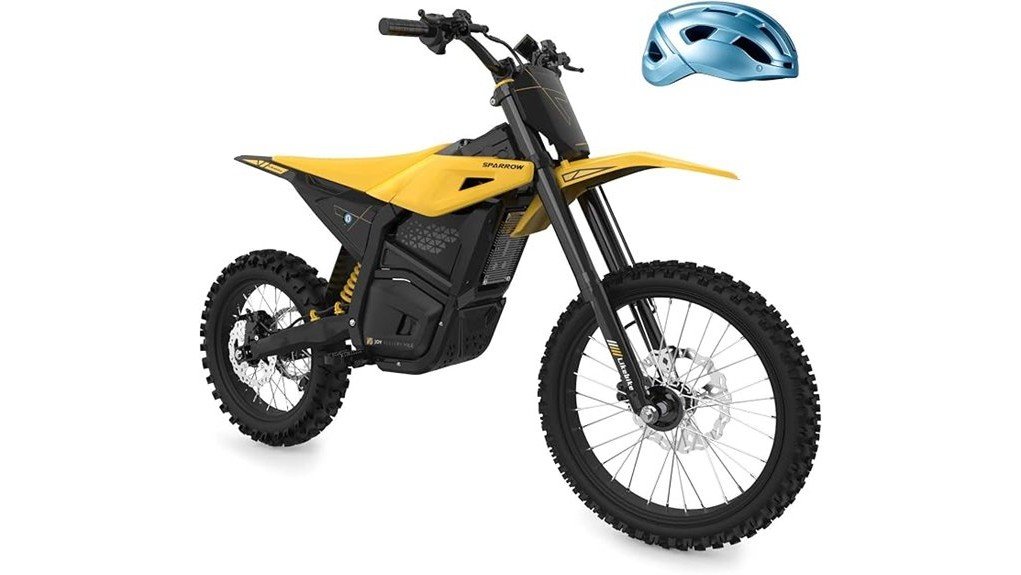
Climbing-focused full-suspension mountain bikes in [2026] range from lightweight carbon builds to budget-friendly trail options. Some emphasize efficiency on steep grades, while others lean on suspension design, tire choice, and frame geometry for better control. The TRIFOX Carbon M6100, SAVADECK Titan, and Canyon Spectral 125 AL 5 each take a different approach. Which models truly stand out becomes clearer with a closer look at their strengths and trade-offs.
Key Takeaways
- TRIFOX Carbon Full Suspension Mountain Bike is the best climbing-focused choice, with a lightweight carbon frame, 140 mm suspension, and Shimano M6100 drivetrain.
- SAVADECK Titan 612 excels on technical climbs, offering a carbon frame, dual-link suspension, and four-piston hydraulic disc brakes.
- Budget options like the 21-speed full-suspension bike, Ecarpat, and Max4out provide decent climbing performance for casual riders.
- Lighter frames and efficient suspension improve climbing speed, while proper geometry and rider fit boost traction and power transfer.
- Hydraulic disc brakes and grippy tires matter on climbs, especially for control on steep, loose, or technical terrain.
TRIFOX Carbon Full Suspension Mountain Bike (M6100)

The TRIFOX Carbon Full Suspension Mountain Bike (M6100) is a strong choice for intermediate trail riders who want efficient climbing without sacrificing downhill control. Its T800 carbon frame and integrated bar keep weight near 12.6 kg, while the 140 mm dual-suspension platform uses Free Floating Technology and an Active Braking Pivot to improve traction and reduce brake jack. A lower shock position helps stabilize handling. Shimano’s M6100 Deore 12-speed drivetrain and hydraulic disc brakes add reliable climbing and descending performance, and the 29 x 2.25-inch tires support grip. Three ride modes further refine efficiency.
Best For: Intermediate trail riders who want a lightweight carbon full-suspension bike with efficient climbing, solid downhill control, and modern Shimano 12-speed performance.
Pros:
- T800 carbon frame with integrated bar keeps weight low at about 12.6 kg for easier handling and climbing.
- 140 mm dual suspension with Free Floating Technology and Active Braking Pivot improves traction, stability, and brake-jack resistance.
- Shimano M6100 Deore 12-speed drivetrain plus hydraulic disc brakes provide dependable shifting and stopping power.
Cons:
- Best suited for intermediate riders, so it may not be ideal for absolute beginners or those wanting a highly specialized race bike.
- 29 x 2.25-inch tires offer good grip, but the setup may feel less aggressive than wider modern trail tires on very rough terrain.
- Carbon full-suspension bikes can be more expensive and may require more careful maintenance than simpler hardtail options.
SAVADECK Titan 612 Carbon Fiber Mountain Bike
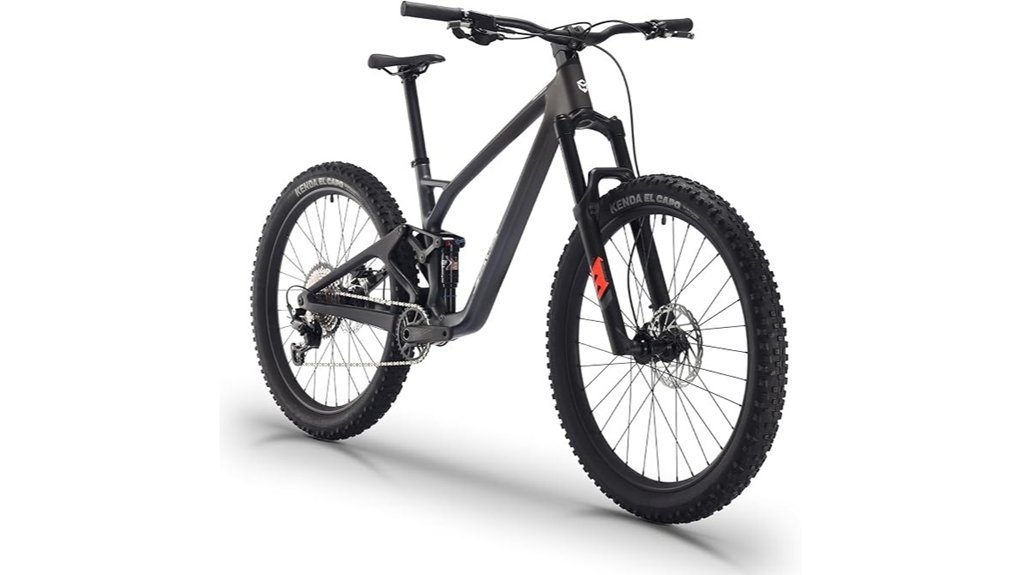
Built for technical climbs, the SAVADECK Titan 612 suits riders who want a lightweight full-suspension carbon frame. Its reinforced rear triangle, internal cable routing, and dual-link suspension with DNM air shock help maintain rigidity, wheel alignment, and control on rough ascents. Shimano DEORE M6100 12-speed shifting offers a wide range for steep grades, while four-piston hydraulic disc brakes add dependable stopping power. Continental 2.4 tires improve roll efficiency and grip across mud, gravel, and rock. Rebound adjustment and hydraulic lockout let riders adapt the bike to changing trail demands.
Best For: Riders who want a lightweight full-suspension carbon mountain bike for technical climbs, rough trails, and all-terrain performance.
Pros:
- Lightweight carbon full-suspension frame with reinforced rear triangle for stability and control
- Shimano DEORE M6100 12-speed drivetrain provides smooth shifting and a wide climbing range
- Four-piston hydraulic disc brakes and Continental 2.4 tires offer strong stopping power and solid grip
Cons:
- Full-suspension carbon setup may be more expensive than hardtail alternatives
- 2.4 tires may not be ideal for riders wanting maximum flotation or cushioning on very rough terrain
- Hydraulic lockout and rebound tuning may require some setup knowledge to optimize correctly
Mountain Bike with Full Suspension, 21-Speed Disc Brakes
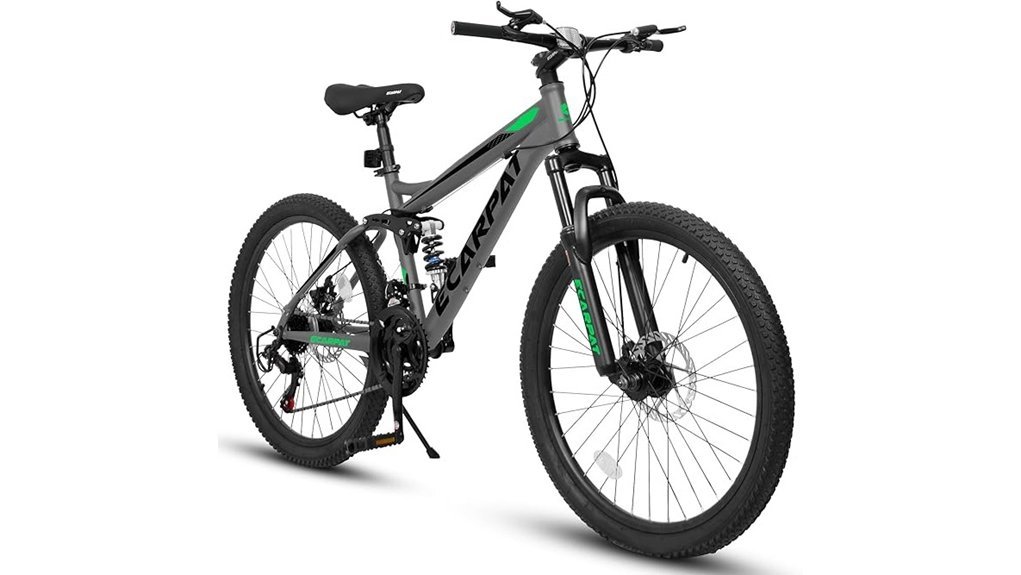
With its 21-speed shifting and dual disc brakes, this full-suspension bike suits riders tackling mixed terrain climbs. Its high carbon steel frame comes in 24, 26, and 27×16-inch sizes, supporting riders from 48 to 66 inches tall and up to 250 pounds. The 21-speed lever includes a gear indicator for controlled changes on steep sections. Mechanical disc brakes simplify upkeep while delivering dependable stopping force. Puncture-resistant 24×2.125 tires add grip on dirt, gravel, and pavement. It arrives 85% assembled, with basic setup required.
Best For: Riders 48–66 inches tall who want an affordable full-suspension mountain bike for mixed terrain, with reliable 21-speed shifting and easy-to-maintain disc brakes.
Pros:
- 21-speed gearing with a gear indicator makes shifting smoother and easier to control.
- Mechanical dual disc brakes provide dependable stopping power with simple maintenance.
- Puncture-resistant all-terrain tires offer good grip on dirt, gravel, and pavement.
Cons:
- 85% pre-assembled bike still requires setup of several key parts before riding.
- High carbon steel frame is durable but can be heavier than aluminum options.
- Full suspension and basic components may be less ideal for advanced or aggressive riders.
Ecarpat 26 Inch Full Suspension Mountain Bike
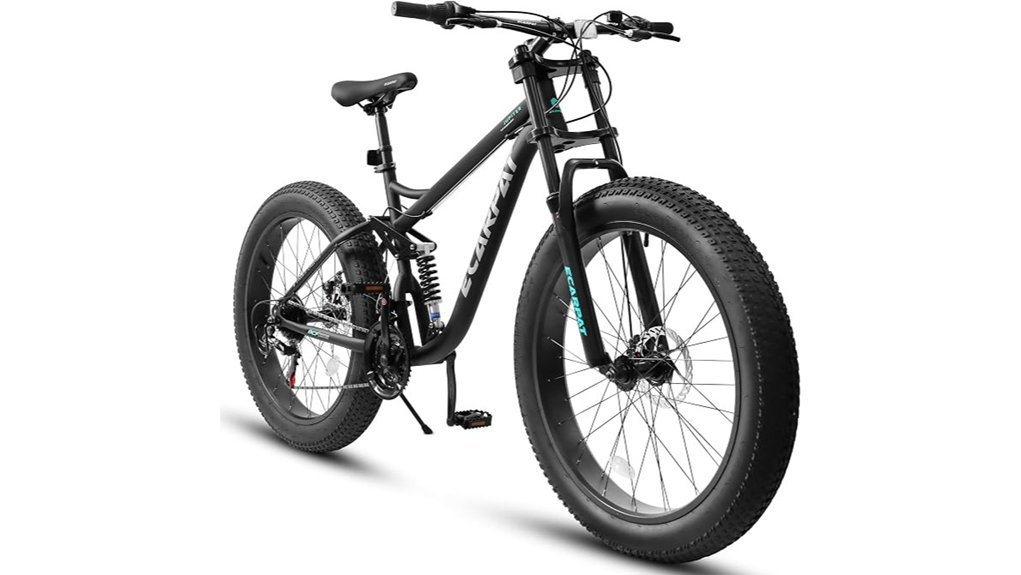
For riders needing stability on mixed terrain, the Ecarpat 26-inch full-suspension bike offers solid climbing support. Its 18.5-inch high-carbon steel frame adds durability for mountain rides, commuting, or daily use, while the thickened front fork and rear shock absorbers help smooth rough climbs. The 26 x 4.0-inch fat tires improve grip across snow, sand, road, and trail, and the puncture-resistant tread includes reflective strips. A 21-speed drivetrain supports varied grades, and mechanical disc brakes deliver dependable stopping in wet mud or loose terrain. It arrives 85% assembled, with customer support responding within 24 hours.
Best For: Riders who want a stable, budget-friendly fat-tire mountain bike for mixed terrain, commuting, and light off-road use.
Pros:
- Full-suspension design with thickened front fork and rear shock for a smoother ride on rough terrain
- 26 x 4.0-inch fat tires offer strong grip and improved stability on snow, sand, road, and trail
- 21-speed gearing and mechanical disc brakes provide versatile control and dependable stopping power
Cons:
- High-carbon steel frame is durable but heavier than aluminum alternatives
- 85% pre-assembled still requires some setup after delivery
- Better suited to casual and mixed-terrain riding than advanced technical mountain biking
Max4out 26-Inch Full Suspension Mountain Bike

The Max4out 26-Inch Full Suspension Mountain Bike suits riders seeking affordable traction and stability on climbs. Its high-carbon steel frame and dual suspension, combining a responsive front fork with a rear coil shock, help soften rough trails and maintain control. The 7-speed drivetrain with twist shifters offers practical gearing for varied gradients, while V-brakes provide dependable stopping power. Twenty-six-inch all-terrain tires improve grip, and the adjustable frame supports riders from 52 to 62 inches. At 39 pounds and 330-pound capacity, it balances durability, fit, and easy assembly.
Best For: Riders looking for an affordable 26-inch full-suspension mountain bike with reliable traction, basic gearing, and a sturdy frame for casual trail riding or everyday use.
Pros:
- Dual suspension helps smooth out rough terrain and improves ride comfort.
- 7-speed drivetrain with twist shifters makes gear changes simple and practical.
- High weight capacity and adjustable fit accommodate a wide range of riders.
Cons:
- At 39 lbs, it may feel heavy compared with lighter mountain bikes.
- V-brakes are dependable, but not as strong or modern as disc brakes.
- Best suited for entry-level or casual riding rather than aggressive trail performance.
VEVOR Mountain Bike with Dual Suspension and Disc Brakes
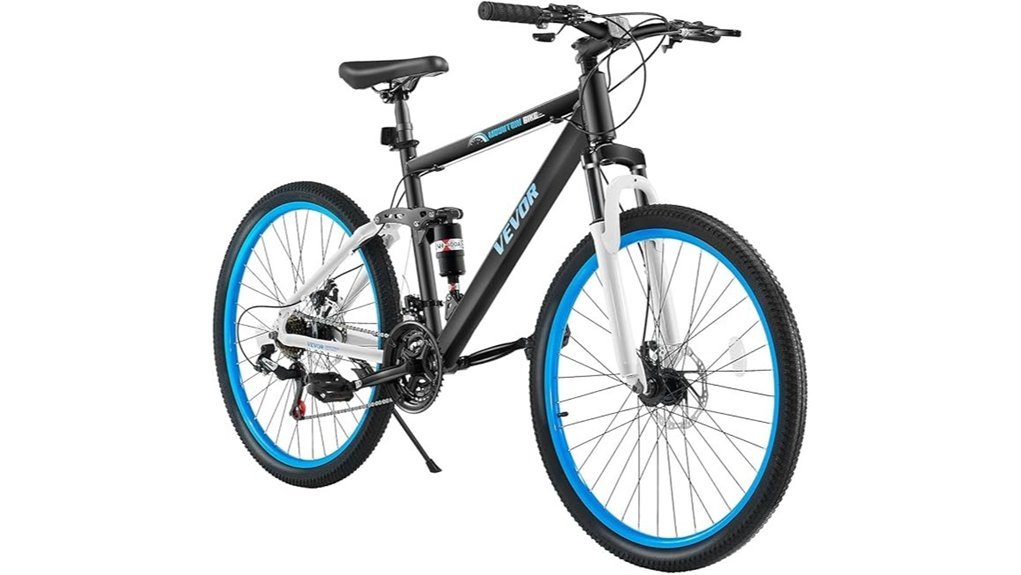
VEVOR suits budget-minded riders who want full suspension and easy climbing control. Its lightweight aluminum alloy frame, 26-inch wheels, and 21-speed drivetrain provide a practical balance of efficiency and range. Front suspension and full suspension help absorb trail chatter, while dual disc brakes improve control on steep descents and wet ground. Thick foam saddle padding and a shock pad add comfort on rough climbs. Arriving 85% pre-assembled with gloves and tools, it is easy to set up. Available in 20, 26, and 29-inch sizes, it fits riders 54 inches and taller.
Best For: Budget-minded riders who want a full-suspension mountain bike with easy climbing control, reliable disc braking, and a comfortable setup for trail riding.
Pros:
- Lightweight aluminum alloy frame with 26-inch wheels for a practical balance of efficiency and handling
- 21-speed drivetrain and all-terrain tires for versatility on gravel, soil, and rocky paths
- Dual disc brakes, front suspension, and full suspension improve control and comfort on rough terrain
Cons:
- At 35.3 pounds, it may feel heavy for some riders
- Assembly is only 85% complete, so some setup is still required
- Best suited for riders 54 inches and taller, limiting fit for shorter users
Syvrac Bike Suspension Fork for Mountain Bikes

Syvrac’s air-sprung 26-inch fork suits riders wanting lighter front-end control on technical climbs. Its double-shoulder, straight-tube design uses a magnesium alloy fork leg and aluminum alloy inner tube to keep weight at 3.63 kilograms. The MTB air shock absorber pairs right-side air pressure lockout with left-side damping adjustment, letting riders firm the front end when climbing. PM pure disc brake mounting and International A-Pillar compatibility support straightforward brake setup. With a 1-1/8-inch steerer, it fits 26-inch mountain, snow, beach, and e-bike builds needing a stout, adjustable front suspension.
Best For: Riders building or upgrading 26-inch mountain, snow, beach, or e-bike setups who want a lightweight air-sprung fork with adjustable damping and lockout for better front-end control.
Pros:
- Air-sprung suspension offers adjustable ride feel for climbing and technical terrain.
- Magnesium alloy fork legs and aluminum alloy inner tube help keep weight down at 3.63 kg.
- Compatible with PM pure disc brakes and International A-Pillar setups for easier installation.
Cons:
- Only fits 26-inch bikes with a 1-1/8-inch steerer, so compatibility is limited.
- At 3.63 kg, it is still relatively heavy compared with many modern forks.
- Double-shoulder downhill design may be overkill for casual riders or lighter trail use.
Canyon Spectral 125 AL 5

Built for intermediate trail riders, the Canyon Spectral 125 AL 5 pairs climbing efficiency with descending control. Its lightweight alloy frame and progressive geometry support stable handling on technical climbs and durable performance on rough trails. RockShox suspension, with 140mm up front and 125mm at the rear, helps absorb impacts without sacrificing pedaling traction. A Shimano Deore M6100 12-speed drivetrain provides a wide gear range for steep ascents and quick descents. Dual disc brakes, a dropper seatpost, and tubeless-ready 29-inch wheels round out a capable trail package. Canyon backs engineered components with a six-year warranty.
Best For: Intermediate trail riders who want a lightweight 29-inch mountain bike with efficient climbing, confident descending, and durable all-around trail performance.
Pros:
- RockShox suspension with 140mm front and 125mm rear travel offers strong control on rough and technical terrain.
- Shimano Deore M6100 12-speed drivetrain provides a wide gear range for climbing and descending.
- Trail-ready features like dual disc brakes, a dropper seatpost, and tubeless-ready wheels improve control and versatility.
Cons:
- Designed for intermediate riders, so it may not be the best fit for complete beginners or riders seeking a simpler setup.
- The 125mm rear travel may feel limited for aggressive enduro or bike-park riding.
- As a trail-focused bike, it may not be ideal for riders wanting maximum speed on cross-country courses.
Factors to Consider When Choosing a Climbing Full Suspension Mountain Bike
When choosing a climbing full-suspension mountain bike, weight and pedaling efficiency often shape how easily it ascends long or steep sections. Suspension balance, drivetrain gear range, tire traction, and brake control also play major roles in maintaining speed, grip, and confidence on varied terrain. A strong climbing setup combines these factors to support steady effort without sacrificing control on the descent.
Weight And Efficiency
Weight is one of the most important factors in a climbing full-suspension mountain bike, because lighter frames—especially carbon fiber models—improve climbing efficiency and reduce rider fatigue on long ascents. Overall bike mass strongly affects acceleration and responsiveness on steep gradients, so high-performance climbers often favor builds near 12.6kg (27.8lbs) or less. Efficiency also depends on how that weight is managed within the frame and suspension design. A lower shock position can help keep the center of gravity down, supporting steadier handling on technical climbs. Tire choice matters as well: 29-inch wheels roll over obstacles more smoothly and can improve traction and stability. When combined with smart weight distribution, these traits create a more efficient bike for sustained climbing performance.
Suspension Climb Balance
Suspension balance plays a major role in how well a full-suspension mountain bike climbs, since a lower shock position can drop the center of gravity and improve stability on steep, technical ascents. A well-tuned dual-suspension layout helps keep traction consistent, especially when climbing over loose or uneven ground. Designs with features such as an Active Braking Pivot can improve suspension control, supporting better power transfer and grip during seated efforts. Rear travel also matters; around 140mm is often enough to absorb trail impacts without adding unnecessary pedal bob. Frame geometry contributes as well, with slacker head angles helping distribute weight more evenly uphill. Integrated suspension systems that offer climb modes or lockout settings can further refine efficiency when the gradient steepens.
Drivetrain Gear Range
A wide drivetrain gear range helps a full-suspension mountain bike handle steep climbs more efficiently by providing lower ratios for sustained torque on demanding ascents and higher ratios for faster sections on flatter terrain. Wider ranges improve adaptability across changing gradients, letting riders maintain cadence without excessive strain. Twelve-speed systems, such as Shimano M6100, are especially useful because they supply more gear choices for varied trail conditions. Lower gears support slow, controlled climbing on steep pitches, while higher gears remain available when the trail eases. A quality drivetrain also matters because smooth, reliable shifting helps preserve momentum during shifts. Regular lubrication and adjustment keep the system performing consistently, particularly on long climbs where rough terrain can expose drivetrain weakness.
Tire Traction Choice
Beyond gearing, tire traction plays a major role in how well a full-suspension mountain bike climbs. Wider tires, typically 2.4 to 2.6 inches, with aggressive knobby tread, can bite into loose dirt, mud, and broken rock more effectively than narrow, smoother options. Rubber compound matters as well: softer compounds generally deliver stronger grip, though they may wear faster over time. Tire pressure should also match terrain, because slightly lower pressure enlarges the contact patch and helps the tire hold on slippery or loose climbs. Multi-terrain tires with specialized grooves offer a practical balance of rolling efficiency and traction across gravel, mud, and rocky trails. Overall bike and rider weight also influence climbing behavior, since a lighter setup often improves efficiency without sacrificing control on steep gradients.
Brake Control Power
Braking power is a key part of climbing control on a full-suspension mountain bike, especially on steep or technical ascents where stability matters as much as speed. Reliable brake response helps riders modulate speed on loose pitches, sharp turns, and rough sections without upsetting traction. Hydraulic disc brakes are often favored because they provide strong stopping force and precise control. Four-piston systems can improve heat management and resist fade during long climbs, keeping performance consistent when demands rise. Brake component weight also matters, since lighter parts can trim overall bike mass and support efficiency. Regular maintenance is equally important; checking pads, rotors, and fluid levels helps preserve dependable braking. Strong brake control contributes to safer, more efficient climbing across varied terrain.
Frame Geometry Fit
Frame geometry plays a major role in how a full-suspension mountain bike climbs, especially on steep or technical terrain where stability, traction, and rider position all affect performance. A slacker head tube angle lowers the center of gravity and improves confidence on steep ascents, while a steeper angle can feel quicker and more agile on descents. Reach and stack also shape fit: longer reach adds room to move, and higher stack can support a more upright climbing posture. Suspension design matters too; dual suspension with adjustable travel helps maintain traction and absorb impacts on rocky ground. Matching frame size to height and body type supports efficient power transfer, better pedaling comfort, and less fatigue during long climbs, making fit a key factor.
Frequently Asked Questions
How Does Suspension Lockout Affect Climbing Performance?
Suspension lockout improves climbing performance by reducing energy loss from bobbing, keeping pedal strokes more efficient on smooth ascents. It can sharpen traction and make the bike feel firmer under load. However, it is not always faster; on rough climbs, some suspension movement helps maintain rear-wheel contact and control. A good lockout is consequently a tool for efficiency, not a universal advantage, especially when terrain becomes technical or loose.
What Frame Geometry Climbs Best on Steep Trails?
A steep, efficient climbing geometry usually features a relatively steep seat tube angle, short chainstays, and moderate reach, keeping the rider centered over the pedals. A slack head angle is less important uphill than stability, while a low front end can help weight the front wheel. Excessively long wheelbases may feel stable but can reduce agility on technical climbs. Balanced anti-squat and low bottom bracket height also improve traction and control.
Are Lighter Wheels Important for Uphill Efficiency?
Yes—lighter wheels are important for uphill efficiency, though not as magically as one might hope. Reduced rotating mass makes acceleration and repeated climbs feel easier, especially on punchy ascents. The effect becomes more noticeable than simply shaving the same weight elsewhere on the bike. Still, tire choice, pressure, and rider position often matter more. In practice, lighter wheels help, but they are only one piece of the climbing puzzle.
How Much Travel Is Ideal for Climbing-Focused Riding?
For climbing-focused riding, about 120 to 140 mm of rear travel is often ideal, balancing traction, comfort, and pedaling efficiency. Shorter travel can feel livelier on smooth ascents, while longer travel usually adds weight and bobbing unless the bike’s suspension is highly refined. The best choice depends on terrain: steeper, rougher climbs benefit from extra travel, while smoother routes favor a firmer, more efficient platform and lighter overall setup.
Can Tire Choice Improve Climbing Traction on Loose Terrain?
Yes, tire choice can improve climbing traction on loose terrain. A softer compound, open tread pattern, and appropriately spaced knobs help the tire bite into dust, gravel, and broken soil. Lower rolling resistance is less important than grip when traction is scarce. Wider tires at slightly lower pressures can also increase contact area and control, though excessive softness may cause squirm or rim strikes on steep climbs.