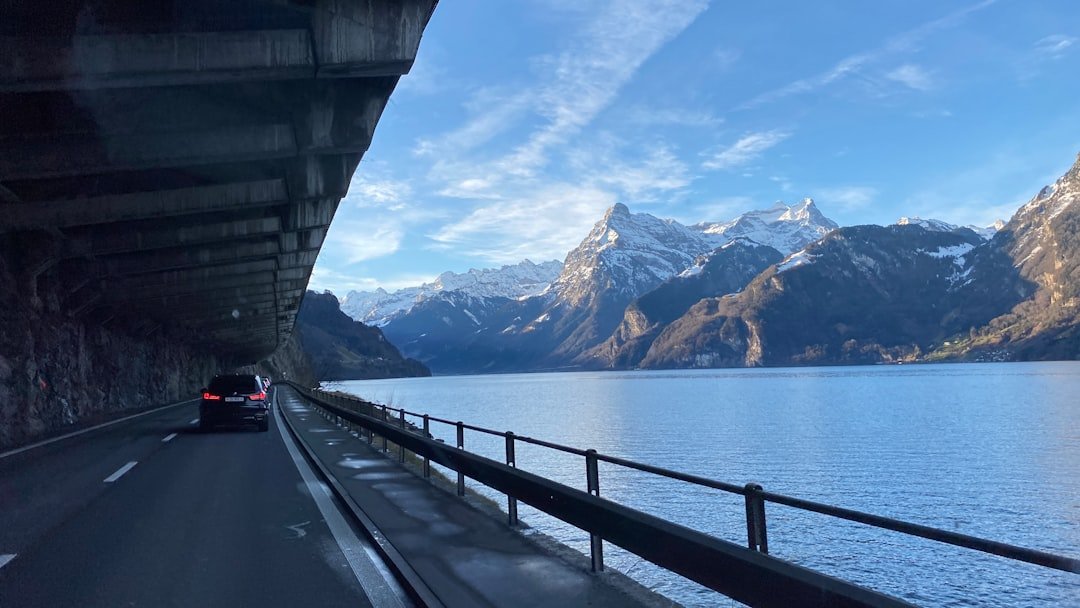
Driving in Switzerland is generally orderly and predictable, but several rules can surprise visitors. The most important driving in Switzerland rules cover speed limits, motorway vignettes, right-of-way, daytime lights, parking zones, alcohol limits, and winter conditions. Mountain roads also demand more care than ordinary city or motorway driving.
Quick Answer
Drive on the right and normally overtake on the left. General car limits are 50 km/h in built-up areas, 80 km/h outside them, 100 km/h on expressways, and 120 km/h on motorways. Motorway travel requires a vignette, while parking, alcohol, child-restraint, lighting, and winter rules need extra attention.
Last checked: October 1, 2026. Dates and figures were verified against official sources.
Key Takeaways
- The 2026 motorway vignette costs CHF 40 and is valid from December 1, 2025, through January 31, 2027.
- The general speed limits are 50, 80, 100, and 120 km/h depending on the road type, unless signs show a different limit.
- Visitors can generally use a valid foreign licence; people resident in Switzerland normally have to exchange a foreign licence after 12 months.
- The ordinary alcohol limit is below 0.05% BAC, with an effectively zero 0.01% limit for several categories of drivers.
- Winter tyres are not universally compulsory, but drivers must keep their vehicle under control. Snow chains become compulsory on roads marked with the relevant chain sign.
Obtaining a Swiss Driver’s License
Visitors do not normally need to obtain a Swiss licence simply to drive during a holiday. Residents, however, need to understand the exchange deadline, while people learning to drive in Switzerland must follow the Swiss learner-permit and testing process.
Using a Foreign Driving Licence in Switzerland
A valid national driving licence issued abroad can be used for the vehicle categories it covers. According to the Swiss Federal Department of Foreign Affairs guidance on foreign licences, an international driving permit may be used together with the national licence.
If you do not carry an international permit and your licence needs translation, carry an official translation in French, German, Italian, or English. Your name should appear in Roman characters so authorities can match the licence to your identification.
Foreign drivers who have lived in Switzerland for more than 12 months, without an uninterrupted stay abroad of more than three months during that period, generally need a Swiss licence. Exchange requirements can vary according to the country that issued the original licence and the licence category.
Learning to Drive in Switzerland
The original rule that a learner must always be at least 18 is no longer accurate. Under the current FEDRO/ASTRA driving-licence rules, a category B learner’s permit can be issued from age 17.
If you obtain the category B learner’s permit before your 20th birthday, a 12-month learning phase normally applies. This allows a learner who starts at 17 to become eligible for the practical test from age 18. People who obtain the learner’s permit after age 20 are not subject to that 12-month learning period.
Swiss licensing also includes theory and practical testing. Applications and licence exchanges are handled by the road traffic office in the relevant canton.
Motorway Vignette for 2026
If you use Swiss motorways or expressways, check whether your vehicle requires a vignette before entering those roads. The official 2026 motorway-vignette information states that the vignette costs CHF 40.
The 2026 vignette is valid from December 1, 2025, through January 31, 2027. There is no daily, weekly, or monthly version. Cars, motorcycles, trailers, caravans, delivery vans, and campers up to 3.5 tonnes generally need one when using roads covered by the vignette system.
You can use either the sticker vignette or the electronic vignette. Driving on a road where a vignette is required without one can result in a CHF 200 fine in addition to the cost of buying the vignette.
Note: Licence-exchange requirements can differ by issuing country, vehicle category, and professional use. If you are moving to Switzerland, confirm your individual case with your cantonal road traffic office before the 12-month deadline.
Traffic Rules and Regulations in Switzerland
Swiss traffic rules put a strong emphasis on predictable driving and protecting other road users. Drive on the right, normally overtake on the left, follow signed priority rules, and expect strict enforcement in both cities and rural areas.

At an intersection without priority signs or other controls, the basic “priority from the right” rule can apply. Signs, traffic lights, road markings, and special priority roads override that general rule.
- Seat belts: Everyone in a seat fitted with a belt must use it.
- Children: According to Switzerland’s official child-seat rules, children under 12 who are under 150 cm tall need an appropriate child restraint. Children over 150 cm and children over 12 use the normal seat belt.
- Phones: Do not hold or operate a mobile phone while driving. Even a hands-free conversation must not distract you from controlling the vehicle.
- Roundabouts: Give way to traffic already circulating in the roundabout and signal when leaving.
- Trams and buses: Watch carefully for public transport, particularly tram tracks and stops in urban areas.
Daytime Lights and Poor Visibility
Motor vehicles must use lights during the day. The Federal Roads Office guidance on daytime and dipped headlights explains that daytime running lights are sufficient in clear daylight.
Switch to dipped headlights when it is raining, snowing, foggy, getting dark, or when you drive through a tunnel. Daytime running lights alone may not illuminate the rear of the vehicle, which is especially important in poor visibility.
Motorway Rules That Can Surprise Visitors
Swiss motorways have several traffic-flow rules worth learning before congestion starts. They are designed to keep traffic moving while leaving access for emergency vehicles.
When a lane ends, use the zipper-merging system near the point where the lanes join instead of moving over far in advance. In slow motorway traffic, the same zipper principle also applies at entrances.
If motorway traffic slows to walking pace, form an emergency rescue lane even when no emergency vehicle is visible. On a two-lane motorway, leave the corridor between the two lanes. On a three-lane motorway, leave it between the far-left lane and the middle lane.
Keep right under normal conditions. Passing slower queues on the right can be permitted in congested traffic, but deliberately moving right, overtaking, and immediately moving left again remains prohibited.
Speed Limits and Enforcement
Switzerland uses kilometres per hour, not miles per hour. Unless a sign sets another limit, the general limits for passenger cars are 50 km/h in built-up areas, 80 km/h outside built-up areas, 100 km/h on expressways, and 120 km/h on motorways.
| Road type | General speed limit | What to watch for |
|---|---|---|
| Built-up areas | 50 km/h | Lower 20 or 30 km/h zones may be signed. |
| Roads outside built-up areas | 80 km/h | Signed reductions override the general limit. |
| Expressways | 100 km/h | Check signs for temporary or lower limits. |
| Motorways | 120 km/h | Variable or permanent lower limits may apply. |
These limits are confirmed by the Swiss authorities’ speed-limit guidance. Always follow the posted sign when it differs from the general limit.
Speed enforcement can include fixed and mobile measurement systems. Penalties increase with the seriousness of the violation and can go beyond a simple fine. More serious speeding can lead to licence withdrawal, while extreme speeding can result in criminal penalties.
Parking Regulations in Switzerland
Parking rules depend on signs, road markings, the municipality, and the type of parking zone. Do not assume an empty roadside space is free to use; check the markings, nearby signs, parking meter, and time restrictions before leaving the vehicle.
Blue Zones commonly require a parking disc. As a practical example, the City of Zurich’s Blue Zone instructions require the disc to be clearly visible and set to the next marked arrival time.
In Zurich, Monday through Saturday, the standard daytime Blue Zone permits one hour between 8:00–11:30 and 13:30–18:00. An arrival between 11:30 and 13:30 allows parking until 14:30, while an arrival between 18:00 and 8:00 generally allows parking until 9:00. Local signs can impose different restrictions, so the sign at the space always matters.
White parking spaces may be subject to payment or time limits. Yellow markings often indicate restricted or reserved areas. Parking machines and local apps are common in cities, while rural locations may have fewer formal spaces. Never block private property, access roads, farm entrances, or emergency access.
Driving in the Mountains and Rural Areas
Mountain driving requires lower speeds, longer sight-distance planning, and careful use of the brakes and gears. Swiss Alpine roads can be narrow, steep, and sharply curved, while conditions can change quickly with altitude.

Slow down before bends rather than braking hard halfway through them. On a long descent, select a lower gear so the engine helps control speed instead of relying continuously on the brakes.
On narrow roads, be prepared to stop where two vehicles cannot pass safely. Pay close attention to priority signs and instructions relating to buses or other large vehicles, which may need extra room on tight mountain sections.
Wildlife can also appear on rural roads, especially around dawn and dusk. Keep a speed that lets you stop within the distance you can see clearly.
Before entering a high mountain route, check the road and weather conditions for the route you intend to use. Snow, ice, rockfall, construction, or seasonal conditions can affect mountain roads even when lower valleys are clear.
Use designated pull-offs or parking areas if you want to stop for photographs. Stopping in a traffic lane or on a blind bend can put both you and other road users at risk.
Rules for Driving in Cities and Urban Areas
Swiss cities require particular attention to pedestrians, cyclists, trams, buses, and restricted-access streets. Traffic may move slowly even when the road itself looks clear because different transport modes often share a compact street layout.
Pedestrian zones and access-restricted streets are common in city centres. Read the entry signs carefully rather than following another vehicle into a restricted area.
Watch for cyclists before turning and before crossing a bike lane. When opening a parked car door, check behind you for approaching bicycles or e-bikes.
Tram tracks need extra attention. Do not stop where your vehicle blocks a tram, and watch for passengers around tram stops. Rails can also reduce tyre grip when wet, particularly for motorcycles and bicycles.
At traffic lights and crossings, follow the signals and markings even when other road users appear to be moving. Dense urban traffic is not a reason to enter a blocked intersection or obstruct a crossing.
Road Signs and Markings in Switzerland
Swiss road signs rely heavily on standardized shapes, colours, and symbols, making many of them understandable even if you do not speak a local language. Switzerland has German, French, Italian, and Romansh as national languages, but written road information normally reflects the language used in the region rather than displaying all four languages on every sign.
Solid road lines generally must not be crossed where crossing is prohibited. Dashed centre lines may allow you to cross or overtake, but only when the manoeuvre is otherwise legal and you have enough visibility and space.
Pedestrian crossings are marked prominently, and you should approach them at a speed that allows you to yield when required. Direction arrows, lane markings, bus lanes, bicycle markings, and temporary construction signs can also change how a road must be used.
Never rely on a general rule when a sign or traffic signal gives a specific instruction. Temporary signs around roadworks or incidents can override the normal arrangement.
Alcohol and Drug Driving Laws
For most drivers, Switzerland prohibits driving at a blood-alcohol concentration of 0.05% or higher. Certain groups face an effectively zero-alcohol limit of 0.01%, so the safest approach is not to drink at all when you intend to drive.
The official Swiss alcohol-driving rules apply the 0.01% limit to professional drivers, drivers holding a probationary licence, learner drivers and their accompanying drivers, and driving instructors.
Penalties can include fines and licence withdrawal, with more serious consequences at higher alcohol levels or when another traffic offence is involved.
Do not drive after taking illegal drugs or any medicine that impairs your ability to drive. Prescription and over-the-counter medicines can affect alertness, reaction time, or coordination, so follow the medicine’s warnings and professional advice.
Warning: If alcohol, drugs, or medication could impair you, do not drive. Use public transport, a taxi, or a sober driver instead.
Winter Driving and Snow Chains
Winter tyres are strongly recommended in cold and snowy conditions, but Switzerland does not impose a blanket legal requirement to fit them throughout winter. You are still responsible for keeping control of the vehicle and using equipment suitable for the conditions.
The Swiss authorities’ winter-tyre guidance recommends winter tyres between October and Easter. It also warns that insurance consequences may follow if inadequate tyres contribute to a crash.
Snow chains are a separate issue. Where the “snow chains compulsory” road sign is displayed, the Touring Club Switzerland snow-chain guidance explains that qualifying vehicles must fit chains to at least two driven wheels on the same axle, or use an approved equivalent device.
Practise fitting your chains before you need them on a snowy roadside. Also check that the chain size is compatible with your tyres and that your vehicle manufacturer allows chains on the wheels you intend to use.
On snow or ice, reduce speed gradually and leave more space between vehicles. Avoid sudden steering, acceleration, and braking. Bridges, shaded sections, and high-altitude roads can remain icy even when nearby surfaces look clear.
Tips for Safe and Enjoyable Driving in Switzerland
A good Swiss road trip is less about driving quickly and more about being prepared for changing road types. Plan for urban traffic, motorway rules, mountain gradients, parking restrictions, and weather rather than treating every part of the journey the same way.
- Check conditions before mountain drives. Weather and road conditions can be very different at higher elevations.
- Read signs before entering restricted streets. This is particularly useful in old city centres, pedestrian areas, and parking zones.
- Keep extra distance in bad weather. Snow, ice, rain, and fog all increase stopping distance and reduce visibility.
- Use lower gears on long descents. This reduces the amount of continuous braking needed.
- Take breaks on long journeys. A safe parking area or designated viewpoint is a better place to enjoy the scenery than the roadside.
- Keep right on motorways. Use the other lanes for permitted passing and follow the special congestion rules when traffic forms queues.
Swiss roads are well suited to exploring cities, lakes, villages, and the Alps, but the safest trip comes from treating posted signs as the final authority. A lower signed speed limit, chain requirement, parking restriction, road closure, or access rule overrides the general guidance in this article.
If you are planning to drive in Switzerland, it is useful to understand the road rules before your trip. Also on Tagline Today: Exploring the Delightful World of Asian Melon.
Frequently Asked Questions
What side of the road do you drive on in Switzerland?
You drive on the right-hand side of the road in Switzerland and normally overtake on the left. Pay close attention at intersections, roundabouts, tram lines, and mountain roads because signs or priority rules may require you to yield even when your lane appears clear.
What are the speed limits in Switzerland?
The general limits are 50 km/h in built-up areas, 80 km/h outside built-up areas, 100 km/h on expressways, and 120 km/h on motorways. Lower limits can be posted for residential areas, construction, traffic management, or other local conditions, and the posted sign takes priority.
Do I need a motorway vignette in Switzerland?
Yes, you generally need a vignette to use Swiss motorways and expressways with a car or other qualifying vehicle up to 3.5 tonnes. The 2026 vignette costs CHF 40 and is valid from December 1, 2025, through January 31, 2027; there is no short-term daily or weekly version.
Can I drive in Switzerland with a foreign licence?
Yes, visitors can generally drive with a valid foreign national licence for the categories it covers. An international driving permit or an official translation may also be needed for a licence that is not readily understandable. Residents generally need to exchange a foreign licence after living in Switzerland for 12 months.
Are winter tyres mandatory in Switzerland?
No, Switzerland does not have a blanket winter-tyre requirement. However, drivers must remain in control of their vehicles, and inadequate tyres can have legal or insurance consequences after a crash. Winter tyres are officially recommended for winter conditions, while snow chains are compulsory where the relevant chain sign is displayed.
What is the alcohol limit for driving in Switzerland?
For most drivers, driving is prohibited at a blood-alcohol concentration of 0.05% or higher. An effectively zero limit of 0.01% applies to several groups, including professional drivers, probationary drivers, learner drivers and their accompanying drivers, and driving instructors. Avoiding alcohol completely is the safest choice before driving.
Do children need a car seat in Switzerland?
Children under 12 years old who are under 150 cm tall must use an appropriate child restraint. Children over 150 cm tall and children over 12 use the vehicle’s seat belt. The restraint should be suitable for the child and installed correctly according to its instructions.
Sources
- Swiss Federal Department of Foreign Affairs: Foreign driving licences, translations, and the 12-month resident rule.
- Federal Roads Office (FEDRO/ASTRA): Learner permits, licence exchange, zipper merging, rescue lanes, and motorway passing rules.
- ch.ch Motorway Vignette: 2026 vignette price, validity, vehicle coverage, and penalties.
- ch.ch Child Seats: Child-restraint age and height requirements.
- FEDRO/ASTRA Lighting Guidance: Daytime running lights and dipped-headlight requirements.
- ch.ch Speed Limits: General 50, 80, 100, and 120 km/h limits and speeding enforcement.
- City of Zurich Blue Zone: Parking-disc use and standard Blue Zone time periods.
- ch.ch Alcohol and Driving: Blood-alcohol limits and driver categories subject to the stricter limit.
- ch.ch Winter Tyres: Winter-tyre law, recommendations, and insurance implications.
- Touring Club Switzerland: Snow-chain requirements and use of the compulsory-chain sign.