At a glance, Airbus looks unbeatable.
The company has massive order books, Boeing has spent years lurching from one crisis to the next, and airlines are still signing giant deals. If you only read the headlines, the conclusion feels obvious. Airbus is winning, Boeing is broken, and the A350 sits right at the center of that story.
But that neat narrative starts to fall apart when you stop looking at press releases and start looking at the market underneath them.
The Airbus A350 is not in headline-grabbing danger. There is no dramatic grounding, no regulatory shock, no sudden collapse. The problem is subtler than that. Orders are no longer building with the force Airbus needs. Competition has held up better than expected. A reputational scar has not fully healed. And the next wave of technology is already creeping into view.
That is what makes the A350 story so interesting. The aircraft is still excellent. It may also be facing the slow erosion that matters most.
✈️ The A350 was built as a direct strike against Boeing
To understand why this matters, you have to go back to why the A350 existed in the first place.
In the early 2000s, Boeing launched the 787 Dreamliner and changed the tone of the widebody market overnight. It promised a more efficient long-haul aircraft built around composites, modern aerodynamics, and a better passenger environment. Airlines responded fast.
Airbus did not.
Its original answer was weak. The first A350 concept was essentially too close to the A330 formula with some updates layered on top. Airlines compared it with the 787 and made it clear that this was not enough. Airbus had to scrap the idea and start over properly.
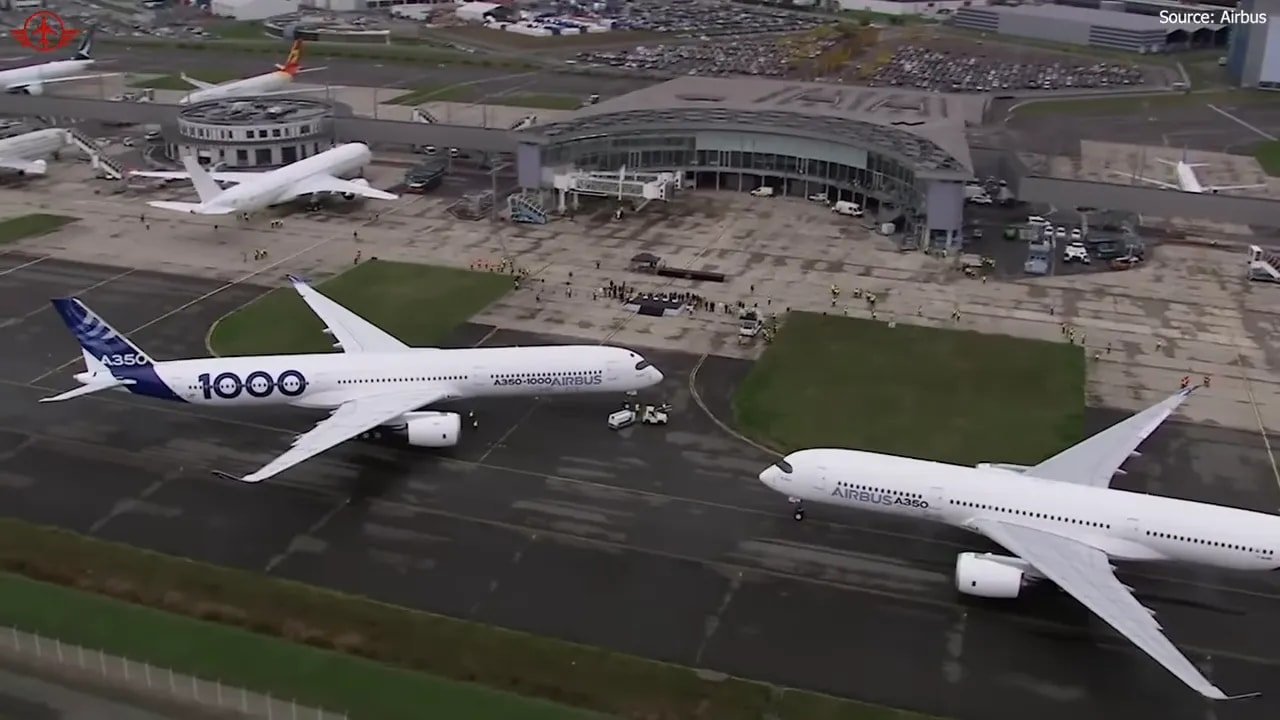
What came out of that rethink was the A350XWB, or extra wide body. This was not a refresh. It was a true reset.
- A composite fuselage
- New Rolls-Royce Trent XWB engines
- Advanced aerodynamic design
- A wider cabin than the 787
- More flexibility for airline interiors
In other words, Airbus stopped trying to answer Boeing with a patch and built a real competitor.
When the A350 entered service in 2015 with Qatar Airways, it quickly proved itself as one of the best widebody aircraft in service. Airlines liked its economics. Passengers liked the cabin. Major carriers across Asia, Europe, and beyond made it a core long-haul platform.
For a while, the strategy looked brilliant.
📉 The real problem starts with the order book
This is where the tone shifts.
At its high point, the A350 order book pushed toward 1,000 aircraft. For a widebody program, that is a serious achievement. These jets are not sold like narrowbodies. The customer pool is smaller, the routes are fewer, and only a limited number of airlines can operate them profitably at scale.
So the issue is not that the A350 failed to sell. The issue is that its momentum is no longer expanding the way Airbus needs.
New orders have not fallen off a cliff. They have slowed. That distinction matters.
A collapse becomes a news story immediately. A slowdown becomes a structural problem that can sit quietly for years while people continue repeating an outdated success narrative.
By 2019, before pandemic distortions scrambled the market, Airbus logged 53 net A350 orders. Recovery years brought some improvement, but not a return to the strongest pace of the aircraft’s earlier years. And once you look past gross order announcements, the picture gets less flattering. Cancellations and conversions have chipped away at the total.
That is not a death blow. But it is exactly the kind of pattern that signals a mature program entering a less forgiving phase.
Why slower sales matter more in widebodies
In the narrowbody market, a manufacturer can often find another customer. In widebodies, every campaign matters more because there are fewer realistic buyers.
Many of the biggest A350 customers were already secured early. Once launch customers and first-wave adopters have committed, the remaining market gets harder. Sales velocity naturally fades as the list of uncommitted airlines shrinks.
That would be manageable if the competitive picture were stable. It is not.
🛫 Boeing’s 787 refused to go away
One of the biggest assumptions behind the A350’s long-term dominance was that the 787 would eventually fade into secondary status.
That was the theory. Airbus would offer the wider cabin, the stronger passenger appeal, and the better economics. Over time, airlines would drift toward the A350 and Boeing’s Dreamliner would lose its grip.
That is not what happened.
The 787 turned out to be far more resilient than Airbus expected.
Yes, Boeing stumbled badly. The 787 suffered production interruptions, fuselage join issues, regulatory pressure, and damaging quality control headlines. Deliveries were paused. Boeing burned through money and credibility.
And yet airlines kept buying the airplane.
That is the part that matters most.
- United deepened its commitment to the 787
- American expanded its 787 plans
- Japan remained a strong Boeing widebody base
In a market this small, every major 787 commitment is not just a Boeing win. It is also an A350 loss.
That may sound harsh, but the widebody market simply does not have enough room for two programs to charge forward at full speed forever. When one airline standardizes around the 787 for long-haul operations, that usually closes the door on a large A350 opportunity.
Airbus likely expected Boeing’s production troubles to push more airlines into its arms. Some of that happened. But not nearly to the degree Airbus would have wanted. The 787 took the hit, survived, and re-entered the fight.
That stubborn survival is one of the clearest reasons the A350’s position looks less secure than people assume.
⚠️ Qatar Airways became the A350’s toughest problem
If there is one episode that exposed the A350’s vulnerability most publicly, it was the collapse in Airbus’s relationship with Qatar Airways.
This was not just any customer. Qatar Airways was the launch operator for the A350. It took the first delivery. It put the aircraft on high-profile routes. It helped define the airplane’s image in the market.
Then that same airline became Airbus’s most damaging critic.
In 2021, Qatar grounded a meaningful portion of its A350 fleet over deterioration involving the aircraft’s painted exterior and the lightning protection mesh beneath it. What initially looked like a cosmetic issue turned into a much bigger fight over whether the matter had implications for airworthiness.
The dispute escalated fast and publicly.
- Qatar Airways sued Airbus for billions
- Airbus canceled Qatar’s A321neo order in response
- The dispute spilled from widebodies into narrowbodies
- Legal filings and public statements made the rift impossible to ignore
The court battle moved toward resolution later, but the commercial and reputational damage did not just disappear because lawyers stopped fighting.
That is the deeper issue. Qatar Airways is not some fringe operator making noise from the sidelines. It is widely regarded as one of the most demanding premium airlines in the world. When that kind of customer raises a red flag on your flagship aircraft, the rest of the industry notices.
Even airlines that did not share Qatar’s exact conclusions still had to account for the dispute in fleet planning, maintenance review, and risk assessment. Safety teams ask questions. Engineering teams ask questions. Executives ask whether a controversy like that could flare up again.
Those doubts do not always show up in a headline. They do show up in slower momentum.
🏭 Airbus solved one production problem and may have uncovered another
For years, one of the major complaints surrounding the A350 was that Airbus could not build enough of them quickly enough.
Supply chains were strained. Deliveries slipped. Airlines waited longer than expected for aircraft they had already committed to. That created friction, cost Airbus money, and tested customer relationships.
So Airbus did what manufacturers are supposed to do. It pushed to ramp production.
But timing matters. The market Airbus ramped into is not the same one that existed before the pandemic.
The recovery in long-haul travel has been uneven
Some premium leisure and business markets came back strongly, especially on major transatlantic and transpacific corridors. Other parts of long-haul aviation recovered more slowly and less predictably.
That matters because the A350 depends on healthy long-range demand, not just general airline optimism.
China is the missing growth engine
One of the most important pieces of the old widebody growth case was China. Chinese airlines were expected to be a huge source of future demand for aircraft in the A350 category.
Instead, recovery has been slower than expected.
That slowdown has been shaped by several pressures:
- Geopolitical tension
- Reduced international route activity
- Domestic market dynamics that do not favor widebody growth as strongly as projected
When one of the most important future demand pools underperforms, a widebody program feels it. Airbus is now in the uncomfortable position of producing A350s into a market that is not absorbing them with the urgency it once did.
Delivery slots are more available. Some airlines are pushing aircraft back. The scramble to secure a place in line is not what it used to be.
For a program that was supposed to symbolize unstoppable momentum, that is a warning sign.
🔬 The A350 may face a technology squeeze sooner than expected
Now for the most unsettling part of the story.
The A350 entered service in 2015. In commercial aviation terms, that no longer makes it brand new. It is now in the middle phase of its life cycle.
The technologies that made it feel revolutionary a decade ago are no longer unique. Composite construction, advanced aerodynamics, and next-generation turbofans have become standard expectations in modern long-haul aircraft.
That means the A350’s advantage is no longer based on being radically ahead of the field. It is based on being a very good current-generation aircraft.
And that is where the next squeeze comes from.
What is coming next
On the horizon, manufacturers are studying new propulsion and airframe ideas that could deliver a more dramatic leap in efficiency than current engines can offer.
Among the concepts attracting attention:
- Open fan engine architectures
- Ultra-high bypass turbofans
- Hybrid electric support systems
Once those technologies mature enough for mainstream large-aircraft use, they could narrow the A350’s efficiency gap over older jets far more quickly than Airbus would like.
That does not make the A350 obsolete today. But it does create a strategic question for airlines making long-range fleet choices. If the next real step-change arrives earlier than expected, how aggressively do you commit to the current generation right now?
Airbus clearly understands this risk. It has spent years studying what a future successor might look like. But the problem is timing. A true next-generation widebody is a decade-scale decision, not something that appears overnight.
Until then, the A350 has to carry Airbus through an increasingly competitive second half of the decade.
🧭 So is the Airbus A350 actually in trouble?
Yes, but not in the simplistic way dramatic headlines would suggest.
The A350 is still one of the best widebody aircraft in the world. It is capable, efficient, and well liked. This is not a failed airplane. It is not a broken program. And Airbus is not suddenly collapsing in long-haul aviation.
The real issue is that the aircraft no longer looks as invulnerable as the public narrative suggests.
The signs are all there:
- Order momentum has slowed
- The 787 remains a serious and durable rival
- The Qatar Airways dispute left a reputational scar
- Post-pandemic widebody demand has been uneven
- China has not returned as the growth pillar many expected
- Next-generation technology threatens to shorten the A350’s relative advantage
That combination does not create an immediate crisis. It creates something more dangerous in the long run: quiet stagnation.
And in aerospace, quiet stagnation can be every bit as consequential as public disaster.
❓ FAQ
Is the Airbus A350 a bad aircraft?
No. The A350 is widely regarded as an excellent widebody aircraft. The concern is not about basic performance or quality as a design concept. The concern is that its market position may be weakening over time.
Why are slower A350 orders such a big deal?
Widebody aircraft sell in much smaller numbers than narrowbodies. There are fewer airlines, fewer routes, and fewer realistic replacement campaigns. That means a gradual slowdown can have a bigger long-term impact than it would in other parts of the market.
How did Qatar Airways damage the A350’s reputation?
Qatar publicly challenged Airbus over surface degradation and lightning protection concerns, grounded part of its fleet, and pursued major legal action. Because Qatar is a highly respected airline, its criticism carried far more weight than a routine customer complaint.
Is the Boeing 787 still a serious threat to the A350?
Absolutely. Even after production and quality problems, the 787 continued winning major airline commitments. In a limited widebody market, that resilience directly affects the A350’s sales potential.
Could new engine technology make the A350 obsolete soon?
Not soon in an immediate sense. But future propulsion concepts could reduce the A350’s advantage faster than airlines and investors expect. That is why long-term fleet planning around current-generation widebodies is becoming more complicated.
Is Airbus still leading Boeing in widebodies?
In several respects, Airbus still holds a stronger immediate position, especially while Boeing works through delays and program gaps. But the competitive balance is less one-sided than the common narrative suggests, particularly because the 787 remains active and Boeing’s wider response is still developing.