Arizona’s desert can be beautiful and unforgiving. Heat, limited shade, long distances between reliable water sources, sudden monsoon storms, rugged terrain, and wildlife all require planning. The safest approach is simple: know the conditions before you leave, carry more than one way to navigate and signal for help, manage heat early, and turn around before a small problem becomes an emergency.
Quick Answer
For Arizona desert safety, avoid unnecessary exposure during extreme midday heat, carry enough water and food for the entire trip, check weather and flash-flood risk, tell someone your route, give wildlife space, and know the signs of heat stroke. Confusion or altered behavior in the heat is an emergency: call 911 and begin rapid cooling.
Key Takeaways
- Plan around heat, terrain, weather, water availability, and your own fitness rather than relying only on mileage.
- Heat stroke can occur with either dry skin or heavy sweating. Confusion, collapse, seizures, or altered mental status require emergency help.
- Carry all the water you expect to need plus a reasonable reserve; do not assume a desert spring, pipe, or trail water source will be usable.
- During monsoon weather, stay out of washes and move to higher ground if flooding threatens. A storm does not have to be directly overhead to cause a flash flood.
- Use species-specific wildlife responses. Mountain-lion guidance is not rattlesnake guidance.
- Share your itinerary and carry redundant navigation and signaling tools because cell service may be weak or absent.
Warning: Heat stroke is a medical emergency. If someone in the heat becomes confused, disoriented, unconscious, has a seizure, or shows another major change in mental status, call 911 and begin rapid cooling immediately. Do not wait for the person to stop sweating.
At a Glance
| Time Required | Plan before every outing and recheck weather, heat, and trail conditions immediately before departure. |
| Difficulty | Varies widely by route, temperature, elevation, exposure, and fitness. |
| Tools Needed | Water, food/electrolytes, sun protection, navigation backup, first-aid supplies, light, whistle or signal mirror, charged phone, and emergency shelter appropriate to the trip. |
| Cost | Varies. Many core safety items are reusable, while advanced satellite communication equipment is optional for many trips. |
Understanding Arizona’s Desert Risks
When you head into Arizona’s desert, you may face extreme daytime heat, cold nights at some elevations and seasons, limited water, rugged terrain, intense sun, wildlife, and sudden weather changes. A short outing can become difficult quickly if you underestimate distance, elevation gain, exposure, or the time needed to return.
Monsoon thunderstorms add another layer of risk. Dry washes can rise quickly, lightning can occur well away from the heaviest rain, and blowing dust can make travel dangerous. The National Weather Service monsoon safety guidance warns that flash flooding may reach valleys and desert washes from storms many miles away.
Desert plants are also not dependable water sources. Some provide shade, while others have spines, irritating sap, or other hazards. Never damage or consume an unfamiliar plant because you assume it contains usable water.
Core desert survival skills include route planning, navigation, heat management, emergency shelter, signaling, and knowing when to turn around. The goal is not to push through every problem. Good judgment means changing the plan when conditions become unsafe.
Preparing Properly Before You Go
Before you set foot on the trail, map your route, check the weather and official trail conditions, note elevation gain and exposed sections, and tell a responsible person when you expect to return. Leave enough detail for that person to explain where rescuers should start looking if you miss your check-in.
- Water strategy: Decide how much you need for the complete trip, where any verified refill points are located, and how much reserve you will carry.
- Navigation: Carry an offline map or paper map in addition to GPS. A compass is useful if you know how to use it.
- Clothing: Wear sun-protective, breathable clothing, a hat, sturdy footwear, and layers appropriate for elevation and nighttime temperatures.
- Emergency kit: Pack first-aid basics, a whistle or signal mirror, light, backup power, food, and emergency shelter appropriate to your route.
Schedule demanding activities for cooler periods when possible. During extreme heat, the safest choice may be to shorten the route, choose a higher-elevation or less exposed alternative, or postpone the outing. In a June 18, 2026 heat warning, Grand Canyon National Park advised avoiding strenuous inner-canyon hiking between 10 a.m. and 4 p.m. during the warned conditions.
Pro Tip: Set a turnaround rule before you start. If the trip is taking longer than expected, water is disappearing faster than planned, someone feels ill, or weather is deteriorating, turn back while you still have options.
Heat Illness: Recognition and First Aid
Heat illness is one of the most important Arizona desert hazards because symptoms can progress quickly. Pay attention to how people are acting, not just how hot they say they feel.
Heat Exhaustion
Possible heat-exhaustion symptoms include headache, nausea, dizziness, weakness, thirst, heavy sweating, irritability, elevated body temperature, and reduced urine output. Move the person out of the heat, remove unnecessary clothing, cool them with cold wet cloths or water, and encourage frequent small sips of cool water if they are fully alert and can swallow normally.
If symptoms are severe, worsening, or not improving, seek medical help rather than continuing the activity.
Heat Stroke
CDC heat-illness guidance lists confusion, altered mental status, slurred speech, loss of consciousness, seizures, very high body temperature, and either hot dry skin or profuse sweating among heat-stroke warning signs.
If you suspect heat stroke:
- Call 911 immediately.
- Stay with the person until emergency help arrives.
- Move them to shade or a cooler area and remove unnecessary outer clothing.
- Begin rapid cooling. A cold-water or ice-water bath may be used when practical and safe. Otherwise wet the skin or clothing with cool water, use cold wet cloths or ice, and fan the person.
- Do not delay cooling while waiting for rescuers.
- Do not force fluids if the person is confused, unconscious, vomiting repeatedly, or unable to swallow safely.
Heat stroke does not require dry skin. A person with heat stroke may still be sweating heavily.
Hydration Strategies for Every Activity
Plan water around the route, temperature, exposure, duration, exertion, elevation, and the needs of the people in your group. No single water quantity is correct for every Arizona outing.
Start adequately hydrated and keep water easy to reach. During prolonged or strenuous activity in the heat, food and electrolyte replacement can help replace salts lost through sweat. Salty snacks or an appropriate electrolyte drink may be useful, especially during long efforts.
More water is not always better. Excessive fluid consumption without enough food or electrolyte replacement can also cause serious problems. Avoid trying to “catch up” by forcing large amounts of water when you are already feeling sick.
Water Carrying Basics
Carry enough water for the complete outing plus a reasonable reserve. Do not depend on an unverified spring, creek, seasonal pipe, or trail faucet as your only supply. Even normally reliable infrastructure can be temporarily unavailable.
Choose sturdy bottles, a hydration bladder, or a combination of both. Spreading water among more than one container also gives you some protection if a bottle leaks or a bladder fails.
- Keep your primary drinking container easy to reach.
- Protect spare containers from punctures and leaks.
- Use pack straps to keep heavy water from shifting.
- Test your loaded pack on a shorter outing before a long desert hike.
Emergency water treatment is useful knowledge, but it does not make every desert water source safe. According to CDC backcountry water-treatment guidance, boiling is the best method for killing germs in water. Filtering followed by disinfection is another option. Boiling or disinfecting cannot make water contaminated with harmful chemicals or toxins safe to drink.
Electrolytes and Timing
Sweat removes water and salts from your body. During a long, hot outing, combine fluids with normal meals, salty snacks, or an appropriate electrolyte product rather than relying on plain water alone for many hours of heavy sweating.
Drink in manageable amounts during activity and pay attention to thirst, urine output, how you feel, and the conditions. Do not use salt tablets unless a qualified medical professional has specifically advised you to do so.
After exertion, continue drinking and eat a normal meal or snack. If nausea, confusion, severe headache, unusual weakness, vomiting, or other concerning symptoms develop, stop treating the problem as ordinary thirst and seek appropriate medical help.
Monsoon, Flash-Flood, Lightning, and Dust Safety
Arizona thunderstorms can change desert conditions rapidly. Always check the forecast before entering remote areas, slot canyons, washes, or places where your only exit crosses a drainage.
Flash-Flood Safety
A storm does not need to be directly overhead for a wash to flood. Rain falling upstream or over nearby mountains can send runoff into normally dry channels.
- If water begins rising, move to higher ground immediately.
- Do not camp or park in washes or other obvious drainage channels when storms are possible.
- Never walk or drive through moving floodwater.
- Do not drive around flood barricades.
- Know your escape route before entering a canyon or wash.
Lightning Safety
If you hear thunder, treat lightning as a nearby threat. A substantial building or hard-topped vehicle is much safer than remaining exposed on a ridge, open desert, or near an isolated tall object. Change or cancel your route when thunderstorms threaten rather than assuming you can outrun the storm.
Dust-Storm Safety
Blowing dust can reduce road visibility suddenly. Avoid entering a dense dust storm if you can. If you are driving, follow current National Weather Service instructions and get completely off the traveled roadway when it is safe to do so rather than stopping in a traffic lane.
Wildlife Encounters: Prevention and Response
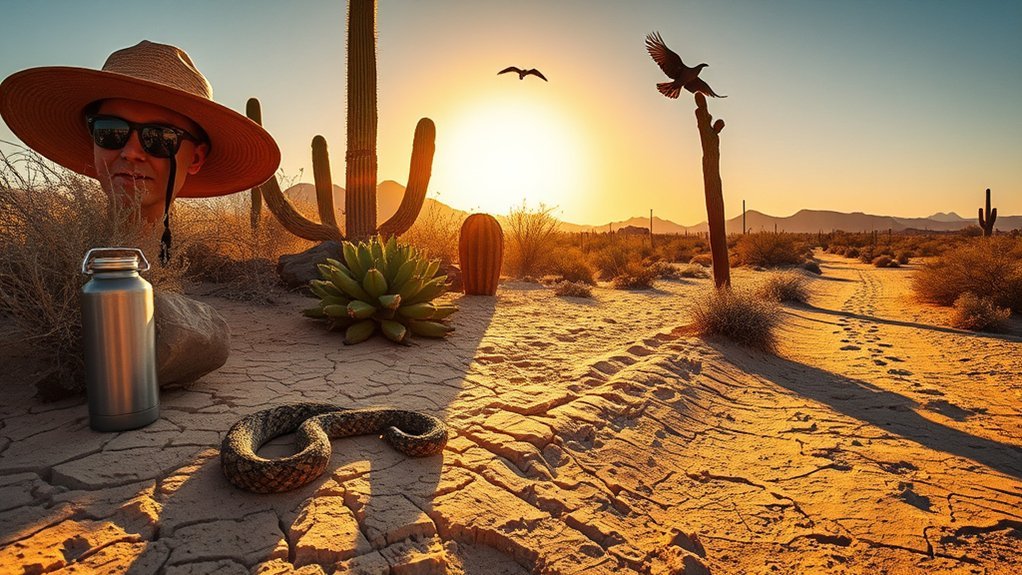
Most desert wildlife does not want close contact with people. Stay on established routes where possible, watch where you place your hands and feet, keep food and scented items secured, supervise children, and give every wild animal an escape route.
Do not use one response for every species. Advice that is appropriate for a mountain lion is not appropriate for a rattlesnake.
Rattlesnake Safety
If you see a rattlesnake, stop and give it plenty of room. Do not approach, touch, harass, move, trap, or try to kill it. Avoid placing your hands or feet into rocks, thick brush, or other places you cannot see clearly. At night, use a light so you can see the ground ahead.
Do not blindly probe brush with a walking stick in an attempt to force hidden animals to move. Watch where you step and let wildlife remain undisturbed.
If a venomous snake bites someone, seek emergency medical care immediately. CDC snakebite guidance specifically advises against cutting the wound, sucking out venom, applying ice, using electric shock, or applying a tourniquet. Do not try to capture the snake.
Mountain-Lion Safety
If you encounter a mountain lion, do not run. Arizona Game and Fish Department guidance advises staying calm, facing the animal, speaking loudly and firmly, appearing larger by raising your arms or opening a jacket, and slowly backing toward a vehicle, building, or busy area while giving the lion a way to escape.
Keep small children close so they do not panic and run. If a mountain lion attacks, fight back.
Preventing Wildlife Conflicts
- Travel predictably and stay aware of your surroundings.
- Never intentionally feed wildlife.
- Keep camps clean and food secured.
- Keep pets controlled and follow local leash rules.
- Give wildlife space instead of approaching for photographs.
Emergency Planning and Communication
Before you leave, identify your route, distances, major landmarks, exit points, road crossings, and any ranger or emergency facilities in the area. Save offline maps because cellular data may disappear far sooner than expected.
Carry more than one signaling method. A whistle and signal mirror require no cellular network. A charged phone is useful where service exists. For more remote trips, a properly maintained personal locator beacon or satellite messenger can add another way to request help, but no device should be treated as a guarantee of immediate rescue.
Plan Your Route
Map both the intended route and the decisions you will make if something goes wrong. Choose trails that match the least-experienced person in the group rather than the strongest.
- Scout the route: Note trail junctions, exposed sections, major climbs, water availability, and bailout options.
- Carry navigation backups: Use an offline map or GPS plus a paper map when appropriate.
- Plan around time and terrain: Account for heat, shade, elevation, fitness, and the slower return pace of a tired group.
- Identify emergency exits: Know the nearest roads, developed areas, ranger facilities, or safe shelters where applicable.
Do not continue simply because the destination is close. If conditions, timing, water supply, or someone’s health no longer match the plan, turning around is a successful safety decision.
Share Your Itinerary
Because help may take time to reach remote desert areas, leave your itinerary with a reliable person who knows what to do if you miss a check-in.
Give them your planned route, trailhead, start time, expected return time, vehicle description and license plate, group information, and any planned alternate route. If you know the appropriate park or ranger contact information, include that too.
Set a specific fail-safe. Explain when your contact should first try to reach you and when they should contact authorities. Update them if your plans change before you lose service.
Emergency Signaling Methods
Keep emergency devices where you can reach them even if you become injured or separated from your pack.
- Whistle: A low-tech signal that carries farther than shouting and uses less energy.
- Signal mirror or bright material: Useful for making yourself more visible in daylight.
- Flashlight or strobe: Useful for signaling after dark.
- Phone: Useful where a cellular connection is available, but do not assume coverage.
- PLB or satellite messenger: Useful redundancy for remote travel when maintained and used according to its instructions.
Conserve battery power on electronic devices. Keep them protected from extreme heat and know how to activate emergency functions before you need them.
What to Do if You Get Lost or Stranded
If you realize you are lost, continuing to walk without a reliable plan can make rescue harder. Stop, get out of dangerous heat if possible, assess your location, check your map and surroundings, and signal for help.
If moving would make your location less certain, remaining in a safe, visible place may be better than wandering. Conserve energy, ration unnecessary exertion rather than dangerously restricting drinking water, and make yourself easier to locate.
If your vehicle becomes stranded in a remote area, it is often easier for searchers to locate a vehicle than a person on foot. Unless the vehicle’s location creates an immediate danger or you have a clearly safer option nearby, avoid abandoning it impulsively.
Frequently Asked Questions
Can I drink from desert springs or washes safely?
Do not assume natural desert water is safe untreated. Water may contain bacteria, parasites, viruses, or other contamination. Boiling is an effective way to kill germs, and suitable filtration followed by disinfection is another option. However, boiling and ordinary disinfection do not remove harmful chemical contamination, so avoid a source if chemical pollution is suspected.
Are local plants safe to use for shade or cooling?
Natural shade can help, but do not lean against, cut, climb into, or consume an unfamiliar desert plant. Cacti, spines, irritating sap, and fragile vegetation can all cause problems. A lightweight tarp, umbrella, or other portable shade is more predictable when the route permits it.
How do medications affect heat tolerance?
Some prescription and over-the-counter medicines can affect sweating, thirst, blood pressure, fluid balance, or the body’s ability to handle heat. Ask your doctor or pharmacist about heat precautions if you take medication regularly. Do not stop or change a prescribed medicine on your own because the weather is hot.
Can I bring pets on desert trails year-round?
Not on every trail and not safely in every season. Pet rules vary by park and land manager, so check the specific trail before leaving. In hot weather, avoid exposing pets to dangerously hot ground, provide water and shade, keep them controlled, and shorten or cancel the outing when conditions are unsafe.
Are commercial cooling vests effective in extreme heat?
Cooling vests can reduce heat strain in some conditions, but effectiveness varies by design, duration, activity, and environment. Treat a vest as an extra cooling tool, not permission to stay out longer in dangerous heat. A cooling vest is also not a substitute for rapid emergency cooling when someone has heat stroke.
How much water should I carry for an Arizona desert hike?
There is no single amount that fits every person and route. Your needs depend on temperature, sun exposure, duration, exertion, elevation, body size, acclimatization, and reliable refill access. Check the official guidance for your specific park or trail, carry enough for the entire outing, and include a reasonable reserve.
What should I do if someone becomes confused in the heat?
Treat confusion, disorientation, slurred speech, seizures, loss of consciousness, or another major mental-status change in the heat as a possible heat-stroke emergency. Call 911, move the person to a cooler area, remove unnecessary outer clothing, begin rapid cooling, and stay with them. Do not wait to see whether they stop sweating.
Is it safe to hike in a desert wash when thunderstorms are nearby?
It may not be. A wash can flood even when the storm producing the runoff is miles away. Check the forecast before entering flood-prone terrain, know how to reach higher ground, and leave immediately if conditions deteriorate. Never try to cross fast-moving floodwater on foot or in a vehicle.
Conclusion
Arizona desert safety comes down to preparation, early decisions, and knowing when conditions have crossed from uncomfortable to dangerous. Carry enough water and food, protect yourself from the sun, avoid unnecessary exposure during extreme heat, check monsoon conditions, give wildlife plenty of space, and keep navigation and signaling backups available.
Most importantly, do not try to push through confusion, severe weakness, worsening illness, flooding, or another obvious warning sign just to finish a route or reach a photo stop. Change the plan while you still can. If heat stroke or another serious emergency is suspected, call 911 and begin appropriate first aid immediately.
Sources
- CDC/NIOSH: Heat-related Illnesses — heat exhaustion and heat-stroke symptoms and first aid.
- Grand Canyon National Park: 2026 Extreme-Heat Hiking Warning — midday heat avoidance, water, electrolyte, and route-planning guidance.
- National Weather Service Phoenix: Monsoon Safety — flash floods, lightning, dust storms, and severe-weather precautions.
- CDC: Water Treatment When Hiking and Camping — boiling, filtration, disinfection, and chemical-contamination limitations.
- Arizona Game and Fish Department: Living With Mountain Lions — prevention and mountain-lion encounter response.
- CDC/NIOSH: Venomous Snake Safety — snakebite response and unsafe first-aid methods to avoid.