Disclosure: As an Amazon Associate, we earn from qualifying purchases. If you click a link on this page and make a purchase, we may receive a small commission at no extra cost to you.
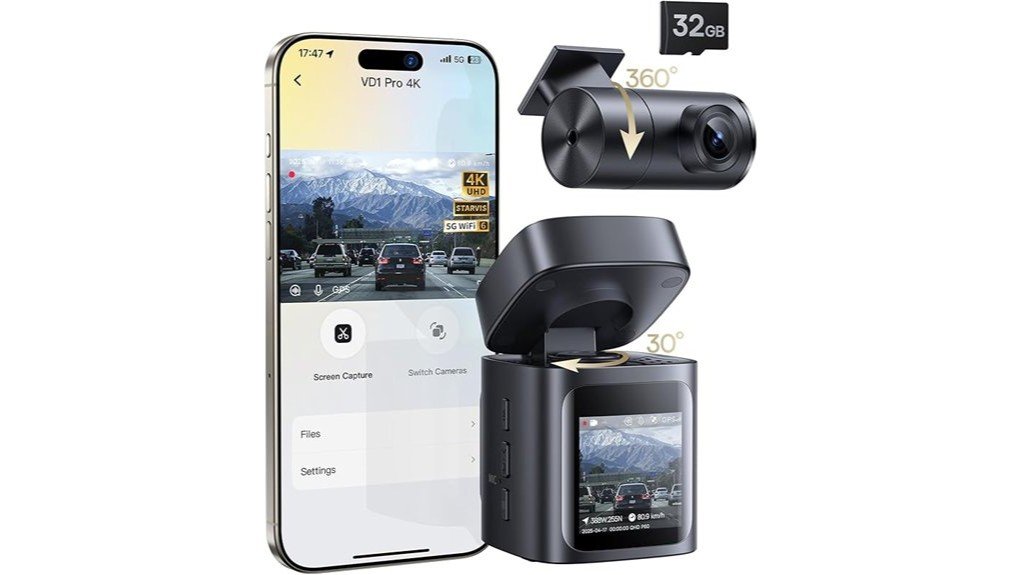
A dash cam can only help after an incident if it records a clear view and saves the right clip. The Baseus PrimeTrip VD1 Pro combines 4K front video, a 1080P rear camera, STARVIS night support, GPS data, app access, and event-triggered parking protection. Its main advantage is the solar-assisted battery system, which can watch for parking events without a fuse-box hardwire kit. The tradeoff is easy to miss: solar and battery power are for parking standby only, so the camera must stay connected to vehicle power while you drive.
Quick Verdict
Rating: 8/10, recommended with caveats
Best For: Drivers who want front and rear footage plus event-triggered parking protection without hardwiring into the fuse box.
Bottom Line: The VD1 Pro offers a useful mix of 4K recording, an included rear camera, a 32GB card, and solar-assisted parking standby. Buy it for easier parking protection, but expect to route power and rear-camera cables and manage footage through the camera and app.
Key Takeaways
- The front camera records at up to 4K UHD, while the included rear camera records at 1080P.
- The current product listing specifies a 140° front view and 120° rear view for simultaneous front-to-rear coverage.
- The solar panel and built-in lithium battery support event-triggered parking mode for up to 14 days under suitable conditions.
- Continuous driving recording still requires the included vehicle power cable, and the rear camera uses a wired connection.
- A 32GB high-endurance microSD card is included, while the Baseus product page states support for expansion up to 256GB.
- The Baseus app supports previews, downloads, GPS driving data, microSD formatting, and firmware updates over 5GHz WiFi 6.
| Specification | Detail |
|---|---|
| Brand | Baseus |
| Model | PrimeTrip VD1 Pro, model C01198 |
| Product Type | Front and rear vehicle dash cam |
| Front Recording | Up to 4K UHD, 2160P |
| Rear Recording | 1080P |
| Lens Coverage | 140° front and 120° rear |
| Night Recording | Sony IMX335 STARVIS sensor, HDR, 6-layer glass lens, f/1.6 aperture, and noise reduction |
| Parking Mode | Solar-assisted battery standby with event-triggered recording, up to 14 days under suitable conditions |
| Parking Clip Length | 30 seconds after a detected parking event |
| Driving Power | Requires connection to vehicle power while driving |
| Vehicle Compatibility | 12V and 24V vehicles listed as compatible |
| Connectivity | 5GHz WiFi 6 and Baseus app |
| Other Functions | GPS driving data, English voice control, G-sensor, loop recording, and OTA updates |
| Display | 1.4-inch LCD |
| Included Storage | 32GB high-endurance microSD card |
| Storage Expansion | Baseus states support up to 256GB; follow the manual supplied with your unit |
| Main Unit Size | About 2.5 × 2.51 × 1.5 inches |
| Main Unit Weight | About 168 grams |
| Included Components | Front dash cam, rear camera with cable, vehicle charger and USB-C cable, mounting parts, trim tool, and 32GB microSD card |
Essential Features That Make the Baseus VD1 Pro Stand Out
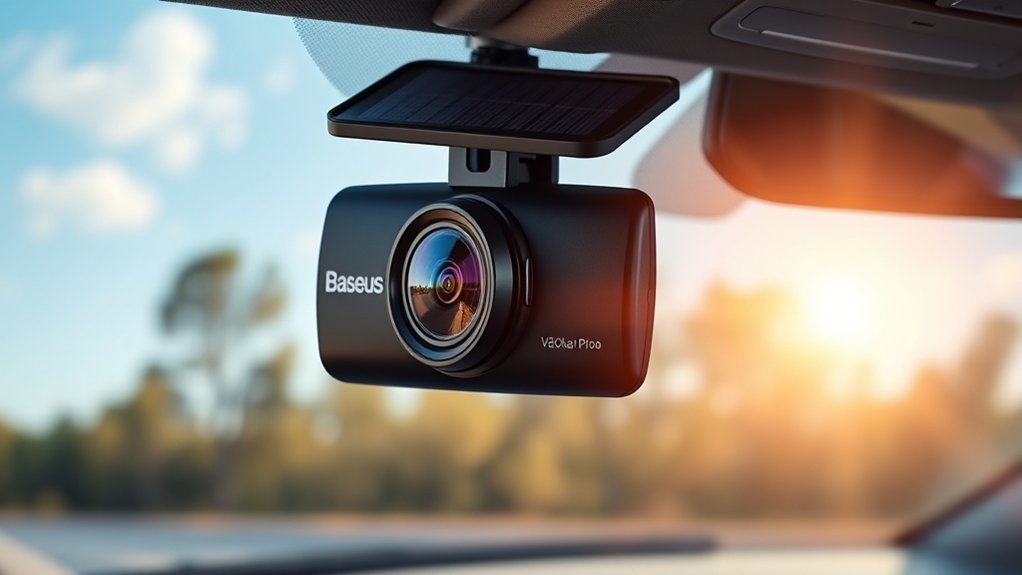
The VD1 Pro combines two functions that many drivers otherwise build with separate accessories: continuous front-and-rear recording while driving and low-power event recording while parked. The camera uses vehicle power for normal driving, then switches to its solar-assisted battery system when the ignition is off.
The front camera records up to 4K UHD, and the rear camera records at 1080P. Both channels record at the same time, although the built-in display shows one view at a time. A G-sensor can protect incident clips from being overwritten by normal loop recording.
The included 32GB card makes the kit usable without an immediate storage purchase. You may still want a larger compatible high-endurance card if you drive long distances or want more time before loop recording overwrites older files.
What Is the Baseus PrimeTrip VD1 Pro?
The Baseus PrimeTrip VD1 Pro is a dual-channel dash cam made for drivers who want a front camera, rear camera, app access, and parking-event monitoring in one package. The main unit is compact, includes a small LCD, and connects to a wired rear camera mounted near the back window.
Its Solar Sync system is the unusual feature. The solar panel supplements a built-in lithium battery during parking standby, so you do not need to connect parking mode to the fuse box. This does not make the camera fully wireless: normal driving recording needs the included power cable, and the rear camera must connect to the front unit.
Before You Buy: The VD1 Pro does not provide continuous solar-powered recording. Solar and battery power support low-power, event-triggered parking mode only. You must connect the camera to vehicle power while driving, and parking standby will be shorter in shade, garages, poor weather, or frequent event conditions.
Who Should Buy It?
Best For
- Drivers who want 4K front footage and a wired 1080P rear view in one kit.
- People who park on streets or in shared lots and want event-triggered monitoring without fuse-box hardwiring.
- Buyers who want an included memory card, GPS driving data, app downloads, and English voice control.
Skip If
- You want true 24/7 parking recording instead of short clips triggered by detected events.
- You want a completely wireless front-and-rear system with no cable routing.
- You only need a simple front camera and do not plan to use the app or parking features.
4K Front and 1080P Rear Recording
The front camera records up to 3840 × 2160 resolution, while the rear camera records at 1920 × 1080. This setup gives priority to the road ahead, where license plates, traffic signals, lane position, and oncoming events often matter most, while still documenting what happens behind your vehicle.
The current listing describes a 140° front field of view and a 120° rear field of view. That is wide enough to cover nearby lanes without relying on an extremely wide image that can make distant details look smaller. Front and rear footage is recorded at the same time once both cameras are connected.
Loop recording automatically replaces older unlocked footage when the card fills. The G-sensor can lock an incident clip, but you should still save important files to your phone or computer soon after an event.
STARVIS Night Recording and HDR
The VD1 Pro uses a Sony IMX335 STARVIS sensor, HDR, a 6-layer glass lens, an f/1.6 aperture, and noise reduction to improve recording in dim conditions. These features can help balance bright headlights, streetlights, and darker areas within the same scene.
Night hardware cannot remove every limitation. Rain, windshield haze, reflections, glare, and high relative speed can still reduce plate detail. Clean the windshield and lens regularly, remove any protective film, and avoid aiming the camera through a heavily tinted windshield strip.
Solar-Assisted Parking Protection
When the vehicle is off, the camera can enter a low-power standby state. A detected collision or parking event wakes the system and records a 30-second clip rather than recording continuously. This design saves battery power and avoids drawing from the vehicle battery through a hardwire kit.
Baseus advertises up to 14 days of parking standby when the battery is charged and the solar panel receives suitable light. Treat that figure as a best-case maximum, not a guaranteed duration. Available sunlight, mounting angle, temperature, battery condition, and the number of triggered events can all shorten standby time.
Pro Tip: After installation, park the car, enable parking mode, and create a controlled test event. Review the saved clip in the Baseus app to confirm that the camera wakes correctly, the rear cable is secure, and both views show useful road detail.
Baseus App, WiFi, GPS, and Voice Control
The camera connects to the Baseus app over 5GHz WiFi 6. You can preview the camera view, review and save clips, format the microSD card, view recorded GPS driving data, and receive firmware updates without removing the card for every task.
GPS is used to add driving information to recordings. Baseus troubleshooting guidance says it is not a live vehicle-tracking service, so do not treat it as an anti-theft tracker. English voice commands can handle supported hands-free functions, but buyers who need voice control in another language should check the current app and firmware before purchase.
Installation and Setup Tips
Place the front unit high on the windshield, usually behind or close to the rearview mirror, while keeping the lens clear of tint bands, wiper-blind areas, and anything that blocks your view. Apply the supplied static cling film and adhesive mount only after cleaning and drying the glass.
Route the power and rear-camera cables along trim edges without crossing an airbag deployment path. Leave enough slack near hinges or moving trim, but do not leave loose cable where it can distract you or interfere with controls. Ask a qualified installer for help if you are unsure about side-curtain airbags or cable routing.
Connect the rear camera, turn on the system, and use the live view to set both angles before pressing mounts firmly into place. Aim the front camera mostly at the road, not the sky or dashboard. Format the included microSD card in the device before first use and check that date, time, speed units, audio, loop length, G-sensor sensitivity, and parking mode match your needs.
How It Performs in Real Use
For Daily Commuting
The 4K front channel provides the most useful detail for traffic, intersections, and lane-change incidents. The rear 1080P channel adds context when another vehicle follows closely or strikes your car from behind. Because the camera uses loop recording, it can stay ready without manual file deletion every day.
For Night Driving
The STARVIS sensor, HDR, wide aperture, and noise reduction give the camera better tools for mixed light than a basic 1080P unit. Results still depend on windshield cleanliness, mounting angle, traffic speed, and glare. Review a few night clips after setup and adjust the angle if the dashboard or headlights create strong reflections.
For Street and Shared-Lot Parking
Parking mode is best suited to cars left in areas where bumps, door strikes, or low-speed impacts are a concern. The camera remains in standby and saves a short clip when an event wakes it. It is not the same as continuous surveillance, so it may not capture activity that falls outside its detection conditions.
For Road Trips
The included 32GB card is convenient, but long drives can overwrite routine footage sooner. A larger compatible high-endurance card gives you more recording history, while regular downloads protect clips you want to keep. Confirm the capacity supported by the manual supplied with your exact unit before buying a replacement card.
Compatibility and Safety Notes
The listing identifies the VD1 Pro as compatible with 12V and 24V vehicles, including common cars, SUVs, vans, trucks, buses, and RVs. Compatibility does not guarantee an easy cable route in every vehicle, especially hatchbacks, long SUVs, or vehicles with powered liftgates.
Do not mount the camera where it blocks your forward view, interferes with mirrors, or sits in an airbag path. The product includes high-temperature protection, but Baseus still advises using a sunshade in very hot weather. Allow the unit to cool if it shuts down or recording stops because of heat.
Check local rules on windshield-mounted devices, audio recording, and video use. Laws vary by location, and a safe mounting position may differ between vehicles.
Storage and Maintenance
Baseus includes a 32GB high-endurance microSD card and states that storage can be expanded up to 256GB. Some retailer specification fields may show a different maximum, so the manual packaged with your unit should be your final guide. Use a Class 10 or better high-endurance card designed for repeated video writing.
Review sample clips every few weeks, format the card at reasonable intervals, and replace it if recording errors continue. Clean both lenses with a soft cloth, confirm mounts remain tight, and check that the rear cable has not been pinched by trim, a hatch, or cargo.
Pros and Cons
Pros
- Records up to 4K at the front and 1080P at the rear at the same time.
- Solar-assisted parking standby avoids a fuse-box hardwire kit.
- Includes the rear camera and a 32GB high-endurance microSD card.
- STARVIS, HDR, GPS data, WiFi 6, loop recording, and G-sensor protection add practical value.
- The app makes it easier to preview, download, format, and update the camera.
Cons
- Solar power does not run continuous driving recording or continuous parking video.
- The rear camera and driving power still require cables to be routed through the vehicle.
- Parking standby and clip capture depend on sunlight, battery condition, temperature, detection, and storage health.
Is It Worth the Price?
The Baseus VD1 Pro fits the mid-range dash cam category. Its value comes from bundling a 4K front camera, a 1080P rear camera, a memory card, GPS data, app access, and solar-assisted parking standby in one package.
It offers the best value to drivers who would otherwise pay for a dual-camera kit and a separate hardwire installation for parking events. It is less compelling when you only need basic front recording or when you require continuous buffered parking surveillance.
Do not judge it only by the 14-day claim. The better buying question is whether short, event-triggered parking clips and easier installation fit your parking habits.
How It Compares to Alternatives
The ROVE R2-4K Dual and 70mai A810 Lite are worth comparing if you want other 4K front-and-rear kits with app features. Their parking modes may suit buyers who prefer a traditional hardwire setup or more connected options, while the Baseus stands out for its solar-assisted, battery-backed parking standby.
A compact front-only model such as the Garmin Dash Cam Mini 3 is easier to hide and install, but it does not provide the same rear coverage or solar-assisted parking feature. The VD1 Pro makes the most sense when dual recording and simpler parking-event power matter more than having the smallest possible camera.
Frequently Asked Questions
Does the solar panel power the dash cam while driving?
No. Solar and battery power support low-power parking standby and event-triggered clips. Continuous driving recording requires the included vehicle power cable.
Does parking mode record continuously?
No. The camera stays in low-power standby and records a 30-second clip when a supported parking event wakes it. This saves power but does not provide a complete 24-hour video timeline.
Do you need a hardwire kit for parking protection?
No fuse-box hardwire kit is required for the advertised parking mode. The built-in battery and solar panel support parking standby, but the main camera still needs vehicle power while driving.
Is the rear camera wireless?
No. The rear camera connects to the front unit with the supplied cable. You will need to route that cable along the headliner or trim and keep it clear of airbags and moving parts.
What microSD card comes with the VD1 Pro?
The current package includes a 32GB high-endurance microSD card. Baseus says you can expand storage up to 256GB, but you should confirm the supported capacity and speed class in the manual supplied with your unit.
Can GPS show the car’s live location?
No. GPS records driving data that you can review with footage. Baseus states that the feature does not provide real-time location tracking.
Does voice control work in multiple languages?
The current listing specifies English voice control. Check the latest app and firmware details before buying if commands in another language are essential to you.
Who should skip the Baseus VD1 Pro?
Skip it if you want a front-only camera, a cable-free rear camera, or continuous parking video. It is better suited to drivers who will use both cameras and are comfortable checking the app and memory card.
The Bottom Line
The Baseus PrimeTrip VD1 Pro is a strong choice for drivers who want 4K front recording, 1080P rear coverage, app access, and event-triggered parking protection without a fuse-box hardwire kit. Skip it if you need continuous parking surveillance or a fully wireless installation. Its biggest strength is the solar-assisted parking system, while its main limitation is that normal driving and the rear camera still depend on cables.