Quick answer: If your cat has inflammatory bowel disease (IBD), diet choice should be made with your veterinarian. The three foods below are over-the-counter sensitive-stomach or digestive-support formulas, not prescription or hydrolyzed IBD diets. They may be reasonable options to discuss with your vet when a standard highly digestible diet is appropriate, but they are not substitutes for a veterinarian-directed elimination or therapeutic diet trial.
Key Takeaways
- Feline IBD can require dietary trials using hypoallergenic, novel-protein, hydrolyzed, or highly digestible diets selected around the cat’s history and symptoms.
- The products in this roundup support sensitive digestion, but none should be presented as a treatment for IBD.
- During a veterinarian-directed food trial, feed only the prescribed trial diet and avoid unapproved treats, table food, and flavored extras.
Affiliate disclosure: This article contains Amazon affiliate links. We may earn a commission from qualifying purchases at no extra cost to you.
| Hill’s Science Diet Adult Sensitive Stomach & Skin Pollock & Barley (3.5 lb) | 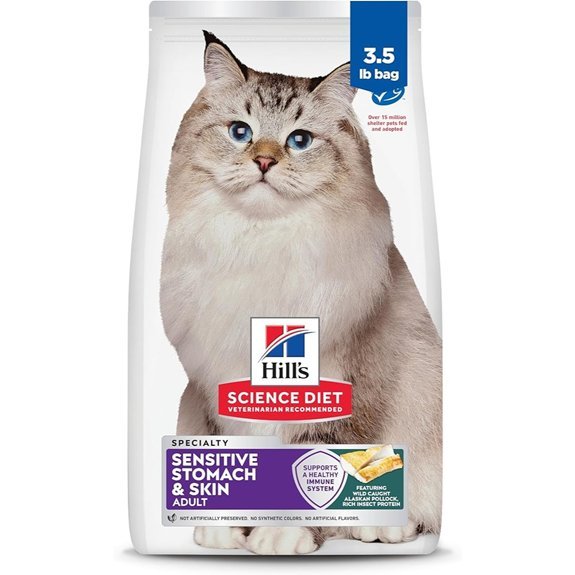 |
Best Overall OTC Digestive Support | Formulation: Dry Cat Food | Weight: 3.5 lb Bag | Digestive Health Support: Prebiotic fiber | Check Product Details on Amazon | Read Our Analysis |
| Purina Pro Plan Adult Sensitive Skin & Stomach Lamb & Rice (7 lb) | 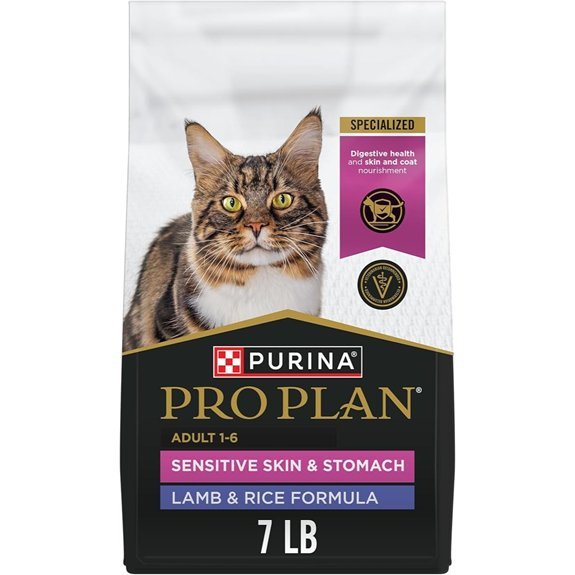 |
Best Lamb-First Sensitive Formula | Formulation: Dry Cat Food | Weight: 7 lb Bag | Digestive Health Support: Prebiotic fiber and probiotics | Check Product Details on Amazon | Read Our Analysis |
| Purina ONE +Plus Sensitive Skin & Stomach Dry Cat Food (16 lb) | 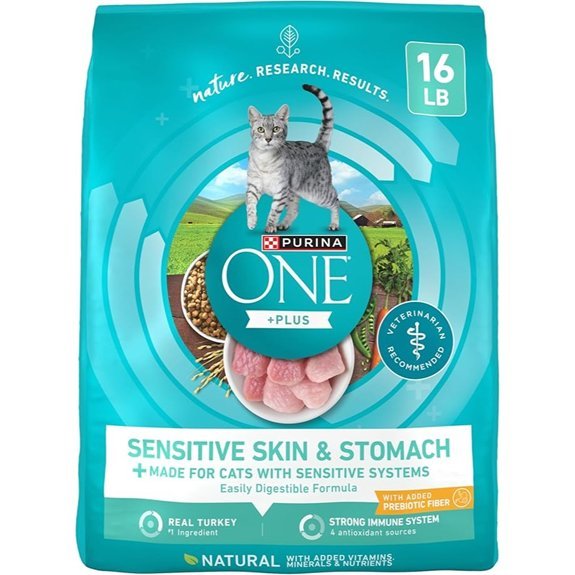 |
Best Large-Bag Sensitive Formula | Formulation: Dry Cat Food | Weight: 16 lb Bag | Digestive Health Support: Prebiotic fiber | Check Product Details on Amazon | Read Our Analysis |
More Details on Our Top Picks
-
Hill’s Science Diet Adult Sensitive Stomach & Skin Pollock & Barley (3.5 lb)
Hill’s Science Diet Adult Sensitive Stomach & Skin Pollock & Barley is the most directly digestive-focused option in this list. Hill’s describes it as highly digestible and includes FOS prebiotic fiber, while vitamin E and omega-6 fatty acids support skin and coat health. That makes it a practical over-the-counter option to discuss with a veterinarian when a cat needs a gentle maintenance formula rather than a therapeutic elimination diet.
Who should consider it: Adult cats whose veterinarian is comfortable with an OTC sensitive-stomach food and who tolerate the listed ingredients.
Who should avoid it: Cats starting a strict novel-protein or hydrolyzed food trial, or cats with known reactions to any of the listed protein sources. It is not an IBD treatment diet.
- Formulation:Dry Cat Food
- Weight:3.5 lb Bag
- Digestive Health Support:FOS prebiotic fiber
- Primary Flavor:Pollock & barley
- Skin & Coat Support:Vitamin E and omega-6 fatty acids
- Life Stage:Adult cats
- Best For:OTC sensitive-stomach support
- Important Limitation:Not a hydrolyzed or prescription IBD diet
- Before You Buy:Confirm the formula with your veterinarian
-
Purina Pro Plan Adult Sensitive Skin & Stomach Lamb & Rice (7 lb)
Purina Pro Plan Adult Sensitive Skin & Stomach Lamb & Rice Formula uses real lamb as the first ingredient and includes easily digestible oatmeal, natural prebiotic fiber, and probiotics for digestive support. It can be a reasonable maintenance-food discussion point for an adult cat with a sensitive stomach, but it contains multiple animal and plant ingredients and should not be confused with a limited-ingredient or hydrolyzed elimination diet.
Who should consider it: Adult cats that tolerate lamb and the rest of the ingredient profile and whose veterinarian wants an OTC sensitive-stomach formula.
Who should avoid it: Cats on a strict elimination trial or cats with known sensitivities to ingredients in the recipe. It is not formulated as a therapeutic IBD food.
- Formulation:Dry Cat Food
- Weight:7 lb Bag
- Digestive Health Support:Prebiotic fiber and probiotics
- First Ingredient:Lamb
- Digestible Carbohydrate:Oatmeal
- Skin & Coat Support:Omega-6 fatty acids and vitamin A
- Best For:Adult cats needing an OTC sensitive-stomach formula
- Important Limitation:Not a single-protein or hydrolyzed elimination diet
- Before You Buy:Review the full ingredient list with your veterinarian
-
Purina ONE +Plus Sensitive Skin & Stomach Dry Cat Food (16 lb)
Purina ONE +Plus Sensitive Skin & Stomach Dry Cat Food is made for adult cats with sensitive systems. Purina lists real turkey as the first ingredient and added prebiotic fiber for digestive support. The 16 lb option can be convenient for multi-cat homes or long-term feeding when your veterinarian has already confirmed the formula is appropriate.
Who should consider it: Adult cats that do well on turkey-based maintenance foods and need a readily available sensitive-stomach formula.
Who should avoid it: Cats undergoing a strict novel-protein or hydrolyzed trial, because the ingredient list includes more than one animal-protein source. It is not an IBD-specific therapeutic diet.
- Formulation:Dry Cat Food
- Weight:16 lb Bag
- Digestive Health Support:Added prebiotic fiber
- First Ingredient:Turkey
- Life Stage:Adult cats
- Immune Support:Four antioxidant sources
- Best For:Long-term OTC sensitive-system feeding when vet-approved
- Important Limitation:Contains multiple protein sources
- Before You Buy:Do not use as an elimination diet unless your veterinarian approves it
Factors to Consider When Choosing Cat Food for IBD Cats
Food can be an important part of managing feline IBD, but the right diet depends on your cat’s medical history, previous foods, symptoms, age, and veterinary workup. The most important decision is not whether a bag says “sensitive stomach”; it is whether the formula fits the specific diet strategy your veterinarian has chosen.
Start With Veterinary Guidance
Chronic vomiting, diarrhea, weight loss, reduced appetite, or blood in the stool can occur with IBD but can also occur with other diseases. A veterinarian may recommend diagnostic testing and then use dietary modification as part of the treatment plan. Do not rely on an OTC food roundup to diagnose IBD or replace a prescribed diet.
Know What Type of Diet Trial Your Cat Needs
For some cats, a veterinarian may recommend a hypoallergenic food trial using a protein or carbohydrate source the cat has not eaten before. Hydrolyzed-protein diets are another common option when food sensitivity is suspected. Other cats may be managed with a highly digestible diet or a different fiber or fat profile. These approaches are not interchangeable, so choose the diet type before comparing brands.
Before You Buy: If your veterinarian is running a strict food trial, ask whether treats, flavored medications, supplements, toppers, and table scraps must be stopped. Mixing in other foods can make the trial difficult to interpret.
Protein Source and Diet History Matter
A “novel” protein is only novel if your cat has not eaten it before. That is why the same lamb, fish, turkey, or chicken formula can be appropriate for one cat and a poor fit for another. Check the full ingredient list rather than relying only on the flavor name on the front of the bag.
Digestibility, Fiber, and Gut Support
Highly digestible ingredients can be useful when the goal is to reduce digestive workload and improve nutrient use. Prebiotic fiber may support the gut microbiome, but prebiotics or probiotics alone do not make a food an IBD treatment. Your veterinarian may also adjust fiber or fat depending on the part of the gastrointestinal tract involved and your cat’s response.
Grain-Free Is Not an IBD Rule
Grain-free food is not automatically better for feline IBD. Food reactions are individual, and the key issue is the cat’s response to specific ingredients and the purpose of the diet trial. A grain-free recipe that contains several familiar protein sources may be less useful for an elimination trial than a carefully selected novel-protein or hydrolyzed diet.
Check Life Stage and Complete Nutrition
Choose a food that matches your cat’s life stage unless your veterinarian directs otherwise. Senior, adult, kitten, pregnant, and nursing cats can have different nutritional needs. Also confirm that the food is complete and balanced for the intended life stage rather than using treats, toppers, or complementary foods as the main diet.
Transition and Monitor Carefully
For ordinary food changes, manufacturers often recommend a gradual transition. A veterinarian may give different instructions for a diagnostic diet trial. Keep notes on appetite, vomiting, stool quality, body weight, and any other symptoms so you can report a clear response. Contact your veterinarian promptly if your cat is losing weight, refusing food, becoming lethargic, or showing worsening gastrointestinal signs.
Quick Comparison: Which Option Fits Best?
| Product | Best Use Case | Main Digestive Feature | Key Limitation for IBD |
|---|---|---|---|
| Hill’s Science Diet Sensitive Stomach | Adult cats needing an OTC highly digestible maintenance formula | FOS prebiotic fiber | Not hydrolyzed or designed as a strict elimination diet |
| Purina Pro Plan Sensitive Skin & Stomach | Adult cats that tolerate lamb and need sensitive-stomach support | Prebiotic fiber, probiotics, digestible oatmeal | Multiple ingredients make it unsuitable for many strict elimination trials |
| Purina ONE +Plus Sensitive Skin & Stomach | Adult cats needing a large-bag OTC sensitive-system formula | Added prebiotic fiber | Contains multiple protein sources and is not therapeutic |
Frequently Asked Questions
What Type of Food Is Commonly Used for Cats With IBD?
Veterinarians may use hypoallergenic, novel-protein, hydrolyzed-protein, highly digestible, or other modified diets depending on the cat’s history and symptoms. There is no single food that is best for every cat with IBD.
Are the Three Products in This Roundup Therapeutic IBD Diets?
No. They are over-the-counter sensitive-stomach or digestive-support foods. They may be worth discussing with your veterinarian for some cats, but they should not be presented as prescription, hydrolyzed, or IBD-treatment diets.
Can I Mix Different Brands of Cat Food for IBD?
Not during a strict veterinarian-directed elimination or food trial unless your veterinarian specifically approves the combination. Adding other foods can introduce extra proteins or ingredients and make it harder to judge whether the trial diet is helping.
How Can I Transition My Cat to New Food Safely?
For a routine change between maintenance foods, follow the manufacturer’s transition directions and monitor stool, vomiting, appetite, and body weight. If the diet change is part of an IBD workup or elimination trial, follow your veterinarian’s instructions even if they differ from the package directions.
Should I Add Human Food to an IBD Diet?
Do not add table food during a strict food trial unless your veterinarian has approved it. Even a small amount of a familiar protein can interfere with an elimination diet and make the result harder to interpret.
How Often Should I Feed My IBD Cat?
There is no universal meal frequency for every cat with IBD. Follow your veterinarian’s plan and the food’s feeding guide, then adjust total daily intake based on body condition, weight trend, appetite, and clinical response.
When Should I Contact a Veterinarian?
Seek veterinary care for persistent vomiting or diarrhea, weight loss, reduced appetite, blood in the stool, lethargy, dehydration, or worsening symptoms. These signs can have causes other than IBD and may require diagnostic testing or medical treatment.
Medical Guidance Sources
- Cornell Feline Health Center: Inflammatory Bowel Disease
- MSD Veterinary Manual: Nutrition in Disease Management in Small Animals
Conclusion
For a cat with IBD, the best food is the one that fits the veterinarian’s treatment or diet-trial strategy and that the cat can tolerate consistently. Among the OTC options retained here, Hill’s Science Diet Sensitive Stomach is the most directly focused on digestibility, while Purina Pro Plan Sensitive Skin & Stomach and Purina ONE +Plus Sensitive Skin & Stomach offer other sensitive-system formulations. None should be treated as a substitute for a veterinarian-directed novel-protein, hydrolyzed, or therapeutic diet when one is needed.