Trail riding in [2026] puts full suspension mountain bikes under closer scrutiny than ever. Models like the Mongoose Impasse, Ecarpat lineup, and TRIFOX carbon bike each bring different strengths in comfort, control, and efficiency. Some favor durability, while others aim for lighter frames or wider tire setups. The real question is which design handles rough terrain best without sacrificing everyday ride quality.
Key Takeaways
- TRIFOX Carbon Full Suspension Mountain Bike offers 140mm dual suspension, a lightweight carbon frame, and Shimano Deore 12-speed shifting for trail performance.
- Ecarpat Full Suspension Mountain Bike is a versatile, 21-speed option with front and rear suspension, making it suitable for trails and commuting.
- Ecarpat 26×4 Full Suspension Mountain Bike adds fat 4.0-inch tires, improving traction and comfort on sand, mud, and rough terrain.
- Mongoose Impasse is an affordable trail-ready hardtail with 100mm front suspension, 27.5-inch wheels, and mechanical disc brakes.
- Full Suspension Mountain Bike for Teens and Smaller Adults provides a smaller fit, 21 speeds, and dependable dual disc brakes for lighter riders.
Mongoose Impassse
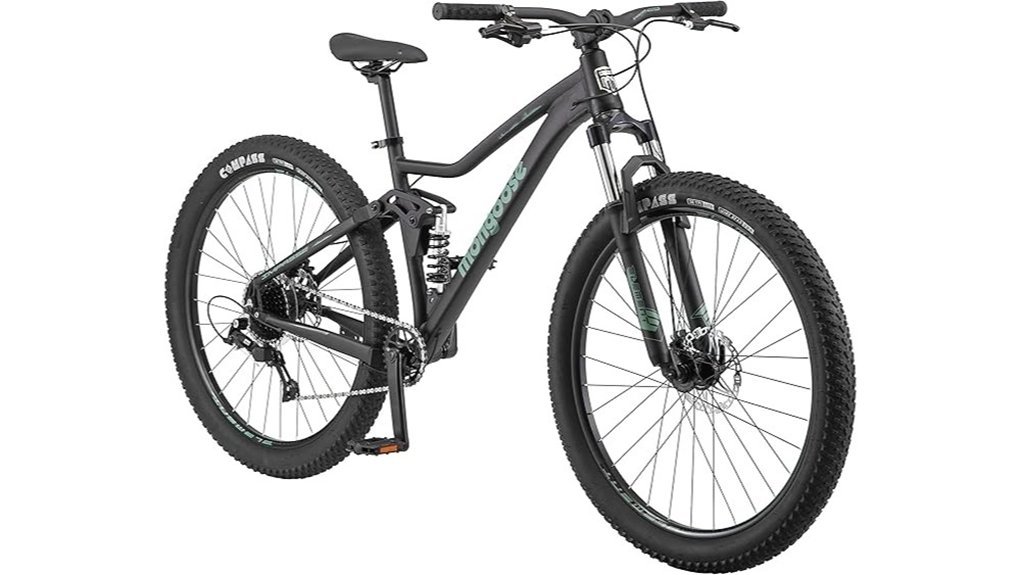
The Mongoose Impasse is a practical pick for riders seeking an affordable trail-ready mountain bike with dependable control on rough terrain. This 27.5-inch adult hardtail uses a lightweight aluminum frame, a 17-inch size suited to riders 53 to 60 inches tall, and 2.6-inch knobby tires for added grip. An RST Blaze suspension fork with 100mm of travel helps smooth bumps, while the 7-speed L-Twoo drivetrain and mechanical disc brakes support steady handling. At 39.3 pounds, it is built for mountain terrain and unpaved trails, backed by Mongoose’s BMX heritage and a limited warranty.
Best For: Riders looking for an affordable, trail-ready adult mountain bike for rough terrain and unpaved paths, especially those in the 53–60 inch height range.
Pros:
- Lightweight aluminum hardtail frame with 27.5-inch wheels for a balanced ride
- 2.6-inch knobby tires and 100mm suspension fork help improve grip and bump absorption
- Mechanical disc brakes and 7-speed drivetrain provide dependable control and simple shifting
Cons:
- At 39.3 pounds, it is relatively heavy
- 7-speed drivetrain may feel limited for more advanced riders or steeper climbs
- Requires assembly, which may be inconvenient for some buyers
Ecarpat Full Suspension Mountain Bike, 21-Speed Dual Disc Brake
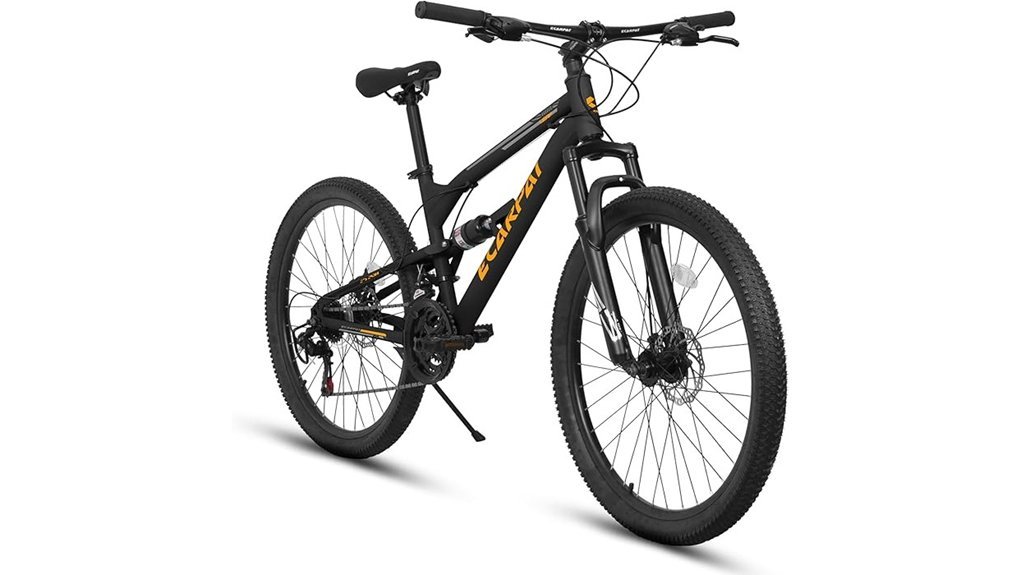
Built for teenagers and adult riders, the Ecarpat suits trail and commuter use. Its 24- or 26-inch full suspension frame pairs a front fork with a rear shock absorber, helping smooth rocks, bumps, and uneven ground while improving traction and reducing wrist fatigue. The 21-speed drivetrain with thumb shifters allows quick, accurate changes for climbs and faster sections. Mechanical dual disc brakes deliver dependable stopping in wet or dry conditions. Carbon steel construction adds durability without excess weight. With 85% pre-assembly, setup is straightforward and usually takes about 20 minutes.
Best For: Teenagers and adult riders who want a durable full-suspension mountain bike for trail riding and commuting.
Pros:
- Full suspension improves comfort, traction, and control on rough terrain.
- 21-speed drivetrain with thumb shifters makes gear changes quick and easy.
- Mechanical dual disc brakes provide reliable stopping in wet or dry conditions.
Cons:
- Assembly is required, even though it comes 85% pre-assembled.
- Carbon steel is durable but typically heavier than aluminum frames.
- Full suspension and disc brakes may require more maintenance than simpler bike setups.
Ecarpat 26×4 Full Suspension Mountain Bike, 21 Speed
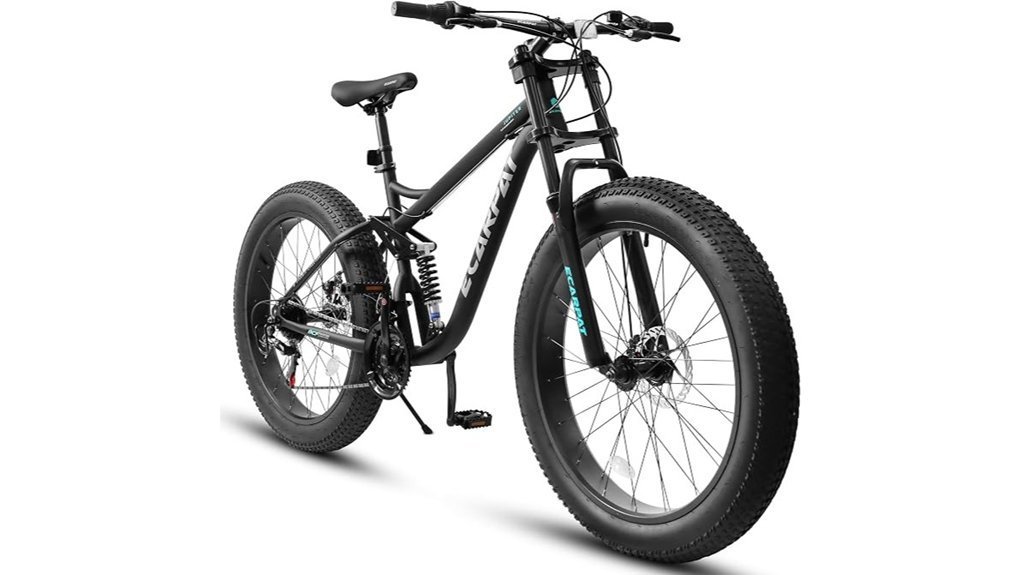
Ecarpat’s 26×4 full-suspension design suits riders who want extra comfort and control on rough trails. A high-carbon steel frame gives the bike a stable feel for everyday use, while thickened front forks and rear shocks help absorb impacts off-road. Its 26 x 4.0-inch fat tires add traction and steadiness on snow, sand, roads, and mountain paths. The puncture-resistant rubber includes reflective strips for visibility. A 21-speed drivetrain supports climbing and descending, and mechanical disc brakes deliver reliable stopping in wet or loose conditions. It arrives 85% assembled, with support available within 24 hours.
Best For: Riders who want a comfortable, stable fat-tire mountain bike for varied terrain like trails, snow, sand, and everyday commuting.
Pros:
- Full-suspension frame with thickened front forks and rear shocks improves comfort and control on rough terrain.
- 26 x 4.0-inch fat tires provide strong traction and stability across diverse surfaces.
- 21-speed gearing and mechanical disc brakes offer versatile riding performance and dependable stopping power.
Cons:
- The high-carbon steel frame may be heavier than some alternatives.
- 85% assembly still requires some setup before riding.
- Fat tires and full suspension can make the bike less efficient for riders focused on speed or lightweight handling.
Ecarpat Full Suspension Mountain Bike, 21-Speed, Disc Brakes
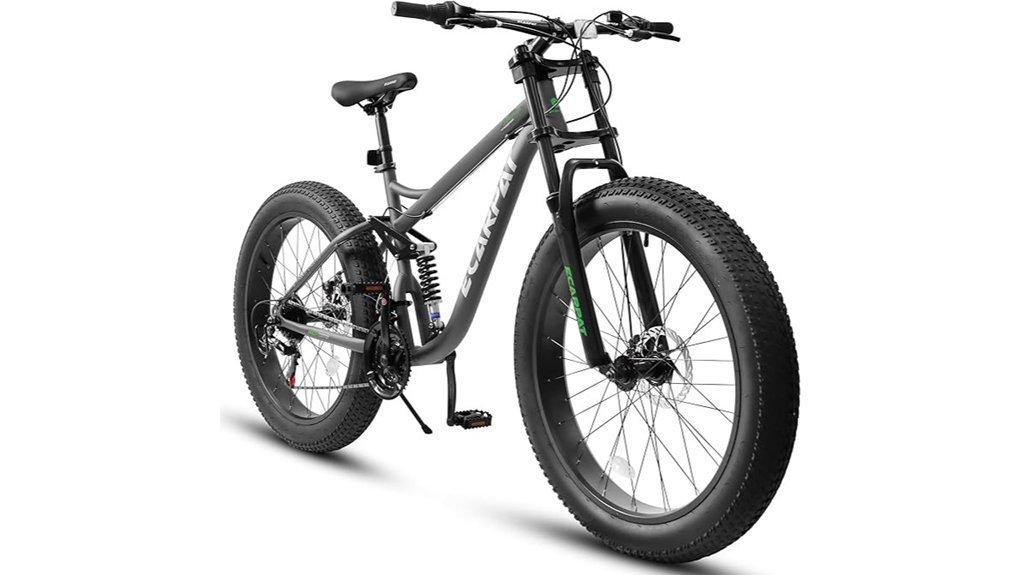
With 21-speed gearing and full suspension, this bike suits riders tackling mixed trail conditions. The Ecarpat 24/26-inch model uses a high-carbon steel frame, thickened front forks, and rear shock absorbers to improve stability on rough ground. Its 26 x 4.0 fat tires add strong traction across snow, sand, road, and mountain paths, while reflective strips support visibility. Mechanical disc brakes deliver dependable stopping in wet, muddy, or sandy settings. Offered for men and women ages 16 and up, it arrives 85% pre-assembled and includes a one-year warranty.
Best For: Men and women ages 16+ who want a full-suspension fat-tire mountain bike for mixed terrain like snow, sand, road, and trails.
Pros:
- 21-speed gearing helps with smooth shifting across different slopes and riding conditions.
- Full suspension, thickened front forks, and rear shock absorbers improve comfort and stability on rough ground.
- 26 x 4.0 fat tires with reflective strips provide strong traction and added visibility.
Cons:
- High-carbon steel frame may be heavier than aluminum alternatives.
- Mechanical disc brakes are reliable, but not as low-maintenance or powerful as hydraulic disc brakes.
- 85% pre-assembled still requires some setup before riding.
TRIFOX Carbon Full Suspension Mountain Bike 12-Speed
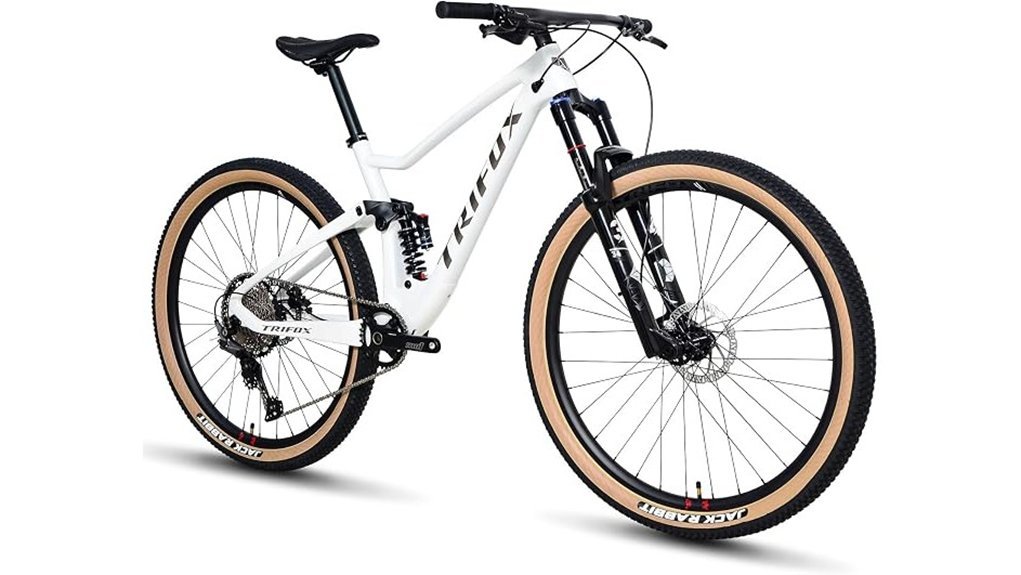
The TRIFOX Carbon Full Suspension Mountain Bike suits intermediate trail riders seeking responsive handling and efficient control. Its T800 carbon frame and integrated bar keep weight near 12.6kg, while 140mm dual suspension adds comfort on rough terrain. Free Floating Technology reduces brake jack, and the Active Braking Pivot helps the rear end stay composed under load. A lower shock position improves stability by lowering the center of gravity. Shimano M6100 Deore 12-speed shifting, hydraulic disc brakes, and 29 x 2.25 knobby tires support confident climbing, descending, and traction. It arrives 85% assembled with a one-year labor warranty.
Best For: Intermediate trail riders who want a lightweight carbon full-suspension mountain bike with responsive handling, reliable Shimano 12-speed shifting, and solid control on varied terrain.
Pros:
- T800 carbon frame with integrated bar keeps the bike relatively light at about 12.6kg.
- 140mm dual suspension with Free Floating Technology and Active Braking Pivot improves comfort and stability.
- Shimano M6100 Deore 12-speed drivetrain and hydraulic disc brakes provide strong, dependable performance.
Cons:
- Best suited to intermediate riders, so it may not be ideal for absolute beginners or highly advanced racers.
- 85% pre-assembled still requires some setup and basic assembly time.
- 29 x 2.25 tires and trail-focused geometry may feel less specialized for very aggressive downhill or technical enduro use.
Full Suspension Mountain Bike with 21-Speed Shifter
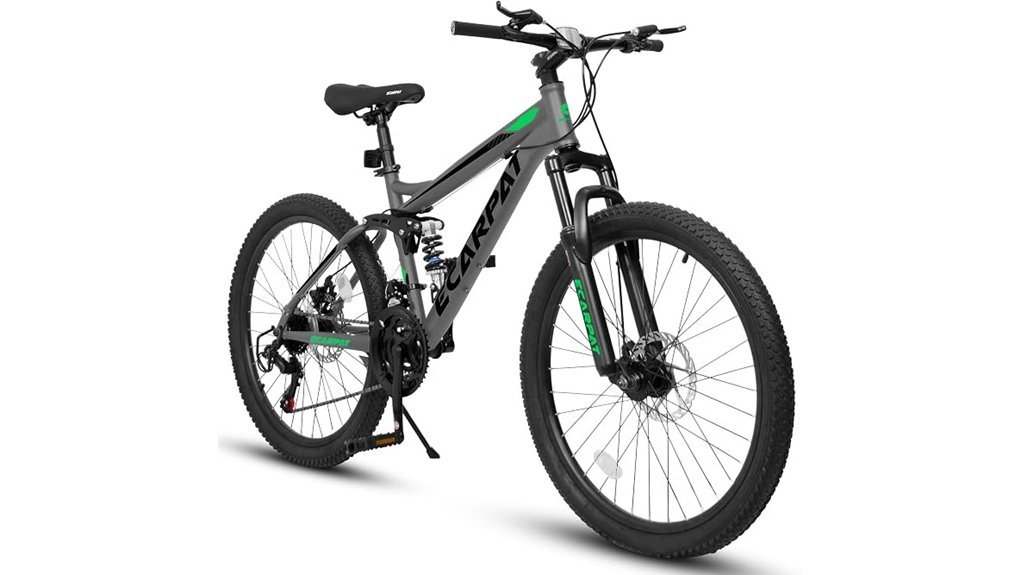
Designed for riders between 48 and 66 inches tall, this full suspension bike suits growing teens and smaller adults. Its high carbon steel frame comes in 24, 26, and 27×16-inch sizes and supports up to 250 lbs. The 21-speed shifter lever with gear indicator helps riders match cadence to climbs, flats, and descents. Mechanical dual disc brakes offer dependable stopping power with simple maintenance. The 24×2.125 all-terrain tires provide grip and puncture resistance on dirt, gravel, and pavement. It arrives 85% pre-assembled, with customer support available for final setup and adjustments.
Best For: Teens and smaller adults between 48 and 66 inches tall who want a durable full suspension mountain bike for mixed terrain riding.
Pros:
- High carbon steel frame with multiple size options and a 250 lb weight capacity
- 21-speed shifter with gear indicator makes gear changes easier across varied terrain
- Mechanical dual disc brakes and puncture-resistant all-terrain tires add safety and stability
Cons:
- Requires assembly of several parts and some final brake/gear adjustments
- High carbon steel frame may be heavier than aluminum alternatives
- Best suited to lighter riders and shorter heights, so not ideal for larger adults
Factors to Consider When Choosing a Full Suspension Mountain Bike for Trail Riding
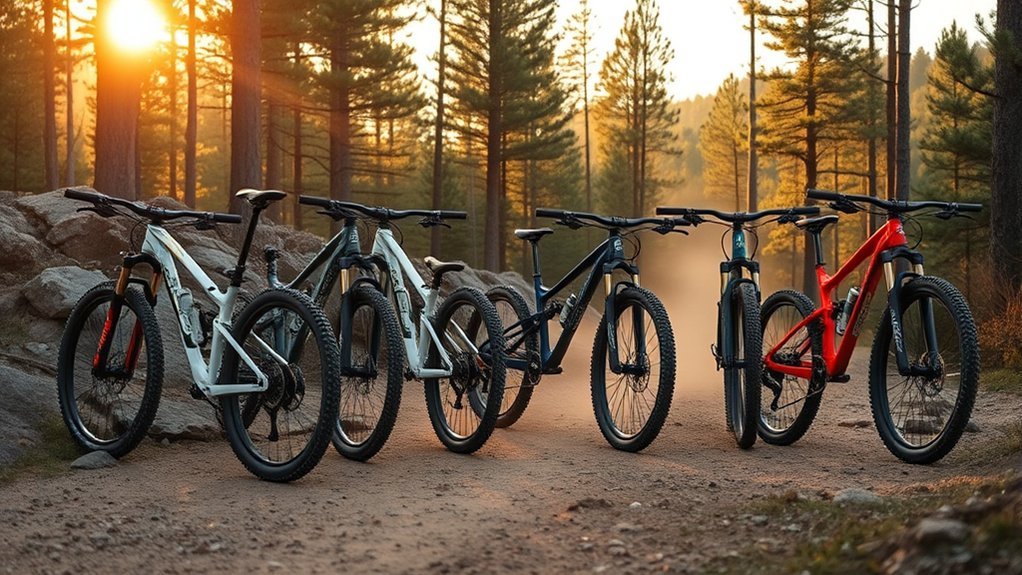
Several factors shape the performance of a full suspension mountain bike on trails, starting with suspension travel and frame material. Wheel size, tire width, and drivetrain speeds also influence control, comfort, and climbing efficiency. A balanced choice depends on how these features work together for the rider’s terrain and style.
Suspension Travel
Suspension travel plays a major role in how a full suspension mountain bike performs on trail terrain, since it determines how much the suspension can compress and extend to absorb bumps and obstacles. This measurement directly affects comfort, traction, and control on varied trails. Bikes with 120mm to 160mm of travel usually suit rough, technical routes because they absorb larger impacts and remain stable at speed. Shorter-travel models, generally 80mm to 120mm, tend to feel lighter and more efficient on climbs and smoother paths. More travel often improves confidence on descents, while less travel can sharpen pedaling efficiency and handling. Trail choice and rider ability matter as well; advanced riders may favor extra travel, while beginners often prefer easier maneuverability.
Frame Material
Frame material shapes a full suspension mountain bike’s balance of weight, strength, and ride feel on the trail. Aluminum is often chosen for its light weight and agile handling, making it well suited to riders who value quick response. High-carbon steel, by contrast, emphasizes durability and impact resistance, which can benefit more rugged terrain and frequent hard use. Carbon fiber offers the strongest strength-to-weight ratio, delivering high performance with excellent stability, though usually at a higher price. It can also reduce trail vibrations, improving comfort on rough surfaces. Maintenance matters as well: aluminum generally needs less care, while steel may require protection from rust. The best choice depends on priorities such as budget, resilience, comfort, and upkeep.
Wheel Size
Wheel size plays a major role in how a full suspension mountain bike handles trail riding. Larger 29-inch wheels roll more easily over roots, rocks, and other obstacles, while also giving added stability at speed. Smaller 24- or 26-inch wheels respond faster, turning and accelerating with less effort, which can benefit tight trails and technical sections. Most full suspension trail bikes fall between 24 and 29 inches, giving riders options suited to terrain and preference. Wheel size can also affect overall weight and efficiency, since bigger wheels usually add mass but may carry momentum better over longer rides. Selecting the right diameter helps balance control, agility, and comfort across varied trail conditions.
Tire Width
Tire width has a major impact on how a full suspension mountain bike performs on trail rides. Wider tires generally deliver more grip and stability, which helps on loose gravel, rocky sections, and other unpredictable terrain. A width of 2.6 inches or more can improve contact with the ground and spread weight more evenly, supporting better control on rugged trails. Fat tires around 4.0 inches add even more friction and confidence in snow, sand, and mud. They also help absorb impacts, softening the ride over roots and broken surfaces. That extra cushioning can reduce hand and wrist fatigue during longer outings. For trail riding, selecting the right tire width is essential because terrain conditions often change quickly and demand a balanced mix of comfort, traction, and control.
Drivetrain Speeds
Drivetrain speeds influence how smoothly a full suspension mountain bike handles changing trail demands. On trail bikes, speed counts typically range from 7 to 21, and that spread affects how efficiently a rider can manage climbs, rolling terrain, and quick descents. More speeds usually mean finer gear ratios, which helps maintain momentum and match effort to terrain changes without abrupt jumps between gears. A 21-speed setup offers a wider selection, making it useful on routes with frequent elevation shifts. Beyond the count itself, shifters and derailleurs must deliver quick, precise changes to keep performance consistent. The best choice depends on riding style and local terrain, with higher-speed drivetrains often better suited to varied, demanding trails where adaptability matters most.
Brake Type
Brake type plays a major role in how confidently a full suspension mountain bike handles trail riding, especially when conditions change quickly. Mechanical disc brakes offer dependable stopping power in mixed weather and usually need less upkeep than rim brakes, which suits riders who want simple reliability. Hydraulic disc brakes deliver stronger power and finer modulation, and they resist mud and debris better on rough trails. Brake pad material also matters: organic pads run quieter, while metallic pads last longer and perform better in severe conditions. Rotor size affects control too, with 180mm or 203mm rotors improving braking force and heat management on steep, sustained descents. Adjustable lever reach and bite point can further refine comfort and control for varied trail demands.
Fit And Geometry
Fit and geometry shape how a full suspension mountain bike feels on trail, influencing comfort, control, and confidence. Frame size must match rider height; an 18.5-inch frame suits a defined range, while ergonomic designs for riders from 48 to 66 inches promote efficient pedaling and reduced fatigue. Geometry also matters: a lower center of gravity improves stability on rough, uneven terrain and sharp turns. Wheel size changes handling, with 29-inch wheels rolling more easily over roots and rocks, while 24-inch wheels respond faster in tight sections. Frame material supports long-term fit and function too; high-carbon steel resists bending and cracking under repeated off-road stress. Together, these elements determine whether the bike feels secure, balanced, and capable on demanding trail rides.
Assembly Ease
Assembly ease can make a full suspension mountain bike far more practical for trail riders, especially when many models arrive about 85% pre-assembled. In most cases, setup involves attaching the handlebars, saddle, front wheel, and pedals, a process that may take about 20 minutes. This reduced effort helps riders get on the trail sooner and with less frustration. Clear support materials also matter. A manual or instructional video can guide each step and reduce mistakes during assembly. Including the needed tools further improves convenience and prevents unnecessary delays. After assembly, quick brake and gear adjustments may still be required to guarantee safe, smooth performance. Bikes that simplify this process offer a more user-friendly start and better overall ownership experience for trail riding.
Frequently Asked Questions
What Frame Size Fits My Height Best?
Frame size should match height so precisely that a bike can feel like a custom-built extension of the body. As a general guide, riders around 5’0″–5’4″ often suit small, 5’4″–5’8″ medium, 5’8″–6’1″ large, and 6’1″+ extra-large. However, inseam, arm length, and riding style can shift the ideal choice dramatically. A test ride remains the surest way to avoid a frame that feels either cramped or unwieldy.
How Much Suspension Travel Suits Trail Riding?
For trail riding, 120 to 140 mm of suspension travel usually suits most riders best, balancing comfort, efficiency, and control on varied terrain. Shorter travel can feel quicker and more playful on smoother trails, while longer travel adds confidence on rough descents. The ideal choice depends on riding style, local trails, and preference for climbing versus descending performance, but this range is the common all-around sweet spot for trail use.
Are Tubeless Tires Worth It for Trails?
Yes, tubeless tires are usually worth it for trail riding. They let riders run lower pressures for better grip and comfort, while reducing pinch flats and sealing small punctures automatically. The setup can be messier and may need occasional sealant top-ups, but the added traction and reliability often outweigh the hassle. For rough, rooty, or rocky trails, tubeless systems are often considered a practical upgrade over tubes.
How Often Should I Service the Suspension?
Like a heartbeat, suspension needs regular attention. It should be serviced every 50 hours of riding for basic cleaning and lubrication, with a lower leg or air-can service around 100 hours. Full damper service is often recommended every 200 hours, or at least once a year. Harsh conditions, wet trails, and heavy use can shorten those intervals. A well-maintained suspension keeps traction, comfort, and control reliably consistent.
Can I Upgrade the Brakes Later?
Yes, the brakes can usually be upgraded later, provided the frame and fork support the desired rotor sizes and caliper mounts. A rider may start with the stock setup and improve stopping power after identifying real needs. However, it is wise to evaluate brake quality at purchase, since better brakes can enhance control, safety, and confidence on steep trail descents from the beginning.