Choosing the best travel pillow starts with one question: will you use it while sitting upright or while lying down? Airplane neck pillows need to limit head movement against a seat, while camping and hotel pillows focus more on loft, pressure relief, and pack size. The ten options below cover both types, so match the design to how and where you actually sleep.
Quick Answer
Among the products covered here, CloudBliss is a practical all-in-one choice for upright air travel, Hikenture stands out when low weight and a tiny packed size matter, and Coop suits travelers who want adjustable fill for camping, hotels, or road trips. Choose by sleep position before comparing materials or extras.
Last checked: September 30, 2026. Dates and figures were verified against official sources where available.
Key Takeaways
- Separate upright neck support from pillows meant for sleeping flat; they solve different problems.
- Memory foam gives more structured cushioning but usually takes up more luggage space than an inflatable pillow.
- Inflatable models such as Hikenture work well when weight and packed size matter most, while adjustable-fill models offer more control over loft.
- For long flights, look closely at rear thickness, side support, chin support, and how securely the pillow stays in place.
- Check the care instructions for the exact model because a washable cover does not mean the foam core itself can go in a washing machine.
Travel Pillow Comparison at a Glance
| Pillow | Type | Best Fit | Main Trade-Off |
|---|---|---|---|
| CloudBliss | Memory-foam neck pillow | Flights and upright travel | Bulkier than minimalist designs |
| Hikenture | Inflatable camping pillow | Backpacking and camping | Less plush than solid foam |
| Travelrest Nest | Memory-foam neck pillow | Long flights and upright sleep | Firm, structured feel |
| Bespilow | Compact cervical foam pillow | Hotels, RVs, and car camping | Not designed like a wraparound flight pillow |
| Travelrest Ultimate | Inflatable body-style pillow | Side leaning in a seat | Unusual shape needs setup |
| Brookstone Free Form | Bendable memory-foam pillow | Neck, lumbar, or leg support | Less specialized neck structure |
| Vekkia | Rectangular foam pillow | Camping and road trips | Takes more room than an inflatable |
| Coop | Adjustable foam-and-fiber pillow | Camping, hotels, and road trips | Heavier than ultralight options |
| Cushion Lab | Contoured memory-foam pillow | Side and back sleeping away from home | More luggage space than inflatables |
| Weekender | Gel memory-foam pillow | Car camping and travel | Foam needs more packed space |
CloudBliss Memory Foam Travel Neck Pillow with Accessories

CloudBliss is best suited to travelers who want an all-in-one upright neck pillow rather than a separate collection of flight accessories. Its memory-foam body wraps around the neck, while the adjustable closure lets you change how closely it fits.
The ergonomic shape is intended to support the head, neck, and chin during flights, car rides, train journeys, or other seated travel. The package also includes an eye mask, earplugs, a carry bag, and storage pockets, which makes it more self-contained than a basic U-shaped pillow.
Best For: Travelers who want a memory-foam neck pillow with several travel accessories in one package.
Pros:
- Memory foam gives the pillow more structure than a simple inflatable neck ring.
- Adjustable closure helps you change the fit around the neck.
- Includes an eye mask, earplugs, storage features, and a carry bag.
Cons:
- The foam construction takes up more room than a fully inflatable design.
- A wraparound fit can feel restrictive if you dislike material close to the chin.
- Its upright-seat design is less useful as a normal sleeping pillow at a hotel or campsite.
Hikenture Inflatable Camping Pillow with Removable Cover

Hikenture is the most clearly backpacking-focused option in this group. It is an inflatable pillow for sleeping horizontally, not a wraparound airplane neck pillow, and its firmness can be adjusted by adding or releasing air.
According to the Hikenture product specifications, the pillow uses a thickened TPU bladder, a removable washable cover, and a one-click valve. It packs to about 5 by 3 inches and weighs about 5.6 ounces. Its contoured shape can support the neck while sleeping and can also be used behind the lower back while sitting.
Best For: Backpackers, campers, hikers, and travelers who care more about low weight and tiny packed size than a home-pillow feel.
Pros:
- Very small packed size makes it easier to fit in a backpack or carry-on.
- Air volume can be changed to adjust firmness.
- Removable washable cover simplifies cleaning.
Cons:
- An air bladder does not feel as plush as solid memory foam.
- You need to inflate it before use and deflate it before packing.
- It is designed mainly for lying down or lumbar support rather than holding your head upright on a flight.
Travelrest Nest Memory Foam Neck Pillow for Travel

The Travelrest Nest is built specifically for upright travel and long flights. Its thermo-sensitive memory foam, tall side walls, front closure, and relatively flat rear profile are designed to support the neck without placing a thick roll of foam between your head and the seat.
The current Travelrest Nest specifications confirm a non-slip backing, compression stuff sack, removable cover, and thermo-sensitive memory foam. The manufacturer says the sack compresses the pillow to roughly one-quarter of its normal size and recommends removing it from the sack when it is not being transported. The cover is removable and hand-washable.
Best For: Long-haul flyers who want structured memory-foam support while sleeping upright.
Pros:
- Flat-backed shape is better suited to a seatback than a thick conventional U-shaped pillow.
- Thermo-sensitive memory foam provides firm, contoured support.
- Compression sack reduces the amount of luggage space it occupies.
Cons:
- The firmer foam may feel too structured for travelers who prefer soft cushioning.
- It remains bulkier than scarf-style or fully inflatable travel pillows.
- The removable cover has different care requirements from the foam core, so the whole pillow should not simply be treated as one washable piece.
Bespilow Travel Cervical Memory Foam Neck Pillow

Bespilow is better suited to sleeping on a flat surface than to holding your head upright in an airline seat. Its compact butterfly-style shape uses memory foam to support the neck during hotel stays, road trips, RV travel, or car camping.
The pillow measures about 18.1 by 11 by 5.1 inches in current product listings and rolls into a travel bag for transport. The supplied product information also describes a CertiPUR-US certified foam core and an OEKO-TEX cover. The cover is removable and washable, while the memory-foam core should be kept out of the washing machine.
Best For: Travelers who want a small cervical-style pillow for hotels, RVs, road trips, or camping rather than a wraparound flight pillow.
Pros:
- Contoured shape provides more defined neck support than a flat mini pillow.
- Compact size is easier to transport than a full-size bed pillow.
- Removable cover makes routine cleaning easier.
Cons:
- It is not shaped to stabilize the head while sitting upright on a plane.
- Solid memory foam occupies more space than an inflatable pillow.
- The smaller dimensions may not suit people who want the surface area of a normal bed pillow.
Travelrest Ultimate Travel Pillow & Body Pillow
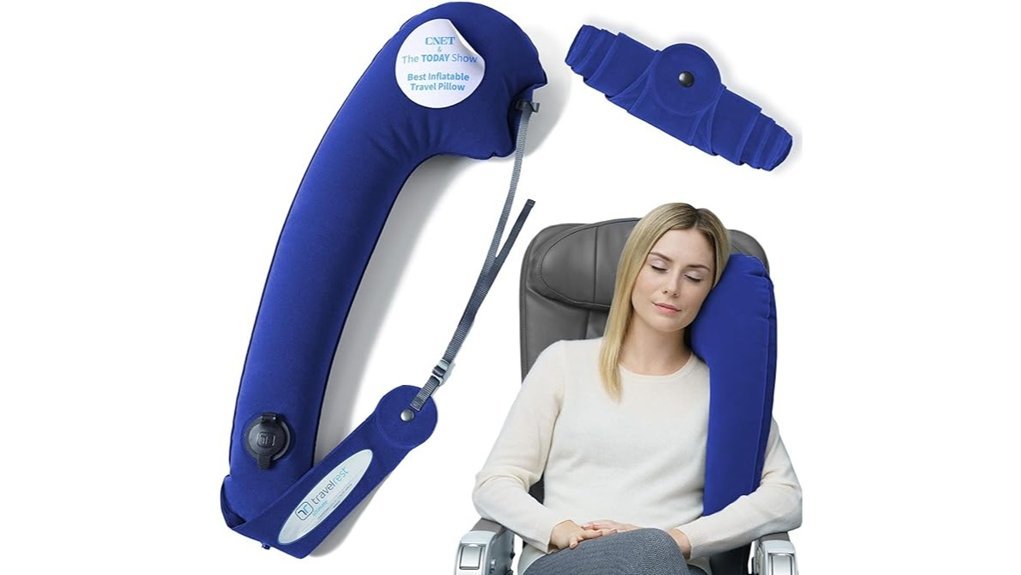
The Travelrest Ultimate takes a different approach from a conventional U-shaped pillow. Its long, inflatable body-style shape sits beside the head and upper body, making it useful for travelers who naturally lean to one side while resting.
The Travelrest All-in-One version combines the inflatable Travelrest design with a washable velour cover containing memory-foam inserts. The manufacturer says it can attach to a seat, be worn messenger-bag style, or be used without a high seatback. It rolls to about 3.5 by 10 inches for transport.
Best For: Travelers who prefer leaning sideways into a pillow instead of wearing a thick cushion around the entire neck.
Pros:
- Supports a different sleep posture from standard U-shaped neck pillows.
- Inflatable core allows the pillow to pack down relatively small.
- Can be positioned against airline or car seats in several ways.
Cons:
- The unusual shape has more of a learning curve than a simple neck ring.
- It needs inflation before use.
- Travelers who sleep with their head centered may prefer a symmetrical wraparound design.
Brookstone Free Form Travel Neck Pillow

Brookstone’s Free Form pillow is the most adaptable design here. An internal bendable spine lets you shape the memory-foam pillow into a U, a curved side support, or a straighter roll for the neck, lower back, or legs.
That flexibility makes it useful when one fixed shape does not suit every part of a trip. The fleece cover is removable and machine washable, and the snap closure can attach the pillow to luggage. The cover can also be used as a stuffable shell with soft clothing when luggage space is tight.
Best For: Minimalists and frequent travelers who want one pillow that can change shape for several types of support.
Pros:
- Bendable structure lets you change the support shape instead of accepting one fixed contour.
- Can work behind the neck, lower back, or legs.
- Removable cover and luggage attachment improve travel convenience.
Cons:
- It does not provide the same dedicated head-locking structure as a purpose-built flight neck pillow.
- Fleece and foam may feel warm during long use.
- Frequent reshaping adds another adjustment step compared with a fixed pillow.
Vekkia Memory Foam Travel Pillow (Gray M)

Vekkia is a compact rectangular pillow for travelers who want something closer to a small conventional pillow. It is better suited to camping, road trips, or leaning against a window than to wrapping around the neck in an upright middle seat.
The Gray M model measures about 17.7 by 11.8 by 3.5 inches and weighs about 14.24 ounces. Its memory-foam construction is compressible, and the removable pillowcase can be machine washed.
Best For: Campers, road-trippers, and travelers who prefer a familiar rectangular pillow shape.
Pros:
- Rectangular shape feels more like a small bed pillow than a neck brace.
- Compressible foam balances support with travel portability.
- Removable washable cover makes cleanup straightforward.
Cons:
- It does not surround the neck to control head movement on an airplane.
- Solid foam takes up more space than a deflated air pillow.
- The 3.5-inch profile may not provide enough loft for every side sleeper.
Coop Home Goods Adjustable Travel Camping Pillow

Coop’s strongest feature is adjustable fill. Instead of accepting a fixed loft, you can remove or add the memory-foam-and-microfiber fill until the pillow better matches your head, shoulders, and usual sleep position.
The current Coop specifications list an uncompressed size of 19 by 13 inches and a compressed size of 10 by 6 inches. The total listed weight is 36 ounces including the water-resistant stuff sack. Coop also states that the pillow and outer cover are machine washable and that its foam is CertiPUR-US certified.
Best For: Campers, hotel guests, and road-trippers who want to customize loft and firmness rather than use a fixed-height pillow.
Pros:
- Adjustable fill lets you fine-tune height and firmness.
- Water-resistant stuff sack protects the pillow during transport.
- Both the pillow and outer cover have manufacturer-provided washing instructions.
Cons:
- At 36 ounces including the stuff sack, it is much heavier than an ultralight inflatable.
- It is designed primarily for sleeping horizontally, not stabilizing the head in an airplane seat.
- Adjusting fill takes more effort than simply inflating or unpacking a fixed pillow.
Cushion Lab Travel Memory Foam Neck Pillow

The Cushion Lab Travel Deep Sleep Pillow is aimed at travelers who want bed-style side or back sleeping support in hotels, tents, or other overnight settings. It is not the same type of product as an upright airplane neck brace.
The Cushion Lab product page describes dual-density CloudSupport memory foam, sculpted side-sleeping bolsters, a washable FreshFace pillowcase, and a RollPress travel pouch. The pouch compresses the pillow to about 12 by 5 by 5 inches. The manufacturer says the memory-foam core itself is not washable.
Best For: Side and back sleepers who want a compact version of a contoured bed pillow for hotels, camping, or overnight travel.
Pros:
- Sculpted bolsters provide a more defined shape for horizontal side sleeping.
- Memory foam offers substantial cushioning compared with an air-only pillow.
- Travel pouch compresses the pillow for easier transport.
Cons:
- It needs more luggage space than an inflatable pillow.
- It does not wrap around the neck for upright airplane sleep.
- The foam core cannot be machine washed.
Weekender Cooling Gel Memory Foam Camping Pillow

Weekender is another compact rectangular option for camping, road trips, and overnight travel. Its gel-infused memory foam and ventilation holes are designed to reduce heat buildup while maintaining a medium-firm sleeping surface.
The 18 by 12-inch pillow weighs about 1.1 pounds and contours around the head, neck, and shoulders. It comes with a carry bag and a zippered cover that can be machine washed and dried. Because it ships compressed, the foam may need 24 to 48 hours to reach its full shape before the first trip.
Best For: Car campers and travelers who prefer solid memory foam but still want a smaller pillow than the one they use at home.
Pros:
- Gel-infused ventilated foam is designed to manage heat better than a solid unventilated block.
- Medium-firm foam provides a familiar cushioned feel with no inflation step.
- Carry bag and removable washable cover make it practical for repeated travel.
Cons:
- It packs larger than an inflatable pillow.
- It needs time to expand fully after being removed from compressed shipping packaging.
- Its rectangular shape does not stabilize the head like a dedicated wraparound flight pillow.
How to Choose the Best Travel Pillow for Your Trip

The right travel pillow depends less on one universal ranking and more on how you sleep, where you use it, and how much space you can spare. Start with the use case, then compare support, material, packed size, fit, and cleaning requirements.
Comfort And Support
For upright travel, support means controlling how far your head can fall forward or sideways after your neck muscles relax. A thick rear cushion can sometimes push the head forward, so the shape of the back matters as much as softness.
For camping or hotel use, support works more like a normal bed pillow. Your goal is enough loft to keep your neck in a comfortable position when lying on your back or side. Adjustable fill or air pressure can help when one fixed height does not suit you.
Material Quality
Memory foam provides dense, contouring support and does not need inflation, but it usually weighs more and takes up more space. Gel-infused or ventilated foam may improve airflow, although no foam pillow stays completely cool once it has absorbed body heat.
Inflatable pillows are lighter and pack much smaller. Their feel depends heavily on air pressure, so slightly reducing inflation can sometimes make an overly firm pillow more comfortable. Hybrid designs add fabric, foam, or padding over an air bladder to reduce the bare-inflatable feel.
Portability Features
If you are backpacking, packed dimensions and weight deserve as much attention as comfort. A pillow that feels excellent but consumes a large part of a small pack may be impractical.
For air travel, look for a compression pouch, snap, drawstring, or luggage attachment. These let you keep the pillow outside your main bag without carrying it loose through the airport. Inflatable models usually offer the smallest packed size, while solid foam gives up some portability for a more substantial feel.
Shape And Fit
The best shape depends on your sleeping posture. Traditional wraparound neck pillows suit travelers whose heads move in several directions, while flat-back designs can sit closer to an airplane headrest. Side-leaning travelers may prefer a tall one-sided or body-style support.
For sleeping flat, choose loft based on the gap between your head and sleeping surface. Side sleepers generally need more height than stomach sleepers, while back sleepers usually fall between the two. A contoured cervical design can feel supportive to one person and overly structured to another.
Care And Maintenance
Check which part is actually washable. Many travel pillows advertise a washable cover even though the memory-foam core must only be spot cleaned or kept dry. Inflatable bladders also have their own care requirements.
After washing a cover, let it dry fully before packing the pillow away. Avoid storing damp fabric in a sealed stuff sack, because trapped moisture can create odor and shorten the useful life of the materials.
Versatile Use Cases
A versatile pillow earns its luggage space by working in more than one setting. Some compact rectangular models can serve as a bed pillow, window cushion, or lumbar support, while bendable designs can move between the neck, back, and legs.
Still, versatility should not replace the main job you need the pillow to perform. If your priority is sleeping upright on a 10-hour flight, dedicated head and neck stability matters more than whether the pillow can also be used at a campsite.
Frequently Asked Questions
Which Travel Pillow Is Best for Long-Haul Flights?
For long-haul flights, choose a pillow made specifically for upright neck support rather than a small camping pillow. The Travelrest Nest and CloudBliss are the most flight-focused options in this group, while the Travelrest Ultimate suits travelers who prefer leaning to one side. Fit matters because a pillow that is too tall or tight can become uncomfortable after several hours.
Are These Travel Pillows Machine Washable?
Some have machine-washable covers, but the entire pillow is not always machine washable. Memory-foam cores commonly need to stay out of the washer, while brands such as Coop provide separate instructions for the pillow and cover. Always follow the care directions for the exact model instead of assuming that a removable cover means the core can be washed the same way.
Which Pillow Works Best for Side Sleepers?
It depends on whether you mean side sleeping in bed or leaning sideways in an airplane seat. For horizontal side sleeping, Cushion Lab, Bespilow, Coop, Vekkia, and Weekender offer bed-style support. For an upright side lean, Travelrest Ultimate or a neck pillow with tall side support is a better match because it helps fill the space beside the head.
Do Any of These Pillows Come With a Travel Bag?
Yes. Several options covered here include a bag, pouch, or stuff sack, including CloudBliss, Hikenture, Travelrest Nest, Bespilow, Coop, Cushion Lab, and Weekender. The bag matters most with foam pillows because compression reduces bulk, while an inflatable model becomes small once the air is released.
Which Travel Pillow Offers the Best Value for Money?
The best value depends on the feature you will actually use rather than the lowest price alone. CloudBliss combines a neck pillow with several accessories, Hikenture delivers very low packed weight for camping, and Vekkia offers a straightforward compact foam design. A more expensive adjustable or contoured pillow can still be better value if its shape matches your normal sleep position.
Sources
- Travelrest Nest product page: memory foam, compression, backing, cover care, and travel features.
- Hikenture camping pillow: packed size, weight, valve, bladder, cover, and adjustable firmness.
- Travelrest All-in-One product page: inflatable construction, memory-foam inserts, use positions, and rolled size.
- Coop Original Adjustable Travel & Camping Pillow: dimensions, weight, fill, certifications, stuff sack, and care.
- Cushion Lab Travel Deep Sleep Pillow: foam construction, travel pouch, cover care, and packed dimensions.