 ‘,
‘‘
)
src_trtl = “https://apac.trtltravel.com/pages/after-care”
src_cdc_jet = “https://www.cdc.gov/yellow-book/hcp/travel-air-sea/jet-lag-disorder.html”
src_faa = “https://www.faa.gov/travelers/fly_safe/turbulence”
src_cdc_dvt = “https://www.cdc.gov/blood-clots/risk-factors/travel.html”
src_mayo = “https://www.mayoclinic.org/symptoms/neck-pain/basics/causes/sym-20050882”
src_tsa = “https://www.tsa.gov/travel/security-screening/whatcanibring/all-list?pubDate=20250608”
sections = []
sections.append(“””
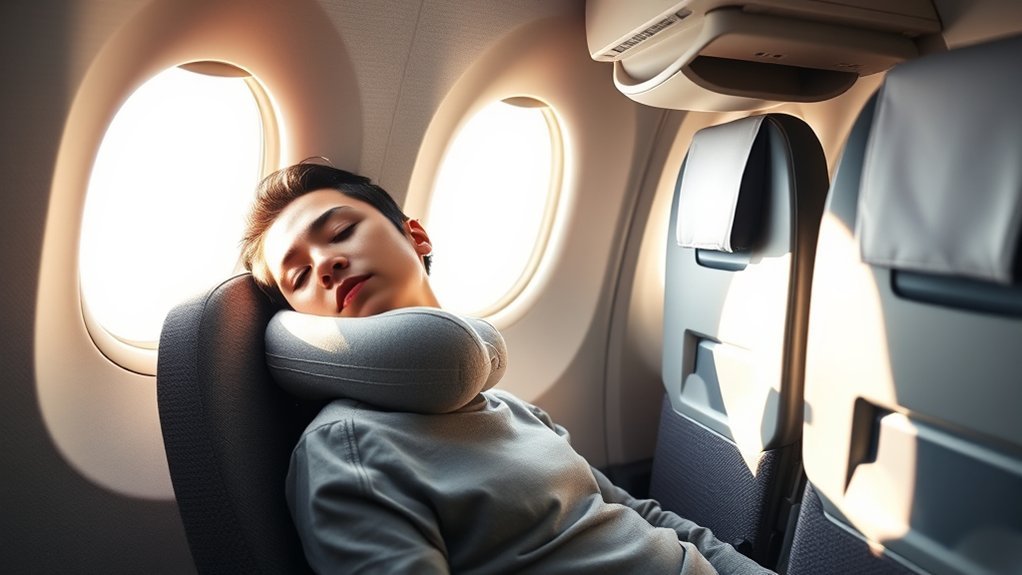
To sleep with a travel pillow on an airplane, place the pillow’s main support where your head naturally drops, keep your head and neck in a neutral line, and secure the fit without squeezing your throat. A standard U-shaped pillow may work with the opening in front for side and rear support, or rotated if the thicker section supports your chin better. Specialized wraparound and seat-attached designs should be worn as their instructions describe.
“””)
sections.append(“””
Quick Answer
Sit fully back, notice whether your head falls forward or sideways, and place the pillow’s firmest support in that direction. Keep your chin level, fasten the pillow snugly but comfortably, recline slightly if allowed, and use an eye mask or earplugs when light and cabin noise make sleep harder.
“””)
sections.append(“””
What Matters Most for Sleeping With a Travel Pillow
“””)
sections.append(“””
Key Takeaways
- Match the support to the direction your head moves when you relax instead of assuming every pillow should face the same way.
- Keep your ears roughly over your shoulders and avoid a pillow that pushes your chin sharply toward your chest.
- Wraparound and seat-attached pillows can control head movement well, but their fit depends more on neck size and seat design.
- Inflatable pillows pack smallest and let you change firmness; memory foam usually gives steadier cushioning but takes more space.
- Washable covers, a storage bag, an eye mask, and earplugs can make a travel pillow easier to use repeatedly on long trips.
“””)
sections.append(“””
How to Sleep With a Travel Pillow on an Airplane
The best setup is the one that keeps your head supported without forcing your neck forward, backward, or to one side. Test the pillow while you are sitting upright before trying to sleep, because its useful position can change with the seat, headrest, and your usual sleep direction.
- Relax and notice your head-drop direction. Sit fully back, close your eyes, and let your neck relax briefly. If your chin falls forward, you need more front or chin support. If your head tips sideways, move the thicker support to that side.
- Position the pillow for its design. A traditional U-shaped pillow can support the back and sides of the neck with its opening forward. If that lets your chin collapse, rotate the pillow only if its shape gives better chin support. Wrap-style, sling, and seat-attached pillows should follow their intended support points.
- Adjust the fit. Use the clasp, hook-and-loop closure, drawstring, or inflation level until the pillow stays in place without pressing on your throat. An inflatable pillow should feel supportive, not hard enough to push your head away from the seat.
- Use the seat, not just the pillow. Sit against the seatback and recline slightly when permitted. A window can provide side support, while a winged headrest can reduce side-to-side movement. Keep the pillow from interfering with the seat belt or your ability to respond to crew instructions.
- Reduce light and noise. An eye mask and earplugs can make it easier to sleep in a bright, noisy cabin. The CDC Yellow Book jet-lag guidance also recommends timing sleep and light exposure around your destination when crossing time zones.
- Wake up and move during long trips. A good pillow can make it easier to stay still for hours, so remember to change position and move your legs when it is safe to do so.
Warning: Keep your seat belt fastened whenever you are seated and follow cabin-crew instructions. The FAA warns that turbulence can occur without warning, so a pillow should never prevent proper seat-belt use or restrict your movement in an emergency.
On trips lasting several hours, comfort should not mean complete immobility. The CDC advises long-distance travelers to move their legs frequently and take breaks to stretch or walk when possible, especially if they have additional blood-clot risk factors.
Note: A travel pillow is a comfort aid, not a treatment for ongoing neck problems. If neck pain persists, worsens, radiates into an arm, or comes with weakness, numbness, or tingling, seek medical advice.
“””)
sections.append(“””
Travel Pillow Options at a Glance
The models below solve different sleep problems. Use this comparison to narrow the list before reading the full product notes.
| Option | Support Style | Best Fit | Main Trade-off |
|---|---|---|---|
| Trtl | One-sided internal support | Compact neck stabilization | Less like a conventional cushion |
| 360° Head Support | Adjustable head support + mask | Light blocking and head control | Takes time to adjust straps |
| Rwotlls | Head strap + silk mask | Long-flight head stabilization | Less cushioning than foam collars |
| SARISUN | Seat/headrest support + mask | Headrest-equipped seats | Seat compatibility matters |
| Inflatable 45° Pillow | Forward-leaning inflatable | Tray-table style resting | Must be inflated and stored |
| ZIKEE | Memory foam + chin support | Firm 360° neck support | Bulkier than minimalist designs |
| Sleeper Hold | Seat-back head support + mask | Reducing head bobbing | Depends on seat/headrest fit |
| Maliton | Tall inflatable 45° support | Taller travelers and forward rest | Airline use can vary |
| Cirorld | Adjustable memory foam | Upright pressure relief | Foam core is not washable |
| YFONG | Memory foam + head strap + mask | Taller travelers | Wrapped fit can feel bulky |
“””)
# product sections
prod = []
prod.append(f”””
Trtl Neck Support Travel Pillow for Flights
{img_wrappers2[0]}
The Trtl pillow is best for travelers who want a compact support rather than a thick U-shaped cushion. Its internal frame supports one side of the head while the fleece wrap secures it around the neck, so you can shift the support left, right, or closer to the chin depending on how your head drops.
Trtl’s official after-care guide lists the original pillow at 4.7 ounces and says the fabric can be machine washed on a cold 30°C cycle after removing the internal support. That makes it one of the lighter choices here and easier to pack than most memory-foam collars.
Best For: Travelers who want compact, structured neck support and often lean to one side while sleeping upright.
Pros:
- Internal support can stabilize the head without the bulk of a full U-shaped pillow.
- Lightweight, compact design is easy to pack or attach to luggage.
- Soft fleece construction is washable after the internal support is removed.
Cons:
- Feels more like a supportive wrap than a traditional cushion.
- Needs careful positioning to find the right support angle.
- The semi-rigid internal structure may not suit travelers who prefer soft all-around padding.
{ctas[0]}”””)
prod.append(f”””
360° Head Support Travel Pillow with Sleep Mask
{img_wrappers2[1]}
The 360° Head Support Travel Pillow with Sleep Mask is aimed at travelers whose heads bob or tilt once they fall asleep. The Telepepe TPEM-833 design combines an adjustable support system with an eye mask, so it tries to solve both head movement and cabin light in one compact setup.
Straps and buckles let you change the fit, while the contoured mask is shaped to avoid direct pressure on the eyes and temples. Because the system depends on adjustment rather than thick cushioning, take time to fit it before you try to sleep.
Best For: Frequent travelers, commuters, and office workers who want a compact 2-in-1 head-support and sleep-mask setup.
Pros:
- 360° support is designed to reduce forward and sideways head movement.
- Integrated eye mask reduces the need to pack a separate light-blocking accessory.
- Soft, breathable construction is lightweight and easy to carry.
Cons:
- Provides less traditional cushioning than a thick neck pillow.
- Straps and buckles may take some trial and error to fit well.
- Travelers who want plush foam around the neck may prefer another style.
{ctas[1]}”””)
prod.append(f”””
Travel Pillow with Head Strap and Eye Mask
{img_wrappers2[2]}
The Rwotlls travel pillow uses a head strap rather than a thick collar to control movement. It pairs that support with an ultra-soft silk eye mask, making it a useful option for travelers who care more about stabilizing the head and blocking light than adding deep neck cushioning.
The adjustable airplane head strap is intended to reduce bobbing, while the breathable materials keep the setup light. At 0.07 kilograms, the set is easy to carry, and the included Oxford pouch keeps the strap and mask together between trips.
Best For: Adults who want lightweight head stabilization and light blocking on long flights or road trips.
Pros:
- Adjustable head strap helps limit head bobbing.
- Silk eye mask blocks cabin light without adding a bulky second accessory.
- Lightweight set packs into a compact Oxford pouch.
Cons:
- Silk materials need gentler handling than many polyester covers.
- Provides less cushioning than a full memory-foam collar.
- Works best in seats that suit the strap system.
{ctas[2]}”””)
prod.append(f”””
SARISUN Travel Pillow with 3D Sleep Mask
{img_wrappers2[3]}
The SARISUN Travel Pillow is built for seats with a usable headrest, where its support can help hold your head more centrally. It combines 360° head-and-neck stabilization with a soft 3D eye mask, making it especially relevant for long flights when sideways drift and cabin light interrupt sleep.
The adjustable U-shaped support is intended to work across different heights, while the contoured mask leaves room around the eyes. Its biggest limitation is seat compatibility: if the headrest cannot accommodate the attachment or support position, the system may not work as intended.
Best For: Long-haul travelers using headrest-equipped seats who want head stabilization and an included eye mask.
Pros:
- 360° support helps reduce head bobbing and sideways tilt.
- 3D eye mask adds light blocking without pressing directly on the eyes.
- Storage bag makes the system easier to pack between trips.
Cons:
- Performance depends heavily on the shape and accessibility of the seat headrest.
- May be more setup than you need on short flights.
- The specialized fit may not suit every neck size or sleep position.
{ctas[3]}”””)
prod.append(f”””
Inflatable Travel Neck Pillow for Airplane Napping
{img_wrappers2[4]}
This inflatable travel pillow is designed for people who prefer to lean forward rather than rely on a collar around the neck. Its 45° shape supports the head and upper body, while a central opening and side spaces give the arms somewhere to rest.
The PVC flocking surface is washable, and the dual-valve design is intended to speed inflation and deflation. It can work on planes, trains, cars, or at a desk, but it takes more in-seat space than a compact wraparound pillow.
Best For: Travelers and office nappers who prefer forward-leaning support with room for the arms.
Pros:
- 45° shape supports a forward resting position instead of forcing an upright neck angle.
- Central and side openings give the face and arms dedicated space.
- Deflates for storage and lets you adjust firmness by changing the air level.
Cons:
- Requires inflation and deflation before and after use.
- Takes more usable space in front of the body while inflated.
- May need to be aired out before first use.
{ctas[4]}”””)
prod.append(f”””
ZIKEE Ergonomic Travel Neck Pillow with Carrying Case
{img_wrappers2[5]}
ZIKEE uses high-density memory foam, chin support, and a dual-hold design to reduce movement around the head and neck. Its ear-free profile and ventilation grooves also try to solve two common problems with thick foam pillows: ear pressure and heat buildup.
Adjustable hook-and-loop fastening and a rear strap let you change the fit. The pillow weighs 0.88 pounds and compresses into a carrying case, but the larger foam build still takes more room than a wrap or deflated inflatable.
Best For: Travelers who want firmer 360° support with chin stabilization and a cooler, ear-free profile.
Pros:
- Memory foam and chin support help stabilize the head from several directions.
- Ear-free shape and ventilation grooves can reduce pressure and heat around the sides of the head.
- Washable cover and carrying case make routine care and packing easier.
Cons:
- Any seat-attachment strap should be used only when the airline and seat design allow it.
- The recommended fit is limited to neck circumferences of 11.8 to 17.7 inches.
- Bulkier than simple fabric or inflatable travel pillows.
{ctas[5]}”””)
prod.append(f”””
Sleeper Hold Travel Pillow with Eye Mask
{img_wrappers2[6]}
The Sleeper Hold Travel Pillow is another seat-supported design made to reduce the “bobblehead” effect instead of surrounding the neck with thick foam. It combines a head-support strap, adjustable eye mask, and soft foam-filled pillow, which can be useful when a normal neck pillow still lets your head fall forward.
The compact carry case and removable machine-washable cover suit frequent travel. Because the system attaches to a seat-back or headrest, its usefulness depends on the seat design and on whether the crew permits the setup.
Best For: Travelers age 13+ who want light-blocking, seat-supported head stabilization for upright sleep.
Pros:
- Seat-back or headrest support helps reduce forward head movement.
- Adjustable eye mask blocks light while the soft pillow supports the face and head.
- Compact case and washable cover simplify packing and cleaning.
Cons:
- Will not fit every headrest or seat equally well.
- Soft foam support may feel too light for travelers who prefer a firm neck brace.
- Primarily useful for seated sleeping rather than general lounging.
{ctas[6]}”””)
prod.append(f”””
Maliton Inflatable Travel Pillow for Neck Support
{img_wrappers2[7]}
The Maliton inflatable pillow uses a tall 45° support angle to give the head and upper body a place to lean. Its shape is especially relevant for taller travelers who feel that standard U-shaped pillows do not add enough height or front support.
The pillow measures 13 x 13 x 20 inches when in use, has a soft flocked surface, and inflates in about 5 to 10 breaths. At 0.98 pounds, it is still light enough for luggage, although the larger inflated footprint may not suit every airline seat.
Best For: Taller travelers who prefer a forward-leaning inflatable support for planes, trains, cars, or desk naps.
Pros:
- 45° shape adds height and creates a supported forward resting position.
- Inflates with a small number of breaths and deflates quickly for storage.
- Soft flocked surface is more comfortable against skin than bare PVC.
Cons:
- Some airlines or seat layouts may not allow a large inflatable sleep aid in use.
- PVC construction feels different from plush foam or fiber pillows.
- Manual inflation adds another setup step.
{ctas[7]}”””)
prod.append(f”””
Cirorld Memory Foam Travel Neck Pillow with Accessories
{img_wrappers2[8]}
Cirorld is a more conventional adjustable memory-foam option for travelers who want cushioning around the neck and chin. Its flat-back shape is intended to reduce the extra bulk behind the head that can push you forward in an upright airplane seat.
Press buttons adjust the fit across different neck sizes, while the foldable pillow stores in the included carrying bag. The set also includes an eye mask and earplugs. The removable pillowcase can be machine washed, but the foam core itself should be kept dry and aired out.
Best For: Adults who want adjustable memory-foam support plus a compact set of sleep accessories.
Pros:
- Memory foam provides pressure-relieving cushioning around the neck.
- Flat-back and adjustable closure help keep the head more upright in a seat.
- Includes an eye mask, earplugs, and carrying bag.
Cons:
- May feel too soft for travelers who prefer rigid support.
- The foam core itself is not washable.
- Foam still occupies more luggage space than a wrap or deflated inflatable.
{ctas[8]}”””)
prod.append(f”””
YFONG Travel Pillow with 3D Sleep Mask
{img_wrappers2[9]}
The YFONG Travel Pillow combines memory-foam neck support, a head strap, and a contoured 3D sleep mask. It is designed for taller travelers who want both chin support and head stabilization during long-haul sleep.
Hook-and-loop straps and a front pull-strap tighten the fit, while the 360° locking design supports the chin, sides, and back of the neck. The 3D mask includes a nose pad and shaped eye cups so you can blink without the mask pressing directly on the eyelids.
Best For: Taller long-haul travelers who want a combined memory-foam neck pillow, head strap, and light-blocking mask.
Pros:
- Combines neck support and a 3D sleep mask in one travel setup.
- Adjustable straps help create a more secure fit.
- Memory foam supports the chin, sides, and back of the neck.
Cons:
- The stated fit is aimed at users roughly 160 to 185 cm tall.
- The wrapped support can feel bulky compared with simpler neck pillows.
- Travelers who already use a separate eye mask may not need the full system.
{ctas[9]}”””)
sections.extend(prod)
sections.append(f”””
Factors to Consider When Choosing the Way to Sleep With Travel Pillow on Airplane
{img_wrappers2[10]}
Your pillow should match both your body and the way you actually fall asleep in an airplane seat. Focus first on head stabilization and neutral neck position, then consider packability, materials, light blocking, and how the design interacts with the seat.
Pillow Support Type
Choose the support style based on what moves when you relax. A wrap or internal brace can be effective if your head falls to one side, a chin-supporting collar can help with forward nodding, and a forward-leaning inflatable can suit travelers who cannot get comfortable against the seatback.
Memory foam usually gives steadier cushioning and pressure relief, while inflatable designs let you vary firmness and pack down smaller. Seat-attached systems can control head movement well, but they depend more on headrest shape and airline rules.
Sleep Position Fit
Your sleep position matters more than the label on the pillow. Back-oriented sleepers usually need balanced support behind and beside the neck, while side leaners need enough height to fill the gap between the shoulder and the support surface.
If you tend to nod forward, use a design that supports the chin without forcing it sharply upward. General neck guidance from Mayo Clinic emphasizes keeping the head and neck aligned rather than sleeping in an awkward position.
Head Stabilization Features
Good stabilization limits repeated forward nodding and side-to-side tipping without locking your head rigidly in place. Look for support that catches the direction your head naturally falls, then adjust closures only enough to stop the pillow from sliding.
Chin supports, flat backs, wraparound frames, and adjustable straps can all help, but the fit should still let you breathe, swallow, and turn your head comfortably. If a design attaches to a headrest, it should never interfere with the seat belt or crew instructions.
Portability And Packing
A travel pillow is useful only if you are willing to carry it. Compressible foam models and wraps reduce bulk, while inflatable pillows usually take the least space once deflated.
Storage bags are helpful because they keep the surface cleaner inside a carry-on. If you plan to wear or clip the pillow outside your bag, remember that airline baggage-size and personal-item rules can differ even when airport security allows the pillow through the checkpoint.
Material Comfort Level
The cover touches your face and neck for hours, so breathability and cleaning matter. Soft fleece can feel cozy, ice-silk-style covers can feel cooler, and removable washable covers are easier to maintain between trips.
Do not assume every foam core is washable just because its cover is. Follow the care label, let washed covers dry fully, and keep memory foam dry unless the manufacturer specifically says otherwise.
Light Blocking Design
Light control is most useful on red-eyes, daytime flights, and cabins where reading lights or window glare interrupt sleep. A separate or integrated eye mask should block light without pressing painfully on the eyelids or pulling the pillow out of position.
Contoured masks leave more room around the eyes, while adjustable straps help prevent gaps around the nose and temples. If your pillow includes a mask, test both parts together before travel so the straps do not compete for the same space around your head.
“””)
# FAQ content
faq_items = [
(“how-do-i-keep-my-travel-pillow-clean-on-long-flights”,
“How Do I Keep My Travel Pillow Clean on Long Flights?”,
“Use a removable washable cover when possible, store the pillow in a clean bag when you are not using it, and follow the care label after the trip. Wipeable or inflatable surfaces can usually be spot-cleaned, while memory-foam cores often need to stay dry. Let every part dry fully before repacking it.”),
(“can-i-use-a-travel-pillow-with-headphones-comfortably”,
“Can I Use a Travel Pillow With Headphones Comfortably?”,
“Yes, if the pillow leaves enough space around your ears and jaw. Over-ear headphones can press against tall side walls, while earbuds usually interfere less with thick neck support. Before a long flight, test the pillow and headphones together for a few minutes and adjust the pillow so neither creates a pressure point.”),
(“whats-the-best-travel-pillow-position-for-window-seats”,
“What’s the Best Travel Pillow Position for Window Seats?”,
“Put the thicker support on the side you plan to lean toward, while keeping your neck as straight as possible rather than sharply bending toward the window. A U-shaped pillow can stay in its normal position or be rotated if that gives better chin support. Avoid putting direct pressure on the hard cabin wall.”),
(“how-do-i-prevent-neck-pain-after-sleeping-upright”,
“How Do I Prevent Neck Pain After Sleeping Upright?”,
“Keep your head centered over your shoulders, avoid letting the chin collapse toward the chest, and change position when you wake. Gentle movement can help after a long period of sitting. If pain persists, worsens, radiates into an arm, or comes with weakness, numbness, or tingling, seek medical care.”),
(“are-travel-pillows-allowed-through-airport-security”,
“Are Travel Pillows Allowed Through Airport Security?”,
“Yes. The TSA currently lists pillows as allowed in both carry-on and checked baggage. A pillow can still be inspected during screening, and airline rules may separately limit the size or number of items you bring into the cabin. Keep straps, electronics, or unusual components accessible if officers need to examine them.”)
]
sections.append(‘
Frequently Asked Questions
‘)
for fid,q,a in faq_items:
if fid==”are-travel-pillows-allowed-through-airport-security”:
vis = a.replace(“The TSA currently lists pillows”, f’The TSA currently lists pillows‘)
else:
vis = a
sections.append(f’
{q}
{vis}
‘)
schema = {
“@context”:”https://schema.org”,
“@type”:”FAQPage”,
“mainEntity”:[
{“@type”:”Question”,”name”:q,”acceptedAnswer”:{“@type”:”Answer”,”text”:a}}
for _,q,a in faq_items
]
}
sections.append(‘‘)
# Sources section
sources_list = [
(src_trtl, “Trtl Travel after-care guide”, “Trtl Original fit, weight, and washing guidance.”),
(src_cdc_jet, “CDC Yellow Book: Jet Lag Disorder”, “Timing sleep and light exposure during international travel.”),
(src_faa, “FAA: Turbulence — Staying Safe”, “Seat-belt use and turbulence safety.”),
(src_cdc_dvt, “CDC: Understanding Your Risk for Blood Clots with Travel”, “Movement guidance during long-distance travel.”),
(src_mayo, “Mayo Clinic: Neck Pain”, “Neck alignment, posture, and symptoms that merit medical attention.”),
(src_tsa, “Transportation Security Administration: What Can I Bring?”, “Pillows in carry-on and checked baggage.”)
]
src_html = ‘
Sources
- ‘ + ”.join(
- {n}: {d}
f’
‘ for u,n,d in sources_list
) + ‘
‘
sections.append(src_html)
final_html = ”.join(sections)
out=Path(‘/mnt/data/fixed_article.html’)
out.write_text(final_html, encoding=’utf-8′)
print(‘chars’,len(final_html),’imgs’,final_html.count(‘
new_srcs=re.findall(r’