Learning how to use a travel pillow correctly matters as much as choosing the right shape. The pillow should support the direction your head tends to drop without forcing your chin toward your chest, whether you are on a plane, train, road trip, or taking a short seated rest. The best setup depends on the pillow’s shape, fit, and the seat behind you.
Quick Answer
Use a travel pillow by placing its supportive section where your head tends to fall, then adjust it until your neck stays close to neutral and your chin is not pushed into your chest. U-shaped pillows do not all face the same way. ZIKEE, napfun, and FlyHugz use different support shapes or closures, so fit each design as intended.
Key Takeaways
- Do not assume every U-shaped pillow must face the same direction; use the orientation that supports your head without pushing it forward.
- Adjust straps, Velcro, or drawstrings until the pillow is stable but not tight around your throat or jaw.
- A wraparound neck pillow suits upright sleep, while a small rectangular pillow is better for head, back, or campsite support.
- Clean removable covers according to their care labels and avoid soaking a foam core unless its manufacturer specifically allows it.
- Airport security and airline cabin-use rules are different: a pillow can pass security yet still be restricted as an in-seat comfort device.
How to Use a Travel Pillow Correctly
Start by sitting in the position you will actually use during the trip, then notice whether your head falls forward, sideways, or backward as you relax. The goal is to fill that unsupported space while keeping your head reasonably centered over your shoulders. Mayo Clinic guidance on neck alignment also recommends keeping the head and neck aligned with the body.
- Sit fully back in the seat. Settle your shoulders against the seatback before fitting the pillow. A pillow that feels right while you are leaning forward may become too thick once you relax.
- Find the direction your head naturally drops. Side support matters most if you lean toward a window or aisle. Chin support matters more if your head falls forward.
- Place the thickest support where the gap is. With a U-shaped pillow, the opening may face forward, backward, or slightly to one side depending on the design and your posture. If rear padding pushes your head forward, rotate or reposition the pillow instead of forcing that position.
- Secure the fit without overtightening. Use Velcro, straps, or a drawstring only firmly enough to stop the pillow from sliding. You should still be able to breathe, swallow, and move your jaw comfortably.
- Test before trying to sleep. Relax for a few minutes. If your chin is pushed down, your head tilts sharply, or you feel pressure, numbness, or increasing pain, loosen, rotate, or remove the pillow.
If the pillow still does not feel right, reduce the amount of padding behind your neck, shift more support to the side or chin, or use the seat headrest or window for secondary support. A travel pillow should reduce awkward movement, not lock your neck into an uncomfortable position.
Note: A travel pillow is a comfort aid, not a treatment for ongoing neck pain. If pain is severe, follows an injury, spreads into an arm or leg, or comes with weakness, numbness, or tingling, seek medical care rather than relying on a pillow alone.
Travel Pillow Options and the Best Way to Use Each
Different travel pillows solve different support problems. Wraparound memory foam models are mainly for upright neck support, rectangular pillows work under the head or behind the back, and wedges are designed for elevation rather than neck wrapping. Match the shape to the position you need before comparing extras such as storage bags, eye masks, straps, or washable covers.
ExploreBliss Memory Foam Travel Neck Pillow Set
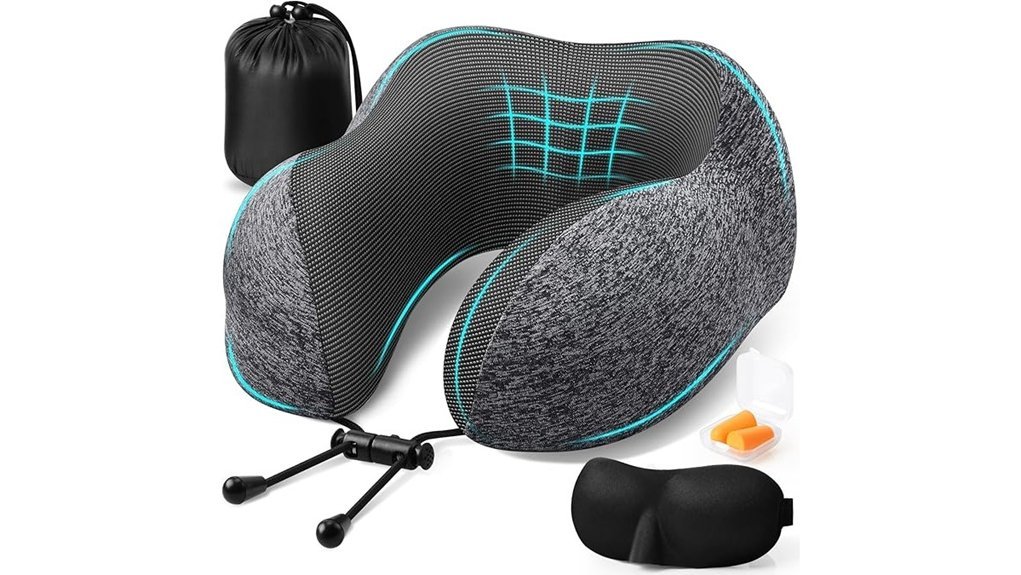
The ExploreBliss Memory Foam Travel Neck Pillow Set is best used as a conventional seated neck support for flights, train rides, and road trips. Fit the curved foam around your neck so it supports the sides without pushing your head forward, then use the included eye mask and earplugs separately when you want less light and noise.
The set includes a neck pillow, eye mask, earplugs, and storage bag. The pillow uses memory foam, a curved shape, an inner fabric described by the seller as magnetic therapy fabric, a soft outer layer, and an invisible zipper for removing the cover. It compresses into the drawstring bag for transport.
Best For: Adults who want a memory foam neck pillow plus basic sleep accessories in one travel set.
Pros:
- Includes a neck pillow, eye mask, earplugs, and storage bag.
- Curved memory foam shape provides structured side and neck support.
- Removable cover and compressible storage bag simplify cleaning and packing.
Cons:
- Designed for adults, so the fit may be too large for younger travelers.
- The bundled accessories add more pieces to keep track of during a trip.
- Memory foam can feel warmer than an inflatable or lightly filled pillow for some users.
ZIKEE Dual-Layer Memory Foam Travel Neck Pillow
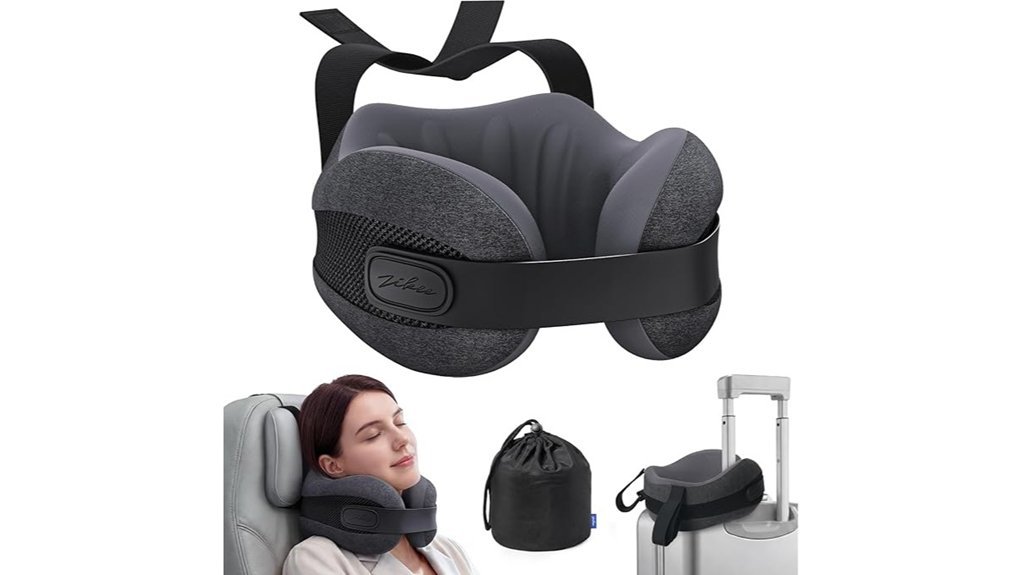
The ZIKEE Dual-Layer Memory Foam Travel Neck Pillow is designed for upright travel when you want wraparound support plus a flatter back against the seat. Position the back panel against the headrest, settle the side sections around your neck, then adjust the front Velcro and seat straps so the pillow stays in place without squeezing.
Its dual-layer BASF memory foam combines a softer outer layer with a firmer core. The 360-degree ergonomic shape includes ear-friendly side areas, while ventilation holes, airflow grooves, and mesh sections are intended to improve airflow. The cover is washable, and the pillow packs into a carry case.
Best For: Long-haul travelers who want wraparound support, seat attachment, and extra ventilation.
Pros:
- Dual-layer memory foam balances cushioning with firmer structural support.
- Seat straps and a front closure help limit pillow movement during upright sleep.
- Ventilation features and a washable cover make repeated travel easier.
Cons:
- The listed neck-fit range of 12.6 to 16.5 inches may exclude some users.
- Seat straps and a close front fit can feel restrictive if you prefer a loose pillow.
- Its structured shape takes more setup than a simple rectangular or inflatable pillow.
Swemos Travel Pillow for Kids and Adults
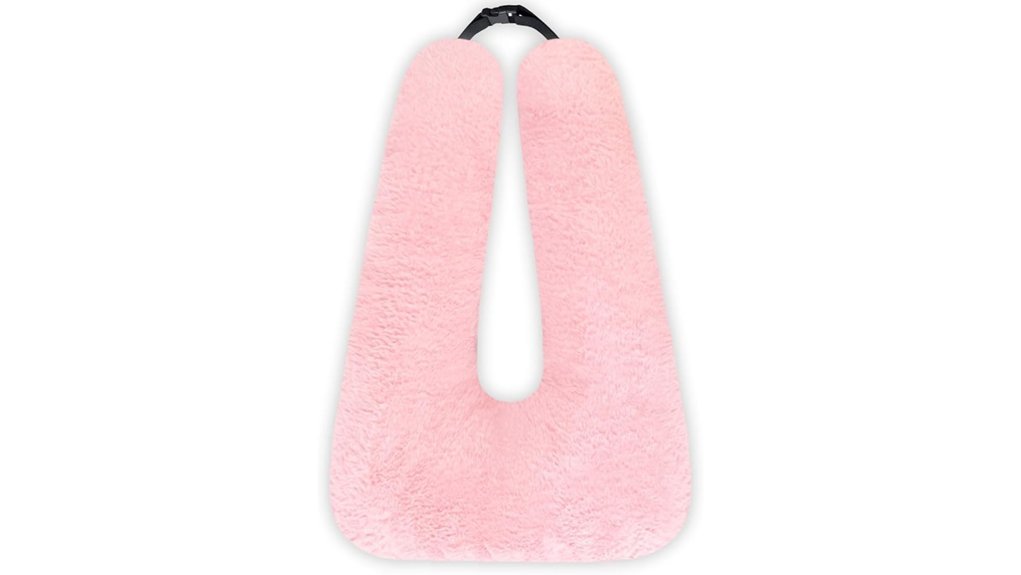
Swemos is a softer, larger U-shaped pillow for travelers who want neck support that can also work as a backrest, headrest, or hugging cushion. Use it around the neck for seated travel, behind the lower or upper back for reading, or against the side of the body when resting in a car, train, or school bus.
The pink cover uses faux rabbit fur, while PP cotton filling provides a plush feel. It is also marketed for sleeping, reading, watching TV, and working. Because it arrives vacuum-compressed, allow about 24–48 hours for it to regain its full shape after unpacking.
Best For: Kids and adults who prefer a plush multipurpose pillow instead of a tightly structured memory foam neck brace.
Pros:
- U-shaped design can support the neck, back, head, or body in several seated positions.
- Faux rabbit fur cover and PP cotton filling create a soft feel.
- Useful beyond travel for reading, watching TV, or resting at home.
Cons:
- Vacuum-compressed packaging means it may need 24–48 hours to recover its shape.
- The larger plush build is less compact than many dedicated flight pillows.
- Soft filling may not provide enough stability for travelers who prefer firm support.
napfun Memory Foam Travel Neck Pillow for Airplane
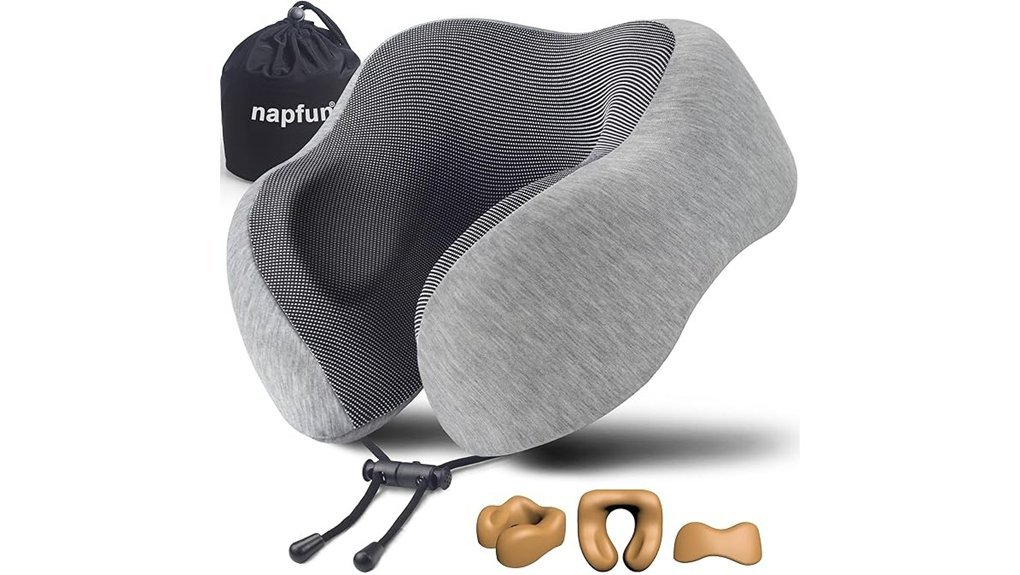
The napfun memory foam travel neck pillow is meant for upright seated travel, especially if your head tends to drop forward. Position the chin-support section so it limits forward tipping, then adjust the fit until the raised side areas support your neck without pressing too tightly against your jaw.
The product is described as using 100% memory foam with 5-second return technology, a raised lobe shape, and an adjustable drawstring. It is intended for airplanes, cars, trains, and buses. Its wraparound build is more structured than a basic U-shaped cushion, so fit matters more than simply placing it around the back of your neck.
Best For: Travelers who want memory foam support with extra help limiting forward head drop.
Pros:
- Memory foam provides structured cushioning for seated rest.
- Chin and side support can reduce head bobbing when the fit is adjusted correctly.
- Compressible design makes it easier to carry between trips.
Cons:
- The structured wrap may feel too firm or enclosed for travelers who like an open U-shape.
- It can feel bulkier around the jaw than a thin scarf-style or inflatable option.
- Comfort depends strongly on neck size, seatback shape, and sleeping position.
Small Shredded Memory Foam Travel Pillow
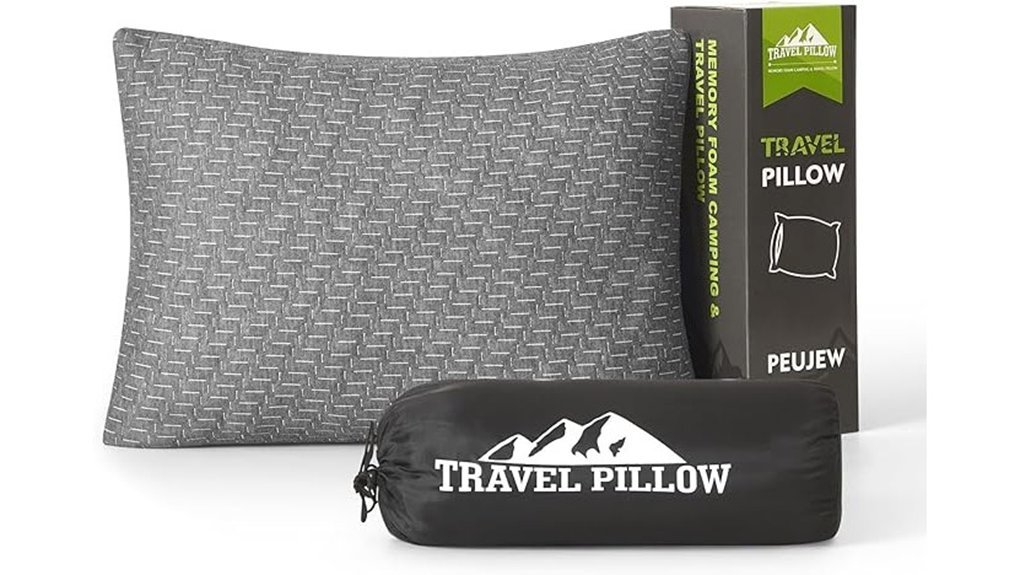
This small shredded memory foam pillow works differently from a wraparound neck pillow. Use its 12 by 16 inch shape under your head when lying down, behind your back in a seat, or as extra cushioning in a tent, hammock, car, or hotel rather than expecting it to stop side-to-side head movement by itself.
The shredded foam can shift and contour more freely than a single molded foam core. A microfiber cover adds a soft outer surface, while the travel bag makes the pillow easier to compress and carry. The removable cover is machine washable and quick drying.
Best For: Travelers, campers, backpackers, and road trippers who want a compact rectangular pillow for several positions.
Pros:
- Compact 12 x 16 inch size works for head, back, or general travel cushioning.
- Shredded memory foam is more adjustable than a single molded foam block.
- Removable machine-washable cover simplifies routine care.
Cons:
- It does not wrap around the neck, so it provides less head stabilization in an upright airline seat.
- Small dimensions may not suit people who want a full-size sleeping pillow.
- Shredded fill can feel less uniform than a molded memory foam core.
Portable Inflatable Wedge Pillow for Sleep Support
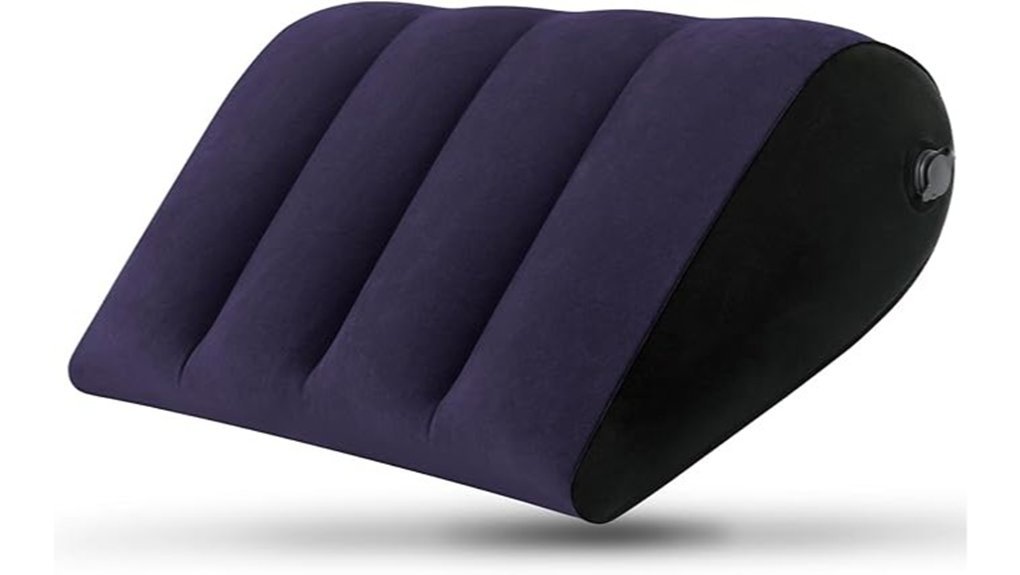
The JCDOBEST portable wedge pillow is for elevation and positional support, not for wrapping around your neck. Inflate it only enough to create a stable slope, then use it behind your back or under your legs, knees, feet, or upper body for temporary support during road trips, hotel stays, beach trips, or other settings where the wedge is permitted.
The listed size is 20 x 14.2 x 6.3 inches, and the pillow weighs 0.40 lb. The seller describes it as a PVC wedge that inflates by mouth in under 60 seconds and deflates through its valve. Its inflatable design packs much smaller than a foam wedge, but airline use deserves extra caution because some carriers prohibit inflatable wedges as in-seat comfort devices.
Best For: Adults who want a lightweight inflatable wedge for temporary back, leg, knee, foot, or upper-body support away from home.
Pros:
- Inflatable construction saves luggage space compared with a full-size foam wedge.
- 0.40 lb weight makes it easy to carry for road trips and hotel stays.
- One wedge can be repositioned for the back, legs, knees, feet, or upper body.
Cons:
- It is not a neck-wrapping pillow for stabilizing the head in an upright seat.
- Manual inflation and deflation add setup time.
- Some airlines restrict inflatable wedges from in-seat use.
3-in-1 Airplane Sleep Support System with Pillow, Mask, Sling
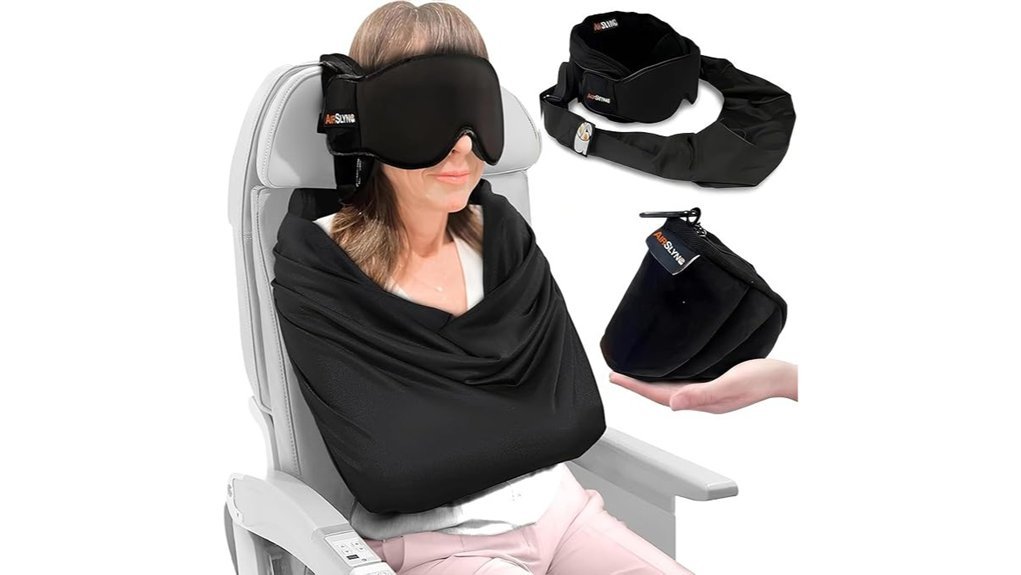
AirSlyng’s 3-in-1 system combines a memory foam neck pillow, adjustable eye mask, and blanket-like body sling for upright travel. Fit the pillow first, add the eye mask only when you are settled, and use the sling only where the operating carrier permits it and where it cannot interfere with the seat, aisle, safety equipment, or another passenger’s space.
The AS2024 listing describes a 16 oz system that packs into carry-on luggage and is hand-wash only. The seller also describes the design as physician-informed ergonomics intended to reduce head bobbing. The integrated approach may appeal to travelers who want several sleep accessories together, but it also makes airline-specific comfort-item rules more important than with a basic neck pillow.
Best For: Adults who want a combined neck pillow, eye mask, and sling system and are willing to confirm the carrier’s cabin-use rules.
Pros:
- Combines three travel-comfort items in one coordinated system.
- Memory foam pillow and adjustable eye mask can be used independently of the sling.
- Packs into carry-on luggage despite including multiple components.
Cons:
- Hand wash only, which is less convenient than a machine-washable cover.
- The sling adds setup and may not be allowed by every airline.
- More components mean more adjustment than a standard travel pillow.
FlyHugz Memory Foam Travel Neck Pillow
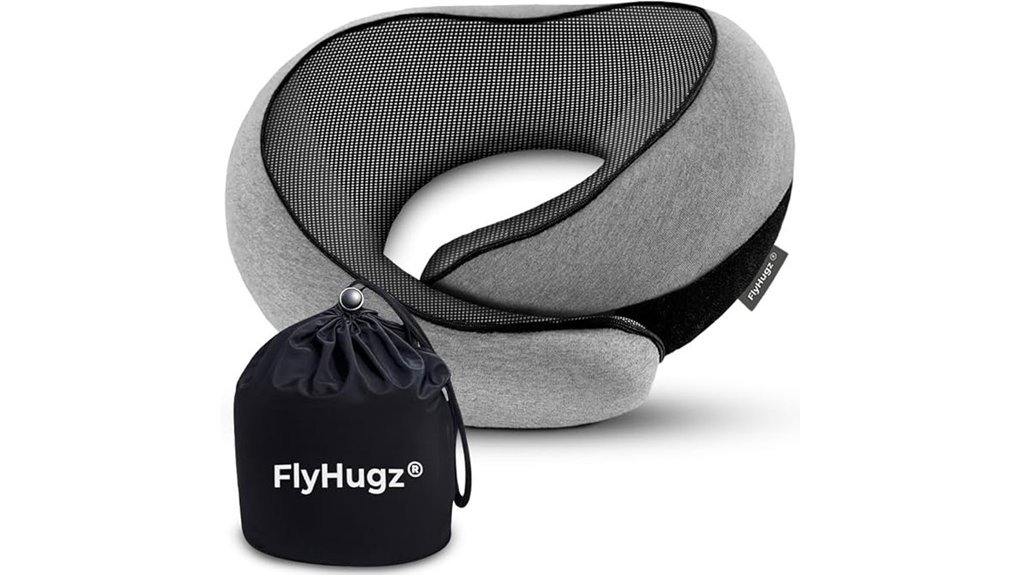
FlyHugz is an adjustable memory foam neck pillow for travelers who want a close wrap around the neck and chin. Fasten the adjustable Velcro only until the pillow stays centered, then check that the front support is limiting head drop without forcing your chin down or making the fit feel tight.
The listing describes premium memory foam with 5-second return technology, a breathable sweat-resistant cover, adjustable Velcro, and a compact roll-up design weighing 4.5 oz. The seller also says the chin support can reduce mouth opening and snoring during travel. The cover is machine washable, while the foam itself should be cleaned according to the product care instructions rather than put through the same wash cycle.
Best For: Travelers who want adjustable wraparound support in a compact memory foam design.
Pros:
- Adjustable Velcro lets you change how closely the pillow wraps the neck.
- Memory foam supports the sides and chin during upright rest.
- Removable washable cover and roll-up packing make it practical for repeated trips.
Cons:
- A close chin-support fit may feel too enclosed for some sleepers.
- Velcro placement must be adjusted carefully to avoid unnecessary pressure.
- It is mainly a seated travel pillow, not a substitute for a full-size bed pillow.
Memory Foam Travel Neck Pillow with 360° Support
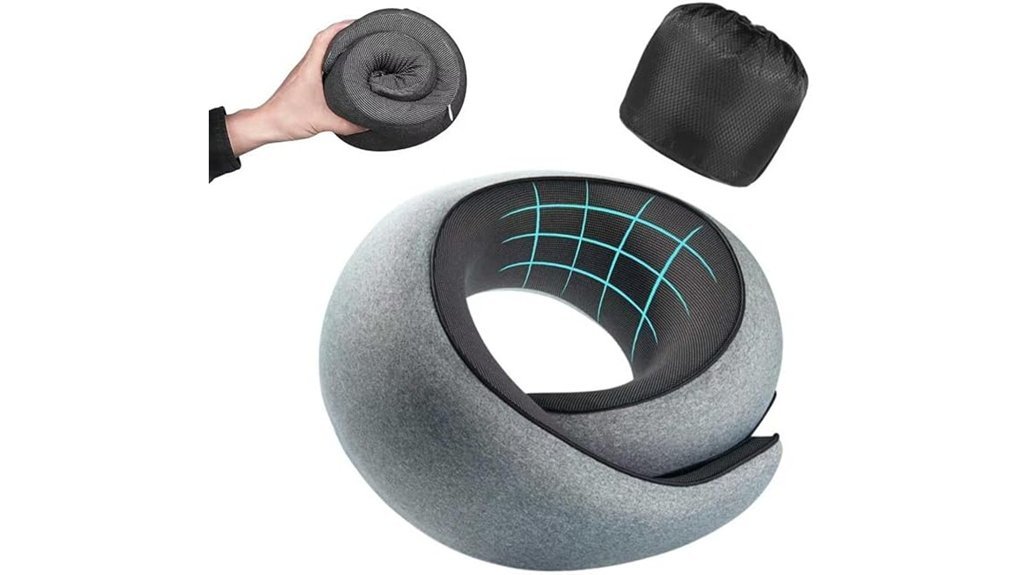
Asteraty’s memory foam travel pillow uses a wraparound 360° shape for seated neck and chin support. Center the back of the pillow against the seat, then position the side and front sections so they limit head movement without lifting your shoulders or forcing the head forward.
The gray pillow uses slow-rebound memory foam and a soft, breathable outer cover. The removable zippered cover supports easier cleaning, while the pillow compresses into its storage bag for a carry-on or backpack. Airing memory foam after unpacking can also help any packaging odor dissipate.
Best For: Travelers and office users who want compact wraparound memory foam support for seated rest.
Pros:
- 360° shape supports the sides, back, and front of the neck.
- Memory foam contours around the neck while keeping more structure than loose fill.
- Storage bag and removable cover improve portability and care.
Cons:
- The round wraparound feel may be too enclosed for people who prefer an open U-shape.
- Memory foam can have a temporary odor after unpacking.
- A thick rear section can be uncomfortable against some seatbacks if it pushes the head forward.
Memory Foam Travel Neck Pillow with Head Support
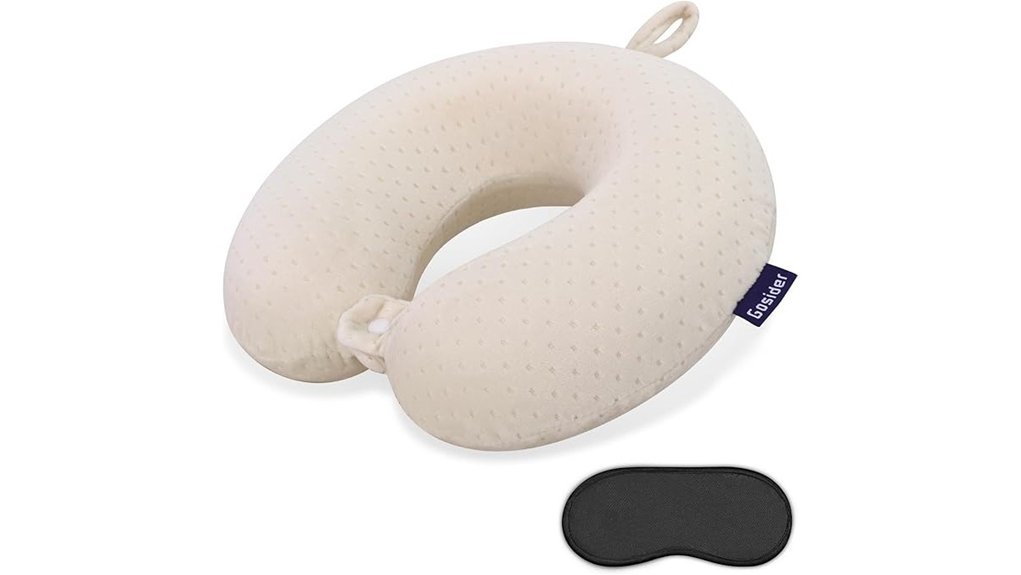
The Gosider memory foam neck pillow uses a semicircular shape with enlarged sides to help keep the head centered during seated rest. Place the curved back against your neck, then settle the larger side sections beside your jaw and head so they reduce sideways sliding without pressing uncomfortably against your face.
The current listing describes memory foam, a breathable cover, and a hanging buckle for attaching the pillow to luggage. The pillow is sold in multiple colors, so color choice is broader than the original beige-only description suggested.
Best For: Travelers, commuters, and home users who want soft semicircular support with larger side sections.
Pros:
- Memory foam offers soft but structured head and neck support.
- Enlarged side sections help reduce sliding and forward leaning.
- Hanging buckle makes the pillow easier to attach to luggage.
Cons:
- Soft firmness may not satisfy users who want a very rigid neck support.
- Semicircular shaping may not match every neck size or preferred sleeping angle.
- It is best suited to seated rest rather than full neck immobilization.
How to Choose the Best Way to Use a Travel Pillow
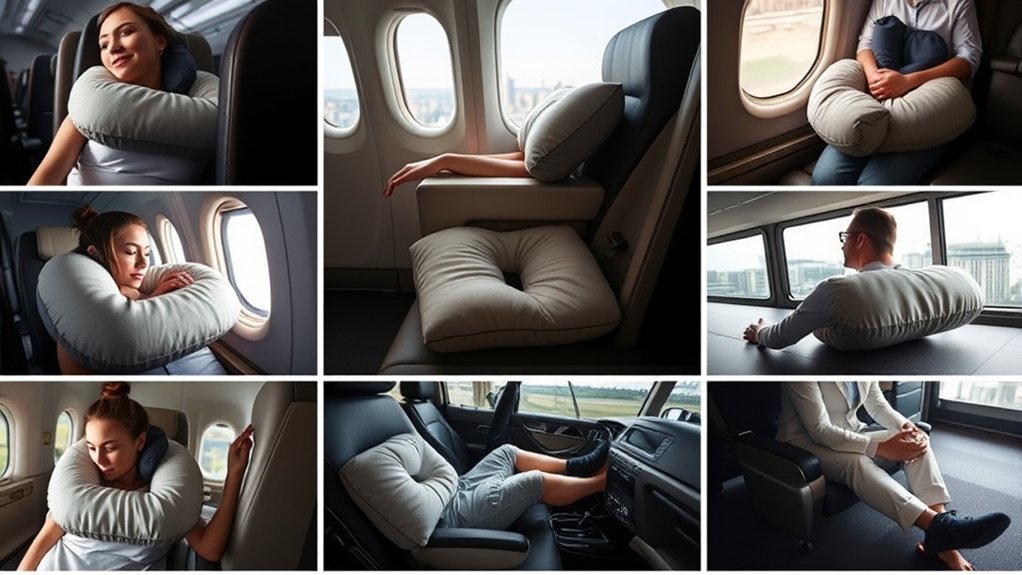
The best way to use a travel pillow depends on what you need it to support: your neck in an upright seat, your head while lying down, your back while reading, or your legs while resting. Shape and fit come first, followed by firmness, breathability, packing size, cleaning needs, and whether the design is permitted on your mode of travel.
Pillow Shape And Fit
U-shaped and semicircular pillows work best when they fill the gap around the neck without lifting the shoulders or pushing the head forward. A close fit can reduce side-to-side drift, but thicker is not automatically better.
If a pillow has a high rear section and the seat already has a headrest, extra thickness behind the neck may move your head too far forward. In that case, rotate the pillow if its design allows it, shift support toward the side or chin, or choose a flatter-back model. Adjustable closures are useful because you can change the fit instead of accepting one fixed position.
Support Level Needs
The longer you plan to rest upright, the more important stable head and neck support becomes. Firm wraparound foam can limit head bobbing better than a loose pillow, while softer fill may feel more comfortable if you only need light cushioning.
Match firmness to both your body and the seat. Chin support can help if your head drops forward, while raised side panels are more useful if you lean sideways. Memory foam holds a defined shape; shredded fill is more adjustable but less likely to stabilize the head on its own.
Material And Breathability
Memory foam provides contouring support, but dense foam can trap more warmth than thin inflatable designs. If you run warm, look for mesh panels, ventilation holes, moisture-managing covers, or less material around the neck.
Soft velvet and faux-fur covers can feel comfortable against the skin, while removable covers are easier to wash after repeated use. Material choice should match the trip: a plush surface may be pleasant in a cool cabin, while a breathable cover can be more practical on warm buses, trains, or road trips.
Portability And Size
A travel pillow is only useful if you are willing to carry it. Compressible foam, roll-up designs, inflatable pillows, storage bags, and hanging buckles reduce the amount of space the pillow occupies in or on your luggage.
Do not judge portability by pillow dimensions alone. A small molded pillow that does not compress can take more usable bag space than a larger inflatable or shredded-foam pillow. Pack it in a way that lets you reach it after boarding without emptying the rest of your carry-on.
Cleaning And Maintenance
Start with the care label because covers, solid memory foam, shredded foam, and inflatable materials are cleaned differently. Remove and machine-wash a cover only when its instructions allow it; otherwise use the specified hand-wash or spot-cleaning method.
Do not assume a washable cover means the foam core is machine washable. For one-piece memory foam, surface cleaning and thorough air drying are usually safer unless the manufacturer says otherwise. Let any pillow dry completely before compressing it into a storage bag so moisture and odor are not trapped inside.
Travel Mode Compatibility
Airplanes, cars, and trains create different support and baggage limits. In the United States, the TSA lists pillows as allowed in both carry-on and checked bags, but passing airport security does not guarantee that an airline will let every pillow or accessory be used at the seat.
For example, Delta prohibits inflatable wedges and slings as in-flight comfort items. Baggage counting also varies by carrier: American Airlines limits a personal item to 18 x 14 x 8 inches and lists specific exceptions that do not include ordinary pillows. A bulky pillow therefore needs to fit your airline’s baggage and cabin-use rules.
Adjustment And Stability
Adjustable straps, Velcro, drawstrings, and seat attachments are useful only when they improve support without creating pressure. Tighten them enough to prevent sliding, then make sure the pillow does not press on your throat, jaw, ears, or shoulders.
A flat-back design can work better against a tall seat because it adds less thickness behind the head. If you lean against a window, shift the pillow’s support toward that side rather than trying to keep every section perfectly centered. Stability should come from filling the unsupported gap, not from making the pillow as tight as possible.
Frequently Asked Questions
How Do I Clean a Travel Pillow Without Damaging It?
Check the care label first, because the cover and inner pillow may require different cleaning methods. Wash a removable cover only as directed, and spot clean a solid foam core unless its manufacturer specifically allows washing. Use mild cleaner, avoid excess water and direct high heat, and let every part dry completely before repacking it.
Can Travel Pillows Help Prevent Neck Pain on Long Flights?
A travel pillow can improve support and reduce awkward head movement, but it cannot guarantee that you will avoid neck pain. The fit should keep your head and neck close to neutral rather than tilted or pushed forward. Change position and move periodically on long trips, and stop using a pillow that makes pain or stiffness worse.
Are Travel Pillows Allowed on All Airlines?
Ordinary travel pillows are generally easy to bring through U.S. airport security, but airline rules still control baggage counting and what comfort devices may be used at the seat. Inflatable wedges, slings, or accessories that attach to the aircraft can face extra restrictions. Check the operating carrier’s rules for the exact device you plan to use.
Which Travel Pillow Works Best for Side Sleepers?
A travel pillow with raised side support or an adjustable wraparound shape usually works better when your head tends to fall sideways. The useful side should fill the gap between your head and shoulder without lifting the shoulder or tilting your neck sharply. A window or seat headrest can provide secondary support when available.
How Do I Pack a Travel Pillow Efficiently in Luggage?
Use the pillow’s stuff sack or storage case if it is designed to compress, and fully deflate an inflatable model before folding it. Avoid tightly creasing a molded foam pillow if the manufacturer does not recommend it. If you clip a pillow outside your bag, make sure the airline still accepts the combined setup within its baggage rules.
Sources
- Mayo Clinic — Neck pain: Supports head-and-neck alignment, movement breaks, and warning signs that warrant medical care.
- Transportation Security Administration — What Can I Bring?: Lists pillows as allowed in carry-on and checked baggage.
- Delta Air Lines — Carry-On Baggage: Supports Delta’s restrictions on inflatable wedges, foot hammocks, and slings.
- American Airlines — Carry-On Bags: Supports the 18 x 14 x 8 inch personal-item limit and listed carry-on exceptions.