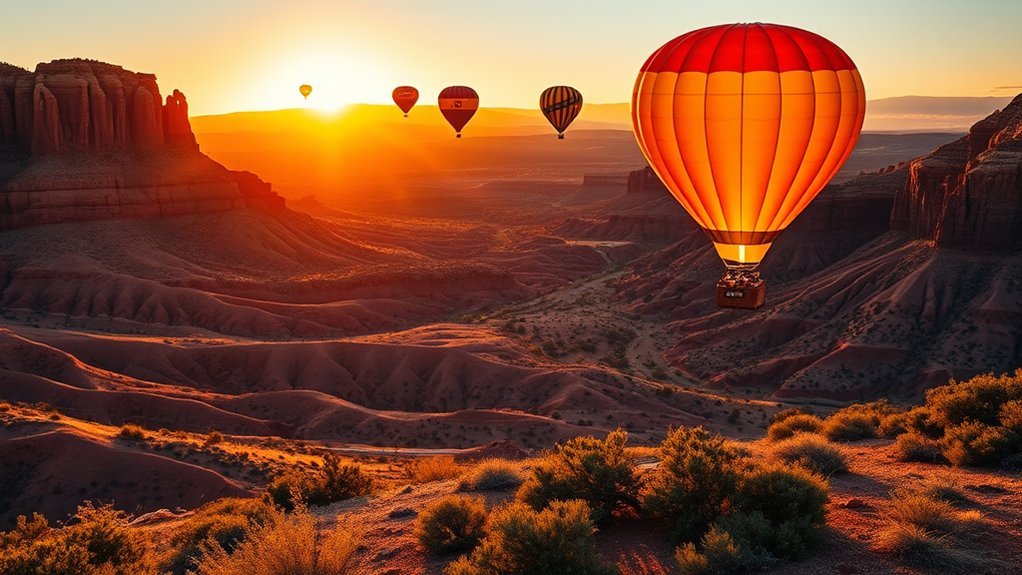
A Sedona hot air balloon ride begins well before sunrise, when the desert is cool and the launch crew can evaluate the morning wind. You will usually check in or meet a shuttle, travel to a launch site, watch the balloon inflate, fly for about an hour, land wherever the wind and terrain allow, and return with the chase crew. The experience can be peaceful, but the route, flight time, landing, and even the launch itself are never guaranteed.
Quick Answer
A Sedona hot air balloon ride normally starts before sunrise and takes about three to four hours from check-in to return. Expect roughly one to one-and-a-half hours in the air, changing red-rock views, a weather-dependent route, and a landing that may be gentle, firm, or bumpy.
Key Takeaways
- Sedona balloon operators normally fly once a day near sunrise because light winds and cooler air are often more favorable.
- The full outing usually lasts three to four hours, while the flight itself commonly lasts about one to one-and-a-half hours.
- The pilot cannot promise a fixed route, altitude, landmark, landing field, or exact return time.
- You must be able to follow the landing brace instructions, and many standard baskets require climbing, standing, and unassisted movement.
- As checked in July 2026, two major Sedona operators list public flights at $375 per passenger, but prices and policies can change.
At a Glance
| Total Experience | Usually three to four hours from meeting or pickup to return |
| Typical Flight Time | About one to one-and-a-half hours, with possible variation |
| Current Public Price | $375 per passenger at two major Sedona operators, checked July 2026 |
| Physical Demands | Standing throughout the flight, entering and leaving a tall basket, bending the knees, and bracing for landing |
Why Sedona Balloon Rides Fly at Sunrise
Hot air balloons are highly sensitive to wind, temperature, terrain, and changing weather. Sedona operators normally schedule one flight near sunrise, when the ground has not yet heated enough to produce the stronger mixing and thermal activity that can develop later in the day.
Sunrise also provides cooler temperatures and low-angle light across the desert. Red cliffs, mesas, washes, juniper-covered slopes, and distant ridges often show more texture during the first part of the morning than they do under harsh midday light.
Sunrise does not guarantee calm conditions. The pilot must review current forecasts, surface observations, winds at different heights, visibility, storms, and safe landing options before deciding whether to inflate and launch. The FAA Balloon Flying Handbook explains that balloon flight planning depends heavily on weather data, local wind patterns, terrain, and available landing areas.
Note: A clear-looking morning can still have unsuitable winds at the surface or above the launch site. The pilot’s decision to delay or cancel is a safety decision, not a customer-service failure.
What to Expect During a Sedona Balloon Ride
Check-In and Transport to the Launch Site
Your meeting time changes with the season because sunrise changes throughout the year. Depending on the operator and where you are staying, you may meet at an office, use a central pickup point, or receive transportation from a participating Sedona hotel.
Arrive at the confirmed time. The crew may need to verify passenger names, weights, waivers, physical requirements, and payment details before departure. Use the restroom before leaving the meeting location because a launch field may not have facilities. Red Rock Balloon Adventures, for example, states that restrooms are available at its office but not at the launch site.
The pilot and crew may select or change the launch site after examining the wind. This flexibility allows the pilot to choose a starting point with better launch clearance and more possible landing areas downwind.
Preflight Briefing
Listen closely to the passenger briefing, even if you have flown before. Basket design, passenger compartments, handholds, landing positions, and crew procedures can differ.
The briefing should cover:
- How to enter and leave the basket
- Where to stand during flight
- Which handles to use
- How to protect cameras and loose items
- What to do during inflation and launch
- The correct landing posture
- When you may leave the basket after landing
Do not step out when the basket first touches the ground. The balloon may become light again, move, drag, or tip as the envelope deflates. Remain inside until the pilot tells you it is safe to exit.
Balloon Inflation
The crew lays the envelope on the ground and uses a large fan to fill it with cool air. Once the envelope has taken shape, the pilot uses the propane burners to heat the air and raise the balloon upright.
This stage can be noisy and warm. Burner flames produce intense radiant heat, and the fan, vehicles, crew instructions, and moving equipment make the launch field busier than the flight itself.
Stay in the location assigned by the crew. Do not walk over ropes, fabric, fuel lines, or other equipment. You may be invited to watch or help, but participation depends on the operator, conditions, and crew instructions.
Takeoff and Flight
Lift-off is often so gradual that passengers do not immediately notice the basket leaving the ground. Once airborne, the balloon travels with the surrounding air, so you may feel less wind across your face than you would on a fixed observation platform.
The pilot controls climb and descent by heating the envelope or allowing the air inside it to cool. Changing altitude may reveal wind moving in a different direction, but a balloon cannot turn or follow a fixed route like a helicopter.
Your flight may pass over open desert, washes, forest patches, ranch land, mesas, canyon areas, or residential edges. The exact view depends on the launch site, wind direction, altitude, visibility, and safe landing options.
Landing and Recovery
Balloon landings vary. A calm morning may allow an upright landing with little movement. Other landings may include one or more bumps, a short drag, or the basket tipping onto its side. These outcomes are normal possibilities and do not automatically mean something has gone wrong.
Warning: Follow the pilot’s landing commands exactly. The FAA’s standard passenger guidance includes facing the direction of travel, placing your feet and knees together, bending your knees, holding firmly in two places, and remaining inside the basket until instructed to leave.
The chase crew follows the balloon from the ground and meets it after landing. Because wind determines the route, you will usually land somewhere other than the launch field. The crew then deflates and packs the balloon before returning passengers to the meeting point or participating hotels.
Some operators include a post-flight champagne toast, a nonalcoholic option, and a short ballooning history. This celebration takes place after landing, not while the balloon is airborne.
Safety Measures and Pilot Qualifications
A Sedona sightseeing flight carrying paying passengers should be conducted by a pilot holding the appropriate FAA commercial balloon privileges. Commercial hot air balloon pilots carrying paying passengers are also subject to the FAA’s second-class medical-certificate requirement.
Before launch, the pilot and crew should inspect the basket, envelope, burners, fuel system, control lines, instruments, and other equipment. They must also evaluate weather, obstacles, terrain, passenger load, launch clearance, and possible landing areas.
A commercial certificate does not tell you how much recent experience a pilot has in Sedona’s terrain. When comparing companies, ask practical questions:
- How long has the company operated in the Sedona area?
- How much recent local experience does the assigned pilot have?
- Is the flight insured?
- How are weather cancellations handled?
- What physical requirements apply to passengers?
- What is the maximum passenger capacity of the basket?
- Does the company participate in a professional ballooning organization or operator-safety program?
- What happens if you feel unable to assume the required landing position?
A pilot who cancels because of wind, visibility, storms, or landing concerns is making the conservative decision you want from a sightseeing operator.
Weather Cancellations and Rescheduling
Balloon flights may be delayed or canceled because of surface wind, winds above the launch site, poor visibility, clouds, rain, nearby thunderstorms, unstable air, unsuitable landing conditions, or other aviation concerns.
The operator may not make the final decision until shortly before launch because local conditions can change overnight. Keep your phone available and follow the company’s check-in instructions on the day before and morning of the flight.
If ballooning is a priority, schedule it near the beginning of your Sedona stay. That gives you another morning to reschedule if weather prevents the first attempt.
Weather-cancellation terms are not the same as customer-cancellation terms. A company may refund or reschedule a flight that it cancels for weather while retaining some or all of the payment when a customer cancels after the stated deadline.
Current examples include:
- Red Rock Balloon Adventures lists cancellation deadlines that range from 24 to 72 hours depending on group size.
- Northern Light Balloon Expeditions lists a 48-hour customer-cancellation policy for public flights and says deposits are refunded when the company cancels because of poor weather or other conditions.
Read the terms attached to your own reservation because policies and processing times can change.
Best Time of Year for Ballooning in Sedona
Sedona balloon rides operate throughout the year when weather permits. There is no single season that guarantees a flight or a better route. Choose according to temperature, daylight, crowd levels, and your wider travel plans.
| Season | What to Expect | Planning Consideration |
|---|---|---|
| Spring | Cool to mild mornings and strong visitor demand | Reserve early and pack layers |
| Summer | Very early meeting times and warmer conditions after landing | Monsoon thunderstorms and outflow winds can affect flights from summer into early fall |
| Fall | Cool mornings, popular travel dates, and changing sunrise times | Book ahead and confirm the meeting time the day before |
| Winter | Cold pre-dawn temperatures and later sunrise times | Wear warm layers and be prepared for frost, mud, or cold landing fields |
The National Weather Service states that northern Arizona’s official monsoon season runs from June 15 through September 30, although the timing and intensity vary each year. Afternoon and evening storms are common during active periods, but their outflow winds and moisture can also affect aviation planning at other times.
How to Prepare for Your Flight
What to Wear
Dress for an outdoor morning rather than for an enclosed aircraft. You may stand in a cold launch field, feel radiant heat from the burners, land in brush or uneven soil, and return after the day has warmed.
- Wear flat, closed-toe shoes with secure soles.
- Use several light layers instead of one bulky coat.
- Wear long pants to protect your legs around brush and equipment.
- Bring a hat that fits securely.
- Consider gloves during cold months.
- Avoid scarves, loose cords, flowing garments, and high heels.
There may be little room for bags. Bring only what the operator allows and leave large backpacks, tripods, and unnecessary equipment behind.
Camera and Phone Tips
A phone or compact camera is easier to handle than a large equipment kit. Use a secure wrist strap, neck strap, or closed pocket. Turn off loud alerts and prepare your settings before takeoff.
For sharper photos:
- Clean the lens before boarding.
- Use a faster shutter speed when light permits.
- Use a wide view for the landscape and a moderate zoom for distant formations.
- Keep spare batteries warm during cold mornings.
- Photograph in short bursts rather than watching the entire flight through a screen.
- Keep both feet stable and remain in your assigned basket compartment.
Pro Tip: Take a few photos during inflation and ascent, then put the camera down for several minutes. The changing scale and silence are easier to appreciate when you are not continuously framing a shot.
Accessibility, Health, and Mobility
Conventional balloon baskets can present significant access barriers. Passengers may need to climb over a high basket wall using footholds, stand for the entire flight, bend deeply at the knees and waist, hold a landing position, and walk across rough ground.
Do not assume that a basket has a door, ramp, seat, or wheelchair space. Ask the operator for its exact basket design and physical requirements before paying.
Red Rock Balloon Adventures currently states that passengers must be able to walk and stand unassisted, climb into and out of the basket, bend for landing, and fly without walkers, canes, crutches, casts, splints, or braces. It also asks passengers over 280 pounds to call before booking because loading and available space affect balloon operations.
Tell the company in advance about recent surgery, broken bones, joint or back problems, limited balance, mobility restrictions, or any concern that could prevent you from assuming the brace position. The operator may decline the booking if it cannot safely accommodate you.
Pregnancy restrictions are common. Red Rock does not accept passengers who are pregnant or possibly pregnant. Check the policy of the company you plan to use rather than relying on a general travel listing.
Children and Family Requirements
Age and height rules vary. Red Rock currently requires every passenger to be at least 48 inches tall. Passengers younger than 18 must be accompanied by a parent or guardian, and the adult must complete the required waiver.
A child should also be able to stand for the full flight, see over the basket wall, understand instructions, tolerate burner noise, and hold the landing position. Confirm every requirement before telling a child that the reservation is final.
Booking Options and Current Prices
Most visitors choose a shared sunrise flight. Private flights provide more privacy but cost considerably more because you reserve the full balloon rather than an individual place.
As checked on July 23, 2026:
| Operator | Public Flight | Private Option | Published Duration |
|---|---|---|---|
| Red Rock Balloon Adventures | $375 per passenger | Contact the operator | Three to four hours total; one to one-and-a-half hours aloft |
| Northern Light Balloon Expeditions | $375 per passenger | $2,625 small balloon; $4,500 large balloon | Usually three to four hours total; about one hour aloft, with possible variation |
These are published examples, not permanent market rates. Recheck the final price, taxes or fees, deposit, refund terms, passenger capacity, transportation, and inclusions before entering payment details.
When comparing a shared flight with a private charter, consider:
- Privacy: A shared basket may contain several passenger compartments.
- Cost: A private booking normally charges for the whole balloon.
- Group weight: Balloon size and capacity depend partly on combined passenger weight and temperature.
- Transportation: Hotel pickup may be available only from selected properties.
- Cancellation terms: Larger groups and private reservations may have stricter deadlines.
- Physical rules: One company’s requirements do not automatically apply to another.
Scenic Highlights and Photo Opportunities
Sedona’s elevated desert landscape can look very different from a balloon. Depending on the route, you may see red-rock ridges, Dry Creek country, the Seven Canyons area, mesas, washes, open forest, distant mountains, ranches, roads, and neighborhoods.
Red Rock Balloon Adventures identifies its primary launch area near Dry Creek Road, Boynton Canyon, Long Canyon, and Seven Canyons. A different launch site or wind direction can produce a completely different view.
Wildlife sightings are possible but never guaranteed. Small animals can be difficult to distinguish from altitude, and passengers should not expect the flight to work like a dedicated wildlife tour.
The strongest photo opportunities often occur during:
- Cold inflation, when the envelope fills across the ground
- Burner ignition against the pre-dawn sky
- Initial ascent near sunrise
- Low-angle light crossing cliffs and washes
- Views of other balloons at a similar or lower altitude
- The landing and deflation process, when the crew permits photography
Combining Ballooning With Other Sedona Activities
You can pair a balloon flight with hiking, a scenic drive, a jeep tour, a winery visit, or a relaxed brunch, but book these as separate activities unless a real operator clearly sells them as one package.
Do not schedule a tightly timed tour immediately after ballooning. Northern Light notes that a flight may last longer than expected while the pilot searches for a suitable landing area. Deflation, packing, driving from the landing site, and returning passengers can also vary.
Safer same-day plans include:
- A flexible late breakfast or brunch after the flight
- An easy afternoon scenic drive with no fixed start time
- A late-morning or afternoon jeep tour with a generous gap
- A winery visit later in the day with a separate driver or tour
- A short hike after you have changed clothes, eaten, and checked the weather
Avoid planning a demanding hike immediately after the flight if you have been awake since before dawn, have not eaten, or feel tired after standing for several hours.
Tips for a Memorable Experience
- Book the flight for an early morning in your trip so you have another day available for weather rescheduling.
- Confirm the pickup or meeting time the day before.
- Give the operator accurate passenger weights when requested.
- Use the restroom before leaving the meeting point.
- Wear closed-toe shoes and flexible layers.
- Leave large bags, tripods, and loose accessories behind.
- Listen during both the initial briefing and the second landing briefing.
- Keep the remainder of the morning flexible.
- Do not pressure the pilot to launch in questionable weather.
- Ask before posting identifiable photos of other passengers.
Frequently Asked Questions
How long does a Sedona hot air balloon ride take?
Plan for about three to four hours from check-in or pickup through your return. The flight itself commonly lasts about one to one-and-a-half hours, although wind, terrain, and the search for a safe landing area can make it shorter or longer.
Do balloon flights land where they take off?
Usually not. The balloon travels with the wind, and the pilot selects a safe landing area along the available route. A chase crew follows on the ground, retrieves the passengers and balloon, and provides return transportation.
Are Sedona balloon landings always gentle?
No. Many are gentle and upright, but a landing can also include bumps, a short drag, or the basket tipping onto its side. Follow the pilot’s brace instructions, hold the designated handles, and remain in the basket until told to exit.
Can children take a Sedona balloon ride?
Requirements vary by company. Red Rock Balloon Adventures currently requires passengers to be at least 48 inches tall. Minors must be accompanied by a parent or guardian, and the adult must complete the required waiver. Confirm the rules before booking.
Can pregnant passengers fly?
Many operators do not accept pregnant passengers because of landing forces and insurance restrictions. Red Rock Balloon Adventures states that anyone who is pregnant or possibly pregnant cannot fly. Check the chosen operator’s current policy.
Are Sedona hot air balloons wheelchair accessible?
Do not assume they are. Standard baskets may require passengers to climb over the side, stand throughout the flight, bend for landing, and walk across uneven ground. Contact the operator before booking and obtain clear confirmation that it can safely accommodate your needs.
Can you bring food, alcohol, or pets onboard?
Policies vary, so obtain approval before bringing anything beyond a phone, camera, and small personal item. Do not plan to eat or drink alcohol during the flight. Sedona operators commonly provide a champagne or nonalcoholic toast after landing. Never arrive with a pet unless the operator has approved it in advance.
What happens if the flight is canceled because of weather?
The operator will normally offer rescheduling or a refund under its weather-cancellation terms. Customer-requested cancellations follow separate deadlines. Read the policy attached to your reservation and book early in your stay when possible.
Are gift certificates available?
Some operators sell them. Red Rock Balloon Adventures currently lists gift certificates purchased directly through the company. Check expiration dates, transfer rules, physical requirements, price differences, and weather-rescheduling terms before buying.
Conclusion
A Sedona sunrise balloon flight can give you a quiet, wide-angle view of the red-rock landscape, but the best experience starts with realistic expectations. Plan for an early meeting, changing weather, a wind-determined route, several hours of standing and transport, and a landing that may be firm or bumpy. Choose a qualified operator, disclose physical limitations, pack lightly, and follow every crew instruction. When the weather cooperates, the changing light and open desert views can make the early alarm worthwhile.
Sources
- Federal Aviation Administration Balloon Flying Handbook — preflight planning, weather, passenger briefings, landing procedures, and balloon operations
- FAA Commercial Balloon Medical Certification Rule — medical-certificate requirements for commercial balloon pilots carrying paying passengers
- Red Rock Balloon Adventures Flight Information — published price, duration, sunrise schedule, launch area, clothing, and flight inclusions
- Red Rock Balloon Adventures FAQ — physical requirements, child height, pregnancy, restrooms, weather cancellations, and customer-cancellation terms
- Northern Light Balloon Expeditions Rates and Terms — public and private pricing, deposits, refunds, and cancellation terms
- National Weather Service Northern Arizona Monsoon Information — monsoon timing and northern Arizona thunderstorm hazards