Planning a Grand Canyon river trip is one of the most rewarding wilderness expeditions in the world, taking you through up to 280 miles of rugged canyon carved by the Colorado River. Whether you are navigating legendary Class 10 whitewater, sleeping under sheer limestone cliffs, or exploring side-canyon waterfalls, successful preparation demands an understanding of strict National Park Service regulations, permit lotteries, specialized river gear, and desert survival protocols.
Quick Answer
To do a Grand Canyon river trip, choose between booking a commercial outfitter (reserve 1–2 years ahead) or leading a self-supported private trip (apply through the annual NPS weighted lottery on Recreation.gov each February). Expeditions launch from Lees Ferry and range from 3 to 21+ days. Essential requirements include Coast Guard Type V PFDs, a self-contained toilet system (“groover”), and rigorous cold-water hypothermia protection.
Key Takeaways
- Commercial vs. Private: Commercial outfitters provide gear, food, and licensed guides; private trips require extensive whitewater rowing experience and an NPS weighted lottery permit.
- Unique River Rating: The Grand Canyon uses a 1–10 whitewater difficulty scale instead of the traditional International Class I–VI system.
- Strict Waste Regulations: Burying solid human waste is strictly prohibited in the river corridor; all solid waste must be packed out in an approved groover toilet system, and all liquid waste must go directly into the river.
- Cold Water Hazard: Water released from Glen Canyon Dam averages 48°F–55°F (9°C–13°C) year-round, posing immediate hypothermia risks regardless of summer desert heat.
At a Glance: Grand Canyon River Expedition
| Time Required | 3 to 18+ days (Motorized: 6–8 days; Oar/Paddle: 12–21+ days) |
| Difficulty | Demanding to Expert (Technical Class 1–10 whitewater & remote desert wilderness) |
| Tools Needed | Whitewater raft/rig, USCG Type V PFDs, groover toilet system, fire pan, satellite messenger, dry bags |
| Cost | Private: ~$400–$1,500/person (permit fees & group food/gear rental) | Commercial: ~$2,500–$6,500+/person |
Planning Your Trip: Permits, Routes, and Timing
Launching a trip down the Colorado River requires rigorous logistical planning. Nearly all Grand Canyon river trips launch at Lees Ferry (River Mile 0), situated just below Glen Canyon Dam, and conclude downstream at takeout points such as Phantom Ranch (Mile 88 for hiking exchanges), Whitmore Wash (Mile 188 for helicopter egress), Diamond Creek (Mile 226 for standard vehicle takeout), or Pearce Ferry (Mile 280 at Lake Mead).
Trip timing strongly dictates river dynamics, weather, and logistics:
- Spring (April–May): Moderate daytime temperatures (70°F–85°F), cool nights, and frequent high desert winds. Water levels rely on Glen Canyon Dam release schedules.
- Summer (June–August): Intense heat with ambient canyon temperatures frequently exceeding 105°F (40°C). Monsoon storms in July and August bring flash floods, chocolate-brown river surges, and spectacular waterfalls down side canyons. Motorized commercial trips run heavily during this window.
- Autumn (September–October): Optimal weather, warm water-air balance, calmer winds, and reduced river congestion as commercial seasons wind down.
- Winter (November–March): Solitude and crystal-clear green water, but short daylight hours, freezing canyon nights, and high risks of cold-water exposure.
Pro Tip: For private noncommercial trips, the main NPS Noncommercial River Permit Lottery runs every February for launch dates in the following calendar year. Follow-up lotteries occur throughout the year to reassign canceled permits, providing last-minute opportunities for flexible teams.
Choosing Between Commercial and Self-Supported Trips
The choice between a commercial outfitter and a private, self-supported trip defines your preparation path, skill requirements, and budget.
| Expedition Factor | Commercial Outfitter Trip | Self-Supported Private Trip |
|---|---|---|
| Permit Process | Book directly with authorized outfitters (1–2 years in advance) | Win a launch slot via the NPS weighted lottery on Recreation.gov |
| Experience Required | None; licensed river guides handle navigation, rowing, and cooking | Expertise in high-volume Class IV/V (Scale 1–10) whitewater rowing and wilderness rigging |
| Logistical Burden | Turnkey: Boats, food sanitation, kitchen, and safety gear provided | Full self-reliance: Rigging rafts, meal planning, waste management, and emergency response |
| Trip Pace | Structured itineraries (Motor: 6–8 days; Oar: 12–14 days) | Flexible layover days and hiking schedules (up to 21+ days in shoulder seasons) |
What to Pack: Gear, Clothing, and Safety Essentials
The Grand Canyon’s environment swings between punishing dry desert heat and bone-chilling river conditions. Your packing list must account for extreme temperature gradients, abrasive silt, and sustained sun exposure.
Essential Safety Gear
The National Park Service strictly enforces safety gear standards for all river craft launching from Lees Ferry:
- Personal Flotation Device (PFD): Every member must wear a Coast Guard–approved commercial whitewater life jacket (Type V or approved Type III/V rating) designed for high-volume rivers.
- Rescue & River Tools: High-tensile perimeter safety lines on all rafts, quick-access throw bags (minimum 50–75 ft of floating rope), river knives mounted on PFD lash tabs, and spare oars/paddles.
- Whitewater Helmets: Highly recommended for kayak paddlers and rowers running heavy rapids (Class 7–10).
- First-Aid & Trauma Supplies: Comprehensive wilderness medical kits, including wound irrigators, broad-spectrum antibiotics, splints, burn treatments, and electrolyte replacement packs.
- Emergency Communication: Satellite communicators (such as a Garmin inReach, ZOLEO, or Iridium satellite phone). Cell coverage is nonexistent within the inner gorge.
Warning: Water released from Glen Canyon Dam enters the river at 48°F–55°F (9°C–13°C). Even when ambient air temperatures reach 110°F, flipping a raft or taking a prolonged swim can trigger cold-water shock and severe hypothermia within minutes. Always secure your PFD snugly before running rapids.
Clothing and Footwear
Cotton clothing (“river cold”) is dangerous in cold rapids but can provide evaporative cooling during sweltering flatwater stretches. Rely on a technical layering system:
- Sun Protection: UPF 50+ long-sleeve hooded sun shirts, wide-brim hats with chin retainers, lightweight sun gloves, and polarized sunglasses with heavy-duty retention straps.
- Thermal Layers: Splash jackets, dry tops, neoprene booties, and quick-drying synthetic base layers for cold morning runs and monster rapids.
- Footwear: Sticky-rubber river sandals with secure heel straps (e.g., Astral, Bedrock, Chaco) or sticky-sole water shoes for scrambling on wet Tapeats sandstone and slick limestone ledges. Pack a dry pair of trail shoes or camp boots for side hikes.
Navigating Rapids and River Skills to Know
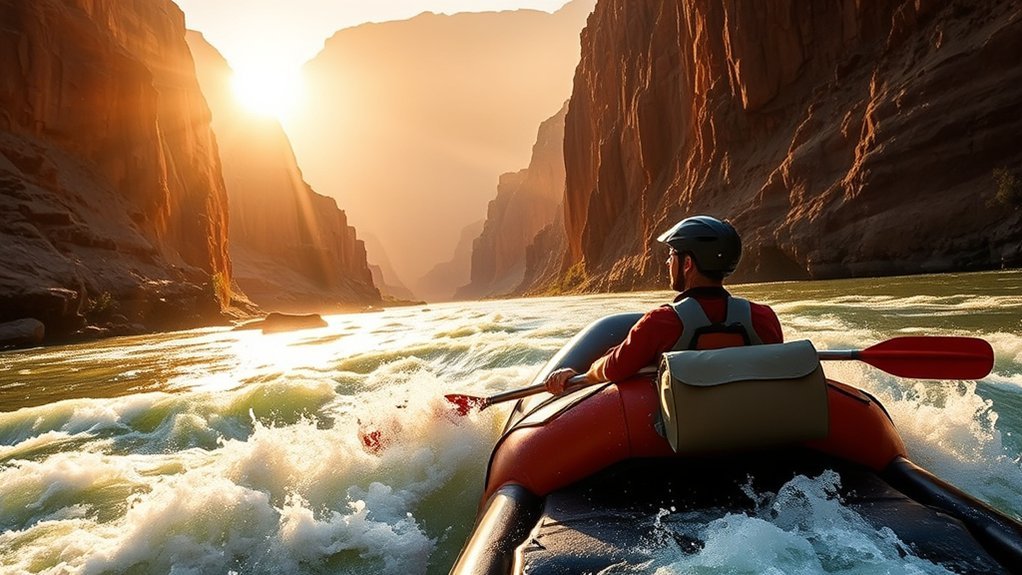
The Colorado River through the Grand Canyon is a high-volume, deep-water river featuring powerful waves, violent boils, strong eddy fences, and massive hole features.
“The Colorado River does not use the standard Class I–VI International Scale. Instead, rapids in the Grand Canyon are rated from 1 to 10 based on technical difficulty, hazard level, and hydraulic power.”
Understanding the Grand Canyon 1–10 Whitewater Scale
- Rating 1–3: Riffles, small straightforward waves, and wide passage with minimal maneuvering required.
- Rating 4–6: Medium-sized waves, clear boat-scouting lines, defined hydraulic holes, and moderate eddy fences (e.g., Badger Creek Rapid, House Rock Rapid).
- Rating 7–8: Heavy hydraulics, constricted channels, large breaking waves, dangerous pour-overs, and precise maneuvering required to avoid raft flips (e.g., Horn Creek Rapid, Granite Rapid, Hermit Rapid).
- Rating 9–10: Maximum volume, massive chaotic wave trains, violent lateral waves, huge recirculating holes, and extreme flip potential (e.g., Crystal Rapid and Lava Falls).
| Stroke | Action & Purpose | Expedition Application |
|---|---|---|
| Forward Push/Pull | Propels raft forward into downstream current or pushes across boils | Building momentum to punch through breaking wave crests |
| Backstroke / Ferry | Checks downstream momentum; angles boat across current seams | Setting up precise lateral lines above major drop horizons |
| Draw Stroke | Pulls water toward the boat to shift sideways without changing heading | Adjusting alignment in narrow chutes and bypassing rock horns |
| Pry / Push Stroke | Leverages water away from hull to adjust craft angle rapidly | Spinning raft bow downstream away from lateral obstacles |
Reading Rapids and Scouting
Rowing high-volume rapids requires scouting lines from shore above blind drops:
- Identify the “V” Tongue: Look for the smooth, downstream-pointing green “V” of water marking the deepest, least obstructed entry chute through the drop.
- Analyze Lateral Waves and Holes: Note large curlers and diagonal waves that can roll a heavily loaded raft. Identify recirculating holes and plan lateral ferry angles to miss them.
- Recognize Flow Rate Impacts: Water levels fluctuate daily depending on releases from Glen Canyon Dam, typically ranging from 8,000 to over 20,000 cubic feet per second (CFS). Check real-time streamgages on the USGS Colorado River at Lees Ferry Gauge before launching.
Camping, Food, and Leave No Trace Practices
The Grand Canyon river corridor is a fragile, heavily visited desert ecosystem. The National Park Service enforces non-negotiable Leave No Trace (LNT) rules to preserve pristine camp beaches.
Warning — Human Waste Protocol: Never bury solid human waste in the Grand Canyon river corridor. All solid waste must be deposited into an NPS-approved self-contained toilet system (“groover”) and packed out. All liquid waste (urine) must go directly into the Colorado River’s flowing water to prevent beaches from smelling and becoming unsanitary.
- Campsite Selection: Pitch tents on dry sandbars below the natural high-water line. Avoid crushing delicate cryptobiotic soil crusts and native desert vegetation above the beach.
- Kitchen & Food Waste: Set up a kitchen tarp under food prep and dishwashing stations to catch micro-trash. Use a multi-bucket dish system with chlorine bleach sanitizer and strain all greywater through a fine mesh strainer before disposing of water into the main river current. Pack out all strained food particles.
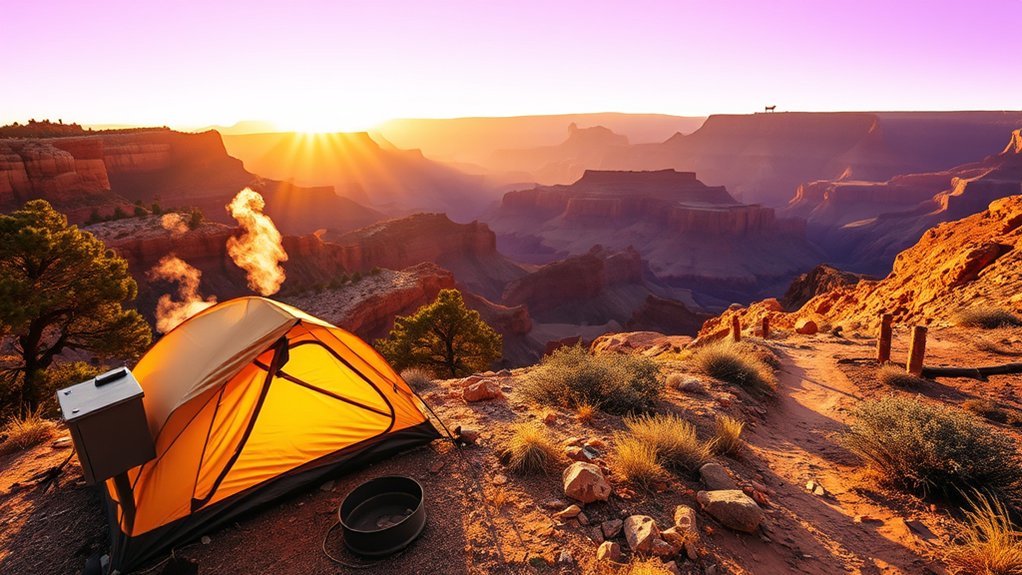
- Campfires: Campfires are permitted only during winter months (October through April). Fires must be contained entirely in an elevated metal fire pan set over a fire blanket to catch embers, and all charcoal/ashes must be packed out in metal ammo cans.
- Food Storage: Store all food, trash, and toiletries in bear-proof aluminum or heavy-duty composite dry boxes to keep out desert rodents, ravens, and ringtail cats.
Wildlife, Geology, and Cultural Highlights Along the Canyon
A Grand Canyon expedition is a journey through 1.8 billion years of geological and human history.
- Geological Wonders: Float past layered sedimentary walls—from the young Kaibab Limestone at the rim down through Redwall Limestone, the bright pink Zoroaster Granite, and the dark, jagged 1.8-billion-year-old Vishnu Schist at the base of the canyon.
- Native Cultural Sites: The canyon is ancestral land to 11 Native American tribes, including the Havasupai, Hualapai, Navajo, Hopi, and Southern Paiute. Visit granaries at Nankoweap (Mile 53) and historic rock art panels with deep respect—never touch petroglyphs, climb on stone structures, or remove artifacts.
- Wildlife Sightings: Watch canyon walls for desert bighorn sheep, peregrine falcons, California condors riding thermal updrafts, great blue herons, and endemic humpback chub in side streams like the Little Colorado River (Mile 61.5).
Health, Safety, and Emergency Preparedness
Remoteness amplifies all health and safety risks. Evacuations by National Park Service search-and-rescue helicopters take hours or may be delayed overnight by weather.
- Hydration & Electrolytes: In hot summer conditions, drink at least 4–6 liters of water per day. Combine water intake with electrolytes (sodium and potassium) to prevent hyponatremia (water intoxication).
- Hygiene & River Sickness: River rot and gastrointestinal illness can spread rapidly through a group. Maintain strict handwashing stations with pump soap before entering food prep areas, and sanitize all shared surfaces daily.
- Side Canyon Flash Floods: When hiking narrow slot canyons (such as Deer Creek, Matkatamiba, or Havasu), check weather forecasts for storms miles upstream. Never enter slot canyons during heavy rainfall.
Frequently Asked Questions
Can I bring a drone for aerial photos of the Grand Canyon?
No. Launching, landing, or operating unmanned aircraft (drones) is strictly prohibited in Grand Canyon National Park and throughout the entire river corridor under federal regulation 36 CFR 1.5. Violations carry severe fines and potential equipment confiscation.
Are there cellphone or Wi-Fi signals along the river?
No. There is zero cellular coverage or public Wi-Fi once you descend beneath the canyon rim at Lees Ferry. Expedition teams must carry satellite communication devices (such as a Garmin inReach or satellite phone) to manage emergency logistics.
Can I bring alcohol on a commercial trip?
Yes. Most commercial outfitters permit guests of legal age to bring a reasonable amount of beer, wine, or liquor in non-glass containers (aluminum cans or boxed wine). Outfitter staff will provide storage bags to secure your beverages on the rafts for camp evenings.
Are pets allowed on raft trips or at river campsites?
No. Pets are not allowed on river trips or at inner-canyon campsites within Grand Canyon National Park to protect native wildlife, prevent sanitation issues, and ensure expedition safety.
Is fishing permitted during a river trip?
Yes. Fishing is permitted along the Colorado River and its tributaries. Anglers aged 10 and older must possess a valid Arizona state fishing license and adhere to state and park regulations, particularly concerning catch-and-release protections for endangered native fish such as the humpback chub.
Conclusion
A river trip through the Grand Canyon is an extraordinary wilderness journey that combines world-class whitewater, towering geology, and rich cultural history. Whether you join a fully guided commercial outfitter or organize a self-supported private expedition through the NPS weighted lottery, thorough preparation, strict adherence to Leave No Trace regulations, and respect for river safety will ensure an unforgettable experience in one of the world’s greatest natural wonders.
Sources
- National Park Service — Grand Canyon Whitewater Rafting & River Operations Guidelines
- Grand Canyon National Park River Permits Office — Noncommercial Weighted Lottery Rules & Regulations
- USGS National Water Information System — Real-Time Streamflow for Colorado River at Lees Ferry (Station 09380000)
- Grand Canyon River Outfitters Association — Safety Protocols and Commercial Expedition Guidelines