Disclosure: As an Amazon Associate, we earn from qualifying purchases. If you click a link on this page and make a purchase, we may receive a small commission at no extra cost to you.
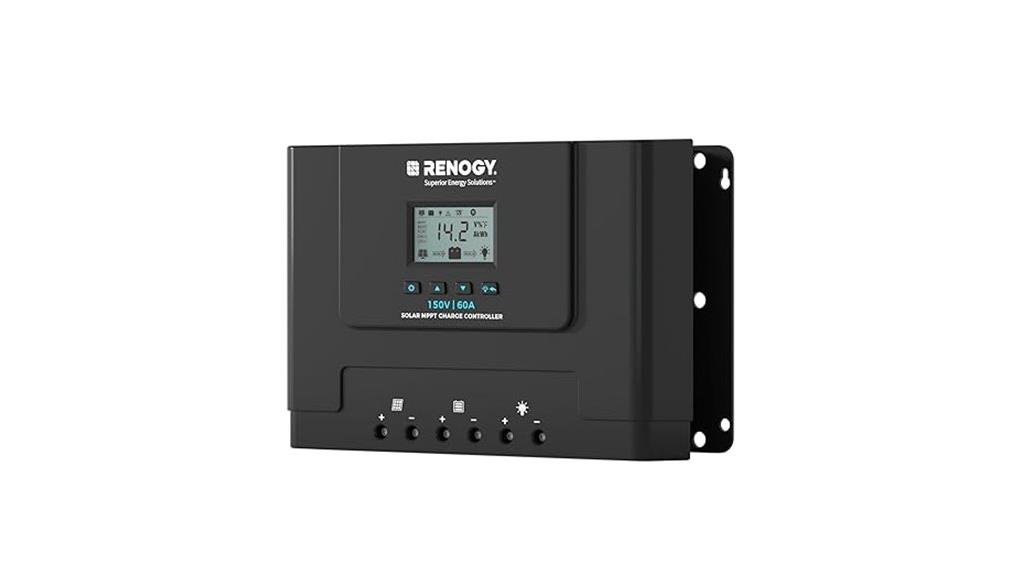
Choosing a 60-amp solar charge controller is not only about buying the highest current rating. You also need the right battery-voltage support, safe panel-array limits, dependable heat control, and controls you can understand during setup. The Renogy Rover Lite 60A MPPT Solar Charge Controller is built for larger off-grid systems that use 12V, 24V, 36V, or 48V battery banks. It offers broad compatibility and a 150V PV input ceiling, but its IP32 enclosure and optional, rather than built-in, Bluetooth mean it needs a protected installation location and may require an extra accessory.
Quick Verdict
Rating: 8.6/10
Best For: RV, marine, cabin, workshop, and home off-grid systems that need up to 60A charging across 12V to 48V battery banks.
Bottom Line: The Rover Lite 60A gives you a high 150V PV input limit, multi-voltage battery support, an LCD, and useful charging presets. Its main tradeoffs are the weather-limited IP32 enclosure and the need to buy a Bluetooth module separately for phone monitoring.
| Specification | Detail |
|---|---|
| Brand | Renogy |
| Model | Rover Lite 60A, RCC60RVRE |
| Product type | MPPT solar charge controller |
| Rated charge current | 60A |
| System voltage | 12V, 24V, 36V, and 48V; automatic recognition applies to non-lithium batteries |
| Battery input range | 9VDC to 64VDC |
| Battery presets | AGM, Gel, Flooded, Lithium Iron Phosphate, and User Custom |
| Maximum PV input voltage | 150VDC open-circuit voltage maximum |
| Maximum solar input power | 900W at 12V, 1,800W at 24V, 2,000W at 36V, and 3,200W at 48V |
| MPPT tracking efficiency | More than 99% claimed |
| Conversion efficiency | More than 97% claimed |
| Operating temperature | -31°F to 113°F full-load range listed on Amazon |
| Enclosure rating | IP32 |
| Communication | RS485; smartphone monitoring requires a compatible optional Bluetooth module |
| Display | LCD with control buttons |
| Dimensions | 12.01 x 8.07 x 3.90 inches |
| Weight | About 7.71 lb |
| Included items | Controller, battery temperature sensor, manual, and four mounting screws |
| Certifications listed | FCC Part 15 Class B, CE, and RoHS |
| Warranty | 2-year material and workmanship warranty |
What Is the Renogy Rover Lite 60A?
The Renogy Rover Lite 60A is an MPPT controller that sits between your solar array and battery bank. It regulates the panel output so the batteries receive the correct charging voltage and current. Its 60A rating makes it more suitable for medium to large off-grid systems than Renogy’s lower-current 20A, 30A, or 40A controllers.
The controller supports common deep-cycle battery types, including AGM, Gel, Flooded lead-acid, and LiFePO4. You choose the correct preset or user-defined charging profile for the battery bank connected to the controller. The LCD and buttons let you check operating information and adjust settings without relying on a phone.
Before You Buy: The 150V rating is a maximum PV open-circuit voltage, not a target. Calculate the array’s cold-weather Voc and keep it below the controller’s limit. You must also stay within the solar-input wattage allowed for your battery-bank voltage.
Who Should Buy It?
Best For
- RV, boat, cabin, workshop, or home systems that need up to 60A of solar charging.
- Buyers planning a 12V, 24V, 36V, or 48V battery bank with a compatible deep-cycle chemistry.
- DIY installers who want a local LCD plus the option to add remote phone monitoring later.
Skip If
- Your solar array and battery bank only need a smaller 20A to 40A controller.
- You need a waterproof controller for an exposed outdoor location.
- You want built-in Bluetooth without buying a separate communication module.
Key Features of the Renogy 60A MPPT Solar Charge Controller
60A Charging Across Four System Voltages
The controller supports 12V, 24V, 36V, and 48V systems. This gives you room to use the same controller architecture across different off-grid designs, although the permitted panel wattage changes with battery voltage. Renogy lists limits from 900W on a 12V bank up to 3,200W on a 48V bank.
Non-lithium system voltage can be recognized automatically. Lithium systems require more careful setup because the charging profile and voltage must match the battery maker’s instructions. Do not treat the broad compatibility list as permission to combine different battery chemistries in one bank.
150V Maximum PV Input
The high PV voltage ceiling lets you wire panels in series to reduce array current and simplify long cable runs. That can be useful on cabins, boats, and larger RV roofs. The real design limit is the array’s open-circuit voltage at the coldest expected temperature, because panel Voc rises as temperature drops.
LCD Controls and Optional Bluetooth
Clearly marked terminals, an LCD, and physical buttons make basic setup and status checks possible at the controller. Optional Bluetooth monitoring is useful when the unit is installed in a utility compartment or equipment room. The module is sold separately on controller-only packages, so include that extra cost when comparing options.
Battery Temperature Sensor
The package includes a battery temperature sensor. Temperature information helps the controller adjust charging behavior for compatible non-lithium batteries. Lithium batteries generally use a different charging approach, so follow both the Renogy manual and the battery manufacturer’s limits.
Performance in Extreme Weather: How the Renogy 60A Handles Heat and Cold
Renogy lists an operating range of -31°F to 113°F and uses a heat-sink cooling design. That range is useful for equipment compartments that face seasonal temperature swings. It does not mean the controller should sit in direct rain, snow, spray, or standing water.
The IP32 enclosure offers limited protection against objects and light dripping water, but it is not waterproof. Install the controller in a dry, ventilated area with room around the heat sink. Avoid sealed cabinets that trap heat, especially when the controller is working near its 60A rating.
Low-temperature battery protection can help protect lithium batteries from charging when conditions are too cold, but you should still verify the exact behavior and limits for your battery model. A controller cannot correct poor battery placement, missing ventilation, damaged wiring, or an array that exceeds its electrical ratings.
How Easy Is It to Install the Renogy 60A?
The labeled connections and on-device controls make the Rover Lite easier to understand than a controller that depends entirely on an app. However, this is still a high-current electrical component. Cable size, fusing, disconnects, torque, grounding, ventilation, and panel configuration must match the manual and local electrical rules.
Setup Tips Before First Use
- Mount it in a dry, ventilated location. Leave enough open space for heat to move away from the heat sink.
- Confirm the battery-bank voltage and chemistry. Use one compatible battery chemistry and select the matching preset or custom profile.
- Calculate array Voc in cold weather. Do not exceed the 150VDC maximum at the lowest expected temperature.
- Check the wattage limit for your bank voltage. A 12V system has a lower permitted solar-input wattage than a 48V system.
- Connect the battery before the solar array. This lets the controller power up and identify the system before PV energy reaches it.
- Use properly sized protection devices. Follow Renogy’s manual and applicable codes for cable gauge, fuses, breakers, and disconnects.
Pro Tip: Write down your panel model, panel Voc, series count, battery voltage, and battery charging profile before installation. This simple worksheet helps you catch an over-voltage or wrong-profile mistake before energizing the system.
Compatibility and Safety
The Rover Lite 60A is designed for deep-cycle AGM, Gel, Flooded lead-acid, and LiFePO4 batteries. It supports several battery types, but it charges one configured battery bank at a time. Do not connect separate banks with different chemistries and expect the controller to apply two charging profiles at once.
Always connect the battery before the solar panels, keep the PV open-circuit voltage below 150VDC, and prevent water from entering the controller. Do not connect an inverter to the controller’s load terminal. Large inverters should be connected to the battery bank with the protection and cable sizing specified by the inverter and battery manufacturers.
Lead-acid batteries can release gas while charging and may require ventilation. Equalization is not appropriate for AGM, Gel, or lithium batteries unless the battery manufacturer specifically permits it. If you are not comfortable designing a high-current DC system, use a qualified solar or marine electrical installer.
How It Performs in Real Use
For an RV or Camper
The 60A output can suit an RV with more panel capacity and a larger battery bank than a basic weekend setup. The LCD is useful for quick checks inside an equipment bay, while optional Bluetooth can reduce the need to open that compartment. Installation space and airflow still matter because the enclosure is not designed for direct weather exposure.
For a Cabin or Workshop
A 24V or 48V bank can use the controller’s higher solar-input wattage limits, making the Rover Lite more practical for stationary systems with longer panel strings. The 150V PV ceiling can also help reduce array current. You must calculate cold-weather Voc for the exact panels and climate instead of choosing a series count by wattage alone.
For Marine Use
The common-negative design and multi-voltage support can fit some marine systems, but IP32 is a major placement limitation. Keep the unit in a dry, protected, ventilated compartment away from spray and condensation. Marine wiring, over-current protection, and corrosion control should follow accepted marine electrical practice.
For System Expansion
The four supported bank voltages give you useful design flexibility, but upgrading from 12V to 24V or 48V is not a simple controller-setting change. Your battery bank, inverter, DC loads, wiring, protection devices, and charging sources must all support the new voltage. Plan the complete system before buying components.
Pros and Cons
Pros
- Supports 12V, 24V, 36V, and 48V battery systems.
- Provides a 60A charge-current rating for larger off-grid setups.
- Accepts up to 150VDC PV open-circuit voltage.
- Includes an LCD, battery temperature sensor, and mounting screws.
- Offers AGM, Gel, Flooded, LiFePO4, and user-custom charging presets.
Cons
- IP32 is not suitable for exposed outdoor mounting.
- Bluetooth phone monitoring needs a separately purchased module on the controller-only version.
- Safe installation requires careful array math, heavy-gauge wiring, and correctly sized protection devices.
Is It Worth the Price?
The Renogy Rover Lite 60A sits in the mid-range to premium part of the DIY charge-controller market. Its value comes from the 60A rating, four system-voltage options, 150V PV ceiling, LCD controls, included temperature sensor, and established battery presets. Buyers building a larger RV, cabin, boat, or workshop system are more likely to use those capabilities than owners of a small 12V setup.
It is worth considering when you need both higher current and multi-voltage flexibility. It is less compelling when a 30A or 40A controller already covers your array and battery bank, or when built-in Bluetooth and stronger environmental sealing are priorities. Compare the full installed cost, including cables, protection devices, disconnects, and the optional communication module.
How It Compares to Alternatives
The standard Renogy Rover 60A is another same-brand option with a different enclosure, specifications, and accessory package, so compare the exact model rather than assuming every “Renogy 60A” listing is identical. The Victron SmartSolar MPPT 150/60 is a close 60A, 150V-class alternative with a different monitoring ecosystem. LiTime also sells 60A MPPT controllers for 12V to 48V systems, including versions with different Bluetooth arrangements.
The Rover Lite makes the most sense when you want a readable local LCD, Renogy battery presets, a 150V PV ceiling, and broad battery-bank voltage support in one unit. Choose based on system voltage, cold-weather array Voc, maximum permitted PV wattage, monitoring needs, enclosure location, and local support rather than brand name alone.
What Warranty and Support Can You Expect?
Renogy lists a 2-year material and workmanship warranty for the Rover Lite 60A. Keep your order record, model number, serial information, and installation details in case you need support. Warranty coverage does not replace the need to follow voltage limits, connection order, ventilation guidance, and battery-profile instructions.
The Amazon listing also identifies the model as RCC60RVRE and includes product-support options. Before ordering, confirm whether the selected package is the controller-only version or a bundle with a Bluetooth module, because package contents can affect the total value.
Frequently Asked Questions
Can the Renogy Rover Lite 60A charge different battery types at the same time?
No. It supports several battery chemistries, but you configure it for the single battery bank connected to it. Do not mix AGM, Gel, Flooded, and lithium batteries in one bank unless the battery manufacturers and a qualified system designer specifically approve the setup.
What is the maximum solar-panel capacity?
Renogy lists 900W for a 12V bank, 1,800W for 24V, 2,000W for 36V, and 3,200W for 48V. Your array must also remain below the 150VDC open-circuit voltage limit in the coldest expected conditions.
Does the controller include Bluetooth?
The controller supports optional smart monitoring, but the Bluetooth module is not included with every package. Check the selected bundle before purchase and confirm that the module is compatible with the Rover Lite 60A.
Is the Renogy Rover Lite 60A waterproof?
No. Its IP32 enclosure is not intended for direct rain, spray, or outdoor exposure. Mount it in a dry, protected, ventilated location and prevent water or condensation from entering the unit.
Which should be connected first, the battery or solar panels?
Connect the battery to the controller before connecting the solar array. During shutdown or service, follow the disconnection order in the current Renogy manual and isolate power with correctly rated disconnects.
Do I need special cables?
You need solar and battery cables with the correct conductor size, insulation rating, temperature rating, length, and terminals for your current and voltage. Use the manual, equipment specifications, and local codes to select cables, fuses, breakers, and disconnects.
Can I connect an inverter to the controller’s load terminals?
No. Renogy’s manual warns against connecting an inverter or battery charger to the load terminal. Connect the inverter to the battery bank using the inverter manufacturer’s required cable size and over-current protection.
Can I use it in an off-grid home, RV, boat, or workshop?
Yes, those are suitable use cases when the system is designed within the controller’s voltage, current, power, temperature, and enclosure limits. Marine and mobile installations need extra attention to vibration, moisture, corrosion, cable support, and applicable electrical standards.
The Bottom Line
The Renogy Rover Lite 60A is a strong choice for buyers who need 60A MPPT charging, 12V to 48V battery-bank support, a 150V PV ceiling, and local LCD controls. Skip it if you need weatherproof outdoor mounting, built-in Bluetooth, or only have a small array that a lower-current controller can manage. Its main strength is flexible system sizing, while its main limitation is that safe installation demands careful electrical planning.