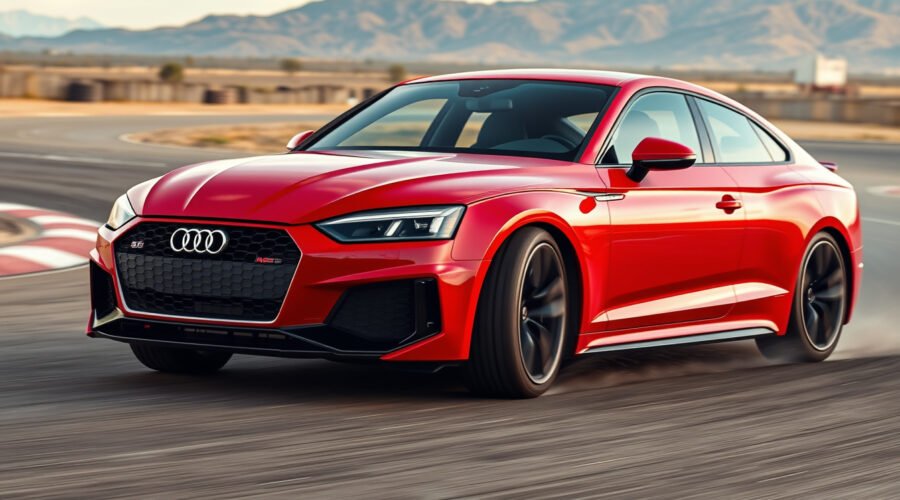
The new Audi RS5 is Audi Sport’s first high-performance plug-in hybrid, and the biggest change is not simply electrification. Its 630-hp system pairs a revised twin-turbo V6 with an electric motor, while a new rear transaxle can actively shift torque between the rear wheels. That hardware gives the RS5 a wide handling range, from quiet electric driving to deliberately rear-biased behavior on a closed course.
Quick Answer
The new Audi RS5 is a 630-hp plug-in hybrid that uses quattro with Dynamic Torque Control to vary torque across the rear axle. Dynamic mode adds rear-biased agility, RS Sport prioritizes traction and speed, and RS Torque Rear is the closed-course setting for controlled drifts. Its hybrid system also supports up to 52 miles of electric range.
Last checked: September 30, 2026. Dates and figures were verified against official sources.
Key Takeaways
- The plug-in hybrid system combines a 2.9-liter twin-turbo V6 with a 130 kW electric motor for 470 kW of system output.
- The 25.9 kWh battery has 22 kWh of usable capacity and can accept AC charging at up to 11 kW.
- Dynamic Torque Control can create up to a 2,000 Nm torque difference between the rear driveshafts and respond in about 15 milliseconds.
- RS Sport is focused on traction and fast laps, while RS Torque Rear is designed for controlled oversteer on closed courses.
- The RS5 is heavy at 2,355 kg for the Sedan, so its sophisticated chassis systems matter as much as its headline power figure.
Audi RS5 Plug-in Hybrid: Power, Battery, and Electric Range
The Audi RS5 combines substantial combustion-engine power with an electric motor integrated into its hybrid drivetrain. According to Audi’s official RS5 technical release, total system output reaches 470 kW, equivalent to about 630 hp or 639 PS, with 825 Nm of system torque.
The revised 2.9-liter twin-turbo V6 produces 375 kW, while the electric motor contributes up to 130 kW. Power reaches the wheels through an eight-speed Tiptronic automatic transmission and quattro all-wheel drive.
| Specification | Audi RS5 |
|---|---|
| Engine | 2.9-liter twin-turbo V6 |
| Electric motor | 130 kW |
| System output | 470 kW / about 630 hp / 639 PS |
| System torque | 825 Nm |
| Battery | 25.9 kWh gross / 22 kWh usable |
| Official electric range | Up to 84 km EAER; Audi UK lists up to 52 miles |
| 0–100 km/h | 3.6 seconds |
| Maximum AC charging | 11 kW |
The high-voltage battery sits beneath the trunk floor rather than simply being an extra power source for acceleration. It also supplies energy to the electric actuator used by the rear torque-vectoring system.
At an 11 kW AC charging point, Audi says a full charge takes about 2.5 hours. Audi UK’s RS5 charging information lists up to 52 miles of electric-only range for the Saloon, though range varies with specification, temperature, speed, and driving conditions.
Understanding Audi RS5 Driving Modes
The RS5’s driving modes do more than change throttle response. They alter the way the powertrain, suspension, steering, stability control, and rear torque-vectoring system work together, allowing the car to move from quiet everyday driving to a much more rear-biased track setup.
The basic modes are Comfort, Balanced, and Dynamic. Audi then adds three RS-specific choices: RS Sport, RS Torque Rear, and RS Individual.
| Mode | Main Character |
|---|---|
| Comfort | Relaxed response and access to all-electric driving. |
| Balanced | Neutral everyday setup with electric driving available. |
| Dynamic | Sharper steering and throttle response with a more noticeable rear bias at corner exit. |
| RS Sport | Maximum propulsion, traction, and neutral handling for fast driving. |
| RS Torque Rear | Maximum rear bias for controlled drifting on closed courses. |
| RS Individual | Lets the driver customize steering, suspension, powertrain response, sound, ESC, and torque vectoring. |
RS Sport and RS Torque Rear also manage battery charge differently from the everyday modes. Audi keeps a high state of charge available so the electric motor and torque-vectoring actuator can continue providing their intended performance during hard driving.
How Torque Vectoring Transforms Audi RS5 Handling
The RS5’s defining chassis technology is quattro with Dynamic Torque Control. It is an electromechanical torque-vectoring system in the rear transaxle that can actively alter the torque delivered to the left and right rear driveshafts.
This is different from rear-wheel steering. The rear wheels do not need to turn to alter the car’s direction. Instead, the system changes the forces acting through the two rear tires, helping the RS5 rotate into or out of a corner as needed.
According to Audi’s detailed explanation of Dynamic Torque Control, the system uses a water-cooled 400-volt electric actuator, overdrive gearing, and a conventional differential. It can create a torque difference of up to 2,000 Nm between the rear driveshafts and react in about 15 milliseconds.
The central driving-dynamics controller calculates the desired torque difference every five milliseconds. On corner exit, sending more torque toward the outside rear wheel can help rotate the car and reduce understeer. If the vehicle begins to oversteer, the system can instead alter the torque distribution to stabilize it.
The center differential has its own job. It varies torque between the front and rear axles, while Dynamic Torque Control manages the left-to-right distribution at the rear. Together, the two systems give the RS5 far more freedom to change its cornering balance than a conventional fixed all-wheel-drive setup.
Controlled Oversteer in the Audi RS5: What Drivers Should Know
Controlled oversteer means the rear tires are operating at a larger slip angle than the fronts while the driver still controls the car’s direction. The RS5 can deliberately encourage this behavior, but Audi specifically positions RS Torque Rear for controlled drifting on closed courses, not public roads.
Warning: Do not practice oversteer, drifting, or stability-control-limit driving on public roads. Use a closed course with adequate runoff, suitable tires, and qualified instruction. A 630-hp, 2,355 kg performance car can build speed and tire load very quickly.
Weight transfer, steering angle, throttle position, tire grip, surface conditions, and vehicle speed all affect a slide. The RS5’s electronics monitor many of these inputs and adjust rear-axle torque rapidly, but electronic assistance cannot overcome the physical limits of the tires or available space.
For a first track session, smooth and predictable inputs matter more than trying to create a large drift angle. Learn the car’s neutral behavior first, then work with an instructor before reducing stability intervention or selecting a more aggressive mode.
RS Sport and RS Torque Rear also serve different purposes. RS Sport is tuned for traction, lateral acceleration, and fast corner exits. RS Torque Rear deliberately increases rear bias, which makes it the appropriate closed-course mode when the goal is controlled oversteer rather than the quickest possible lap.
Pro Tip: Treat a track session as a progression. Start by learning braking points, steering response, and the car’s neutral balance before exploring rear-biased modes. That gives you a clearer sense of what the torque-vectoring system is changing.
Why a Closed-Course Track Session Suits the RS5
A closed course is the right environment for exploring the RS5’s more aggressive handling modes because it provides controlled conditions, runoff space, and instruction without exposing public-road users to the risks of high-speed oversteer.
Audi demonstrated that point during a 2026 international media event based at the ÖAMTC Driving Technique Center in Saalfelden. Journalists used a closed dynamic area there to explore the vehicle near its handling limits.
That event should not be confused with a standing public RS5 track-day program. Owners who want similar experience should use a sanctioned circuit or performance-driving school that permits the vehicle and the intended exercises.
A track also gives the RS5’s chassis technology room to make sense. Its Sedan curb weight is 2,355 kg, yet the combination of five-link suspension, twin-valve dampers, quattro all-wheel drive, and rear torque vectoring is designed to manage that mass during rapid braking, direction changes, and corner exits.
The car can also record performance information in RS Torque Rear mode, including lap-related data and drift angle. Used in the right environment, those tools help turn a dramatic slide into something measurable rather than simply theatrical.
Frequently Asked Questions
What Is the Warranty Coverage for the Audi RS5?
Audi USA’s New Vehicle Limited Warranty currently covers new Audi vehicles for four years or 50,000 miles, whichever comes first. Market-specific coverage for the new RS5’s plug-in-hybrid and high-voltage components should be confirmed from the warranty booklet supplied with the vehicle.
How Does the RS5 Compare to Other Luxury Performance Sedans?
The RS5 differs from many traditional performance sedans by combining a plug-in-hybrid drivetrain with all-wheel drive and active electromechanical torque vectoring at the rear axle. Its 630-hp system emphasizes a broad range of behavior, from electric commuting to rear-biased closed-course handling, rather than relying only on engine power and conventional differentials.
What Are the Maintenance Costs for the Audi RS5?
There is no single fixed maintenance cost for the new RS5 because labor rates, service plans, tire choice, brake equipment, mileage, and market all affect the total. The car’s performance tires and available ceramic braking system can also make consumable costs different from those of a regular A5, so use market-specific Audi service pricing when budgeting.
Can the RS5 Be Charged Using Standard Home Outlets?
The RS5 supports AC charging, but charging equipment differs by market. Audi’s European specifications list Mode 3 Type 2 charging at up to 11 kW and about 2.5 hours for a full charge at that power level. Do not assume a particular U.S. 120-volt household-outlet charging time or compatibility until Audi publishes the relevant U.S.-market equipment specifications.
What Safety Features Are Included in the Audi RS5?
The RS5’s documented dynamic-safety systems include electronic stability control, brake-by-wire blending of regenerative and friction braking, RS-specific ABS calibration, quattro all-wheel drive, and Dynamic Torque Control. Driver-assistance equipment can vary by country, trim, and option package, so the applicable market specification should be used for a complete feature list.
Conclusion
The Audi RS5’s defining feature is not simply its 630-hp hybrid output. Dynamic Torque Control, the new center differential, and distinct RS driving modes let the car move from stable everyday behavior to deliberate rear-biased handling. If you want to explore RS Torque Rear and controlled oversteer, a properly supervised closed course is the place to do it.
Sources
- Audi: The new Audi RS 5 — high performance in a hybrid: Powertrain output, battery capacity, charging, range, chassis, driving modes, and vehicle weight.
- Audi: RS 5 performance hybrid driving dynamics: Dynamic Torque Control operation, torque-vectoring response, and handling behavior.
- Audi UK: RS 5 Saloon battery and range: Electric range, AC charging rate, and charging time.
- ÖAMTC: Audi RS 5 presentation in Saalfelden: Closed-course media testing at the ÖAMTC Driving Technique Center.
- Audi USA Warranty: Current U.S. New Vehicle Limited Warranty terms.