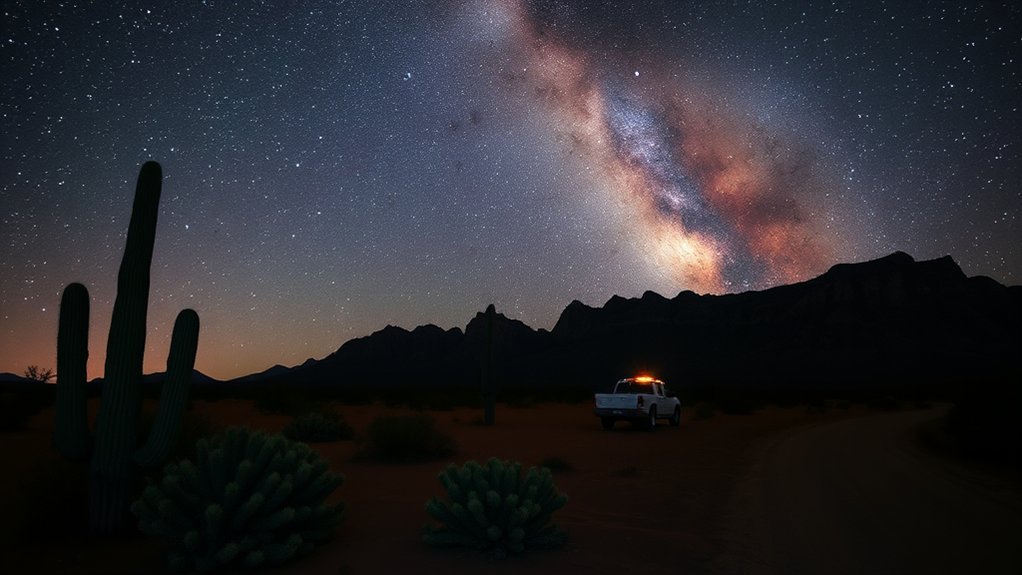
Arizona offers some of the clearest, darkest night skies in North America, thanks to its high-elevation plateaus, arid desert climate, and pioneering dark-sky lighting ordinances. From the isolated reaches of Grand Canyon–Parashant to the world-renowned telescope domes of Kitt Peak and Flagstaff, the state provides unmatched transparency for observing the Milky Way, meteor showers, and deep-sky objects.
Quick Answer
The best stargazing in Arizona is found at designated Dark Sky Parks and high-altitude observatories, including Grand Canyon–Parashant National Monument (Bortle 1), Kitt Peak National Observatory, Flagstaff (the world’s first Dark Sky City), and the Mogollon Rim. Optimal viewing occurs during the new moon phase from March through October for the Galactic Core.
Key Takeaways
- Exceptional Transparency: Low relative humidity, high elevations (up to 10,470 feet), and stable air masses minimize atmospheric scintillation and distortion across Arizona.
- Pioneering Lighting Codes: Flagstaff, Tucson, and surrounding counties enforce strict outdoor lighting ordinances to protect research-grade night skies.
- True Bortle 1 Darkness: Remote northern reserves like Parashant and Vermilion Cliffs offer near-zero artificial light pollution.
- Year-Round Astronomy: The bright Galactic Core dominates spring through autumn, while the crisp Winter Milky Way and deep-sky targets highlight colder months.
Why Arizona Is a Premier Stargazing Destination
Arizona’s reputation as a global astronomical capital rests on a unique combination of geography, climate, and public policy. The state’s vast expanses of high-altitude desert place observers above the dense, turbulent lower atmosphere, drastically reducing light scatter and atmospheric scintillation. Stable pressure gradients and more than 300 clear nights per year provide consistent observing windows with high signal-to-noise ratios for astrophotography.
Equally critical is Arizona’s legal commitment to dark-sky preservation. In 1958, Flagstaff enacted the world’s first municipal dark-sky lighting ordinance, followed by comprehensive light-pollution codes across Coconino and Pima Counties. These regulations mandate fully shielded, low-temperature light fixtures, curbing urban skyglow and preserving pristine Bortle Class 1 and 2 skies near major scientific research centers.
At a Glance: Top Arizona Stargazing Regions
| Top Remote Dark Sky | Grand Canyon–Parashant & Vermilion Cliffs (Bortle 1) |
| Best Public Observatories | Kitt Peak (Quinlan Mtns) & Lowell Observatory (Flagstaff) |
| Best Accessible High-Altitude | Mogollon Rim Overlooks (7,500–8,000 ft) |
| Best Desert Nightscape | Organ Pipe Cactus National Monument (Bortle 1–2) |
Grand Canyon-Parashant National Monument
Located on the remote Arizona Strip north of the Grand Canyon, Grand Canyon–Parashant National Monument was officially designated an International Dark Sky Park by DarkSky International in 2014. Spanning over one million acres of rugged plateaus, deep canyons, and unpaved wilderness, Parashant is free from grid electricity and urban skyglow, earning a pristine Bortle Class 1 rating.
Here, the Milky Way casts perceptible diffuse shadows on moonless nights, and atmospheric airglow is frequently visible along the horizon. Stargazers setting up tracking mounts or wide-angle astrophotography rigs will find unobstructed horizons on the Shivwits and Uinkaret Plateaus.
Warning: Grand Canyon–Parashant is an extreme wilderness area with no cell service, paved roads, water, or fuel stations. High-clearance 4WD vehicles equipped with heavy-ply all-terrain tires and two spare tires are required. Visitors must be completely self-sufficient.
Kitt Peak National Observatory and Surroundings
Perched at an elevation of 6,875 feet in the Quinlan Mountains, 56 miles southwest of Tucson on the Tohono O’odham Nation, Kitt Peak National Observatory (KPNO) hosts the world’s largest and most diverse collection of optical and radio research telescopes. Operating under the auspices of NSF NOIRLab, the facility sits above the desert thermal inversion layer, benefiting from exceptionally stable laminar airflow.
Public night programs allow amateur astronomers and visitors to observe through large-aperture research telescopes guided by staff astronomers. The surrounding mountain roads offer dramatic dark-sky horizons shielded from Tucson’s urban center by the Baboquivari mountain range.
Pro Tip: Public night programs at Kitt Peak (such as the Night Observing Program) require advance online reservations. Red-filtered lights are strictly enforced throughout the mountain complex after sunset.
Flagstaff Dark Sky Parks and Observatories
In 2001, Flagstaff was recognized as the world’s first International Dark Sky City. Sitting at 7,000 feet elevation at the base of the San Francisco Peaks, the city balances urban infrastructure with world-class astronomical research. It is home to the historic Lowell Observatory—where Clyde Tombaugh discovered Pluto in 1930—and the U.S. Naval Observatory Flagstaff Station (NOFS).
Within the city and its immediate perimeter, several designated dark-sky parks and public viewing areas provide high contrast for deep-sky observation:
- Buffalo Park: An open 215-acre public space on an ancient lava flow, offering expansive 360-degree celestial panoramas just minutes from downtown.
- Lowell Observatory’s Giovale Open Deck Observatory: Features a suite of public-access telescopes, including 8-inch to 32-inch Planewave and custom refractors for viewing nebulae and planets.
- Sunset Crater Volcano and Wupatki National Monuments: Located just north of Flagstaff, both monuments are certified International Dark Sky Parks offering Bortle 2 conditions over volcanic cinder fields and ancient pueblo architecture.
Saguaro West and Saguaro East: Desert Night Skies
Flanking the city of Tucson, Saguaro National Park is divided into two distinct districts: the Tucson Mountain District (Saguaro West) and the Rincon Mountain District (Saguaro East). Saguaro National Park holds certification as an Urban Night Sky Place, providing accessible desert nightscapes populated by towering giant saguaro cacti (Carnegiea gigantea).
While low-horizon skyglow from Tucson is visible to the east in Saguaro West and to the west in Saguaro East, zenith transparency remains high. The iconic silhouette of saguaros against the rising Milky Way makes both districts prime locations for wide-field astrophotography, nightscape time-lapses, and planetary observation along pullouts on Scenic Bajada Loop Drive.
Mogollon Rim and Forest Road 300 Area
Stretching 200 miles across central Arizona, the Mogollon Rim forms a massive 2,000-foot sedimentary and basalt escarpment. With elevations ranging between 7,500 and 8,000 feet, the rim edge elevates stargazers above the lower desert dust and haze, providing pristine Bortle Class 2 observing corridors.
Prime Mogollon Rim Viewing Spots
Forest Road 300 (Rim Road) traces the cliff edge, providing access to numerous clearings and designated scenic overlooks that make ideal telescope setup points:
- Promontory Butte & Overlook: One of the highest points along the central Rim ($7,920\text{ ft}$), offering completely unobstructed southern horizons ideal for tracking the Galactic Core.
- Woods Canyon Lake & Spillway Recreation Area: Dark, sheltered clearings surrounded by ponderosa pines, which block ground-level wind during long-exposure astrophotography.
- Rim Visitor Center Viewpoint: Located at the junction of Highway 260 and FR 300, providing paved access for stargazers with standard passenger vehicles.
Mogollon Rim Seeing Conditions
The Mogollon Rim benefits from rapid radiative cooling after sunset. While high-altitude air ensures excellent sky transparency, temperature drops of $30^\circ\text{F}$ to $40^\circ\text{F}$ are common within hours of nightfall. Observers should insulate optical tubes to prevent thermal dew formation on telescope corrector plates and lenses.
Organ Pipe Cactus National Monument Nightscapes
Positioned along the Mexican border in the deep Sonoran Desert, Organ Pipe Cactus National Monument was designated an International Dark Sky Park in 2019. Its immense distance from major metropolitan centers grants it pristine Bortle 1 to 2 skies with minimal artificial skyglow.
Dark Skies Preservation
Organ Pipe Cactus National Monument enforces strict light management protocols, using low-lumen, amber-spectrum shielded lighting across all visitor facilities and campgrounds. This preservation work maintains natural darkness critical to native nocturnal wildlife, including lesser long-nosed bats and desert kit foxes.
Best Viewing Spots
Top viewing locations within the monument include:
- Ajo Mountain Drive Pullouts: A 21-mile unpaved loop leading into the foothills of the Ajo Range, offering sweeping foregrounds of rare organ pipe cacti framed by the celestial sphere.
- Twin Peaks Campground Perimeter: Provides easily accessible, stabilized viewing pads for amateur astronomers staying overnight.
- Puerto Blanco Drive: Remote desert expanses offering uninhibited 360-degree southern horizons into northern Sonora, Mexico.
Night Photography Tips
Capturing the monument’s dramatic nightscape requires methodical camera settings. For pinpoint stars without trailing, calculate exposure times using the 500 Rule ($500 / \text{focal length}$) or the more precise NPF Rule. Pair a fast wide-angle lens ($f/1.4$ to $f/2.8$) with an ISO between 3200 and 6400, and bracket foreground exposures during blue hour to blend with the night sky exposure during post-processing.
Mt. Graham International Observatory Region
Rising abruptly from the desert floor near Safford, the Pinaleño Mountains culminate at Mount Graham ($10,720\text{ ft}$). At an elevation of 10,470 feet sits the Mount Graham International Observatory (MGIO), operated by the University of Arizona. The site hosts premier research instruments, including the Large Binocular Telescope (LBT), the Heinrich Hertz Submillimeter Telescope (SMT), and the Vatican Advanced Technology Telescope (VATT).
The extreme altitude places MGIO above roughly one-third of the Earth’s atmosphere, yielding dry, stable air with negligible water vapor absorption. While access to the observatory summit is restricted to protect sensitive ecological habitats and scientific operations, public observation areas along Swift Trail (Highway 366) offer exceptional high-altitude stargazing from late spring through autumn.
Vermilion Cliffs and Marble Canyon Viewing Spots
The Colorado Plateau’s sedimentary marvels—Vermilion Cliffs National Monument and Marble Canyon—provide dramatic geological backdrops under Bortle Class 1 dark skies. Overlooking the Paria Plateau and the Colorado River, these sites are shielded from municipal glare by towering sandstone escarpments.
- Navajo Bridge (Marble Canyon): Provides safe, stable pedestrian access directly over the Colorado River canyon, offering open northern and southern celestial sightlines.
- Lees Ferry: Situated at the base of the canyon walls, providing accessible, paved parking with dramatic vertical cliffs framing the night sky.
- House Rock Valley Road: Offers remote pullouts along the western base of the Vermilion Cliffs for unobstructed western horizons.
Tips for Planning a Night Under Arizona Skies
Note: Target your observing trips within three to four days of the new moon. Even a 25% illuminated waxing or waning crescent moon washes out faint nebular structures and the outer arms of the Milky Way.
Executing a successful stargazing excursion in Arizona requires specific logistical preparation:
- Check Astronomical Seeing: Consult specialized forecasting tools like ClearDarkSky or Astrospheric to evaluate transparency, seeing (atmospheric turbulence), and smoke cover before traveling.
- Protect Night Vision: Human eyes require 20 to 30 minutes in total darkness to produce rhodopsin (visual purple). Use only dim red LED headlamps ($620\text{–}660\text{ nm}$) to preserve dark adaptation.
- Prepare for Severe Temperature Drops: Arid desert climates lose surface heat rapidly after dusk. Pack thermal base layers, windbreakers, and insulated footwear, even during summer months in high-elevation areas like Flagstaff and the Mogollon Rim.
- Practice Leave No Trace: Stay on marked roads and durable surfaces to prevent damage to fragile biological soil crusts (cryptobiotic soil) in desert and plateau ecosystems.
Frequently Asked Questions
Are there guided night-sky photography workshops nearby in Arizona?
Yes. Numerous professional astrophotographers and educational non-profits conduct guided workshops throughout the year across Sedona, the Grand Canyon, Saguaro National Park, and Monument Valley. These workshops cover tracking mount setup, exposure blending, and wide-field Milky Way composition.
Can I see the Milky Way year-round in Arizona?
Yes, but the visible portion changes with the seasons. The bright, dense Galactic Core (located toward Sagittarius and Scorpius) is visible from late March through October. From November through February, observers see the fainter Winter Milky Way running through the constellations of Orion, Taurus, Auriga, and Perseus.
Are drones allowed during nighttime stargazing in Arizona?
No. The National Park Service strictly prohibits the launching, landing, or operating of unmanned aircraft (drones) on all National Park and National Monument lands (36 CFR § 1.5). On other public lands, FAA Part 107 rules require specific anti-collision lighting visible for at least 3 statute miles for nighttime flight, which conflicts with dark-sky preservation etiquette.
What are the best months for meteor shower viewing in Arizona?
The two most reliable annual meteor showers are the Perseids (peaking August 11–13 under warm summer conditions) and the Geminids (peaking December 13–14 with high hourly rates and brilliant fireballs under crisp, stable winter skies). The Quadrantids in early January also provide strong viewing if skies are clear.
Do any Arizona sites offer wheelchair-accessible stargazing areas?
Yes. Lowell Observatory in Flagstaff provides fully paved walkways, ADA-compliant ramps, and the Giovale Open Deck Observatory with accessible viewing stations. Kitt Peak National Observatory features accessible visitor center exhibits and telescope viewing pads. Buffalo Park in Flagstaff and Navajo Bridge at Marble Canyon also offer flat, paved viewing surfaces.
Conclusion
Arizona remains one of the world’s premier destinations for astronomy and dark-sky exploration. By pairing high elevations and low humidity with active municipal lighting conservation, the state delivers pristine observing conditions from the rim of the Grand Canyon to the saguaro-studded valleys of the south. Whether visiting an active research facility like Kitt Peak or setting up a personal telescope along the Mogollon Rim, planning around moon phases and seasonal atmospheric shifts ensures an extraordinary view into the cosmos.
Sources
- DarkSky International — Official dark-sky designations, municipal lighting standards, and International Dark Sky Places registry.
- National Park Service: Grand Canyon–Parashant National Monument — Wilderness access, road condition alerts, and backcountry regulations.
- NSF NOIRLab: Kitt Peak National Observatory — Telescope specifications, elevation metrics, and public observing program access.
- Lowell Observatory — Flagstaff dark-sky history, research history, and Giovale Open Deck Observatory specifications.
- Mount Graham International Observatory (University of Arizona) — Research facility instrumentation, altitude parameters, and access guidelines.