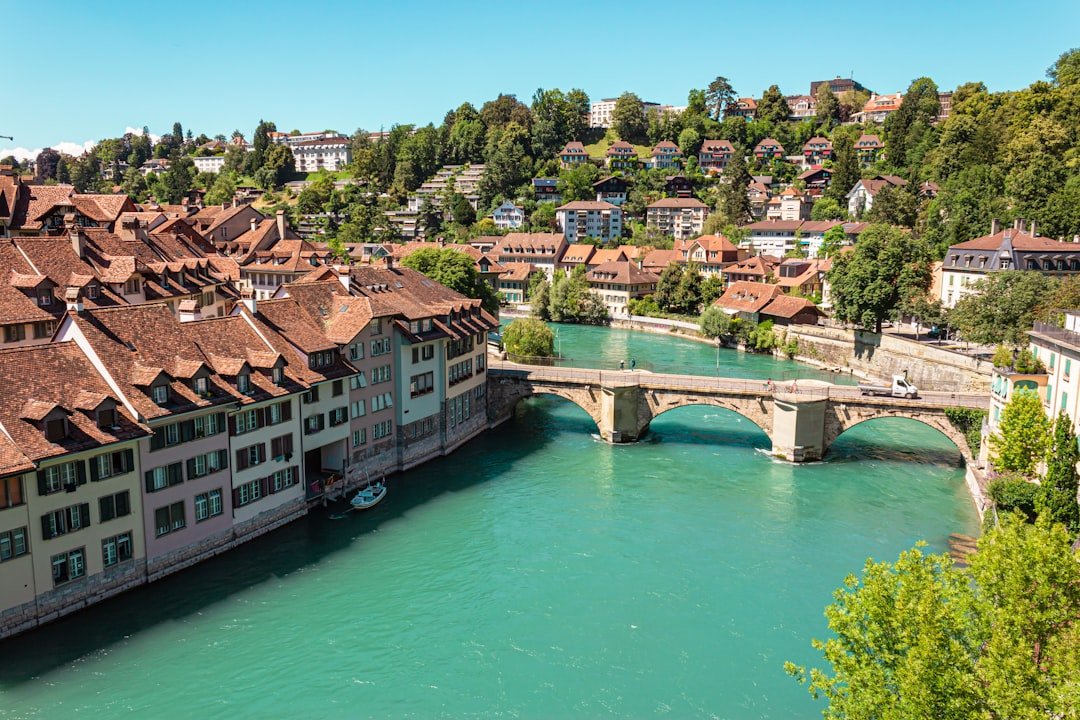
Bern, the federal seat of Switzerland, seamlessly bridges preserved medieval grandeur with a relaxed, contemporary outdoor lifestyle. Built along a tight horseshoe bend of the turquoise Aare River, the Swiss capital is celebrated for its sandstone architecture, subterranean cellar shops, and panoramic views of the Bernese Alps.
Quick Answer
The best things to do in Bern include exploring the UNESCO-listed Old Town, watching the astronomical clockwork at the Zytglogge, climbing the Berner Münster cathedral spire, taking in panoramic views from the Rose Garden, touring the Swiss Parliament (Bundeshaus), floating down the glacial Aare River, and visiting the Bern Historical Museum and Zentrum Paul Klee.
Key Takeaways
- UNESCO Medieval Center: Bern’s Old Town features 6 kilometers of weather-protected sandstone arcades (Lauben) and ornate 16th-century Renaissance fountains.
- Dual Einstein Heritage: Visitors can tour Albert Einstein’s original rented flat on Kramgasse as well as the comprehensive Einstein Museum inside the Bern Historical Museum.
- Spectacular Vantage Points: The Rose Garden, Gurten mountain, and the 100.6-meter spire of the Berner Münster deliver sweeping panoramas across the historic center and the Bernese Alps.
- Iconic River Life: The clean, glacier-fed Aare River is central to local recreation, offering scenic riverbank walks year-round and world-famous urban drift swimming in summer.
- Complimentary Transit: Overnight guests in official Bern accommodations receive a digital Bern Ticket covering free transit on all city buses, trams, and the Gurten funicular.
At a Glance
| Time Required | 1 to 2 days (ideal for a weekend city break or base for the Bernese Oberland) |
| Difficulty | Easy (compact, highly walkable medieval center with extensive public transit) |
| Best Time to Visit | June to September (river swimming & open-air dining) or November to December (markets & winter lights) |
| Transit & Pass | Free Bern Ticket included with any overnight hotel, hostel, or guesthouse stay |
Exploring the Historic Old Town and the Zytglogge
The Old City of Bern was designated a UNESCO World Heritage site in 1983 due to its remarkably preserved medieval ground plan, established in 1191 by Duke Berthold V of Zähringen. After a catastrophic fire in 1405 destroyed the original wooden settlement, the burghers systematically rebuilt the city in distinctive greenish molasse sandstone, creating the uniform, arcaded streetscape visible today.
The architectural centerpiece of the Old Town is the Zytglogge (Clock Tower). Constructed between 1218 and 1220 as Bern’s first western gate tower, the structure was later converted into a prison before receiving its famous astronomical clockwork in 1530, built by Swiss master craftsman Kaspar Brunner.
Exactly four minutes before the strike of each hour, spectators gather along the Marktgasse to witness the mechanical puppet show driven by the internal pendulum clockwork:
- A crowing rooster flutters its wings and sounds the arrival of the hour.
- A whimsical parade of armored bears marches out from the tower facade.
- Chronos, the Greek personification of time, flips his hourglass and counts each strike of the bell.
- High atop the spire, the gilded mechanical bell striker (Hans von Thann) hammers out the full hour on the great bronze bell.
Pro Tip: Arrive at the eastern face of the Zytglogge at least 5 minutes before the hour to secure an unobstructed viewing position. To see the massive 16th-century iron gear train and astronomical movement up close, book a daily behind-the-scenes guided tour through the local tourist office.
Wandering Kramgasse, the Covered Arcades, and Einstein House
Extending eastward from the Zytglogge is Kramgasse, an elegant boulevard lined with baroque facades, cobbled sidewalks, and ornate stone architecture.
Bern’s 6 kilometers of continuous vaulted sandstone arcades (Lauben) form one of the longest weather-sheltered shopping promenades in Europe, sheltering specialty boutiques and historic vaulted cellars.
Albert Einstein’s Flat at Kramgasse 49
At Kramgasse 49, visitors can climb the narrow wooden stairs to the second floor to enter the Einstein House (Einsteinhaus). Albert Einstein rented this modest apartment from 1903 to 1905 while employed as a probationary technical examiner at the Swiss Federal Patent Office.
During his quiet evenings in this flat, Einstein drafted his revolutionary Annus Mirabilis (Miracle Year) papers, which formulated the Special Theory of Relativity, introduced the mass-energy equivalence equation ($E = mc^2$), and explained the photoelectric effect (which earned him the 1921 Nobel Prize in Physics). The apartment has been preserved with authentic turn-of-the-century Biedermeier furnishings, personal correspondence, and photographs of Einstein with his physicist wife, Mileva Marić, and infant son, Hans Albert.
Renaissance Allegorical Fountains
Down the center of Kramgasse, Gerechtigkeitsgasse, and neighboring streets stand Bern’s striking 16th-century public fountains. Sculpted primarily by Renaissance artist Hans Gieng between 1542 and 1546, these brightly painted limestone columns provided the medieval populace with clean spring water and reinforced civic virtues:
- Zähringerbrunnen: Depicts a crowned bear in complete plate armor bearing the coat of arms of the city’s founder.
- Gerechtigkeitsbrunnen (Justice Fountain): Features Lady Justice blindfolded with scales and sword, standing above the severed busts of the Pope, the Sultan, the Emperor, and the Mayor.
- Kindlifresserbrunnen (Ogre Fountain): Located on Kornhausplatz, this fearsome statue depicts an ogre devouring a child, created as an allegorical warning for medieval children.
Climbing the Berner Münster (Cathedral of Bern)
The Cathedral of St. Vincent, known as the Berner Münster, is the largest and most architecturally significant late-medieval ecclesiastical monument in Switzerland. Construction started in 1421 and spanned nearly five centuries before the 100.6-meter open-work neo-Gothic spire was finalized in 1893.
Before entering the nave, examine the main west portal to admire the magnificent sculpted relief of the Last Judgment. Crafted by master builder Erhard Küng, the portal contains 294 intricately carved sandstone figures depicting the separation of the righteous from the damned, with the original polychrome pigments remarkably intact.
Inside, the towering choir features 15th-century stained glass windows, including the vivid “Three Kings” and “Host Mill” compositions. Active travelers can purchase an entry ticket to ascend the cathedral tower. A 344-step spiral stone staircase leads through the lower bell chamber (housing Switzerland’s largest church bell, weighing over 10 tons) up to the open observation platform, yielding sweeping panoramas of the Aare River loop and the distant peaks of the Eiger, Mönch, and Jungfrau.
The Münster Platform and the Historic Matte District
Directly behind the cathedral, the shaded Münsterplatform (Münsterplattform) terrace overlooks the river basin. Once an elevated churchyard, it now serves as a scenic gathering space filled with chestnut trees and casual open-air cafes.
From the terrace edge, travelers can look down into the historic Matte district, Bern’s oldest working-class enclave located directly along the water’s edge. Historically populated by fishermen, craftsmen, and bargemen, the Matte developed its own unique dialect, known as Mattenenglisch. To reach the Matte without walking down the steep hillside steps, ride the Senkeltram (Mattelifte)—a historic electrical public elevator operating since 1897 that carries passengers directly between the cathedral platform and the riverside alleys in under a minute.
Admiring the Views from the Rose Garden (Rosengarten)
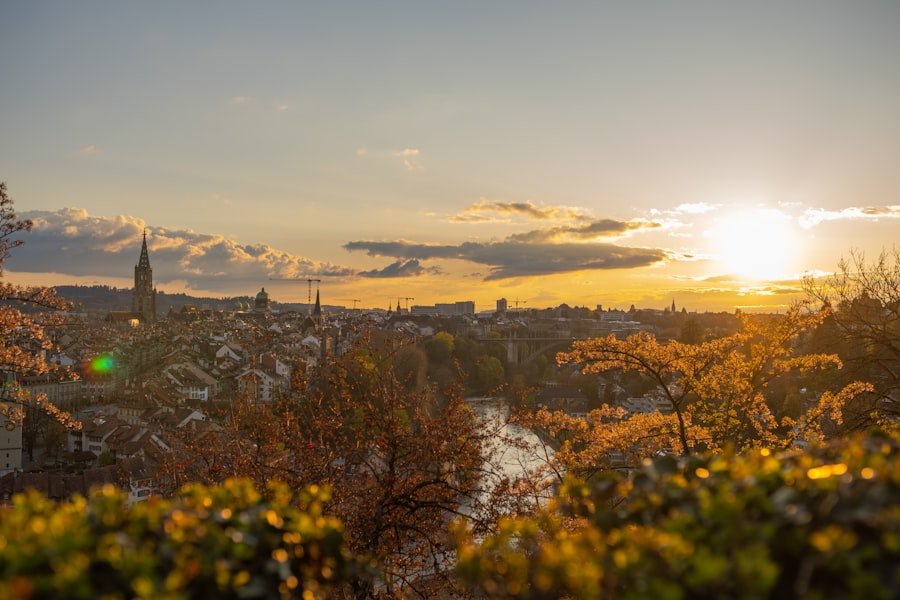
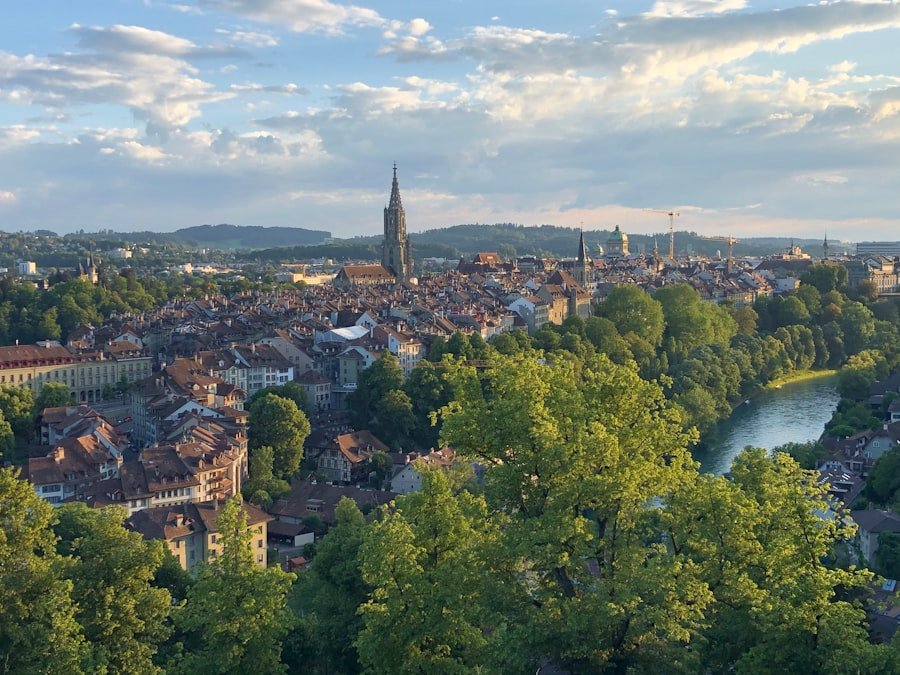
Situated on a steep hillside across the Aare River east of the Old Town, the Rose Garden (Rosengarten) provides the classic postcard vista of the capital’s red-tile roofs framed by the looping river bend. The grounds served as a municipal burial ground from 1765 until 1877 before being redesigned and opened as a botanical public park in 1913.
Today, the park cultivates more than 220 cataloged varieties of fragrant roses, 200 iris species, and dozens of rhododendrons surrounding a tranquil central water basin. In late March and early April, Japanese cherry blossom trees (donated to Bern by the city of Nara) flower along the southern paths. Comfortable benches and low stone walls face directly west across the medieval skyline, making the Rose Garden the premier sunset gathering spot in the city.
Exploring the Zentrum Paul Klee Museum
The Zentrum Paul Klee celebrates the life and output of Swiss painter and Bauhaus master Paul Klee (1879–1940), who spent his childhood and final artistic years in Bern. Designed by Pritzker Prize-winning architect Renzo Piano, the museum is itself an engineering masterpiece: three rolling, wave-like pavilions of curved steel and glass that mimic the undulating topography of the surrounding Bernese countryside.
The museum holds approximately 4,000 paintings, watercolors, drawings, and personal puppets created by Klee—representing roughly 40% of his entire lifetime body of work. Due to the acute light sensitivity of Klee’s delicate graphic prints and fragile paper substrates, works are shown through regularly rotating thematic exhibitions rather than a static permanent installation. The complex also incorporates Creaviva, an interactive studio offering hands-on workshops for children, an acoustically tuned concert hall, and scenic walking trails through working wheat fields.
Touring the Bern Historical Museum and Einstein Museum
Across the Kirchenfeldbrücke bridge on Helvetiaplatz stands the Bern Historical Museum (Bernisches Historisches Museum), the second-largest historical cultural institution in Switzerland. Housed in a striking 1894 neo-Gothic castle designed by architect André Lambert, the museum holds more than 500,000 artifacts tracing Swiss cultural heritage from prehistory through the Middle Ages to the modern era.
Among its greatest treasures are the world-renowned 15th-century Burgundian Tapestries, captured by the Swiss Confederates following their historic military victories over Duke Charles the Bold at Grandson and Murten in 1476. The museum also showcases ancient Celtic burial relics, medieval ecclesiastical silver, and regional guild collections.
Integrated within the castle complex is the dedicated Einstein Museum. Spanning 1,000 square meters of multimedia galleries, the exhibition places Einstein’s scientific theories against the backdrop of contemporary global history. Displays include his original matriculation papers, personal letters, handwritten scientific proofs, and detailed audio-visual simulations illustrating the curvature of spacetime.
Sampling Swiss Cuisine at the Bern Market
To experience the agricultural flavors of the surrounding Canton of Bern, visit the traditional weekly market (Wochenmarkt), held every Tuesday and Saturday morning on the spacious stone squares of Bundesplatz and Bärenplatz. Small-scale producers from the Emmental dairy country and the fertile Seeland vegetable plains assemble to sell fresh mountain cheeses, wood-fired crusty breads, cured alpine meats, and seasonal berries.
| Food Specialty | Serving Style | Average Cost | Culinary Highlights |
|---|---|---|---|
| Raclette | Scraped melted over boiled potatoes with cornichons | CHF 9 – CHF 14 | Nutty, pungent alpine cow’s milk cheese melted freshly from heated half-wheels. |
| Chäsbängel | Hollowed crusty baguette filled with hot fondue cheese | CHF 10 – CHF 12 | Handheld street fondue blended with aged Gruyère AOP and Emmentaler AOP with white wine. |
| Bernese Rösti | Pan-crisped grated potato cake with smoked bacon lardons | CHF 8 – CHF 12 | Golden-brown exterior, buttery interior; classic comfort food originating from Swiss farm breakfasts. |
| Artisan Swiss Chocolate | Handcrafted pralines, truffles, or bean-to-bar tablets | CHF 6 – CHF 15 | Silky texture made using the conching refining technique, invented in Bern by Rodolphe Lindt in 1879. |
For a traditional sit-down dinner, reserve a table at an authentic cellar restaurant to sample the Berner Platte—a historic feast plate piled with boiled ham, smoked bacon, pork loin, beef tongue, and marrow bones served over spiced sauerkraut, dried green beans, and parsley potatoes.
Walking and Swimming Along the Aare River
The turquoise waters of the Aare River originate high in the Bernese Alps from the Grimsel and Unteraar glaciers, encircling three sides of the historic core. During warm summer months, floating down the river is Bern’s quintessential municipal pastime.
Locals pack their dry clothes, wallets, and mobile phones into waterproof float sacks (affectionately known as Aaresäcke), stroll upstream on the river pathways to entry points such as Camping Eichholz or the Schönausteg pedestrian footbridge, jump into the current, and drift naturally downriver toward the city center.
The primary destination for swimmers is the Freibad Marzili, an expansive public bathing complex sitting on the riverbank directly beneath the Federal Parliament. Marzili features spacious manicured lawns, 50-meter swimming pools, diving towers, lockers, and designated river exit ramps. Admission to the Marzili facility and its outdoor pools is completely free to the public year-round.
Warning: The Aare is an alpine river characterized by swift currents, cold glacier-fed waters (rarely climbing above 20°C / 68°F), and changing underwater hazards. River swimming is recommended exclusively for experienced, confident swimmers. Never jump into the water under the influence of alcohol, always monitor designated exit points before entering, exit before reaching the Dalmazibrücke or the dangerous Matteschwelle weir, and keep non-swimmers and small children inside the dedicated pool basins at Marzili or Lorraine Bad.
Visiting the Bear Park (BärenPark)
The bear has reigned as the heraldic animal of Bern since the 12th century, appearing on municipal seals, guild crests, and public flags. Live bears have been maintained in the capital continuously since 1513, originally confined to urban military moats and later housed in concrete pits.
In 2009, the city fundamentally transformed this tradition with the inauguration of the modern BärenPark. This 6,000-square-meter naturalized reserve extends from the historic circular Bear Pit (Bärengraben) down the wooded riverside embankment directly to the Aare’s edge. The resident Eurasian brown bears roam through open grassy hillsides, climb mature trees, and fish in a dedicated 100-meter-long private river basin. Visitors can view the bears year-round free of charge from elevated pedestrian pathways, open riverfront viewing ramps, and an inclined glass elevator that provides barrier-free access down to the shoreline.
Touring the Bundeshaus (Swiss Parliament Building)
Perched dramatically on a rock promontory above the Aare, the Bundeshaus (Federal Palace) serves as the seat of the Swiss Federal Assembly (the National Council and Council of States) and the seven-member Federal Council executive cabinet. Designed by Swiss-Austrian architect Hans Wilhelm Auer and inaugurated in 1902, the neo-Renaissance building was constructed using 38 distinct types of native stone sourced from all regions of Switzerland to symbolize inter-cantonal unity.
Beneath the central green copper dome, the cavernous entrance hall features the monumental bronze statue of the “Three Confederates” swearing the Rütli oath of 1291. During parliamentary recess periods, visitors can join free 60-minute guided architectural and historical tours offered in English, German, French, and Italian. When parliament is actively in session (spring, summer, autumn, and winter sessions), travelers can reserve public gallery passes to observe live legislative debates.
Note on Parliament Tours: All guided tours and gallery entries inside the Bundeshaus are free of charge, but security protocols require advance online reservation through the official parliamentary website. Visitors aged 16 and older must present an official valid passport or government ID card at the security pavilion on Bundesplatz before entering.
Directly outside on the pedestrianized Bundesplatz, the granite plaza features an animated fountain display with 26 synchronized water jets—one for each Swiss canton—shooting up to 7 meters into the air, offering a refreshing gathering spot for families throughout the warmer months.
Taking a Day Trip to Gurten Mountain
For outdoor recreation and high-elevation vistas overlooking the medieval capital and the Alps, travel to Gurten, Bern’s local recreation mountain rising 858 meters above sea level. Situated directly south of the city in Wabern, it is reached via tram line 9 followed by a short ascent on the red Gurtenbahn funicular, which has carried day-trippers up the slope since 1899.
At the car-free mountain summit, visitors can access well-marked hiking and trail-running loops, a dedicated downhill mountain bike course, and a wooden observation tower providing 360-degree views stretching across the Swiss Plateau to the Jura mountains in the north and the snowfields of the Stockhorn range in the south. Families can enjoy large adventure playgrounds, a free miniature steam train loop, and a summer toboggan run. In mid-July, the mountain slopes host the internationally renowned Gurtenfestival, drawing major global music headliners.
Pro Tip: Anyone booking at least one night in an official hotel, hostel, bed-and-breakfast, or campground within the city of Bern automatically receives the digital Bern Ticket. This pass grants unlimited free transportation across all local trams and buses in Libero zones 100 and 101, and includes free passage on the Gurtenbahn funicular and the Münster-Plattform Senkeltram lift.
Frequently Asked Questions
What are the top must-see tourist attractions in Bern?
The top must-see attractions include the UNESCO World Heritage-listed Old Town, the Zytglogge clock tower with its mechanical performance, the Berner Münster cathedral spire, the Federal Palace (Bundeshaus), the riverside Bear Park (BärenPark), the hilltop Rose Garden (Rosengarten), and the Zentrum Paul Klee modern art museum.
How do visitors swim safely in the Aare River?
Safe Aare river swimming requires strong swimming ability and vigilance. Swimmers store dry belongings in a waterproof bag (Aaresack), enter at upstream spots such as Camping Eichholz or Schönausteg, and drift downstream to the public Marzili pools. Swimmers must exit well before reaching the Dalmazibrücke or the Matteschwelle weir, avoid alcohol, and refrain from swimming during high water conditions following alpine rains.
What is the difference between the Einstein House and the Einstein Museum?
The Einstein House (Einsteinhaus) is the preserved second-floor apartment at Kramgasse 49 where Albert Einstein lived with his family from 1903 to 1905 while working on his Special Theory of Relativity. The Einstein Museum is a larger 1,000-square-meter permanent exhibition located inside the Bern Historical Museum on Helvetiaplatz, housing his personal archives, original scientific notes, and extensive multimedia exhibits.
How does the complimentary Bern Ticket work for tourists?
When booking an overnight stay at any registered hotel, youth hostel, bed-and-breakfast, or campsite in Bern, guests automatically receive a complimentary Bern Ticket upon check-in. The digital pass provides unlimited free travel on all Libero network buses and trams within urban zones 100 and 101, including the Gurten funicular and the Mattelifte elevator. Your lodging reservation confirmation can also be used as a valid transit ticket from the Bern main railway station or airport on your arrival day.
What family-friendly activities are best in Bern?
Families will enjoy watching the brown bears forage and swim at the BärenPark, riding the Gurtenbahn funicular up to the free summit playgrounds, mini train, and toboggan track on Gurten mountain, exploring the hands-on art workshops at Creaviva in the Zentrum Paul Klee, and seeing the moving figures of the Zytglogge clock tower.
What are the most famous seasonal festivals and events in Bern?
The most celebrated annual event is the Zibelemärit (Onion Market), held every fourth Monday of November, where farmers sell braided onions, textiles, and warm glühwein. Other signature events include the Gurtenfestival music festival in mid-July, the illuminated Museum Night (Museumsnacht) in March, and the summer Buskers Bern street music festival held across the Old Town arcades.
Sources
- UNESCO World Heritage Centre — Official inscription records, boundaries, and historic preservation criteria of the Old City of Bern.
- Bern Welcome (Official Tourism Organization) — Visitor records, Zytglogge tour information, and Libero transit zone regulations for the Bern Ticket.
- The Federal Assembly (Swiss Parliament) — Architectural archives, parliamentary schedule, and visitor security protocol for the Bundeshaus.
- Zentrum Paul Klee — Official collection catalog, conservation data, and Renzo Piano architectural blueprints.
- Tierpark Bern — Enclosure specifications, river pool engineering, and wildlife habitat documentation for the BärenPark.
- Bernisches Historisches Museum — Curatorial archives for the Burgundian Tapestries and the Einstein Museum permanent collections.