Finding reliable pest control in Broken Arrow is less about choosing the company with the loudest advertising and more about verifying its credentials, treatment approach, guarantees, and experience with your specific pest. Start by identifying the problem, compare more than one provider when time allows, and ask exactly what will be applied in or around your home before you sign a service agreement.
Quick Answer
The best pest control company in Broken Arrow is one that holds the proper Oklahoma credentials, correctly identifies your pest, explains its treatment and products, provides a clear written quote, and backs the work with understandable service terms. Compare local experience, reviews, follow-up policies, and pest-specific expertise rather than choosing by price alone.
Key Takeaways
- Verify the pest-control business and applicator credentials through the Oklahoma Department of Agriculture, Food and Forestry before hiring.
- Get more than one estimate when the situation is not urgent and compare the scope of work, follow-up visits, products, exclusions, and guarantee terms.
- Do not assume an organic or plant-derived pesticide is automatically risk-free. Ask about the exact product, active ingredient, label directions, and precautions.
- Use reviews as one signal, not the whole decision. Ratings and review counts change and may differ across platforms.
- The strongest long-term approach usually combines correct pest identification, prevention, exclusion, monitoring, and targeted treatment when needed.
Recognizing Pest Problems: Signs That You Need Control Services
When you notice signs of pests in your home, identifying the pest correctly should come before choosing a treatment. Oklahoma State University Extension recommends identification as an important first step because different pests require different management methods.
For rodents, common warning signs include droppings, gnaw marks, nesting material, scratching sounds, and damaged food packages. The CDC advises checking homes for rodent droppings and gnaw marks because these signs may appear before you see a mouse or rat.
For insects, look for live insects, shed skins, egg cases, repeated activity around food or water, damaged materials, or a pattern of sightings in the same area. Spider activity can sometimes occur where insect prey is available, but seeing spiders by itself does not prove that you have a larger hidden infestation.
Termite warning signs can include mud tubes, discarded wings, damaged or hollow-sounding wood, and other evidence of wood-destroying activity. Because termite treatment can involve specialized products and structural applications, the EPA notes that termiticide applications often require a trained pest-management professional.
Pro Tip: Take clear photos of droppings, insects, wings, damage, nests, or entry points before cleaning the area. Those details can help a technician identify the pest and determine where the activity is concentrated.
Essential Criteria for Choosing the Right Pest Control Company
Choosing a pest control company affects both treatment effectiveness and how pesticides or other control methods are used around your property. Price matters, but it should not be your only deciding factor.
| Criteria | What to Check |
|---|---|
| Oklahoma credentials | Verify that the company and people performing pesticide work have the required licensing, certification, or technician credentials for the work being performed. |
| Pest-specific experience | Ask how frequently the company treats your exact problem, especially for termites, bed bugs, rodents, or wildlife. |
| Inspection process | A useful inspection should identify the pest, likely entry points, food or moisture sources, damage, and areas requiring treatment or exclusion. |
| Written treatment plan | Look for the target pest, treatment areas, products or methods, preparation requirements, follow-up schedule, and preventive recommendations. |
| Guarantee or retreatment policy | Find out what pests are covered, how long coverage lasts, whether return visits cost extra, and what situations are excluded. |
| Clear pricing | Compare the total first-year cost rather than only the introductory treatment price. |
Verify Oklahoma Pest-Control Credentials
The Oklahoma Department of Agriculture, Food and Forestry regulates pesticide applicators in the state. ODAFF explains that certification and licensing are separate matters and that commercial pesticide work requires the appropriate license.
Before hiring a company, ask for the business name under which its pesticide license is held and the credentials of the person who will perform or supervise your service. A reputable provider should be willing to explain its licensing status.
Get More Than One Written Estimate
The EPA recommends obtaining several estimates when circumstances allow. Compare what each quote actually includes instead of automatically selecting the cheapest option.
For each estimate, check:
- The pest being treated and how it was identified.
- Areas that will be treated or excluded.
- Whether treatment is one-time or recurring.
- Number and timing of follow-up visits.
- Products or control methods that may be used.
- Preparation required from you.
- Guarantee, warranty, or free-retreatment terms.
- Cancellation terms and recurring-service commitments.
- Total expected cost, including renewal or inspection fees.
Watch for Pest-Control Sales Red Flags
Be cautious if a salesperson pressures you to sign immediately, refuses to show credentials, claims to use a secret pesticide formula, cannot explain the treatment, or insists that a large pesticide application is necessary without first identifying the pest.
EPA consumer guidance specifically advises homeowners to be wary of high-pressure tactics and companies that will not provide licensing or pesticide information.
Broken Arrow Pest Control Companies to Compare
No single company is automatically the best choice for every home or pest. The providers below are examples of companies currently advertising service in Broken Arrow or the Tulsa-area market. This is a comparison starting point, not a ranking or endorsement.
| Provider | Current Public Information to Compare |
|---|---|
| Guardian Angel Exterminating | Its Broken Arrow page lists residential pest services, while the company also advertises organic treatment options and a 45-day indoor service guarantee on nearly every pest it treats. Confirm which guarantee applies to your specific service. |
| Arrow Exterminators, Inc. | The Oklahoma company has a Broken Arrow office and advertises guaranteed pest-control services. Ask for the exact plan terms, covered pests, follow-up policy, and any renewal requirements. |
| Xtreme Exterminators | The company advertises residential and commercial pest control throughout the Tulsa surrounding area and describes an Integrated Pest Management approach. Verify current Broken Arrow availability for your address and pest. |
| AVFX Pest and Wildlife | AVFX advertises pest control, termite work, and wildlife services across Northeast Oklahoma and the Tulsa area. This may be useful if your problem involves both structural pests and nuisance wildlife. |
| Terminix | Terminix has Broken Arrow service coverage and advertises recurring pest plans, termite protection, and plan-specific retreatment guarantees. Read the exact coverage before comparing it with a local provider. |
| Orkin | Orkin has a Broken Arrow service page and advertises free touch-up visits plus a money-back guarantee. Confirm current terms for the service you are buying. |
Note: Company ownership, service areas, review counts, ratings, prices, and guarantee terms can change. Treat directory ratings as a current snapshot and verify the company’s live terms before signing a contract.
Choose Between Organic and Traditional Pest Control Methods
When choosing a treatment method, avoid reducing the decision to “organic is safe” and “synthetic is dangerous.” A better comparison looks at the target pest, active ingredient, application site, amount used, exposure potential, label precautions, treatment effectiveness, and whether a nonchemical option can solve part of the problem.
Integrated Pest Management provides a useful framework. IPM emphasizes monitoring and correct identification, prevention, and lower-risk effective controls before broader pesticide applications are considered.
Organic Pest Control Benefits
Some homeowners prefer plant-derived, biological, or minimum-risk products because they want to reduce reliance on certain conventional pesticides. Guardian Angel Exterminating, for example, currently advertises organic pest control in Broken Arrow and notes that its organic program may require more frequent applications for some pests.
However, “natural” or “organic” should not be treated as a guarantee that a product cannot irritate people, affect pets, harm other organisms, or cause problems when misused. Ask for the product name, active ingredients, label directions, treatment location, and any instructions for children or animals.
Traditional Methods Considerations
Conventional pesticides can be appropriate when they are specifically labeled for the pest and application site and are used according to their directions. Some difficult infestations, including termites, bed bugs, or severe cockroach problems, may require products and techniques that are impractical for a homeowner to use effectively.
The goal should be targeted control rather than unnecessary chemical use. EPA consumer guidance recommends addressing sources of food, water, shelter, and entry points and using targeted treatments where practical.
Warning: Keep children and pets away from pesticide-treatment areas for the period specified by the product label or pest-control professional. Tell the technician about pets, aquariums, pregnancy concerns, respiratory sensitivities, or other household circumstances before treatment so the company can provide the appropriate preparation instructions.
How to Assess Customer Reviews and Testimonials?
Customer reviews can help you spot patterns, but a high average rating does not prove that a company is the best fit for your infestation. Pay more attention to repeated comments about diagnosis, communication, punctuality, follow-up visits, billing, contract cancellation, and whether the pest problem actually improved.
As of August 15, 2026, HomeAdvisor’s Broken Arrow listings show examples such as AVFX Pest and Wildlife at 5.0 from 9 reviews and Xtreme Exterminators at 4.9 from 60 reviews. The same directory also displays more than one Bulwark listing with different review counts and recommendation percentages. That is a useful reminder that third-party profiles are dynamic and sometimes duplicated.
| Review Signal | What It Tells You |
|---|---|
| Recent detailed reviews | More useful than short ratings because they may describe the pest, treatment, communication, and outcome. |
| Large number of reviews | Can provide a broader sample, but volume alone does not prove treatment quality. |
| Repeated complaints | Watch for patterns involving missed appointments, unexpected charges, ineffective follow-up, or difficulty canceling service. |
| Company responses | Can show how the business handles disputes and service failures. |
| Platform differences | Compare more than one source because review counts and business records can differ. |
Pro Tip: Search recent reviews for the name of your pest, such as “termites,” “bed bugs,” “mice,” or “roaches.” A company can have excellent general ratings without having the same level of experience with every pest problem.
Pest Control Plans: What You Need to Know
Pest-control plans can range from a one-time visit to ongoing inspection and treatment programs. The right structure depends on the pest, severity, building conditions, previous infestations, season, and whether the underlying entry or sanitation problem has been corrected.
Types of Treatment Plans
A one-time treatment may make sense for a limited problem that can be corrected at its source. Recurring plans can be useful where pest pressure remains high, monitoring is needed, or the service includes ongoing inspection and retreatment.
Before accepting a recurring plan, ask:
- Which pests are included?
- Does every scheduled visit involve pesticide application, or can a visit be inspection-only?
- Are indoor treatments performed only when needed?
- Are return visits between scheduled treatments free?
- What conditions void the guarantee?
- Can you cancel at any time?
- Does the price increase after an introductory period?
Frequency of Services
Monthly and quarterly plans are common offerings, but there is no universal schedule that every Broken Arrow home needs. A provider should base frequency on the pest, current activity, treatment method, property conditions, and follow-up findings.
Guardian Angel currently states that many homes may use quarterly treatments while persistent ant, roach, or rodent problems may require more frequent service. EPA guidance takes a more cautious general approach: recurring contracts should include monitoring, and routine pesticide applications should not replace proper pest identification and nonchemical prevention.
| Service Pattern | When It May Be Appropriate |
|---|---|
| One-time | Limited or isolated problem with a clear source and follow-up instructions. |
| Monthly | Higher pest pressure, certain commercial settings, active recurring problems, or a product/program requiring that frequency. |
| Quarterly | Common structure for general residential monitoring and seasonal service when justified by the property and plan. |
| Annual or periodic inspection | Monitoring situations in which regular pesticide application is not automatically required. |
| On-demand | Homeowners who prefer to call when evidence of a specific pest appears. |
Customization Options Available
A useful customized plan is more than selecting monthly versus quarterly service. It should identify what is attracting or admitting the pest and combine treatment with practical prevention.
Depending on the problem, a plan may include sealing entry points, trapping, baiting, removing food or moisture sources, treating cracks and crevices, exterior treatment, termite bait stations, habitat modification, or follow-up monitoring.
A strong pest-control plan does not only ask, “What can we spray?” It asks what pest is present, why it is there, how it is entering, and which effective control creates the least unnecessary exposure.
Questions to Ask Before Signing a Pest-Control Contract
Use the consultation to gather information you can compare across companies. Useful questions include:
- What pest did you identify, and what evidence supports that identification?
- Can I see your Oklahoma pest-control credentials?
- What products or active ingredients may be used?
- Can you provide the pesticide label or EPA registration number where applicable?
- Where will each product be applied?
- What nonchemical measures should be completed first?
- What should I do with children, pets, pet food, toys, or aquariums before treatment?
- How long should people and pets remain out of treated areas?
- What follow-up is included in the quoted price?
- What exactly does your guarantee cover?
- Does the agreement renew automatically?
- Is there a cancellation fee?
EPA guidance says reliable applicators should be able to show credentials and provide pesticide-label information, including application directions and precautions.
What to Expect During a Pest Control Inspection?
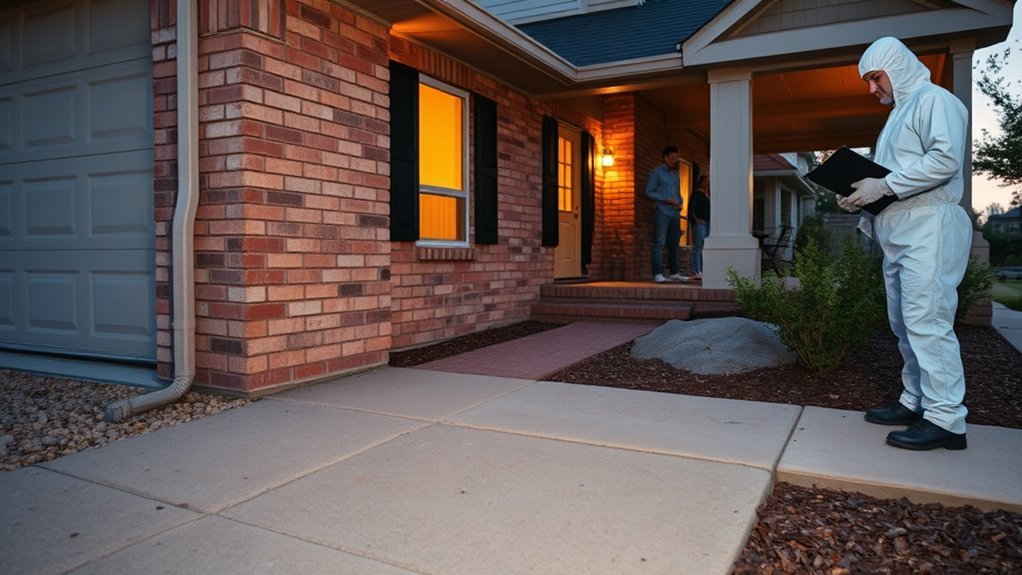
During a pest-control inspection, the technician should look for evidence of the target pest and the conditions supporting it. That may include droppings, nests, live insects, damaged materials, termite tubes, gnawing, rub marks, entry gaps, moisture, food sources, clutter, and protected hiding areas.
The technician may inspect kitchens, bathrooms, utility areas, garages, attics, crawl spaces, exterior walls, foundations, doors, windows, plumbing penetrations, rooflines, vegetation, and other locations relevant to the suspected pest.
A thorough inspection should help answer four questions:
- What pest is present?
- Where is the activity concentrated?
- What conditions are allowing the pest to survive or enter?
- Which treatment and prevention measures are appropriate?
Afterward, ask for a clear explanation of the findings and proposed plan. You should understand what will be treated, what you need to prepare, what improvement to expect, and when a follow-up inspection is needed.
When DIY Pest Control May Be Enough
Light infestations of some household pests may sometimes be managed with sanitation, exclusion, traps, baits, and carefully selected products used according to their labels. Oklahoma State University notes that homeowners can often manage light household infestations when they correctly identify the pest and follow product directions.
Professional help becomes more important when:
- You cannot confidently identify the pest.
- The infestation keeps returning.
- You suspect termites or significant structural damage.
- Bed bugs have spread beyond a small area.
- Rodents are entering walls, attics, or inaccessible spaces.
- Wildlife is involved.
- The treatment requires specialized equipment or restricted-use products.
- You are concerned about safely treating around children, pets, or sensitive occupants.
Tips for Maintaining a Pest-Free Home After Treatment
Professional treatment works better when you remove the conditions that help pests return. Prevention should continue after the technician leaves.
- Remove food sources: Store food in sealed containers, clean crumbs and spills, manage garbage, and avoid leaving pet food out unnecessarily.
- Control moisture: Repair leaks, improve drainage, and address damp areas that can attract pests or support their survival.
- Reduce clutter: Cardboard, stored paper, and crowded storage spaces can provide hiding areas and make inspections difficult.
- Seal entry points: Check gaps around doors, windows, foundations, pipes, vents, utility penetrations, and other openings appropriate to the pest.
- Monitor activity: Watch for new droppings, insects, gnawing, termite signs, or other evidence rather than assuming a treatment permanently solved the problem.
- Follow preparation and aftercare instructions: Respect re-entry times, cleaning directions, bait placement, and other instructions provided for the products used.
The EPA recommends pest prevention measures such as removing food, water, and shelter, reducing clutter, sealing openings, and using pesticides according to label directions.
Frequently Asked Questions
Who Is the Best Company for Pest Control in Broken Arrow?
There is no single company that is best for every household and pest. Compare Oklahoma credentials, experience with your specific infestation, inspection quality, treatment methods, written pricing, follow-up service, reviews, and guarantee terms. Local and national providers can both be good choices when those fundamentals check out.
Which Pest Control Is Better, Terminix or Orkin?
Both currently advertise service in Broken Arrow. Terminix offers plan-specific recurring-service and termite guarantees, while Orkin advertises free touch-up visits and a money-back guarantee. Compare the exact pest covered, local inspection findings, first-year cost, contract length, follow-up terms, and exclusions rather than choosing by brand name alone.
What Are the 3 C’s of Pest Control?
There is no universally recognized EPA or Oklahoma pest-control standard called the “3 C’s” of consultation, control, and continuous monitoring. A more authoritative framework is Integrated Pest Management, which emphasizes accurate identification and monitoring, prevention, selection of effective lower-risk controls where practical, and continued evaluation.
How Do I Choose the Best Pest Control Company?
Verify Oklahoma credentials, obtain written estimates when possible, confirm the pest diagnosis, ask what products or methods will be used, compare guarantees and recurring-service terms, and review recent feedback for your specific pest. Avoid companies that use high-pressure sales tactics or will not explain their treatment.
How Often Should Pest Control Be Done in Broken Arrow?
There is no single schedule for every home. Some providers offer monthly or quarterly programs, while other problems may need one treatment plus monitoring. Frequency should depend on the pest, severity, property conditions, treatment method, and evidence found during follow-up inspections.
Is Organic Pest Control Safer for Children and Pets?
Not automatically. Some plant-derived or minimum-risk products may offer useful alternatives for certain pests, but safety depends on the specific ingredients, dose, application method, exposure, and label directions. Ask the provider what will be used and follow all instructions for children and pets.
Sources
- Oklahoma Department of Agriculture, Food and Forestry — Pesticides — Oklahoma applicator certification, licensing, and credential requirements.
- U.S. Environmental Protection Agency — Tips for Selecting a Pest Control Service — estimates, licensing, pesticide information, contracts, guarantees, and sales red flags.
- U.S. Environmental Protection Agency — Integrated Pest Management Principles — monitoring, prevention, risk-based control, and targeted treatment.
- U.S. Environmental Protection Agency — Do’s and Don’ts of Pest Control — household prevention, pesticide use, children and pet precautions, and product information.
- Oklahoma State University Extension — Household Pest Control — pest identification and household pest-management guidance.
- Centers for Disease Control and Prevention — Controlling Wild Rodent Infestations — rodent warning signs, inspection, and prevention.
Conclusion
The best pest control choice in Broken Arrow is the provider that can clearly show why a treatment is needed, prove that the work is properly credentialed, explain what will be used, and give you understandable pricing and follow-up terms. Start with correct pest identification, compare qualified companies when possible, and favor a plan that addresses entry points, food, water, shelter, and monitoring along with any necessary treatment. That approach gives you a better chance of solving the current infestation without paying for unnecessary service or relying on unsupported claims.