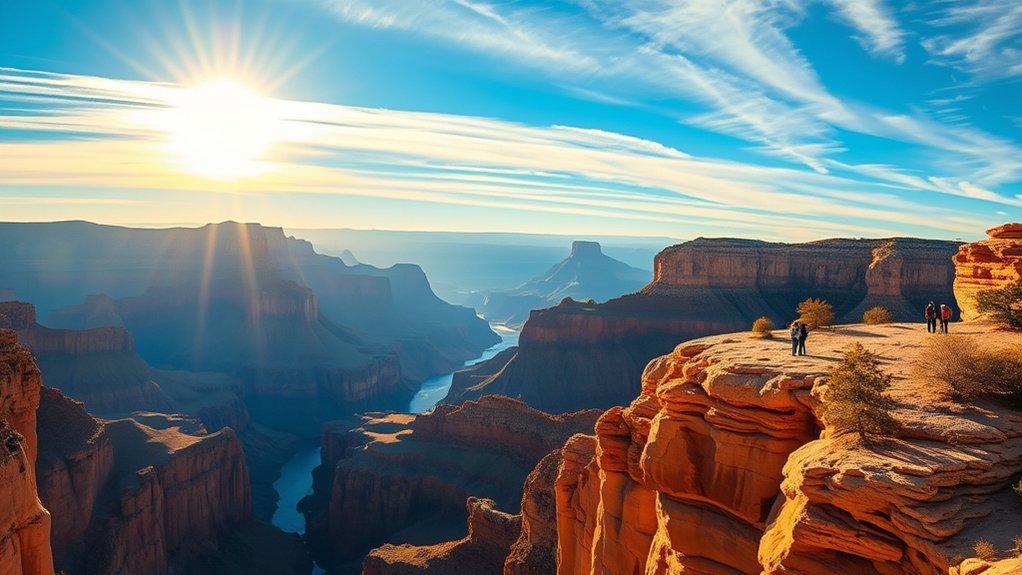
The best time to visit the Grand Canyon depends on what you want to do, but for most travelers, mid-April through May and mid-September through October offer the best balance of comfortable rim weather, good daylight, and fewer extremes than midsummer or winter. Season matters even more if you plan to hike below the rim, where temperatures can be dramatically hotter than at the viewpoints.
Quick Answer
For most visitors, the best time to visit the Grand Canyon is mid-April through May or mid-September through October. These periods generally offer comfortable rim temperatures and better hiking conditions than midsummer. Visit November through February for the lightest crowds, but expect snow, ice, cold nights, and possible road impacts.
Key Takeaways
- Best overall: mid-April through May and mid-September through October.
- Fewest crowds: generally November through February on the South Rim, with winter weather as the tradeoff.
- Summer: rim temperatures can be pleasant, but the inner canyon can exceed 110°F (43°C).
- Winter: the South Rim stays open, but snow, ice, freezing temperatures, and temporary road impacts are possible.
- North Rim: 2026 has unusual post-fire access and service restrictions, so check current NPS conditions before traveling.
- Below-rim hikers: always check current trail, heat, weather, and drinking-water conditions before starting.
When to Go: Seasonal Overview
Grand Canyon weather changes dramatically with elevation. The South Rim sits around 7,000 feet above sea level, the North Rim is roughly 1,000 feet higher, and the Colorado River is thousands of feet below both. That means a comfortable day at a rim overlook can become dangerously hot during a hike into the canyon.
According to the National Park Service climate guide, summer highs on the South Rim are generally in the 80s°F, while temperatures near the river commonly rise above 100°F. Summer thunderstorms are most common during July, August, and early September. Winter can bring substantial snow and ice to the rims while conditions near the river remain considerably warmer.
| Season | Best For | Main Tradeoffs |
|---|---|---|
| Spring | Rim sightseeing, photography, moderate hiking | Snow and freezing nights can continue into spring; weather changes quickly |
| Summer | Long daylight, rim walks, family sightseeing | Heavy crowds, extreme inner-canyon heat, monsoon thunderstorms |
| Fall | Hiking, photography, cooler rim weather | Cold mornings and nights; early winter storms are possible later in the season |
| Winter | Fewer visitors, snow photography, quiet South Rim viewpoints | Snow, ice, short daylight, freezing temperatures, and possible road impacts |
The temperature can rise about 5.5°F for every 1,000 feet you descend into the canyon, and summer highs near Phantom Ranch can average roughly 30°F warmer than temperatures on the rims.
Best Months for Mild Weather and Fewer Crowds
For many first-time visitors, mid-April through May and mid-September through October provide the most useful balance of weather and accessibility. These periods avoid the worst inner-canyon summer heat, although popular South Rim locations can still be busy.
If your highest priority is avoiding crowds rather than finding mild weather, November through February is generally quieter on the South Rim. The tradeoff is winter weather.
Late February to April: Quiet First, Milder Later
Late February and March can be peaceful, but they should still be treated as winter or early-spring travel on the rim. Snow, icy trails, freezing temperatures, and temporary road impacts remain possible. April is usually more comfortable, particularly later in the month, although the National Park Service notes that snow can still occur through April and even into May.
- Choose late February or March mainly if low crowds matter more than predictable mild weather.
- Choose mid-to-late April for a better chance of comfortable daytime rim conditions.
- Carry layers and traction appropriate for current trail conditions.
- Check the forecast and road status shortly before traveling.
Note: A forecast for Grand Canyon Village does not describe conditions at the Colorado River. Check conditions for the elevation where you will actually hike.
Mid-September to October
Mid-September through October is another strong window for visiting. Summer heat gradually eases, monsoon activity usually becomes less frequent, and mornings become noticeably cooler. Fall weather can be excellent for rim walking and hiking, but temperatures vary greatly between the rims and river.
Do not rely on one temperature range for the entire park. NPS climate data show rim temperatures cooling substantially during fall while the inner canyon remains much warmer. Bring layers for early starts and sunset outings.
Wildlife such as elk, mule deer, birds, and smaller animals may be visible throughout the park. Observe rather than approach. Current NPS wildlife guidance recommends staying at least 75 feet (23 meters) from large animals such as elk, deer, bison, bighorn sheep, California condors, and mountain lions, and at least 20 feet (6 meters) from smaller wildlife.
Weekday Visits Recommended
A weekday can help reduce some congestion, particularly outside holidays and school-break periods, but it does not guarantee empty overlooks. Popular locations such as Mather Point, Grand Canyon Village, and major trailheads can still be busy.
- Arrive early if you want easier parking and quieter viewpoints.
- Use the South Rim shuttle rather than repeatedly searching for parking.
- Schedule famous viewpoints for early morning and explore less concentrated areas later.
During busy seasons, the National Park Service specifically warns about congestion and parking problems on the South Rim. A little planning can save more time than trying to drive between every viewpoint.
Peak Season: Pros, Cons, and How to Handle Crowds
Summer brings long daylight hours, extensive visitor services, ranger activities, and easy access to many South Rim attractions. It is a convenient season for rim sightseeing, but it is also one of the busiest periods.
The major mistake is assuming pleasant weather at the rim means safe hiking conditions below it. The inner canyon becomes much hotter as you descend. The National Park Service warns that daytime summer temperatures inside the canyon can exceed 110°F (43°C) and strongly discourages hiking during the hottest part of the day.
Warning: From May through September, treat below-rim heat as a serious safety issue. NPS advises avoiding inner-canyon hiking between roughly 10 a.m. and 4 p.m. Check current heat risk, water availability, and trail conditions before leaving the rim.
July, August, and early September also bring the Arizona monsoon. Thunderstorms can produce torrential rain, lightning, strong winds, and flash flooding. Do not stay exposed on a rim or overlook when lightning threatens, and never enter a drainage simply because the sky directly overhead looks clear.
To manage summer crowds:
- Arrive early rather than at the busiest midday hours.
- Use the free South Rim shuttle network.
- Reserve lodging and campgrounds well ahead of your trip.
- Leave extra time for shuttle lines and traffic.
- Follow trail etiquette and yield appropriately to other trail users and stock.
The NPS South Rim shuttle page lists current routes and seasonal schedules. In 2026, several shuttle routes operate during the summer and fall, and Hermit Road is closed to private vehicles from March 1 through November 30.
Pro Tip: Park once near the South Rim Visitor Center and use the shuttle for major viewpoints and trail access. This is usually easier than moving your vehicle throughout Grand Canyon Village during busy periods.
Winter Visits: Snow, Quiet Trails, and Access Issues
Winter is one of the quietest times to experience the South Rim. Snow can create dramatic contrast on the canyon walls, and visitation is generally lighter than during spring, summer, and fall.
The tradeoff is real winter weather. South Rim roads and trails can become snowy or icy, visibility can deteriorate during storms, and temporary road closures are possible. Average winter afternoon temperatures on the rim remain cold, and overnight temperatures commonly fall well below freezing.
- Check road and weather conditions before driving to the park.
- Carry warm layers, gloves, a hat, and traction devices when ice is present.
- Keep a headlamp available because winter daylight is shorter.
- Do not assume a sunny afternoon means ice-free trails.
The South Rim remains open year-round, but some individual facilities may operate on reduced winter schedules.
North Rim Vs South Rim: Seasonal Differences and Access
The South Rim and North Rim have very different access patterns. The South Rim is open year-round and offers the broadest selection of lodging, food, campgrounds, shuttle transportation, and visitor facilities. The higher North Rim is cooler and normally operates seasonally.
2026 North Rim Update: The North Rim reopened for the 2026 season after the Dragon Bravo Fire, but operations are limited. The North Rim Campground opened June 1 and is scheduled through October 15, 2026. In-park North Rim lodging is unavailable in 2026, and visitors should expect a remote, limited-service environment. Always check the current North Rim status before traveling.
Post-fire hazards along parts of the North Kaibab Trail include falling rocks, falling trees, debris flows, and flash flooding, particularly during rain or high winds.
Water is another major 2026 consideration. As of the NPS hiking update dated August 12, 2026, water at the North Rim, North Kaibab Trailhead, and Supai Tunnel was off. Bottled water was available for purchase at the North Rim General Store, and some lower-canyon water sources were operating. Because waterline conditions can change suddenly, verify the latest NPS hiking and water status immediately before your hike.
There is also an important 2026 trail restriction: the North Kaibab Trail between Redwall Bridge and the northern end of Cottonwood Campground is scheduled to close beginning at 11:59 p.m. on October 15, 2026 for Transcanyon Waterline work. Traditional North Rim-to-South Rim and South Rim-to-North Rim hikes will therefore not be possible beginning October 16, 2026.
Best Time of Day for Photography and Wildlife Viewing
Sunrise and sunset are usually the most rewarding times for canyon photography because lower-angle light creates stronger shadows, depth, and color. Early morning also tends to be cooler for walking and may be quieter than midday.
- Arrive before sunrise rather than trying to park at the exact sunrise time.
- Bring warm layers, even during summer, because rim temperatures can drop quickly after sunset.
- Use a tripod only where it will not obstruct trails or crowded viewpoints.
- Use a long lens for wildlife rather than approaching an animal.
Wildlife activity can vary by species, weather, season, and location, so there is no guaranteed viewing hour. Give every animal room to move naturally and increase your distance if its behavior changes because of your presence.
Hiking Considerations by Season: Rim-to-River and Backcountry
Hiking below the rim is fundamentally different from walking along the rim. Every descent creates an uphill return, temperatures generally rise as you descend, shade can be scarce, and water sources may be seasonal or temporarily unavailable.
| Season | Key Consideration |
|---|---|
| Spring | Changing temperatures, possible rim snow or ice, windy conditions |
| Summer | Extreme inner-canyon heat, dehydration risk, monsoon storms and flash floods |
| Fall | Cooling rim temperatures, warm canyon interior, shorter daylight later in the season |
| Winter | Snow and ice near the rim, cold nights, short daylight |
A rim-to-rim or rim-to-river itinerary should not be treated as an ordinary day hike. NPS describes rim-to-rim travel as an overnight trip for most hikers and discourages attempting it during hot summer conditions.
Before every below-rim hike, check current trail closures, drinking-water availability, weather, and heat risk. Do not depend on a water spigot simply because it appears on an older map.
What to Pack for Each Season and Time of Day
Grand Canyon packing should account for elevation, season, and the amount of vertical travel in your itinerary. Conditions at the rim can differ dramatically from those several thousand feet below.
Spring/Fall: Layering Essentials
Spring and fall often produce large temperature swings between chilly mornings and warmer afternoons. A simple three-layer system works well for most rim-based visits:
- A moisture-wicking base layer.
- A fleece or lightweight insulating layer.
- A wind-resistant or waterproof outer shell.
Add sturdy footwear, sun protection, water, and a headlamp if you will be outside around sunrise or sunset. Traction devices may still be appropriate when snow or ice is present near the rim.
Summer/Winter: Day/Night Gear
Summer and winter require very different preparation. Summer visitors need serious sun and heat protection, while winter visitors should be prepared for freezing rim conditions.
| Summer | Winter |
|---|---|
| Sunscreen and wide-brim hat | Insulated jacket |
| Breathable clothing | Thermal base layers |
| Adequate water and electrolytes | Warm hat and gloves |
| Light shell for wind or storms | Wool or synthetic socks |
| Headlamp and emergency supplies | Traction devices when trails are icy |
For any substantial below-rim hike, also carry food, first-aid supplies, navigation, and a water-treatment method. Current NPS guidance recommends carrying a treatment option because water availability can change without much warning.
Budget and Travel Tips: When Costs Are Lowest
Travel costs vary by date, lodging property, demand, and how early you reserve, so there is no guaranteed cheapest Grand Canyon season. Winter and portions of the shoulder seasons may offer better lodging availability than peak periods, but compare actual rates before choosing dates solely for savings.
- Compare in-park lodging with Tusayan, Williams, and other gateway communities.
- Check weekday and weekend rates separately.
- Reserve campgrounds early if camping is part of your budget strategy.
- Use the free South Rim shuttle instead of paying for extra transportation inside the main developed area.
- Avoid assuming an off-season tour or room will automatically be discounted.
The National Park Service notes that South Rim lodging can book well ahead, especially during spring break, summer, and fall weekends.
Planning Your Itinerary: Timing, Permits, and Reservations
Start with three decisions: which rim you will visit, whether you will stay above or hike below the rim, and how much weather variability you can tolerate. Then check lodging, campground, permit, shuttle, and trail requirements for those exact dates.
Best Months to Go
For the broadest range of visitors, mid-April through May and mid-September through October remain the strongest overall periods. Spring offers warming conditions and long daylight, while early fall offers cooler weather after summer’s peak heat.
- Choose spring or fall for the best overall balance.
- Choose summer primarily for rim sightseeing, long daylight, and full seasonal activity, while treating below-rim heat seriously.
- Choose winter for quiet South Rim scenery if you are prepared for snow and ice.
- Choose the North Rim carefully in 2026 because post-fire operations differ from normal years.
Permit and Permit Timing
A standard sightseeing visit does not require a timed-entry reservation. You still need a valid park entrance pass, and lodging and campground reservations are separate.
A backcountry permit is required for overnight backcountry hiking and other specified overnight uses. Grand Canyon’s current system uses Recreation.gov and an Early Access Lottery for advance backcountry reservations.
Under the current schedule, lottery applications generally open on the 16th of the month five months before your desired trip month and close at 5 p.m. Mountain Standard Time on the first day four months before the trip month. Remaining availability later becomes available through Recreation.gov.
Always verify the current schedule on the NPS backcountry permit page before planning around a specific deadline.
Booking Trails and Lodging
You normally do not “book” ordinary day-hiking trails. Instead, match the trail to your fitness, the season, current conditions, available daylight, and water situation. Overnight backcountry trips require the appropriate permit.
- Reserve South Rim lodging early for spring, summer, and fall.
- Reserve developed campgrounds through the appropriate campground reservation system.
- Do not confuse a developed campground reservation with a backcountry permit.
- Build extra time into itineraries involving the North Rim because services and access are more limited.
NPS campgrounds commonly fill well ahead, and reservation windows can open months before arrival.
Note: Cellular service and Wi-Fi are limited in Grand Canyon National Park. Download maps, reservation details, permits, and the NPS app content for offline use before arriving.
Frequently Asked Questions
Are there guided tours for stargazing at the Grand Canyon?
Grand Canyon National Park offers scheduled astronomy and night-sky programs, including constellation programs and special telescope-viewing events. The annual Grand Canyon Star Party is a major astronomy event, and additional programs occur during the year. Availability changes, so check the NPS night-sky event calendar for your dates rather than assuming a program runs every night.
Can I camp overnight without a backcountry permit?
Yes, if you are staying in a developed campground under that campground’s reservation or site rules. A backcountry permit is required for overnight backcountry hiking and camping and for certain overnight uses outside developed campgrounds. Do not confuse a campground reservation with a backcountry permit.
Are service animals allowed on trails and in park facilities?
Qualified service animals assisting people with disabilities are permitted where pets may otherwise be restricted, including below the rim. Because corridor trails are steep, narrow, and shared with wildlife and stock, the National Park Service strongly recommends contacting the Backcountry Information Center before taking a service animal below the rim.
Is cell phone service available throughout the park?
No. Cellular service is limited and unreliable in many parts of Grand Canyon National Park, particularly below the rim and in remote areas. Download maps and important trip information before arriving, and do not make emergency planning dependent on having a phone signal.
Are drones permitted for photography over the canyon?
No. Launching, landing, or operating an unmanned or remotely controlled aircraft from lands and waters administered by Grand Canyon National Park is prohibited. Plan to photograph the canyon from established viewpoints and trails instead.
What is the single best month to visit the Grand Canyon?
There is no perfect month for every visitor, but late April, May, late September, and October are strong choices for many trips. They generally avoid the most extreme inner-canyon summer heat while providing more moderate rim conditions than winter.
Do I need a reservation just to enter Grand Canyon National Park?
No timed-entry reservation is currently required for ordinary park entry. You do need an entrance pass. Lodging, campgrounds, backcountry trips, river trips, and certain special activities have separate reservation or permit requirements.
Conclusion
For most travelers, mid-April through May and mid-September through October are the best times to visit the Grand Canyon. They offer a useful balance of moderate rim weather and better hiking conditions than the hottest part of summer. Summer works well for rim sightseeing but requires serious caution below the rim, while winter rewards prepared visitors with quieter South Rim viewpoints and possible snow-covered scenery.
Whatever season you choose, match your plans to the elevation you will visit rather than relying on one park-wide forecast. Check current trail closures, water availability, weather, and North Rim access immediately before your trip, particularly if you plan to hike below the rim.
Sources
- National Park Service — Grand Canyon Weather and Climate — seasonal temperatures, elevation differences, snow, summer storms, and monsoon conditions.
- National Park Service — Key Hiking Messages — current trail status, drinking water, heat risk, hiking hazards, and 2026 closures.
- National Park Service — North Rim Current Status — 2026 fire recovery, services, campground operations, access, and post-fire hazards.
- National Park Service — Backcountry Permits — permit requirements, Early Access Lottery schedule, and Recreation.gov process.
- National Park Service — South Rim Shuttle Buses — seasonal shuttle schedules, Hermit Road access, and transportation planning.
- National Park Service — Permits and Reservations — park entry, lodging, campground, backcountry, and other reservation requirements.