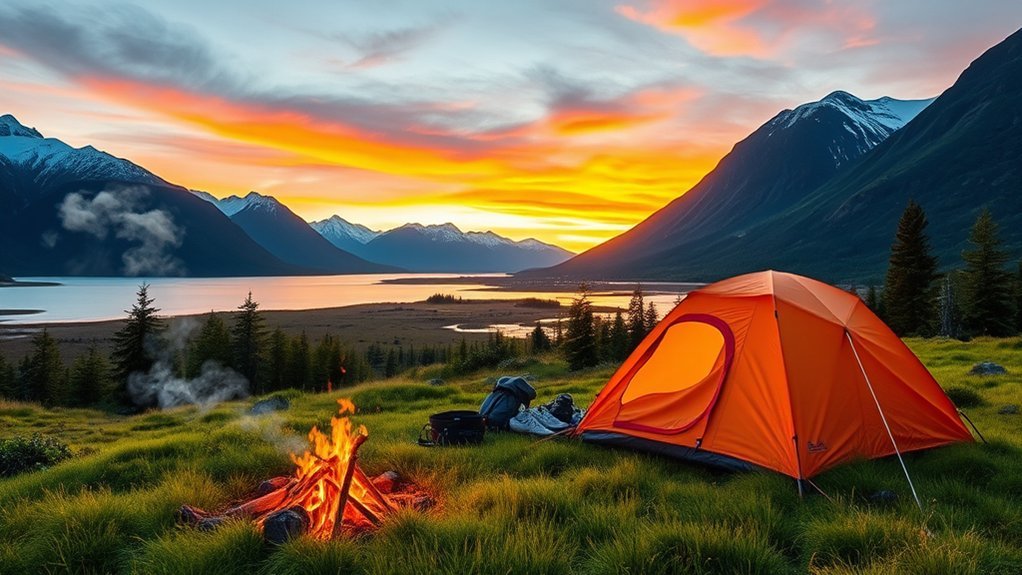
Camping in Katmai National Park can feel wild almost immediately. There are no roads into the park, bears commonly use the same rivers and travel routes as visitors, and storms can delay aircraft or boats. Brooks Camp offers Katmai’s only developed campground, while wilderness camping requires stronger navigation, food-storage, sanitation, and emergency-planning skills.
Quick Answer
You can camp at Brooks Camp Campground with a reservation or camp in Katmai’s wilderness without a standard backcountry permit. Brooks Camp has basic facilities and strict food rules. Wilderness campers must use approved bear-resistant food containers, camp outside restricted areas, prepare for changing weather, and follow current bear-safety and waste-disposal rules.
Key Takeaways
- Brooks Camp is Katmai’s only developed campground, and reservations are strongly recommended before arrival.
- Ordinary wilderness camping does not require a permit or camping fee, but it is prohibited inside the Brooks Camp Developed Area.
- Approved bear-resistant food containers are mandatory in Katmai’s backcountry.
- At Brooks Camp, attend the required bear orientation, remain at least 50 yards from bears, and eat only in designated areas.
- Build extra time into flights and boat connections because wind, fog, and storms can delay transportation.
- Check current closures, campground availability, fire restrictions, and ranger guidance shortly before departure.
What Makes Katmai National Park Unique?
Katmai National Park and Preserve protects about 4 million acres on the Alaska Peninsula. Its landscape includes salmon-rich rivers, tundra, lakes, volcanic terrain, Pacific coastline, and the Valley of Ten Thousand Smokes.
Brown bears attract many visitors, especially when salmon gather in the Brooks River. Depending on your route, you may also encounter moose, wolves, foxes, marine mammals, and many bird species.
No road connects Katmai with Anchorage or Alaska’s highway system. According to the park’s transportation guidance, most visitors arrive by small aircraft or boat, often connecting through King Salmon. Weather can change arrival and departure times with little warning.
Note: Cell service and internet access are not available at Brooks Camp Campground. Carrying a satellite messenger or personal locator beacon is a sensible precaution for wilderness travel, but it does not replace navigation skills or a written trip plan.
Where Can You Camp in Katmai?
Katmai has two main camping options: the developed campground at Brooks Camp and wilderness camping elsewhere in the park. Choose based on your outdoor experience, transportation plan, equipment, and comfort traveling in active bear habitat.
| Camping Option | Reservation or Permit | Facilities | Best For |
|---|---|---|---|
| Brooks Camp Campground | Paid reservation through Recreation.gov | Food and gear caches, cooking shelters, vault toilets, seasonal potable water, fuel lockers, and an electric fence | First-time Katmai campers and visitors focused on Brooks River bear viewing |
| Wilderness camping | No standard camping permit or fee, but closures and special-use rules may apply | Usually none | Experienced backpackers, paddlers, anglers, photographers, and guided groups |
Brooks Camp Campground
Brooks Camp Campground is Katmai’s only developed campground. It sits near Naknek Lake, about 0.3 mile from the Brooks Camp Visitor Center, and has a total capacity of 60 campers.
The campground does not operate like a drive-in campground with private vehicle sites. You arrive by aircraft or boat, carry your equipment to the campground, and use shared facilities under strict wildlife-safety rules.
Brooks Camp Reservations and 2026 Fees
- Reserve through Recreation.gov or by calling the reservation service listed by the park.
- The posted 2026 fee is $18 per person per night from June 1 through September 17.
- The posted fee is $10 per person per night from May 1 through May 31 and September 18 through October 31.
- Groups are limited to six people per reservation.
- Campers may stay up to seven nights in July and up to 14 nights during the calendar year.
- For 2026, reservation blocks opened January 7 for May and June, February 7 for July and August, and March 7 for September and October.
Fees and release schedules can change. Confirm the current details on the NPS and Recreation.gov pages before arranging nonrefundable flights.
Brooks Camp Facilities
| Facility | What to Know |
|---|---|
| Electric fence | Maintained from June 1 through September 18. It deters bears but is not bear-proof. |
| Food cache | Food, garbage, toiletries, and other odorous items must be secured when not in active use. |
| Cooking shelters | Prepare and eat food only in the designated shelters. Do not cook or eat at your tent. |
| Potable water | Available from June 1 through September 18. Outside that period, arrive prepared for limited services. |
| Toilets | Two vault toilets are located in the campground. |
| Fuel lockers | Store liquid and gaseous stove fuels in their assigned lockers. Store stoves in the gear cache. |
| Cell and internet | Neither service is available at the campground. |
Check in at the Brooks Camp Visitor Center when you arrive. Visitors must complete the park’s bear-safety orientation before traveling through the Brooks Camp area. Campground checkout is at noon.
Brooks Camp has two tent locations with compacted surfaces and routes to several campground facilities for visitors with mobility needs. However, trails can be narrow and muddy, and assistance may still be necessary.
Warning: The campground’s electric fence is bear-resistant, not bear-proof. Keep food and odors secured, remain alert, and stay at least 50 yards from every bear even when the fence stands between you and the animal.
Wilderness Camping in Katmai
Ordinary wilderness camping in Katmai does not require a backcountry permit or camping fee. However, food-storage rules, campsite limits, private-property boundaries, seasonal closures, and regulated activities still apply.
Wilderness camping is prohibited inside the Brooks Camp Developed Area, which extends about 1.5 miles from Brooks Falls. Campers without a Brooks Camp reservation must travel beyond that boundary. Depending on the route and terrain, reaching a suitable site may require a hike longer than the straight-line distance.
Katmai generally limits camping in one wilderness location to 14 consecutive days. To continue camping after that period, move at least two miles from the original site.
Seasonal Camping Closures
Do not assume that every beach, meadow, river mouth, or bear-viewing area is open to camping. Current NPS regulations close the core Hallo Bay meadows and the designated Geographic Creek bear-viewing site to camping from April 1 through October 31. Other mapped restrictions may apply in areas such as Moraine and Funnel Creeks.
Review the park’s current closure maps before selecting a campsite, and confirm local restrictions with park staff or your authorized transport provider.
How to Reach Katmai and Plan Transportation
Most visitors first fly from Anchorage to King Salmon and then continue by floatplane, wheeled aircraft, or water taxi. Other authorized operators fly directly from Anchorage, Homer, Kodiak, Kenai, or nearby communities to suitable lakes, beaches, rivers, and gravel bars.
- Reserve camping before booking restricted travel: Confirm Brooks Camp availability before buying nonrefundable transport when possible.
- Use authorized operators: Review the NPS list of permitted transportation providers and ask exactly where the operator can land or dock.
- Confirm baggage limits: Small aircraft often have strict weight and size limits for fuel, food, electric fences, paddling equipment, and hard-sided food containers.
- Build in buffer time: Leave room before important flights, hotel bookings, or work commitments in case weather delays your return.
- Plan for delayed baggage: Essential rain gear, medication, navigation equipment, and emergency items should remain accessible during your journey.
- Share your itinerary: Give a trusted person your operator’s name, route, campsite area, planned return date, and overdue-response instructions.
Pro Tip: Schedule an extra night in King Salmon or Anchorage after a remote trip when missing your onward flight would create a major problem. Strong wind, fog, and rough water can delay transportation even when your equipment and itinerary are ready.
Essential Gear for Camping in Katmai
Pack for rain, wind, cool nights, wet ground, insects, and travel delays. Summer conditions can change quickly, and the park’s weather guidance reports a broad summer temperature range of about 30°F to 80°F.
- Strong shelter: Use a waterproof three-season tent with a full rainfly, reliable stakes, and extra guylines.
- Warm sleep system: Bring an appropriately rated sleeping bag and an insulated sleeping pad.
- Waterproof clothing: Pack a rain jacket, rain pants, warm insulating layers, gloves, a hat, and dry socks.
- Footwear: Wear waterproof boots with strong traction and carry suitable footwear for water crossings when your route requires it.
- Cooking equipment: Bring a stove, compatible fuel, a lighter, and a backup ignition source.
- Water treatment: Carry a filter or purifier and a backup chemical treatment for wilderness water sources.
- Bear-resistant food container: Use a model approved for Katmai’s backcountry and large enough for food, garbage, toiletries, and other odors.
- Electric fence: Consider a properly designed portable bear fence for wilderness camps. Test it and learn the setup process before departure.
- Navigation: Carry a paper map, compass, and a protected GPS device with offline mapping.
- Emergency communication: Carry a satellite messenger or personal locator beacon and know how to activate it.
- First aid: Bring a kit appropriate for cold exposure, cuts, sprains, burns, blisters, and the length of your evacuation route.
- Repair supplies: Carry tent patches, tape, cord, spare batteries, and tools needed for your stove, paddlecraft, or fence.
- Waste supplies: Bring a trowel where catholes are allowed, sealable bags for used toilet paper, and a human-waste bag system where pack-out is required.
- Bear spray: Learn how to carry and deploy it safely. Confirm commercial-airline and air-taxi transport rules before your trip rather than assuming you can fly with it.
Do not rely on a campfire for cooking, warmth, or emergency survival. A stove provides more reliable heat and creates less impact on fragile ground.
Wildlife and Bear Safety
Bear safety should influence where you walk, where you camp, how you prepare food, and what you do with every scented item. Each bear encounter is different, and no checklist guarantees safety. Follow current ranger instructions and the park’s bear-safety rules.
How to Reduce Bear Encounters
- Travel in a group when possible. Groups of four or more are generally easier for bears to detect and avoid.
- Stay alert in thick brush, near noisy water, beside salmon streams, and in poor visibility.
- Use your normal human voice to warn bears of your approach where visibility is limited.
- Do not depend on bear bells as your main warning method.
- Never approach, follow, feed, surround, or block a bear.
- Move out of a bear’s travel path before it reaches you.
- Avoid camping near salmon streams, carcasses, sedge meadows, clam flats, fresh bear tracks, scat, digging, tree rubs, or dense alder that blocks your view.
- At Brooks Camp, remain at least 50 yards from bears and follow ranger closures immediately.
What to Do During a Bear Encounter
- Stop and remain calm: Do not run. Running may encourage pursuit.
- Assess whether the bear knows you are there: If it has not noticed you, quietly retreat along the route you came.
- Identify yourself as human: If the bear is aware of you, speak calmly. Group together and slowly wave your arms if necessary.
- Back away when possible: Give the bear an open travel route without turning and sprinting away.
- Watch its behavior: Huffing, jaw popping, flattened ears, and sudden ground slaps can indicate stress or defensiveness. Standing on the hind legs is usually an information-gathering posture, not an attack by itself.
- During a defensive charge: Stand your ground, speak calmly, and prepare your bear spray. Do not shout or throw objects at a defensive bear.
- If a defensive bear makes contact: Lie face down, spread your legs, protect your neck with your hands, and play dead. If the attack continues for an extended period, fight back.
- If a persistent non-defensive bear approaches: Act assertively, make yourself look large, shout, prepare bear spray, and fight back if it attacks.
Read the park’s complete bear-encounter guidance before departure. Practice removing bear spray from its holster without discharging it, and keep it accessible rather than buried inside a pack.
Warning: Never run from a bear, climb a tree as your main response, or place yourself between a female and her cubs. Do not use these general instructions instead of ranger guidance for a specific encounter.
Food Storage and Clean-Camp Rules
Food-conditioned bears can become dangerous to visitors and may eventually be removed or killed. Treat food storage as a mandatory wildlife-protection measure, not a convenience.
| Location | Storage Rule | Eating and Cooking Rule |
|---|---|---|
| Brooks Camp | Store food and odorous items in designated food caches. Keep extra gear in the gear cache and fuel in the correct fuel locker. | Eat only in designated picnic areas or buildings. Campers must cook and eat inside the campground cooking shelters. |
| Backcountry | Store food, garbage, toiletries, sunscreen, cooking equipment, and other odorous items in an approved bear-resistant container except during active use. | Cook away from the sleeping area. Keep food and odors out of the tent, even when using an electric fence. |
Ordinary coolers, dry bags, soft luggage, plastic storage totes, and unmodified kayaks usually do not meet Katmai’s bear-resistant-container requirement. Approved containers may be borrowed in limited numbers from the King Salmon and Brooks Camp visitor centers, but availability is not guaranteed.
If you camp without an electric fence, current NPS guidance recommends creating a triangle with the tent, cooking area, and food-storage area about 100 yards from one another. If you use a fence, follow the current NPS placement instructions and the fence manufacturer’s setup procedure. An electric fence is only a deterrent.
Pro Tip: Repackage meals before leaving home. Removing bulky boxes and excess wrappers makes food easier to fit inside a certified container and reduces the amount of trash you must protect and carry out.
How to Select and Set Up a Backcountry Campsite
- Check closures first: Confirm that the area is open to overnight use and is not private land.
- Look for bear activity: Avoid tracks, scat, carcasses, digging, salmon concentrations, sedge meadows, clam flats, and obvious travel corridors.
- Choose durable ground: Use an existing impacted site when appropriate or select gravel, sand, rock, snow, or other resilient ground.
- Stay away from water: Aim to camp at least 200 feet from lakes, rivers, and streams when conditions allow.
- Keep a clear view: Avoid thick alder and brush that could hide an approaching bear.
- Check overhead hazards: Do not place a tent under unstable dead trees or branches, especially along the Valley of Ten Thousand Smokes Road.
- Separate camp activities: Keep sleeping, cooking, and food storage apart according to current NPS bear-safety guidance.
- Secure loose equipment: Wind can remove tents, clothing, boats, paddles, and food containers. Anchor equipment before leaving it unattended.
Water and Human Waste
Treat water from lakes, rivers, and streams before drinking. Avoid collecting water immediately below busy camps, animal concentrations, fish-cleaning areas, or visible contamination.
Follow the current backcountry sanitation rules for your location:
- Carry out all trash, food scraps, hygiene products, and used toilet paper.
- Do not burn or bury garbage.
- Dispose of cooking water away from the tent, food-storage area, and natural water sources.
- Where catholes are allowed, current park guidance calls for a hole about 6 to 8 inches deep. Cover and disguise the site afterward.
- Use a portable toilet bag where burial is impractical, vegetation is dense, or the area receives heavy use.
- Pack out solid human waste when required by a location-specific rule. Current camping guidance requires pack-out when the waste event occurs within 0.25 mile of a lake in applicable wilderness areas.
Campfires and Cooking
At Brooks Camp, fires are permitted only in the fire rings next to the cooking shelters. Use only dead and down wood, never burn food or garbage, and obey any seasonal fire ban.
In the wilderness, use a stove as your normal cooking method. Check current fire restrictions before departure and avoid building fires on tundra, ash, or other fragile ground.
Navigating Katmai’s Terrain and Weather
Katmai has fewer than five miles of maintained trails. Backcountry routes may cross wet tundra, dense alder, loose volcanic ash, gravel bars, steep slopes, mud, tidal coastline, and fast-changing streams.
- Carry a paper map and compass even when using GPS.
- Download maps before entering the park and protect electronics from rain.
- Allow more travel time than the map distance suggests.
- Use trekking poles for mud, riverbanks, loose ash, and uneven ground.
- Do not cross a stream simply because it was safe earlier. Rain and snowmelt can raise water quickly.
- Unbuckle a backpack’s hip and chest straps before a risky ford so you can release the pack if you fall.
- Turn back when water depth, speed, visibility, or footing exceeds your skills.
- Use current tide tables when camping or traveling along the coast.
- Keep warm, dry clothing protected in a waterproof bag.
In Katmai, weather is part of the itinerary. A delayed flight, flooded stream, or strong coastal wind is a reason to change the plan, not a problem to force through.
Planning Your Katmai Camping Itinerary
A safe itinerary leaves room for bear activity, transportation delays, river conditions, and changing weather. Plan fewer fixed goals than you would in a road-accessible park.
- Select your camping style: Decide whether Brooks Camp or wilderness camping matches your skills and equipment.
- Confirm access: Reserve the campground, aircraft, boat, bus, or guide needed for each stage.
- Check current rules: Review camping closures, food-storage requirements, fire restrictions, and local waste rules.
- Set one main goal each day: Choose bear viewing, hiking, paddling, fishing, photography, or camp relocation rather than overloading the schedule.
- Add weather days: Leave unused time before important return connections.
- Create turnaround points: Decide in advance when water, wind, visibility, fatigue, or bear activity will make you stop.
- File a route plan: Share it with a trusted contact and consider submitting Katmai’s voluntary backcountry travel planner.
- Stay flexible: Ranger instructions, aircraft decisions, closures, and actual conditions take priority over the original itinerary.
Sample Brooks Camp Planning Framework
- Arrival day: Complete bear orientation, check in, secure food and fuel, set up the tent, and learn the designated eating areas and routes.
- Full day: Visit bear-viewing platforms, hike only when conditions allow, and leave enough time for ranger closures or bear traffic.
- Departure day: Pack early, clean the tent area, remove all food and garbage, and remain prepared for a transportation delay.
Sample Wilderness Planning Framework
- Day one: Reach the intended landing area, assess weather and bear sign, and establish camp well before dark.
- Middle days: Keep daily travel goals conservative and maintain a clean, separated camp.
- Final day: Return to the pickup point early and remain prepared to wait safely if the aircraft or boat cannot reach you.
Leave No Trace in Katmai
Small impacts can last for years in tundra, ash, wet meadows, and remote coastal areas. Use the following practices to protect wildlife, water, vegetation, cultural sites, and future visitors:
- Plan ahead and learn the rules for the exact area you will visit.
- Travel and camp on durable surfaces.
- Use existing impacted campsites when doing so will not create a bear conflict.
- Pack out all garbage, food, toilet paper, and hygiene products.
- Leave rocks, bones, antlers, plants, historic objects, and archaeological material where you find them.
- Use a stove and minimize campfire impacts.
- Keep noise low and avoid disturbing wildlife for photographs.
- Never feed animals or allow them to obtain human food.
- Do not leave fishing line, hooks, food scraps, or fish waste where wildlife can reach them.
- Restore the campsite by removing cord, anchors, trash, and other signs of your stay.
Frequently Asked Questions
What is the best time of year for camping in Katmai?
June through September is usually the most practical period for backcountry travel, although the park remains open year-round. At Brooks Camp, bear viewing is generally strongest in July and September. August can have fewer bears along Brooks River because salmon are less concentrated and harder to catch.
How much does Brooks Camp Campground cost?
For 2026, the posted fee is $18 per person per night from June 1 through September 17 and $10 per person per night in May and from September 18 through October 31. Verify current rates before booking because fees can change.
Do you need a permit for backcountry camping in Katmai?
No standard permit or camping fee is required for ordinary backcountry camping. However, closures, food-storage rules, campsite limits, private lands, and permits for regulated activities still apply. The park recommends submitting a voluntary backcountry travel planner.
What food storage is required in Katmai’s backcountry?
You must use an approved bear-resistant food container for food, garbage, cooking equipment, toiletries, sunscreen, and other odorous items except during active use. Keep these items out of your tent, even when you use an electric fence.
Are campfires allowed while camping in Katmai?
At Brooks Camp, fires are allowed only in the fire rings beside the campground cooking shelters, and seasonal bans may apply. Wilderness campers should use a stove and check current fire restrictions before building any fire.
Can you carry bear spray in Katmai?
Bear spray is allowed in the park and can be useful when carried accessibly and used correctly. Do not assume you can transport it on a commercial flight. Confirm airline and air-taxi rules and arrange to obtain it legally after your main flight when necessary.
What wildlife should campers be cautious around?
Brown bears require the greatest planning, but moose, wolves, foxes, marine mammals, and other wildlife also need space. Never approach an animal for a photograph, block its route, or leave food where it can reach it.
Are there restrooms and drinking water at Katmai campgrounds?
Brooks Camp has two vault toilets and seasonal potable water, which is currently available from June 1 through September 18. Wilderness campsites usually have no toilets, treated water, shelters, or other facilities.
Where can you camp if Brooks Camp is full?
You must travel outside the 1.5-mile Brooks Camp Developed Area before wilderness camping. Possible routes extend toward Dumpling Mountain or along the Valley of Ten Thousand Smokes Road, but suitable ground, water, weather, bear activity, and closures must all be considered.
Sources
- Camping in Katmai — developed and wilderness camping options, the Brooks Camp boundary, closures, and wilderness requirements
- Brooks Camp Campground — current fees, reservation schedule, capacity, facilities, food rules, and seasonal services
- Directions and Transportation — aircraft, boat, and authorized-operator planning
- Bear Safety in Katmai — food containers, odor storage, electric fences, and campsite separation
- Bear Encounters in Katmai — avoiding encounters and responding to approaches, charges, and attacks
- Backcountry Regulations and Suggested Best Practices — food storage, campsite limits, sanitation, and seasonal closures
Plan a Safer, Lower-Impact Katmai Camping Trip
Katmai rewards campers who prepare for isolation, respect wildlife, and stay flexible. Brooks Camp provides the most structured experience, but its reservation, eating, storage, and bear rules require careful attention. Wilderness camping offers more solitude without a standard permit, but it demands reliable equipment, approved food storage, strong navigation, clean sanitation, and a realistic emergency plan.
Before departure, confirm campground availability, transportation, weather, closures, fire restrictions, food-storage rules, and ranger guidance. Pack enough equipment and food to handle delays, share your route with someone you trust, and change your plan whenever conditions make the original itinerary unsafe.