Disclosure: As an Amazon Associate, we earn from qualifying purchases. If you click a link on this page and make a purchase, we may receive a small commission at no extra cost to you.
A large portable power station can keep essential devices running during an outage, but capacity alone does not make a model practical. You also need enough output for demanding appliances, useful ports, fast recharging, and a design you can move without special equipment. The DJI Power 2000 combines a 2048Wh LFP battery with 3000W continuous AC output, quick wall charging, app control, and an expandable battery system. Its main tradeoffs are its roughly 48.5-pound weight and the extra accessories required for solar, car, and high-capacity expansion setups.
Quick Verdict
Rating: 8.8/10, recommended with caveats
Best For: Home backup, RV trips, mobile work, outdoor production, and DJI drone owners who need high-output portable power.
Bottom Line: The DJI Power 2000 delivers strong 3000W output, fast AC recharging, and an excellent mix of USB and SDC ports. It is a premium, heavy unit, and several of its best charging and expansion features require accessories sold separately.
| Specification | Detail |
|---|---|
| Brand | DJI |
| Model | DJI Power 2000, DYM2000L or DYM2000H depending on region |
| Product type | Portable power station |
| Battery capacity | 2048Wh |
| Battery chemistry | LFP, lithium iron phosphate |
| Cycle life | More than 80% capacity after 4,000 cycles under DJI test conditions |
| Continuous AC output | 3000W |
| Dimensions | 448 × 225 × 324 mm, about 17.6 × 8.9 × 12.8 inches |
| Weight | About 22 kg, or 48.5 pounds |
| AC outlets | 4 |
| USB-C ports | 4 total, two up to 140W and two up to 65W |
| USB-A ports | 4, up to 24W per port when used individually |
| SDC ports | 2 full SDC ports for compatible DJI accessories |
| Total physical ports | 15, including 14 output or accessory ports and 1 AC input |
| US AC recharge time | About 55 minutes to 80% and 90 minutes to full under DJI test conditions |
| UPS transfer time | About 10 milliseconds |
| Maximum expanded capacity | 22,528Wh with up to 10 compatible expansion batteries |
| Connectivity | Wi-Fi, Bluetooth 5.0, and DJI Home app control |
| Included items | DJI Power 2000 and AC power cable |
What Is the DJI Power 2000?
The DJI Power 2000 is a 2kWh-class battery power station made for home backup, camping, RV use, mobile work, and off-grid equipment. It stores energy in an LFP battery and converts that energy into AC and DC power for appliances, laptops, phones, tools, lights, and compatible DJI equipment.
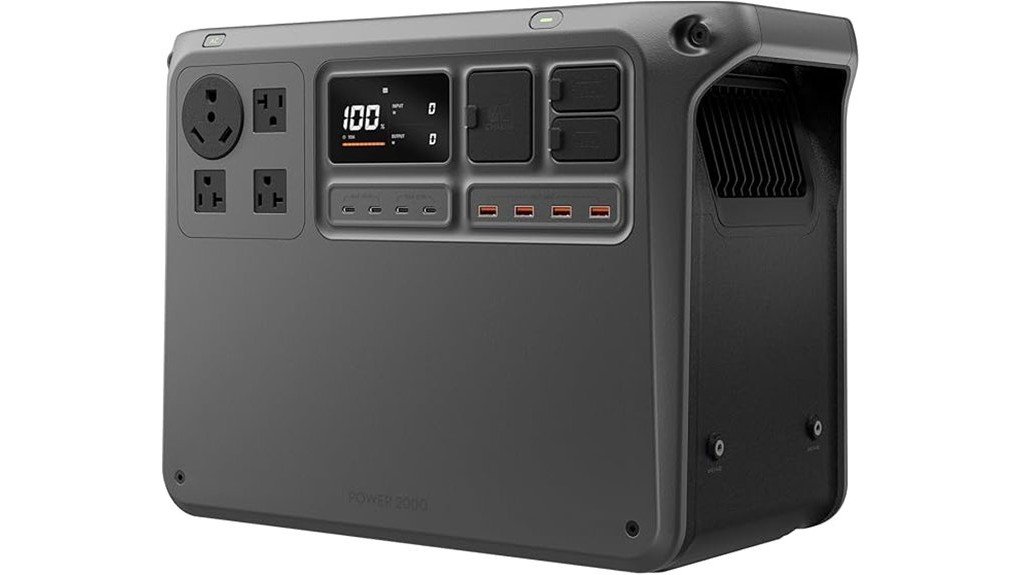
Its main selling point is the combination of 2048Wh capacity and 3000W continuous output in a relatively narrow body. The front panel keeps the display, controls, input, AC outlets, USB ports, and SDC connections on one side, which makes the unit easier to place against a wall or inside a vehicle storage area.
Who Should Buy It?
Best For
- Homeowners who want backup power for a refrigerator, router, lights, fans, laptops, or similar essentials.
- RV, camping, and mobile-work users who need several AC and USB connections at the same time.
- DJI drone owners who can benefit from optional SDC fast-charging cables and the wider DJI Power accessory system.
Skip If
- You need a lightweight power station that one person can carry for long distances.
- You expect solar panels, car-charging hardware, wheels, or expansion batteries to be included in the base package.
- Your main goal is permanent whole-home backup or direct electrical-panel integration.
Before You Buy: The advertised 22.5kWh capacity and multi-day backup estimate require separately sold expansion batteries. The base DJI Power 2000 stores 2048Wh, so actual runtime depends on appliance wattage, startup demand, inverter losses, and how many devices you run.
Power Output and Appliance Support
The 3000W continuous AC output is the strongest reason to choose this model over many 2kWh competitors. It gives you enough headroom for many refrigerators, microwaves, coffee makers, cooking appliances, power tools, and entertainment devices, provided their combined running load stays within the station’s limit.
High output does not guarantee that every appliance will work. Motors and compressors can draw a brief startup surge that is much higher than their normal running wattage. Before connecting a refrigerator, pump, air conditioner, or power tool, check both its running watts and startup requirement.
Ports, USB Charging, and DJI SDC Connectivity
The Power 2000 has four AC outlets, four USB-C ports, four USB-A ports, and two full SDC ports. DJI describes 15 physical ports in total because the AC charging input is counted with the 14 output and accessory connections.
Two USB-C ports can provide up to 140W each with a compatible PD 3.1 device and EPR-rated cable. The other two USB-C ports provide up to 65W, which is still enough for many laptops, tablets, cameras, and phones. The four USB-A ports support up to 24W when used individually, but output drops when several USB-A ports are active at once.
The two SDC ports make this model more useful for buyers already using DJI products. With separately sold cables and modules, the SDC system can support compatible drone battery charging, solar input, vehicle charging, expansion batteries, and 12V accessories.
Pro Tip: List the devices you plan to run, note each device’s wattage, and leave extra output headroom for startup surges. For longer runtime, connect only the essentials and avoid powering heating appliances unless necessary.
Recharging Speed and Charging Options
For the US 120V version, DJI rates AC charging at about 55 minutes from empty to 80% and about 90 minutes to full under controlled conditions. That is fast enough to refill the station between outage periods, work sessions, or travel stops without leaving it connected all day.
The station also supports solar, car, and hybrid recharging, but the required hardware is not built into the base package. Depending on the setup, you may need DJI’s MPPT solar adapter, a compatible solar or car fast charger, and the correct SDC cables. Buyers who want a complete solar generator should include these accessory costs in the budget.
Battery Life and Long-Term Storage
DJI rates the LFP battery to retain more than 80% of its original capacity after 4,000 full cycles under its laboratory test conditions. That cycle rating is suitable for regular use, not only occasional emergency storage.
For long-term storage, DJI recommends keeping the battery around 50% to 70%, checking it every three to four months, and avoiding storage after a full discharge. A periodic charge and discharge cycle also helps maintain the system. Keep the station within its stated temperature limits and do not store it in a hot vehicle for extended periods.
Design, Portability, and Noise
At about 48.5 pounds, the DJI Power 2000 is portable in the sense that you can move it between a house, garage, vehicle, campsite, or work area. It is not a light carry-on device. The dual top handles help with short moves, but stairs and long distances may require two people or an optional hand truck.
The compact footprint is a stronger advantage than the weight. The front-facing layout helps you stack or store the unit without needing rear access for most connections. In Standard Recharge Mode, DJI rates noise at no more than 30 dB under its test conditions, which is useful when charging indoors, in an RV, or near sleeping areas.
App Controls and UPS Backup
The DJI Home app connects through Bluetooth and Wi-Fi so you can check battery status, view power flow, adjust settings, manage auto-off behavior, and review error information. The Power 2000 connects directly, so it does not require the separate dongle used by some earlier DJI Power products.
UPS mode can switch connected equipment to battery power in about 10 milliseconds when grid power fails. This is useful for routers, computers, and selected electronics, but it is not a substitute for a purpose-built medical or data-center UPS. Test your exact device setup before relying on it during an outage.
Safety and Operating Limits
The Power 2000 uses LFP cells, a smart battery management system, flame-retardant housing, and a board-level sub-nano coating. These protections help manage temperature, charging, discharging, and electrical faults, but they do not make the station waterproof or suitable for careless exposure.
Use it in a dry, stable, ventilated location. Keep vents clear, avoid moisture, and follow the manual for cable selection and charging accessories. DJI lists a power-supply temperature range of 14°F to 113°F and a recharging range of 32°F to 113°F. Performance can drop in cold conditions.
How It Performs in Real Use
For Home Outages
The base 2048Wh battery is best treated as targeted backup for essential devices. A refrigerator, router, lights, fans, phones, and laptops can be practical loads, but runtime falls quickly when you add cooking appliances, space heaters, or air conditioners.
For RV and Camping Trips
The mix of AC, USB-C, USB-A, and SDC connections works well for groups carrying phones, cameras, laptops, lights, and small appliances. The quiet standard charging mode is useful at camp, but the 48.5-pound weight makes a fixed storage location or rolling support preferable.
For Mobile Work and Production
A 3000W output can support tools, monitors, charging stations, and production gear where grid power is limited. DJI drone users gain the most from the SDC ecosystem because compatible fast-charge cables can reduce dependence on separate AC chargers.
For Expandable Backup
You can connect up to 10 Power Expansion Battery 2000 units for a total capacity of 22,528Wh. This creates a much longer backup system, but it also raises the total cost, weight, storage requirement, and charging complexity. Plan the system around measured daily energy use rather than a generic number of backup days.
Setup Tips Before First Use
- Charge the station fully and update its firmware before your first emergency-use test.
- Connect the DJI Home app and confirm that status, output controls, and auto-off settings work as expected.
- Test refrigerators, pumps, and tools individually before combining them with other loads.
- Use PD 3.1 and EPR-compatible cables when you need the full 140W from the two high-power USB-C ports.
- Keep the original shipping packaging because large lithium battery products can have special return and transport requirements.
- Store solar, car-charging, and drone cables with labels so you can identify the correct SDC accessory quickly.
Pros and Cons
Pros
- 3000W continuous output supports many high-demand household and work devices.
- 2048Wh LFP battery is rated for more than 4,000 cycles to 80% capacity.
- Two 140W USB-C ports can fast-charge compatible laptops and devices.
- Fast wall recharging reaches about 80% in 55 minutes on the US model.
- Expandable to 22,528Wh and especially useful for DJI drone owners.
Cons
- About 48.5 pounds, so frequent hand carrying can be difficult.
- Solar, car charging, rolling transport, and expansion require separate accessories.
- Four AC outlets may feel limited when compared with some 2kWh alternatives.
Is It Worth the Price?
The DJI Power 2000 sits in the premium 2kWh portable power station category. Its value comes from the 3000W output, fast AC recharge, four USB-C ports, direct app connection, quiet charging, and SDC accessory system rather than capacity alone.
It offers the strongest value to buyers who will use high-output appliances, charge several USB-C devices, or add DJI drone and expansion accessories over time. It is less attractive if you only need occasional phone and laptop charging or want a complete solar kit with all adapters included.
How It Compares to Alternatives
The EcoFlow DELTA 2 Max has the same 2048Wh capacity, more AC outlets, and built-in DC-style outputs, but its standard continuous AC rating is lower. The Jackery Explorer 2000 Plus competes in the same 3000W class and offers a large expansion ecosystem, though it is heavier.
The DJI Power 2000 makes the most sense when you want high output in a narrower body, strong USB-C charging, quiet AC recharging, and access to DJI’s SDC drone-charging accessories. Buyers who prioritize more AC receptacles or built-in rolling transport should compare alternatives before deciding.
Frequently Asked Questions
Can the DJI Power 2000 run a refrigerator?
Yes, it can run many refrigerators as long as the appliance’s running and startup demand stay within the station’s limits. Runtime depends on compressor cycling, room temperature, fridge efficiency, and other connected loads.
How long will 2048Wh last?
A simple estimate is usable watt-hours divided by the device’s average watts, but inverter loss and changing loads reduce real runtime. A 100W average load may run much longer than a 1,000W cooking appliance.
Does it include solar panels or a car-charging adapter?
No. The standard package includes the power station and AC power cable. Solar and vehicle charging require compatible panels, modules, chargers, or SDC cables sold separately.
Is the 22.5kWh capacity built into the base unit?
No. The base station has 2048Wh. Reaching 22,528Wh requires up to 10 separately sold DJI Power Expansion Battery 2000 units.
How heavy is the DJI Power 2000?
It weighs about 22 kg, or 48.5 pounds. The two top handles help with short moves, but a hand truck or second person may be useful for stairs and longer distances.
Can you use the DJI Power 2000 indoors?
Yes, because it is a battery power station and does not burn fuel. Use it in a dry, stable, ventilated area, keep the vents clear, and follow DJI’s operating and temperature guidance.
Does the DJI Home app require a separate dongle?
No. The Power 2000 has direct Wi-Fi and Bluetooth connectivity. You can use the DJI Home app to check status, change settings, manage output behavior, and review errors.
Who should skip the DJI Power 2000?
Skip it if you need a small unit for light electronics, cannot manage a 48.5-pound battery, or expect a full solar system in the standard box. It is also not a direct substitute for a permanent home battery or professionally installed transfer system.
The Bottom Line
The DJI Power 2000 is a strong choice for buyers who need a 2048Wh LFP power station with 3000W output, fast AC charging, capable USB-C ports, and expandable backup. Skip it if low weight, included solar hardware, or permanent whole-home integration matters more than output and DJI accessory compatibility.