Alabama packs a surprising range of experiences into one state. You can hike through Appalachian forests, relax on Gulf Coast beaches, trace major chapters of the Civil Rights Movement, explore space history in Huntsville, fish nationally known lakes, and finish the day with barbecue, seafood, or traditional Southern cooking. The best trip combines several of these experiences instead of focusing on only one region.
Quick Answer
Some of the best things to do in Alabama include hiking in Bankhead National Forest and the state parks, visiting Civil Rights landmarks in Montgomery, Selma, and Birmingham, exploring Huntsville’s U.S. Space & Rocket Center, enjoying Gulf Shores and Orange Beach, fishing Lake Guntersville, and sampling Alabama barbecue and seafood.
Key Takeaways
- Alabama combines mountain hiking, forests, rivers, lakes, and Gulf Coast beaches in one trip-friendly state.
- Montgomery, Selma, and Birmingham contain nationally significant Civil Rights sites that deserve time beyond a quick photo stop.
- Alabama barbecue includes the state’s distinctive mayonnaise-based white sauce, especially associated with North Alabama.
- Cheaha, Monte Sano, DeSoto, Gulf State Park, and other Alabama State Parks offer hiking and camping for different experience levels.
- Huntsville’s space attractions and Birmingham and Gulf Coast family attractions make Alabama easy to visit with children.
- Check official park, attraction, fishing, and weather information shortly before visiting because hours, reservations, regulations, and conditions can change.
Outdoor Adventures in Alabama
Alabama’s landscapes stretch from the southern Appalachian foothills in the north to beaches along the Gulf of Mexico. One of the state’s major outdoor destinations is Bankhead National Forest in northwestern Alabama. The U.S. Forest Service currently lists the forest at more than 181,000 acres, giving hikers, campers, anglers, and nature lovers plenty of room to explore.
Within Bankhead, the Sipsey Wilderness is known for rugged terrain, sandstone formations, streams, waterfalls, forest ecosystems, and a network of numbered hiking trails. Rather than looking for a single trail called the “Sipsey Wilderness Trail,” use current Forest Service maps to choose a route that matches your distance, navigation skills, and experience.
Alabama’s rivers and lakes also support kayaking, canoeing, fishing, boating, and paddleboarding. Conditions vary greatly by waterway, so a calm recreational stretch of river should never be assumed to represent the entire river.
If you want a more controlled whitewater experience without leaving Alabama, Montgomery Whitewater offers guided rafting on engineered whitewater channels in Montgomery. Depending on the activity selected, the facility offers Class II-IV whitewater experiences for different skill levels and age groups.
From Appalachian hiking and wilderness camping to Gulf Coast beaches and whitewater rafting in Montgomery, Alabama offers outdoor experiences that range from relaxed to physically demanding.
Warning: Heat, thunderstorms, slippery rocks, changing water levels, rip currents, and limited cell service can affect outdoor trips in Alabama. Check official weather and park alerts before leaving, carry enough water, use a properly fitted life jacket when appropriate, and do not enter flooded trails or fast-moving water.
Historic Sites to Visit in Alabama
Alabama’s history includes Indigenous cultures, early settlement, slavery, the Civil War, industrial development, and events that transformed the modern Civil Rights Movement. Montgomery is one of the most important places to begin exploring that history.
The Civil Rights Memorial Center and Dexter Avenue King Memorial Baptist Church help visitors understand the struggle against racial segregation and discrimination. The National Park Service notes that Dexter Avenue Baptist Church was closely connected to the 1955-1956 Montgomery Bus Boycott and that Martin Luther King Jr. served as its pastor during this period.
Selma provides another essential stop. The Selma to Montgomery National Historic Trail commemorates the people, places, and route associated with the 1965 voting-rights marches. The trail extends roughly 54 miles between Selma and Montgomery, and the Selma Interpretive Center serves as a visitor center for this Civil Rights history.
In Mobile, USS Alabama Battleship Memorial Park preserves the World War II battleship USS Alabama along with the USS Drum submarine, aircraft, military vehicles, memorials, and other exhibits. Touring the battleship gives visitors a physical sense of the tight living and working spaces aboard a major naval vessel.
Exploring Southern Cuisine in Alabama

Food is a major part of an Alabama trip. The state draws from Southern, African American, Gulf Coast, Greek, agricultural, and barbecue traditions, so the most interesting food experiences vary by region.
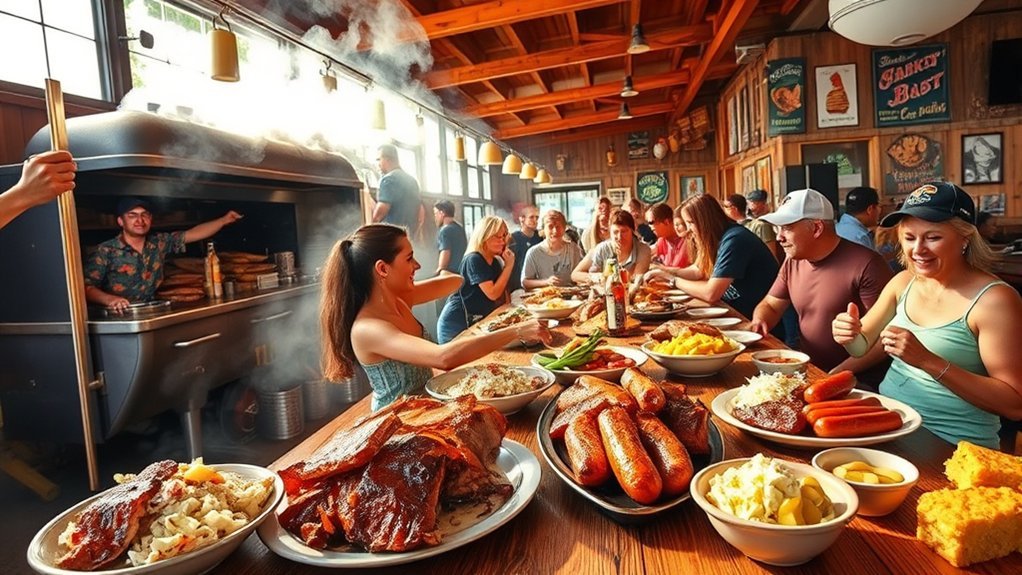
Barbecue is especially important. North Alabama is famous for Alabama white sauce, a tangy mayonnaise-based barbecue sauce commonly served with smoked chicken. Red sauces, vinegar-forward sauces, smoked pork, ribs, chicken, and other preparations are also found around the state. The Alabama Tourism Department’s barbecue guide is a useful starting point if barbecue is one of the main reasons for your trip.
Traditional Southern meals may include fried chicken, collard greens, turnip greens, cornbread, macaroni and cheese, beans, and other changing daily vegetables. Coastal areas add shrimp, oysters, fish, and other seafood to the mix.
Niki’s West in Birmingham remains a well-known option for Southern cafeteria-style dining, while seafood dishes and shrimp and grits are good choices to look for closer to the Gulf Coast. Restaurant menus and operating hours can change, so check directly before making a long detour for one meal.
Note: If you also enjoy learning about unusual ingredients while traveling, the site’s existing guide to Asian melon varieties covers several fruits and culinary uses. It is a general food guide rather than an Alabama-specific attraction.
Hiking and Camping in Alabama’s Natural Parks
The Alabama State Parks system currently includes 21 parks and more than 500 miles of hiking, biking, and equestrian trails. Options range from mountain terrain in northern and eastern Alabama to lakes, caves, forests, and coastal environments.
| Park | Hiking Highlights | Camping | Best For |
| Cheaha State Park | Mountain trails and overlooks around Alabama’s highest point at 2,407 feet | 77 improved campsites plus primitive camping options | Mountain scenery and sunsets |
| Monte Sano State Park | About 20 miles of hiking trails plus biking trails | Improved campsites and a separate primitive campground | Huntsville-area hiking and camping |
| DeSoto State Park | Lookout Mountain trails, waterfalls, and forest scenery | 94 full-hookup improved sites plus primitive and backpacking choices | Waterfalls and mixed camping styles |
Cheaha State Park contains Alabama’s highest point and offers mountain views as well as trails with different difficulty levels. Monte Sano, above Huntsville, combines hiking and biking with easy access to city attractions. DeSoto State Park sits on Lookout Mountain near Fort Payne and is known for waterfalls, woodland trails, and several types of overnight accommodation.
Camping does not have to mean giving up basic facilities. Many Alabama State Parks provide modern campsites, bathhouses, picnic facilities, and reservable sites. Primitive camping is also available at a number of parks.
For a more remote experience, national forests such as Bankhead and Talladega provide backcountry opportunities. Wilderness travel requires more preparation than a developed state-park campground, so carry navigation tools, enough water, weather protection, and a plan for limited phone coverage.
Pro Tip: Reserve popular state-park campsites early for weekends and holidays. Alabama State Parks specifically recommends advance camping reservations during busy periods.
Exploring Civil War History and Antebellum Sites in Alabama
Alabama also preserves places connected to the Civil War and the antebellum period. These sites are most useful when visited with historical context that includes slavery, secession, military events, emancipation, and Reconstruction rather than treating historic houses only as architectural attractions.
Selma had a role in Alabama’s Civil War history, but visitors should not confuse that history with the Selma Interpretive Center. The center operated by the National Park Service focuses on the 1965 Selma-to-Montgomery voting-rights movement, not Civil War battles.
In Demopolis, Gaineswood is a Greek Revival historic house managed by the Alabama Historical Commission. Construction took place over many years during the antebellum period, and the house preserves architecture and furnishings associated with nineteenth-century life.
When visiting historic homes from this period, consider both the people who owned the property and the enslaved people whose labor supported plantation economies and domestic life. Interpretation can vary by location, so official historic-site material and guided tours can provide valuable context that is easy to miss by looking only at architecture and furnishings.
Montgomery’s First White House of the Confederacy was the executive residence of Confederate president Jefferson Davis and his family while Montgomery served as the Confederate capital in 1861. Visitors interested in this period may get a fuller picture by pairing Confederate-era sites with museums and memorials that interpret slavery, emancipation, Reconstruction, racial violence, and the later Civil Rights Movement.
Sampling Southern Cuisine in Alabama’s Local Restaurants

Alabama’s restaurant scene ranges from family-run cafeterias and barbecue joints to seafood restaurants and more formal dining rooms. The experience can be as much about local tradition as the individual dish.
The Bright Star in Bessemer has operated since 1907 and combines Southern food with Greek influences. Its menu history makes it one of the state’s distinctive long-running dining institutions.
Dreamland Bar-B-Que began in Tuscaloosa in 1958 and remains closely associated with ribs and barbecue sauce. It now operates multiple locations, but travelers interested in the restaurant’s origins can visit the Tuscaloosa area.
Niki’s West in Birmingham remains another option for traditional cafeteria-style Southern food. Its changing selections let diners combine meats, vegetables, breads, and desserts rather than ordering a single signature plate.
These restaurants also show why Alabama food cannot be reduced to one barbecue sauce or one definition of Southern cooking. Greek influences, African American food traditions, Gulf seafood, regional barbecue practices, and agricultural ingredients all contribute to the state’s food culture.
Fishing and Water Activities in Alabama’s Lakes and Rivers
Alabama has an extensive network of rivers, streams, reservoirs, and lakes that support fishing and other water recreation. Bass, crappie, catfish, bream, and other species attract anglers to different parts of the state.
Lake Guntersville is one of Alabama’s best-known fishing destinations. Outdoor Alabama lists the reservoir at about 69,100 acres and notes its strong reputation for largemouth bass as well as crappie, catfish, bream, and other fishing opportunities.
The Coosa River system and other Alabama waterways offer additional fishing, paddling, and boating opportunities. Water conditions vary, however, and sections near dams or after heavy rain may behave very differently from calm recreational areas.
Fishing rules depend on the location, species, season, residency, and type of water. Before fishing, check Outdoor Alabama’s current license information and the latest freshwater or saltwater size and creel limits. Recreational-license requirements and exemptions should not be assumed from older travel articles.
Visiting Alabama’s Historic Landmarks and Museums
Alabama’s museums and historic landmarks help connect individual attractions to larger national stories. In Birmingham, the Birmingham Civil Rights Institute presents exhibits on segregation, protest, the Birmingham Campaign, and the continuing struggle for human rights.
The surrounding Birmingham Civil Rights District adds important physical context. The Birmingham Civil Rights National Monument includes significant places such as 16th Street Baptist Church, Kelly Ingram Park, the Fourth Avenue Historic District, and A.G. Gaston Motel.
In Montgomery, the First White House of the Confederacy preserves a site connected to the Confederate government. Visiting it critically alongside Civil Rights and slavery-related sites helps place the building within the much broader history of Alabama and the United States.
Alabama’s historic sites are not limited to Civil War and Civil Rights history. Museums and preserved places across the state also interpret Indigenous history, early settlement, industry, agriculture, music, science, military history, and changing community life.
Enjoy Alabama’s Gulf Coast Beaches
One major gap in many Alabama itineraries is the coast. Alabama’s Gulf Coast includes Gulf Shores and Orange Beach, where visitors can combine beaches with fishing, boating, nature activities, seafood, and family entertainment.
Gulf State Park is especially useful for travelers who want more than sitting on the sand. The park combines beach access with walking and biking trails, camping, wildlife habitat, and other outdoor recreation.
Dauphin Island provides another coastal option and is home to beaches, birding opportunities, fishing, and the Alabama Aquarium at the Dauphin Island Sea Lab.
Beach conditions can change quickly. Pay attention to posted beach flags, local weather alerts, and rip-current information. Never assume calm-looking water is free of hazardous currents.
Explore Space, Science, and Family Attractions
Huntsville adds a completely different type of experience to an Alabama trip. The U.S. Space & Rocket Center is a Smithsonian Affiliate and the official visitor center for NASA’s Marshall Space Flight Center. Its exhibits include rockets, space hardware, and displays related to American space exploration.
Families can also build an itinerary around interactive attractions. Birmingham’s McWane Science Center offers hands-on science exhibits and an IMAX Dome, while the Birmingham Zoo provides animal exhibits and conservation-focused programming.
In Mobile, the Exploreum Science Center provides interactive science exhibits and a digital dome theater. On the coast, the Alabama Gulf Coast Zoo is another family-oriented option.
Because temporary exhibits, animal programs, films, simulations, and operating schedules change, check each attraction’s official website before choosing a specific day.
Plan Your Alabama Trip
Alabama is easier to explore when you divide the state into regions instead of trying to cross it repeatedly. A northern itinerary can combine Huntsville, Monte Sano, Bankhead, and Lake Guntersville. Central Alabama can focus on Birmingham and Montgomery. A southern itinerary can connect Selma, Mobile, and the Gulf Coast.
- For hiking: Check trail length, elevation, weather, water availability, and park alerts before starting.
- For camping: Reserve popular state-park sites in advance, especially for weekends and holidays.
- For fishing: Verify current license, season, size, and daily-limit requirements through Outdoor Alabama.
- For museums: Check current operating days and timed-ticket requirements before driving long distances.
- For Civil Rights sites: Allow enough time to read exhibits and visit several connected locations rather than treating them as quick photo stops.
- For the Gulf Coast: Check marine weather, beach-flag warnings, and rip-current information before entering the water.
Frequently Asked Questions
What are some popular outdoor activities in Alabama?
Popular outdoor activities include hiking and camping in Alabama State Parks and national forests, fishing on lakes such as Lake Guntersville, kayaking and canoeing, birdwatching, Gulf Coast beach activities, biking, and guided whitewater rafting at Montgomery Whitewater.
What are some cultural attractions in Alabama?
Important cultural attractions include the Birmingham Civil Rights Institute, U.S. Space & Rocket Center in Huntsville, museums and historic sites in Montgomery and Selma, Mobile’s museums, and performing-arts venues such as the Alabama Shakespeare Festival. Check current programs and schedules before visiting.
What are some family-friendly activities in Alabama?
Families can visit the Birmingham Zoo, McWane Science Center, U.S. Space & Rocket Center, Exploreum Science Center in Mobile, Alabama Gulf Coast Zoo, Gulf State Park, and many state parks. The best choice depends on children’s ages, weather, and how much driving you want to do.
What are some must-visit historical sites in Alabama?
Major historical stops include the Selma to Montgomery National Historic Trail, Dexter Avenue King Memorial Baptist Church, Birmingham Civil Rights District, USS Alabama Battleship Memorial Park, Fort Morgan, Gaineswood, and museums in Montgomery. Choose sites that cover several periods so your itinerary reflects more than one part of Alabama’s history.
What are some popular food and drink experiences in Alabama?
Look for Alabama barbecue, North Alabama white sauce, Gulf Coast seafood, meat-and-three restaurants, traditional Southern vegetables and cornbread, and restaurants that reflect the state’s Greek and other cultural influences. Alabama also has breweries and wineries, but locations and tasting schedules should be checked directly.
Where are the best beaches in Alabama?
Gulf Shores and Orange Beach are Alabama’s best-known beach destinations. Gulf State Park provides another convenient option for combining beach time with trails, camping, and outdoor recreation, while Dauphin Island offers a quieter coastal experience with beaches, fishing, and nature attractions.
Do I need a fishing license in Alabama?
Many anglers need an Alabama freshwater or saltwater fishing license, although exemptions depend on factors such as age, residency, location, and fishing method. Check Outdoor Alabama immediately before your trip for the current license requirements, exemptions, seasons, and size and creel limits.
How many days should I spend in Alabama?
A long weekend works for one region, but five to seven days is more practical if you want to combine northern Alabama, Birmingham or Montgomery, and the Gulf Coast. Alabama is large enough that trying to cover Huntsville, Montgomery, Mobile, and Gulf Shores in one or two days creates too much driving.
Sources
- U.S. Forest Service, National Forests in Alabama — Bankhead National Forest, Sipsey Wilderness, national-forest recreation, and wilderness guidance.
- Alabama State Parks — current park, trail, camping, reservation, and recreation information.
- National Park Service, Selma to Montgomery National Historic Trail — Selma, Montgomery, and 1965 voting-rights history.
- National Park Service, Birmingham Civil Rights National Monument — Birmingham Civil Rights landmarks and visitor information.
- Outdoor Alabama — fishing destinations, licenses, regulations, and Alabama natural-resource information.
- Alabama Tourism Department — Gulf Coast destinations, Alabama food traditions, attractions, and statewide trip-planning information.