Planning a visit to the Grand Canyon South Rim is easier when you know how the entrances, parking, shuttles, viewpoints, trails, lodging, and permits fit together. The South Rim is open year-round, but crowds, weather, and inner-canyon heat change the experience dramatically. This guide covers practical routes from Flagstaff, Phoenix, and Las Vegas, the best ways to get around without constantly moving your car, realistic hiking options, current fees and permits, and the safety details that matter before you head below the rim.
Quick Answer
The Grand Canyon South Rim is open year-round and works well for anything from a two-hour viewpoint visit to a multi-day hiking trip. Most first-time visitors should arrive early, park once, use the free shuttle system, combine one or two viewpoints with part of the Rim Trail, and check current weather, water, and trail conditions before hiking below the rim.
Key Takeaways
- The standard private-vehicle entrance pass is $35 for seven days. Parking inside the park is not separately charged.
- Flagstaff is about 81 miles away, Phoenix about 231 miles, and Las Vegas about 278 miles from the South Rim.
- Visitor Center parking can fill by late morning during busy periods, so arriving early and using free shuttles saves time.
- Summer weather on the rim can be pleasant while the inner canyon is dangerously hot, sometimes exceeding 110°F.
- Day hikes normally do not require backcountry permits, but overnight camping below the rim does.
- Check current trail closures, drinking-water availability, weather, and shuttle schedules immediately before your visit.
Getting to the South Rim: Routes, Distances & Transportation
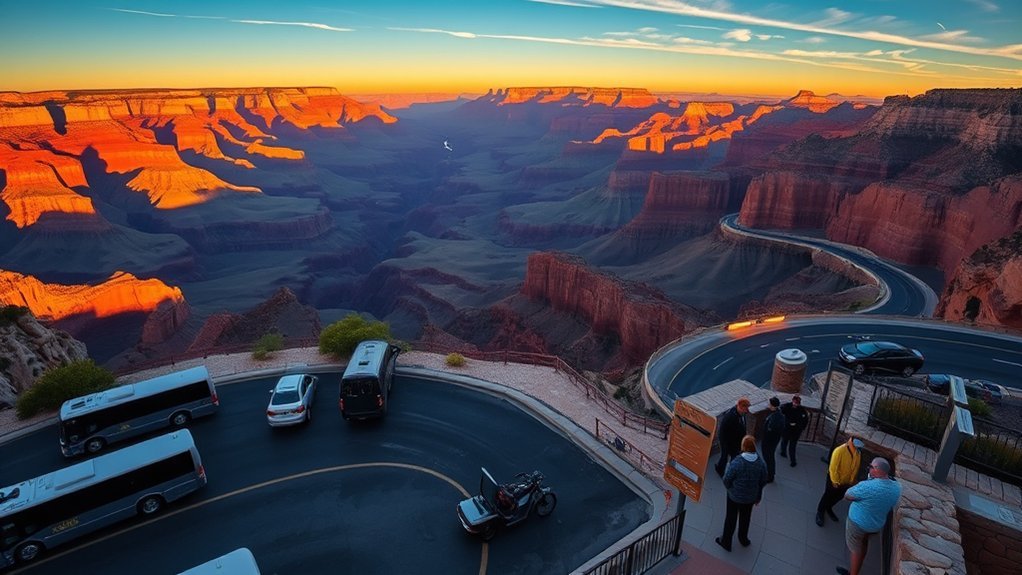
Getting to the South Rim is straightforward whether you drive, fly into northern Arizona, or take the train from Williams. According to the National Park Service South Rim directions, Flagstaff is about 81 miles away, Phoenix about 231 miles, Williams about 63 miles, and Las Vegas about 278 miles.
Most drivers arriving from Phoenix or Flagstaff use the South Entrance near Tusayan. Travelers approaching from Page, Cameron, or Monument Valley can enter through the East Entrance at Desert View and follow the 23-mile Desert View Drive toward Grand Canyon Village. Using the East Entrance can also make sense when Desert View Watchtower is already on your itinerary.
The standard entrance charge is a $35 private-vehicle pass valid for seven days, not a parking fee. Motorcycles are $30 and individuals entering on foot or bicycle are $20. The America the Beautiful passes are also accepted. Grand Canyon National Park currently does not require a timed-entry reservation. Check the official NPS fees and passes page before traveling because fees and policies can change.
Pro Tip: During spring break, summer, and busy holiday periods, arrive early and park once. Visitor Center lots often fill by late morning, while the shuttle system can take you to major viewpoints, trailheads, lodges, and village services.
Grand Canyon Railway from Williams
If you would rather avoid driving into the park, the Grand Canyon Railway runs between Williams and Grand Canyon Village. Under the standard 2026 schedule, the train leaves Williams at 9:30 a.m., arrives at the South Rim at 11:45 a.m., departs the canyon at 3:30 p.m., and returns to Williams at 5:45 p.m. November and December use an earlier schedule, and additional trains may operate on high-demand dates. Check the official Grand Canyon Railway schedule when booking.
Flying to the South Rim
Commercial airline service is available in Flagstaff, Phoenix, and Las Vegas. Flagstaff is the closest of those cities by road, while Phoenix and Las Vegas generally offer more flight choices. Grand Canyon National Park Airport is near Tusayan outside the park boundary, and commercial fixed-wing and helicopter sightseeing tours operate from facilities outside Grand Canyon National Park. See the NPS air travel guidance for current options.
Parking, Shuttles & Getting Around the South Rim
You do not need to drive between every South Rim attraction. Parking at the Visitor Center, Market Plaza, or the Historic District and then using the shuttle system is often faster during busy periods.
For summer 2026, the park operates the Village Route, Kaibab Rim Route, Hermits Rest Route, seasonal Tusayan Route, and the early-morning Hikers’ Express. Schedules change by season, so use the official South Rim shuttle page for the timetable on your travel date.
- Village Route: Connects the Visitor Center with lodging, campgrounds, Market Plaza, the Backcountry Information Center, and the Historic District.
- Kaibab Rim Route: Serves Mather Point, Yavapai Geology Museum, South Kaibab Trailhead, Yaki Point, and Pipe Creek Vista.
- Hermits Rest Route: Serves scenic overlooks along the seven-mile Hermit Road corridor.
- Hikers’ Express: Provides early-morning transportation toward South Kaibab Trailhead.
- Tusayan Route: Seasonal park-and-ride transportation between Tusayan and the Visitor Center.
During 2026, Hermit Road is closed to private motor vehicles from March 1 through November 30, with shuttle buses and authorized commercial tours providing motorized access during that period. Walking and cycling remain options.
Note: Shuttle routes and operating dates change seasonally. Do not rely on an old screenshot or schedule saved months earlier. Check the NPS shuttle page shortly before arrival.
Best Time to Visit: Seasons, Crowds & Weather Tips
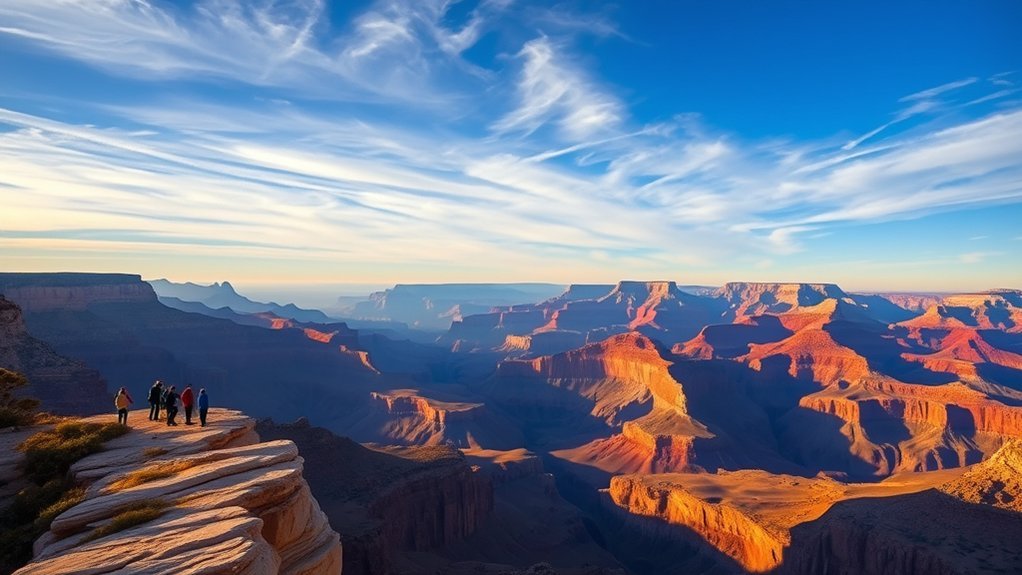
The South Rim is open 24 hours a day, 365 days a year, but the best season depends on whether you plan to stay mostly along the rim or hike into the canyon. Spring and fall usually give sightseeing visitors comfortable daytime conditions with smaller crowds than peak summer. Winter can be peaceful and beautiful but may bring snow, icy trails, and temporary road problems.
Summer requires an important distinction: the South Rim sits around 7,000 feet in elevation, where daytime highs are often in the 80s°F, while temperatures deep inside the canyon can exceed 100°F and sometimes 110°F. Afternoon thunderstorms are also common during the summer monsoon period, especially in July, August, and early September. Check the NPS Grand Canyon weather guidance before your trip.
| Season | Typical South Rim Conditions | Visitor Tips |
|---|---|---|
| Spring | Mild days, cold mornings and nights, possible late snow | Pack layers and expect changing trail conditions |
| Summer | Pleasant to warm on the rim; extreme heat below the rim; monsoon storms | Sightsee early; avoid exposed inner-canyon hiking during peak heat |
| Fall | Cooler days and increasingly cold nights | Excellent for rim walks; daylight becomes shorter |
| Winter | Snow, ice, cold nights, fewer visitors | Carry traction devices when trails are icy and check road conditions |
Spring break, summer, and holiday weekends can produce substantial entrance traffic and parking congestion. November through February is generally quieter, although winter weather becomes a major planning factor.
The weather you feel at the rim is not the weather you will experience thousands of feet below it. Temperature rises rapidly as you descend into the canyon.
Top Things to Do: Viewpoints, Trails, Museums & Activities
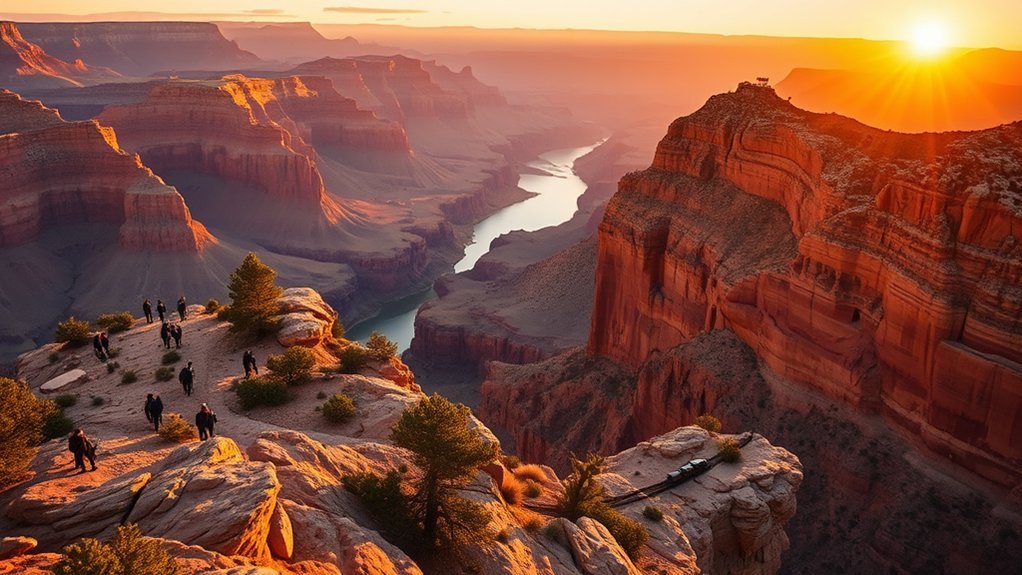
A good first visit mixes panoramic rim views, a walk along the Rim Trail, a geology or cultural stop, and, if your fitness and conditions allow, a carefully planned hike below the rim.
Mather Point, Yavapai & the Rim Trail
Mather Point is one of the easiest first viewpoints to reach from the Visitor Center. From there, you can walk toward Yavapai Point and Yavapai Geology Museum. The broader Rim Trail extends for roughly 13 miles from the South Kaibab Trailhead area west toward Hermits Rest, but surfaces vary. Some sections are paved and accessible, while others are unpaved.
The Trail of Time between Yavapai Geology Museum and the Historic District adds geology interpretation to the walk. It is a particularly useful option if you want to understand the canyon without committing to a strenuous below-rim hike.
Hermit Road Viewpoints
Hermit Road offers a chain of overlooks including Maricopa Point, Powell Point, Hopi Point, Mohave Point, Pima Point, and Hermits Rest. Hopi and Mohave Points are popular for sunrise and sunset because of their broad views, while Pima Point can provide views toward the Colorado River.
Because the Rim Trail and shuttle route parallel portions of Hermit Road, you can walk one section and then use the bus for the next stretch instead of completing the entire corridor on foot.
Desert View Watchtower
Desert View Watchtower sits about 23 miles east of Grand Canyon Village along Desert View Drive. The road is normally open to private vehicles, weather permitting, and the drive includes several scenic pullouts. Desert View works especially well as your first or last major stop when entering or leaving through the East Entrance.
Bright Angel Trail
Bright Angel Trail begins in the Historic District and drops steeply below the rim. The 1.5-Mile Resthouse is about 1.6 miles one way, the 3-Mile Resthouse about 3.1 miles one way, and Havasupai Gardens about 4.5 miles from the rim. Water availability at resthouses is seasonal and can be interrupted, so never assume a tap will be working.
Plateau Point is much more serious than a casual extension. The complete outing from the rim is approximately 12.2 miles round trip with about 3,195 feet of elevation change and can take 8–12 hours. It should be treated as a strenuous full-day hike for experienced, well-prepared hikers.
South Kaibab Trail
South Kaibab Trail offers wide canyon views but has little shade and no potable water along the trail. Popular turnaround points include Ooh Aah Point at about 0.9 mile one way, Cedar Ridge at 1.5 miles, and Skeleton Point at 3 miles. Skeleton Point therefore means roughly a six-mile round trip with a major climb back to the rim.
Warning: Do not judge a Grand Canyon hike only by mileage. Every step down creates an uphill climb back to the rim. The South Kaibab Trail has almost no shade and no trail water, and inner-canyon heat can become life-threatening. During extreme heat, NPS advises against hiking below the rim and strongly discourages exposed inner-canyon hiking during the hottest part of the day.
Museums, Ranger Programs & Guided Experiences
Visit Yavapai Geology Museum, walk the Trail of Time, explore the Historic District, or attend a ranger program to add geology, history, wildlife, and cultural context to the views. Mule rides, guided bus tours, bicycle tours, hiking programs, and commercial scenic air tours are also available, although reservations, age limits, operating seasons, and availability vary.
How Long to Spend at the South Rim
If You Have 1–2 Hours
Park near the Visitor Center, walk to Mather Point, continue part of the Rim Trail toward Yavapai Point, and return by foot or shuttle. This gives you major views without spending most of your limited visit moving between distant areas.
If You Have Half a Day
Combine Mather Point and Yavapai with either the Historic District or a portion of Hermit Road. You can also take a short below-rim hike, such as part of Bright Angel Trail or South Kaibab Trail to Ooh Aah Point, if weather, fitness, and trail conditions are appropriate.
If You Have One Full Day
Start early with a rim viewpoint or short hike, visit Yavapai Geology Museum and the Historic District, then spend part of the afternoon on Hermit Road or drive Desert View Drive. Finish at a sunset viewpoint if conditions are clear.
If You Stay Overnight
An overnight visit gives you time for both sunset and sunrise without rushing your driving. It also makes a longer rim walk, ranger program, Desert View visit, or carefully planned below-rim hike much easier to fit into the trip.
Planning Your Stay: Lodging, Camping, Permits & Fees
Because the South Rim receives heavy demand, reserve lodging and camping early whenever your dates are fixed. The in-park lodging choices include El Tovar Hotel, Bright Angel Lodge, Kachina Lodge, Thunderbird Lodge, Maswik Lodge, and Yavapai Lodge. South Rim lodging is available year-round, although availability and temporary operational changes can occur. Use the NPS lodging page to reach the authorized concessionaires.
South Rim Camping
Mather Campground is in Grand Canyon Village, is open year-round, and has 327 campsites. It does not provide individual RV hookups. Trailer Village RV Campground is also open year-round and provides full-hookup RV sites. Desert View Campground is seasonal and is currently listed for roughly May 15 through October 15. Campground operating dates can change, so verify them on the official NPS camping page.
Entrance Fees
Standard entrance pricing is $35 per private vehicle, $30 per motorcycle, or $20 per individual entering on foot or bicycle, with the pass valid for seven days. Eligible annual, senior, military, access, and other interagency passes may also apply.
Day Hikes vs. Backcountry Permits
You generally do not need a backcountry permit for an ordinary day hike. A backcountry permit is required for overnight backcountry camping, including overnight stays at inner-canyon campgrounds such as Bright Angel Campground and Havasupai Gardens Campground.
The current NPS backcountry fee is $10 per permit or lottery application plus $15 per person per night for below-rim areas or $4 per person per night for above-rim areas. Grand Canyon now uses Recreation.gov for its backcountry reservation process. Read the current NPS backcountry permit instructions before choosing dates.
Phantom Ranch Reservations
Phantom Ranch lodging is separate from an NPS backcountry camping permit. Its cabins and hiker accommodations are managed by the park concessionaire and use their own reservation and lottery procedures. The reservation system has also had special inventory releases during the 2026 reopening of hiker dorm accommodations, so do not rely on an old “13 months ahead” rule. Check current Phantom Ranch availability and reservation instructions before planning a canyon-floor stay.
Safety, Gear & Practical Tips for Hiking the Canyon
Booking lodging and campsites gets you to the rim. Your decisions after you start hiking determine whether the day stays manageable. Grand Canyon trails are unusual because the easy-looking downhill section comes first and the hardest climbing comes when you are already tired.
NPS advises planning for the climb to take much longer than the descent. A useful time-management rule is to spend roughly one-third of your available hiking time descending and two-thirds climbing back out.
Temperatures also rise rapidly as you descend. Summer highs near Phantom Ranch can average roughly 30°F warmer than at the rim, and temperatures on exposed inner-canyon trails can exceed 110°F.
Carry enough water for your route and conditions, but also carry food and electrolytes. During warm-weather full-day hiking, NPS guidance notes that a hiker may need roughly a gallon, or 4 liters, over the course of the day. Actual needs vary with heat, distance, exertion, and the person. Never depend on a trail water station without checking its current status first.
| Item | Why It Matters |
|---|---|
| Water plus electrolytes | Helps replace fluids and salts lost during exertion |
| High-energy and salty food | Supports sustained effort and electrolyte balance |
| Layered clothing | Handles large temperature changes between rim and canyon |
| Sturdy trail footwear | Improves traction on steep, uneven surfaces |
| Sun protection | Reduces exposure on trails with little shade |
| Headlamp | Protects you if the hike takes longer than planned |
| First-aid supplies | Useful when immediate rescue may not be available |
| Offline map | Cell service can be unreliable |
| Traction devices in winter | Packed snow and ice commonly affect upper trail sections |
Wear a wide-brim hat, sunscreen, and UV-protective sunglasses. Carry a headlamp even for a planned day hike. Tell someone your route and expected return time, and understand that rescue may be delayed by weather, heat, staff availability, or helicopter limitations.
Note: Before any below-rim hike, check the NPS Key Hiking Messages page for current trail closures, drinking-water availability, weather, heat risk, and construction impacts.
Accessibility, Pets & Other Practical Details
Accessibility
All park shuttle buses are wheelchair accessible, although individual trail surfaces and viewpoints vary. Visitors with mobility limitations may also request a Scenic Drive Accessibility Permit, which can allow access to some roads normally closed to general public traffic. Portions of the Rim Trail and Greenway system are accessible.
Pets
On the South Rim, leashed pets are allowed on trails above the rim, in developed areas, and in designated campgrounds. Pets are not permitted on inner-canyon trails or park shuttle buses. Yavapai Lodge offers designated pet-friendly rooms, and a kennel operates on the South Rim. Review the current NPS pet rules before bringing an animal.
Food, Fuel & Cell Service
Grand Canyon Village has restaurants, groceries, a general store, lodging, and other basic visitor services. Fuel is available in and around the South Rim area, including the gateway community of Tusayan and the Desert View area depending on current operating status.
Cell service can be unreliable, especially away from the developed village. Download maps, reservation details, shuttle information, and important phone numbers before leaving dependable service.
Frequently Asked Questions
How much time do you need at the South Rim of the Grand Canyon?
Allow at least two hours for a quick viewpoint visit. A half day lets you combine viewpoints with part of the Rim Trail or Historic District. A full day works much better for multiple viewpoints, a short hike, museums, and Desert View or Hermit Road. Staying overnight gives you time for both sunrise and sunset without rushing.
Why is 90% of the Grand Canyon closed off?
It is not accurate to say that 90% of Grand Canyon National Park is closed. Much of the park is remote, roadless backcountry where access is controlled by terrain, permits, seasonal closures, and resource-protection rules rather than a blanket closure. The commonly cited 90% figure is more closely connected to visitation: the South Rim receives roughly 90% of park visitors.
Is a guided tour of the Grand Canyon worth it?
It can be worthwhile if you want transportation, geology and history interpretation, sunrise or sunset planning, or help making efficient use of limited time. Self-guiding is easy for most rim sightseeing because the park provides maps, free shuttles, ranger programs, and well-marked viewpoints.
What is one danger tourists should be aware of when visiting the canyon?
Heat-related illness is one of the most important hazards for below-rim hikers. Inner-canyon temperatures can be dramatically hotter than the South Rim. Avoid exposed hiking during extreme heat, carry sufficient water plus electrolytes and food, rest when needed, and turn around early enough to leave plenty of time for the climb out.
Do you need a reservation to enter the Grand Canyon South Rim?
Grand Canyon National Park currently does not require a timed-entry reservation for ordinary park entry. You still need an entrance pass, and separate reservations or permits may be required for lodging, camping, backcountry overnight trips, Phantom Ranch, mule rides, and certain tours.
Do you need a permit for a Grand Canyon day hike?
Ordinary day hiking generally does not require a backcountry permit. Overnight camping below the rim does require one, including stays at backcountry campgrounds such as Bright Angel Campground and Havasupai Gardens.
Can you see the South Rim without hiking below the rim?
Yes. Mather Point, Yavapai Point, Hermit Road viewpoints, Desert View, the Rim Trail, museums, ranger programs, and scenic shuttle routes provide extensive canyon views without requiring a steep inner-canyon hike.
Conclusion
You now have the essentials for planning a safer, smoother visit to the Grand Canyon South Rim: how to get there, where to park, how to use the shuttles, which viewpoints and trails fit your available time, where to stay, and when permits are required. You do not need to hike to the Colorado River to experience the canyon. Rim viewpoints, museums, ranger programs, Desert View, and short walks can deliver an outstanding visit without extreme exertion. If you do hike below the rim, respect the elevation, heat, weather, steep climb back out, and changing water conditions, and check current NPS updates before you start.
Sources
- National Park Service: Directions to the South Rim — driving distances, entrances, and transportation planning.
- National Park Service: Fees & Passes — current entrance fees, passes, campground season information, and entry-reservation policy.
- National Park Service: South Rim Shuttle Buses — current shuttle routes, seasonal schedules, and Hermit Road access.
- National Park Service: Hike Smart — summer heat, water, electrolytes, and inner-canyon hiking safety.
- National Park Service: Backcountry Permits — permit requirements, current fees, and Recreation.gov reservation process.
- Grand Canyon Railway: Schedule & Route — current Williams-to-South-Rim train schedules and travel times.