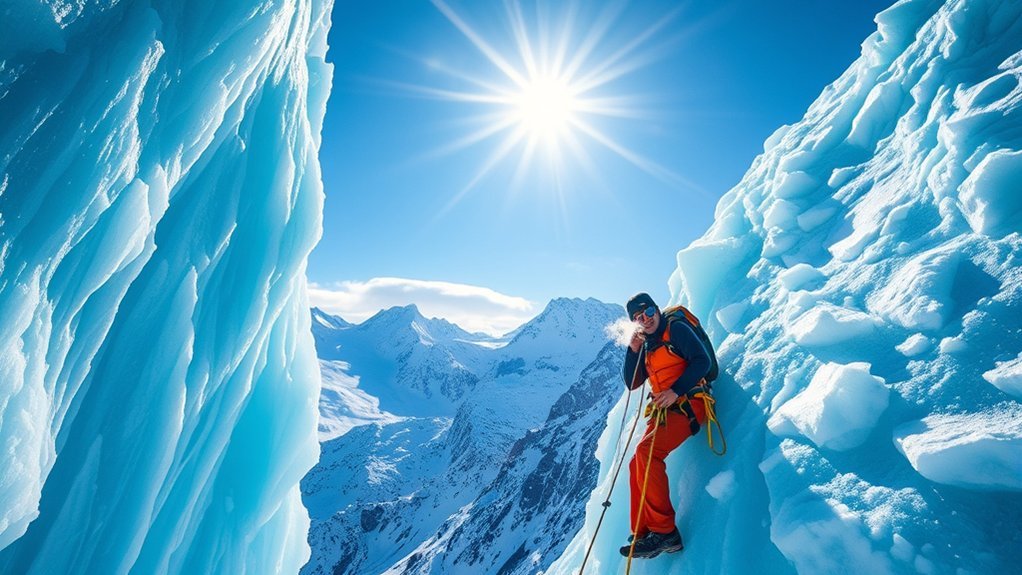
Ice climbing in Alaska can mean very different things: climbing frozen waterfalls near Valdez, practicing technical skills on glacier ice, or traveling through serious alpine terrain where crevasses, avalanches, rockfall, and fast-changing weather are part of the equation. Alaska has an enormous amount of glacier terrain, but choosing the right location, guide, equipment, and season matters far more than simply finding ice.
Quick Answer
For ice climbing in Alaska, beginners should start with professional instruction at a documented climbing area such as Valdez or on an appropriate guided glacier trip. Conditions vary by location and season, so confirm access, weather, ice quality, avalanche exposure, required equipment, and guide policies before leaving for the climb.
Key Takeaways
- Valdez and Keystone Canyon are among Alaska’s best-documented destinations for winter waterfall ice climbing.
- Matanuska Glacier access requires careful planning: the common Glacier Park access is private and guided, while the nearby state recreation site does not provide direct glacier access.
- Root Glacier conditions and access can change. The National Park Service announced a closure beneath an unstable slope on the access trail on July 21, 2026.
- There is no single statewide ice-climbing season. Waterfall ice, glacier ice, and alpine icefield travel have different condition windows.
- Beginners should learn movement, belaying, protection, hazard assessment, and rescue-related skills from a qualified instructor rather than relying on written instructions alone.
At a Glance
| Time Required | Varies from a short instructional outing to full-day or multi-day alpine objectives. |
| Difficulty | Beginner-friendly with professional instruction through expert-only glacier and alpine terrain. |
| Tools Needed | Appropriate boots, crampons, helmet, harness and ice tools or axe; technical routes can also require ropes, protection, belay equipment, navigation and rescue gear. |
| Cost | There is no standard statewide price. Guide fees, access, equipment, transportation and lodging vary by destination, season and trip length. |
The U.S. Geological Survey says the most recent comprehensive survey identified about 27,000 glaciers in Alaska. Older USGS work estimated more than 100,000, which is why both figures still appear online.
The Best Ice Climbing Locations in Alaska
The best place depends on whether you want winter waterfall ice, guided glacier climbing, or a remote alpine objective. These are not interchangeable activities, and access rules can be as important as climbing difficulty.
Valdez and Keystone Canyon
Valdez deserves a prominent place on any Alaska ice-climbing list. Alaska’s official tourism site identifies Valdez as a winter ice-climbing destination, and the city’s February ice-climbing festival has long centered on frozen waterfalls in Keystone Canyon. The combination of road-accessible climbing terrain and a town that serves winter travelers makes Valdez a logical base for both instruction and more advanced climbing.
Even here, ice routes are not permanently “in.” Temperature swings, snowfall, avalanche exposure, flowing water, sun, and recent weather can change a climb dramatically. Check current route conditions with experienced local climbers or your guide instead of choosing a climb only from a photograph or guidebook description.
Matanuska Glacier
Matanuska Glacier is one of Alaska’s best-known roadside glaciers and can be used for guided glacier experiences. Access needs clarification, however. According to Travel Alaska, most visitors approach through Glacier Park at Mile 102 of the Glenn Highway, a private access area where guided glacier tours begin. The nearby Matanuska Glacier State Recreation Site offers glacier views but does not provide direct access to the ice.
For a first glacier-based climbing experience, arrange the activity with an operator that specifically offers the level of climbing or instruction you want. A glacier sightseeing walk and technical ice climbing are different products and may use different equipment and terrain.
Root Glacier and Kennecott
Root Glacier in Wrangell-St. Elias National Park and Preserve is reached from the Kennecott area and is used for glacier hiking and guided ice-climbing activities. The National Park Service describes Root as one of the park’s most accessible glaciers but warns that the surface can be extremely slippery and recommends traction and experienced guidance for glacier travel.
Warning: On July 21, 2026, the National Park Service announced a closure beneath an unstable hill on the Root Glacier access trail north of Kennecott. Falling rock or a landslide could injure or bury visitors. Check the current NPS Root Glacier access notice and speak with a ranger or guide before your trip.
Exit Glacier and the Harding Icefield
Exit Glacier is an important access point into the Harding Icefield area, but it should not be presented as a simple beginner ice-climbing stop. The National Park Service’s mountaineering guidance says Harding Icefield travelers should already understand glacier travel and crevasse rescue and should be prepared for buried crevasses, severe storms, whiteouts and extended delays.
If your goal is sightseeing rather than technical mountaineering, the developed Exit Glacier area has maintained trails and viewpoints. Do not treat walking near a glacier viewpoint as evidence that stepping onto glacier ice is safe.
What About Eagle Glacier?
Eagle Glacier is mentioned in many Alaska recreation contexts, but it should not be treated as a plug-and-play ice-climbing recommendation. The authoritative sources reviewed for this guide do not support the broad claim that Eagle Glacier is a standard climbing destination “known for vibrant icefalls.” If you are considering an objective with this name, first confirm the exact glacier, access route, land status, technical difficulty, transportation and current local conditions with experienced Alaska climbers or a professional guide.
Pro Tip: Choose the climbing objective first and the town second. Valdez works well for winter waterfall ice, while Matanuska and Root Glacier are better known for guided glacier experiences. Remote icefield and alpine objectives require a completely different level of planning.
Waterfall Ice, Glacier Ice, and Glacier Travel Are Different
The original idea of “ice climbing in Alaska” covers several activities that require different judgment and skills.
- Waterfall ice climbing: You climb frozen waterfalls or seeps, usually during winter. Ice thickness, temperature history, running water, sun and avalanche terrain can affect whether a route is safe enough to attempt.
- Glacier ice climbing: A guide may use suitable glacier features to teach crampon movement and ice-tool technique. Crevasses, moulins, meltwater channels and unstable edges can exist nearby.
- Glacier travel and mountaineering: The objective may involve traveling across snow-covered glaciers rather than climbing a frozen waterfall. Hidden crevasses, navigation, rope systems, crevasse rescue, weather and self-sufficiency become central concerns.
Do not assume that being comfortable on one type of ice automatically prepares you for another.
Equipment Essentials for Ice Climbing
The exact kit depends on the route and whether you are climbing waterfall ice, practicing on glacier ice, or crossing glaciated alpine terrain. For a guided beginner trip, confirm what the operator supplies before buying or renting anything.
- Climbing helmet: Essential because ice and debris can fall from above. A helmet reduces head-injury risk but cannot make an ice climb safe.
- Compatible mountaineering boots and crampons: The boot-crampon combination must fit correctly and suit the type of terrain.
- Ice tools or ice axe: Technical waterfall climbing normally uses tools designed for steep ice, while glacier travel may call for a mountaineering axe.
- Harness: Used as part of the climbing or glacier-travel rope system.
- Rope, belay equipment and protection: Requirements depend on the route and should be selected and used by climbers who understand the system.
- Layered clothing: Use moisture-managing base layers, insulation and weather protection appropriate for Alaska conditions.
- Warm gloves plus spare gloves: Wet gloves can quickly become a problem in cold conditions.
- Eye protection: Sunglasses or goggles help with glare, wind, blowing snow and falling ice fragments.
- Emergency essentials: Navigation, communication, food, water, first-aid supplies, headlamp and emergency insulation should match the remoteness and duration of the trip.
Note: “Ice axe,” “technical ice tool,” “hiking traction device,” and “technical crampon” are not interchangeable terms. Use equipment suited to the actual route and learn its correct use before relying on it.
Safety Tips for Beginners
Ice climbing is a technical activity with consequences that can include serious injury or death. Beginners should treat professional instruction as part of the equipment list, not as an optional upgrade.
| Safety Step | Why It Matters |
|---|---|
| Wear a climbing helmet | Ice, rock and equipment can fall from above. |
| Learn from an instructor | Movement, belaying, protection, anchors and hazard assessment are difficult to learn safely from text alone. |
| Inspect the day’s conditions | Ice quality and avalanche exposure can change after snowfall, warming, rain, wind or temperature swings. |
| Use an appropriate partner or guide | Technical climbing and glacier travel can require immediate assistance, belaying or rescue skills. |
| Know your turnaround point | Worsening weather, unstable ice, fatigue or route uncertainty are valid reasons to stop. |
| Check access and emergency options | Remote Alaska locations may have limited cellular service and delayed rescue response. |
Watch for More Than Falling Ice
Depending on the location, hazards can include avalanches, crevasses, moulins, hidden water channels, unstable glacier edges, rockfall, cornices, extreme cold, whiteouts and rapid warming. Wrangell-St. Elias National Park specifically lists glacier travel, extreme weather, rockfall, mudslides and avalanches among its backcountry hazards.
On snow-covered glacier terrain, a surface that appears smooth can hide a crevasse. On waterfall ice, the visible ice itself can change rapidly as temperatures and water flow change.
Ice Climbing Techniques to Master
Good ice climbing is based more on efficient movement and judgment than on swinging tools as hard as possible. These skills should be practiced under qualified instruction where mistakes can be corrected immediately.
Essential Gear Checklist
Before climbing, confirm that your boots and crampons are compatible, your helmet and harness fit correctly, and all technical equipment is appropriate for the route. Inspect equipment for damage and check for current manufacturer safety notices or recalls. Do not assume a guide supplies every item; ask before arriving.
Footwork and Balance
Efficient climbers rely heavily on deliberate foot placement and balance rather than exhausting their arms. Practice placing crampons accurately, keeping a stable stance and moving without unnecessary tension. Your instructor can help you recognize when your body position is wasting energy or reducing control.
Tool Techniques Explained
Ice-tool placement requires control, accuracy and the ability to judge whether the ice can support the intended load. Learn how to place and remove tools without destabilizing yourself or showering the climber or belayer below with unnecessary ice. Belay positioning is also important because falling ice is a major concern on technical ice routes.
Technical anchors, ice-screw placement, rappelling, V-threads and rescue systems require hands-on training. They should not be learned from a short online description and then attempted independently.
Understanding Route Difficulty
Waterfall-ice climbs are commonly described using WI, or Water Ice, grades. A grade is useful for comparing routes, but ice routes are unusually changeable. The same named climb can become thinner, steeper, wetter or more brittle as conditions change. Treat the grade as one piece of information, not a guarantee of today’s difficulty.
Guided Tours vs. Independent Climbing
For beginners, a guided or instructional trip is the clear starting point. A guide can choose appropriate terrain, provide or check technical equipment, teach movement and rope skills, and adjust the day when ice or weather conditions deteriorate.
When choosing a guide, ask specifically whether the trip includes ice climbing rather than only glacier walking. Also ask about guide training, technical equipment, group size, prerequisites, cancellation rules, age requirements and what conditions could change the day’s objective.
The American Mountain Guides Association Alpine Guide program, for example, covers alpine snow, ice, rock, glacier climbing and waterfall ice. A credential is not the only way to evaluate a guide, but asking about professional training and experience is reasonable.
Warning: Independent technical climbing is not simply a guided trip without the guide. You are taking responsibility for route selection, ice assessment, anchors, belaying, descent, navigation, emergency response and any glacier or avalanche hazards encountered along the way.
Seasonal Considerations for Ice Climbing
There is no single “best ice-climbing season” that applies across Alaska.
Winter Waterfall Ice
Frozen waterfalls around places such as Valdez are primarily a winter objective. Midwinter can produce extensive ice, but the calendar alone cannot tell you whether a particular route is safe enough to climb. Cold snaps, warm spells, rain, sun, wind loading and new snow can alter both ice and avalanche conditions.
Glacier Ice
Glacier-based hiking and climbing can occur outside the classic waterfall-ice season. Matanuska Glacier, for example, has guided glacier tours available throughout the year, although the exact activity and route depend on conditions and the operator.
Harding Icefield and Alpine Travel
For the Harding Icefield specifically, the National Park Service says April is generally the best time for an icefield crossing because days are becoming longer while enough snow typically remains for the approach and descent. That guidance applies to a serious mountaineering objective, not to Alaska ice climbing as a whole.
NPS also warns that Gulf of Alaska storms can bring severe winds and whiteout conditions. Plan for the possibility that weather changes your objective completely.
Notable Glaciers and Ice Areas for Climbing Adventures
- Matanuska Glacier: A well-known Southcentral Alaska glacier with private guided access at Glacier Park. Confirm that the specific tour includes climbing if that is your goal.
- Root Glacier: A popular glacier near Kennecott with guided glacier and climbing opportunities. Check current NPS alerts because access conditions can change.
- Exit Glacier / Harding Icefield: Important mountaineering terrain, but not a casual beginner ice-climbing recommendation. NPS emphasizes glacier-travel and crevasse-rescue skills.
- Valdez / Keystone Canyon: Not a glacier, but one of the most important additions to this list because its frozen waterfalls are a major Alaska winter ice-climbing attraction.
- Eagle Glacier: Remote glacier terrain that requires exact location-specific planning rather than a generic recommendation based only on the glacier name.
Preparing Physically for Ice Climbing
Ice climbing rewards leg strength, core stability, mobility, grip endurance and cardiovascular fitness. You do not need to train like an elite climber for a beginner lesson, but arriving with basic fitness makes it easier to concentrate on technique instead of fighting fatigue.
- Legs: Squats, step-ups, lunges and hiking help prepare you for repeated crampon movement and approaches.
- Core: Planks and controlled anti-rotation exercises support balance and body positioning.
- Upper body: Pulling and shoulder-stability exercises can help, although beginners should avoid thinking of ice climbing as an arm-dominant activity.
- Cardiovascular endurance: Hiking, running, cycling, skiing or similar training improves your ability to handle approaches and long days.
- Mobility: Maintain comfortable movement through the hips, ankles and shoulders.
Indoor climbing can improve general movement awareness and belay familiarity, but rock-climbing technique does not automatically teach ice-tool use, crampon technique, glacier rescue or ice assessment.
How to Plan an Alaska Ice-Climbing Day
Conditions can change between the day you book and the morning you climb. Use a final pre-departure check rather than assuming the original itinerary still works.
- Confirm the exact climbing location and legal access.
- Check the latest weather forecast.
- Ask about current ice and route conditions.
- Check avalanche information when your route or approach enters avalanche terrain.
- Verify what equipment your guide provides and what you must bring.
- Confirm the meeting location and transportation.
- Check current road conditions through Alaska 511, particularly for winter trips to Valdez or along the Glenn and Richardson Highways.
- Carry enough food, water and insulation for delays.
- Tell a reliable person where you are going and when you expect to return if you are traveling independently.
- Be willing to switch routes or cancel when conditions do not support the original plan.
Accommodations and Local Amenities
Your lodging strategy should follow the climbing objective. Alaska’s large distances make it inefficient to choose a hotel first and then search for ice nearby.
Lodging Options Available
Valdez is the practical town base for Keystone Canyon and other nearby winter climbing. Staying in town keeps you closer to food, lodging and road services than a remote backcountry objective.
For Matanuska Glacier, lodging is available along the Glenn Highway corridor and in the wider Mat-Su region. The state recreation site has camping facilities during its operating season, but Travel Alaska notes that the site itself does not provide glacier access.
For Root Glacier, climbers normally plan around the McCarthy/Kennecott area. This is a much more remote logistics problem than staying in Valdez, so confirm road, shuttle, lodging and guide arrangements before arriving.
For Exit Glacier and the Harding Icefield, Seward is the main service hub. NPS identifies Exit Glacier as the only part of Kenai Fjords National Park accessible by road.
Dining Experiences Nearby
Rather than planning around a specific restaurant that may have seasonal hours, build flexibility into your food plan. Alaska climbing days can start early, finish late or change because of weather. Carry food for the climbing day even when you expect to eat in town afterward, and confirm restaurant and grocery hours in smaller communities before traveling.
Transportation Services Offered
A rental car can be useful for road-accessible areas, but winter driving is part of the risk calculation. Check Alaska 511 for road conditions before departure and avoid assuming a normal summer drive time will apply in winter.
Matanuska Glacier is reached from the Glenn Highway corridor. Valdez is reached by the Richardson Highway. Kennecott and McCarthy require more involved road or shuttle planning, while the Exit Glacier area is reached from Seward. Guided trips may include transportation, but this varies by operator and should be confirmed when booking.
Weather, Avalanches, and Emergency Planning
Alaska weather can change quickly enough to turn an enjoyable climbing day into a navigation or exposure problem. Check the forecast immediately before leaving and continue evaluating conditions during the day.
Avalanche danger matters whenever a climb, approach, descent or belay location sits beneath or within snow-covered avalanche terrain. A frozen waterfall itself may look solid while the snow slopes above it create the larger hazard.
Glacier objectives add another layer. The National Park Service advises visitors not to attempt glacier crossings without training and appropriate equipment, including crampons, ropes and ice axes. Remote climbers also need the navigation, communication and rescue skills appropriate for their route.
Pro Tip: Decide your turnaround criteria before the climb. Warming ice, unexpected running water, avalanche warning signs, whiteout conditions, equipment problems or slower-than-planned progress are all valid reasons to change the objective.
Environmental Awareness and Conservation
Ice-climbing areas may look durable, but approaches often cross fragile vegetation, moraines, stream banks and wildlife habitat. Use established routes where available, avoid creating unnecessary shortcuts and pack out everything you bring.
Glacier landscapes are also dynamic. Do not approach unstable glacier edges, climb beneath obvious rockfall zones for photographs or enter closed areas simply because older trip reports show people there.
Wildlife awareness depends on the destination. The National Park Service specifically warns that bears can be present along the Root Glacier route and that wildlife can even be encountered around the Harding Icefield. Store food appropriately, give animals space and follow the current rules for the park or land manager you are visiting.
Frequently Asked Questions
What is the best time of year for ice climbing in Alaska?
There is no single statewide season. Winter is the main period for frozen waterfall ice around places such as Valdez. Glacier climbing and alpine objectives have different windows, and NPS says April is generally best for a Harding Icefield crossing. Always use current conditions rather than the calendar alone.
Do I need prior climbing experience to ice climb in Alaska?
Not for every guided beginner lesson. Some operators teach first-time ice climbers on suitable terrain. Independent technical routes are different and can require competence in climbing systems, hazard assessment, anchors, descent, glacier travel, avalanche awareness or rescue.
Are there age restrictions for ice climbing in Alaska?
Do not rely on a universal age such as 10 or 12. Minimum ages, size requirements and adult-supervision rules are set by individual guide services and may differ by trip. Confirm the operator’s current policy before booking a child.
Can I rent equipment locally for ice climbing?
Sometimes, but availability should not be assumed. Many guided beginner trips provide at least some technical equipment. Ask exactly which boots, crampons, helmet, harness, tools and clothing are included and reserve rentals in advance when necessary.
What wildlife should I be aware of while ice climbing?
Wildlife varies by location. Bears are specifically documented along the Root Glacier route and may occur surprisingly far into glaciated terrain. Follow the land manager’s current bear and food-storage guidance and never approach wildlife for a photograph.
Is glacier hiking the same as ice climbing?
No. A glacier walk may use crampons or traction on relatively moderate terrain, while technical ice climbing uses climbing tools, a harness, rope systems and steeper ice. Glacier travel can also involve crevasse hazards even when no steep climbing is involved.
What should I check on the morning of an Alaska ice climb?
Check weather, route and ice conditions, access alerts, avalanche information when relevant, road conditions, equipment, meeting details and your turnaround plan. For Root Glacier, check current NPS alerts; for road travel, Alaska 511 provides current statewide road information.
Sources
- U.S. Geological Survey — How many glaciers currently exist in Alaska? — supports the current glacier-count discussion.
- Travel Alaska — Valdez — supports Valdez’s winter ice-climbing and Keystone Canyon information.
- Travel Alaska — Matanuska Glacier — supports access, guided-tour and state recreation site information.
- National Park Service — Root Glacier Access Trail Closure, July 21, 2026 — supports the current unstable-slope warning.
- National Park Service — Glaciers in Wrangell-St. Elias — supports glacier-travel training and equipment guidance.
- National Park Service — Kenai Fjords Mountaineering — supports Harding Icefield timing, crevasse, weather and glacier-travel guidance.