Disclosure: As an Amazon Associate, we earn from qualifying purchases. If you click a link on this page and make a purchase, we may receive a small commission at no extra cost to you.
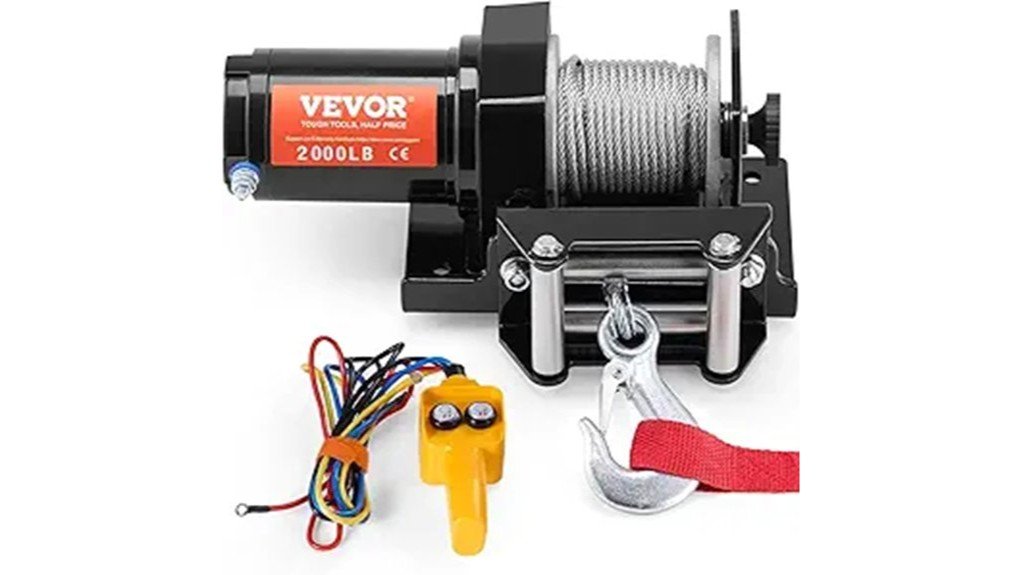
Getting an ATV or UTV stuck in mud can turn a short ride into a long recovery job, so your winch needs enough pulling power without being oversized for the vehicle. The VEVOR P2000-1 ATV Winch is a compact 12V model with a 2,000 lb rated line pull, a 39 ft steel cable, and a wired remote. It is best suited to smaller off-road vehicles and light pulling tasks where a secure mounting point is available. Its low-cost design and simple controls are appealing, but the steel cable, wired-only control, and limited 2,000 lb capacity will not suit every recovery setup.
Quick Verdict
Rating: 8/10, recommended with caveats
Best For: ATV and UTV owners who want a compact, wired 12V recovery winch for occasional use
Bottom Line: The VEVOR P2000-1 gives you useful pulling power, a durable steel cable, and straightforward wired control at an accessible level. Its 2,000 lb rating is modest, and you may still need a vehicle-specific mounting plate or a higher-capacity winch for heavier machines.
| Specification | Detail |
|---|---|
| Brand | VEVOR |
| Model | P2000-1 |
| Product type | 12V electric ATV/UTV winch |
| Rated line pull | 2,000 lb (907 kg) |
| Motor | 12V DC, 0.95 HP permanent-magnet copper motor |
| Gear system | Planetary gear system, 153:1 ratio |
| Cable | 7-strand steel cable, 5/32 in x 39 ft |
| Remote control | Wired remote control |
| Weather rating | IP55 |
| Main materials | Alloy aluminum, steel, copper, and PPS/PA plastics |
| Dimensions | About 10.9 x 4.0 x 4.2 in |
| Net weight | 16 lb |
| Fairlead | Roller fairlead |
| Best use | Occasional recovery and pulling jobs with smaller ATVs or UTVs |
What Is the VEVOR P2000-1 ATV Winch?
The VEVOR P2000-1 is a compact electric winch made for 12V ATV and UTV systems. Its 0.95 HP motor works through a 153:1 planetary gear ratio to deliver a rated line pull of 2,000 lb. The package is built around a 39 ft, 7-strand steel cable and a roller fairlead that helps guide the cable onto the drum.
This is not a full-size truck winch. It makes more sense on a smaller machine, trailer, or utility setup where the mount, wiring, battery, and anchor point are all rated for the job. You should treat the 2,000 lb figure as a maximum line-pull rating under proper conditions, not as permission to pull any 2,000 lb vehicle from any angle.
Who Should Buy It?
Best For
- Owners of smaller ATVs and UTVs that can use a 2,000 lb winch
- Buyers who prefer a simple wired remote with no remote batteries to maintain
- Occasional mud recovery, trailer loading, and light utility pulling on a properly rated mount
Skip If
- Your vehicle or recovery load calls for more than a 2,000 lb rated line pull
- You want synthetic rope or wireless remote operation
- You need a complete vehicle-specific mounting kit with confirmed fitment
Key Takeaways
- The verified model is the VEVOR P2000-1 with a 2,000 lb rated line pull.
- The 12V DC, 0.95 HP motor uses a 153:1 planetary gear system.
- The steel cable measures 5/32 in by 39 ft and uses a roller fairlead.
- The wired remote avoids wireless battery issues but limits where you can stand.
- The IP55 rating helps with rain and mud exposure, but the winch is not submersible.
Pulling Power and Gear System
The 2,000 lb rating is the main reason to consider this model. It gives a small ATV or UTV a useful recovery tool without the size and electrical demand of a larger truck winch. The 153:1 planetary gear ratio trades speed for controlled pulling force, which is what you need when easing a stuck machine toward firm ground.
Winch capacity changes as cable builds up on the drum. The highest rated pull is available on the cable layer closest to the drum, so a nearly full drum gives you less mechanical advantage. Pulling at an angle also increases cable stacking and side load. For a difficult recovery, a straight line and a correctly rated pulley block can reduce strain, but every part of the rigging must be rated for the load.
Before You Buy: Do not choose a winch by vehicle weight alone. Mud suction, slope, cable angle, drum layers, and rolling resistance can raise the required pull, so heavier ATVs and UTVs may need a higher-capacity model.
Steel Cable and Roller Fairlead
The P2000-1 uses a 7-strand steel cable that is 5/32 in thick and 39 ft long. Steel handles abrasion well and works with the included roller fairlead, but it can develop burrs, broken strands, and rust if you neglect it. Wear heavy leather gloves when handling the line, inspect it before each use, and replace it if you find kinks or damaged strands.
VEVOR adds red markings near the final wraps to help you see when little cable remains on the drum. You should still keep at least five full wraps on the drum while pulling. Never use your hand to guide a loaded cable, and keep people away from the cable path in case a hook, anchor, or line fails.
Build Quality and Weather Resistance
The winch uses alloy aluminum, steel, copper, and engineering plastics, with a black matte finish intended to improve rust resistance. Its compact body measures about 10.9 x 4.0 x 4.2 in and weighs 16 lb, so it is easier to fit on a small vehicle than a high-capacity truck winch.
An IP55 rating provides protection against dust intrusion and water exposure such as rain or splashing. It does not make the winch safe for immersion or long-term saltwater exposure. After wet or muddy use, clean the exterior, let the cable dry, inspect electrical connections, and address surface rust before it spreads.
Installation and Controls
The color-coded power leads help you identify the electrical connections, while the wired remote gives direct in-and-out control. A wired controller is dependable because it does not need a separate battery, but the cable limits your operating position. Route it where it cannot contact the drum, steel line, hot engine parts, or moving suspension components.
Installation depends on your ATV or UTV. The winch needs a flat, secure mount that keeps the motor, drum, and gearbox aligned. The structural support, bolts, fairlead position, wiring, battery, and circuit protection must all match the winch and vehicle. Disconnect the battery before installation and follow the supplied manual and your vehicle maker’s guidance.
Pro Tip: Practice a light, controlled pull at home after installation. This lets you check cable spooling, remote reach, battery connections, and mounting hardware before you need the winch on a trail.
Compatibility and Safety
This winch is marketed for ATVs and UTVs, but fitment is not universal. Confirm the bolt pattern, fairlead opening, mounting-plate dimensions, cable routing, and 12V electrical capacity before ordering. A vehicle-specific mounting plate may be required even when the winch itself fits the available space.
During use, keep the pull as straight as possible and place a recovery damper, heavy blanket, or similar weight over the cable near the hook. Stand clear of the cable and hook, keep the clutch fully engaged under load, and never exceed the rated capacity. Do not use the winch to hold a load in place after pulling, and do not rely on it as a lifting device.
For loads above half the rated capacity, the manual recommends using a properly rated pulley block to double the line. Run the vehicle engine when appropriate so repeated winching does not leave the battery too weak to restart. Stop if the motor overheats, the cable stacks at one side of the drum, or the mount shifts.
How It Performs in Real Use
Mud Recovery
On a smaller ATV or UTV, the 2,000 lb pull can help when the tires have lost traction but the machine is not deeply buried. The best results come from a strong anchor, a straight pull, and enough cable spooled out to keep the load on the inner drum layers. Deep mud or a steep uphill pull may exceed what this compact winch can handle safely.
Trailer and Utility Pulling
The compact design can suit light trailer loading or utility pulling when the rolling load, ramp angle, mount, and power supply are within safe limits. It should pull the load into position, not act as the only device holding that load. Secure the item with straps, chocks, or another rated restraint after the pull.
Wet Trail Conditions
The IP55 enclosure and corrosion-resistant remote casing help when you ride through rain, mud, and splash. You still need basic maintenance after use. Dry the cable, clean debris from the drum and fairlead, and inspect the power connections before storing the vehicle.
Occasional Emergency Use
This model makes the most sense as an occasional recovery tool rather than a high-duty commercial winch. Regular practice and inspection matter because a winch that sits unused can develop corroded terminals, a stiff clutch, or poorly layered cable. Re-spool the line under light tension if it becomes loose or uneven.
Setup Tips Before First Use
- Confirm fitment: Measure the mounting area and verify that your plate and fairlead opening match the winch.
- Check the electrical system: Use a healthy 12V battery and follow the manual’s cable and circuit-protection instructions.
- Inspect the full line: Look for kinks, rust, crushed sections, or broken strands before loading the cable.
- Pre-tension the cable: Re-spool it evenly under light tension so it does not bury itself during the first hard pull.
- Pack recovery gear: Carry gloves, a rated tree strap or anchor strap, a damper, and correctly rated shackles or soft shackles.
- Test the remote: Confirm both directions work and that the cable reaches a safe operating position.
Pros and Cons
Pros
- Verified 2,000 lb line-pull rating for smaller recovery jobs
- Compact 16 lb body is easier to mount than a large truck winch
- 39 ft steel cable resists abrasion and works with the roller fairlead
- Wired remote does not rely on replaceable remote batteries
- IP55 enclosure and matte finish add protection in wet, dirty conditions
Cons
- 2,000 lb capacity may be too low for heavier UTVs or severe recoveries
- Steel cable needs gloves, inspection, careful spooling, and rust prevention
- Vehicle-specific mounting hardware or a compatible plate may be required
Is It Worth the Price?
The VEVOR P2000-1 is positioned as a budget-focused recovery winch for riders who need basic pulling ability rather than premium controls or high capacity. You get a verified 12V motor, planetary gearing, a steel cable, a roller fairlead, and a wired remote in a compact package.
It offers strong value for the price when your ATV or UTV falls within the winch’s practical range and you already have, or can source, the correct mount. It is not the best fit if you need synthetic rope, wireless control, frequent heavy pulls, or enough reserve capacity for a large UTV.
How It Compares to Alternatives
Several competing ATV winches from AC-DK, RUGCEL, and XPV AUTO offer 2,500 lb ratings, and some versions add synthetic rope, wireless controls, longer cable, or a mounting plate. Those options may be better when you want more capacity or a more complete kit.
The VEVOR P2000-1 makes the most sense when you prefer a simple 2,000 lb steel-cable winch, a wired remote, and compact dimensions. Compare the full package contents and mounting requirements rather than choosing only by the advertised pull rating.
Frequently Asked Questions
What vehicles can use the VEVOR P2000-1 winch?
It is designed mainly for smaller ATVs and UTVs with a compatible mounting system and 12V electrical supply. Check your vehicle manual and mount specifications because physical fit and safe pulling capacity vary by model.
Is a 2,000 lb winch enough for my ATV?
It may be enough for a smaller ATV and moderate pulls, but the answer depends on mud depth, slope, rolling resistance, cable angle, and drum layers. Choose a higher-capacity winch when your calculated recovery load leaves little safety margin.
How long is the steel cable?
The verified cable size is 5/32 in by 39 ft. Keep at least five wraps on the drum during a pull and inspect the steel strands for damage before each use.
Does it include a vehicle-specific mounting plate?
The listing confirms a roller fairlead, but you should not assume the package includes the exact mounting plate your vehicle needs. Confirm current box contents and buy a plate designed for your ATV or UTV when required.
Can you use this winch in rain or saltwater areas?
The IP55 rating supports use around rain, mud, and splashing, but it does not make the winch submersible or salt-proof. Rinse away salt residue, dry the cable and housing, and protect exposed metal and electrical connections after use.
Does the VEVOR P2000-1 have a wireless remote?
No. This model uses a wired remote. That removes the need for remote batteries, but you must route the control cable safely and stay clear of the loaded winch line.
What warranty does this winch include?
The current Amazon listing states that manufacturer warranty support can be requested, but it does not clearly publish a fixed warranty length in the product details. Confirm the current terms with the seller or VEVOR before purchase.
What common winching mistakes should you avoid?
Avoid side pulls, overloading, touching a tensioned cable, operating with too few wraps on the drum, and using the winch to hold a load in place. Stop immediately if the cable bunches on one side, the motor overheats, or the mounting structure moves.
The Bottom Line
The VEVOR P2000-1 is worth considering when you need a compact, wired 12V winch for a smaller ATV or UTV and you understand its 2,000 lb limit. Its main strengths are the 39 ft steel cable, simple remote, and compact build, while its main limitations are modest capacity and possible extra mounting requirements. Skip it for heavy UTVs, frequent demanding recoveries, or setups that need wireless control and synthetic rope.
Ready to Buy?
Check the latest price, package contents, and mounting requirements before you decide.