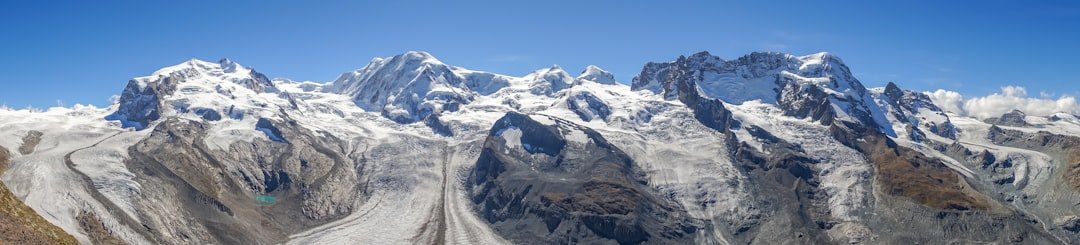
The Great Aletsch Glacier is the largest glacier in the Alps and one of Switzerland’s most impressive high-mountain landscapes. It lies within the Swiss Alps Jungfrau-Aletsch UNESCO World Heritage Site in the canton of Valais. Current Aletsch Arena information describes the glacier as more than 20 kilometres long and about 79 square kilometres in area. Visitors can admire it from high viewpoints, hike through the surrounding alpine landscape, walk to the glacier edge on marked routes, or join a professionally guided tour onto the ice.
Quick Answer
For most visitors, the easiest Aletsch Glacier experience is to travel to Fiesch, ride the gondola to Fiescheralp, and continue toward Eggishorn for panoramic views. Hikers can reach the glacier edge on marked routes, but walking on the glacier itself should be done only as part of a properly equipped guided tour.
Key Takeaways
- The Great Aletsch Glacier is more than 20 km long and covers about 79 km² according to current Aletsch Arena information.
- The glacier lies within the Swiss Alps Jungfrau-Aletsch UNESCO World Heritage Site; the glacier itself is not a separate UNESCO property.
- Fiesch, Riederalp, and Bettmeralp are the main visitor gateways to viewpoints and hiking routes around the glacier.
- Summer and early autumn are the main hiking seasons, but exact trail and cable-car conditions should always be checked before departure.
- Marked hiking trails can take visitors near the glacier, while travel on the ice requires glacier-specific skills, equipment, and preferably a qualified mountain guide.
Current Aletsch Arena information lists the Great Aletsch Glacier at more than 20 kilometres long and about 79 square kilometres in surface area.
How to Get to the Aletsch Glacier
The easiest way to understand access is to separate three different experiences: seeing the glacier from a viewpoint, hiking to its edge, and actually travelling on the ice.
Fiesch to Fiescheralp and Eggishorn
Fiesch is one of the most convenient gateways for visitors arriving by public transport. The train stops beside the public-transport hub, where a gondola runs to Fiescheralp. According to Aletsch Arena’s official travel information, the ride from Fiesch to Fiescheralp takes about 10 minutes.
From Fiescheralp, a second cable car climbs to the Eggishorn area. The Eggishorn viewpoint, at about 2,869 metres, gives a sweeping view along the Great Aletsch Glacier toward Konkordiaplatz and the high peaks of the Jungfrau region.
Hiking from Fiescheralp to the Glacier Edge
Visitors who want a closer look without walking on glacier ice can use the marked route from Fiescheralp through the Tälligrattunnel toward Märjelensee and the glacier edge. The official Aletsch Arena route is approximately 10.6 km, takes about 3 hours 5 minutes, and is rated moderate.
Warning: Reaching a viewpoint or the glacier edge is not the same as safely walking on glacier ice. Crevasses, hidden snow bridges, unstable ice, rockfall, and rapidly changing conditions can make glacier travel dangerous. Do not leave normal hiking terrain and enter the glacier unless you have the required alpine skills and equipment or are with a qualified guide.
Riederalp and Bettmeralp
Riederalp and Bettmeralp provide alternative access to hiking trails and glacier viewpoints. Cable cars connect the valley with these car-free mountain communities. From Riederalp, visitors can continue toward Hohfluh or Moosfluh, while Bettmeralp provides access to Bettmerhorn.
What About Jungfraujoch?
Jungfraujoch is sometimes described as an access point to the Aletsch Glacier, but this needs context. It is used as the starting point for demanding guided alpine traverses across the glacier rather than as a normal self-guided approach. Aletsch Arena currently advertises a two-day guided Jungfraujoch-to-Fiesch glacier trip that includes glacier travel and an overnight stay at Konkordia Hut.
2026 Note: As of August 17, 2026, the published summer season for the Fiescheralp–Eggishorn cable car runs from June 6 through October 25. Construction work is taking place at Eggishorn, although the cable car and viewpoint remain accessible. The short Eggishorn themed circular trail is currently closed until further notice, so check the latest status before travelling.
Pro Tip: Check the official cable-car timetable, trail status, webcams, and mountain weather on the morning of your visit. High-alpine conditions can change much faster than weather in the valley.
Best Time to Visit the Aletsch Glacier
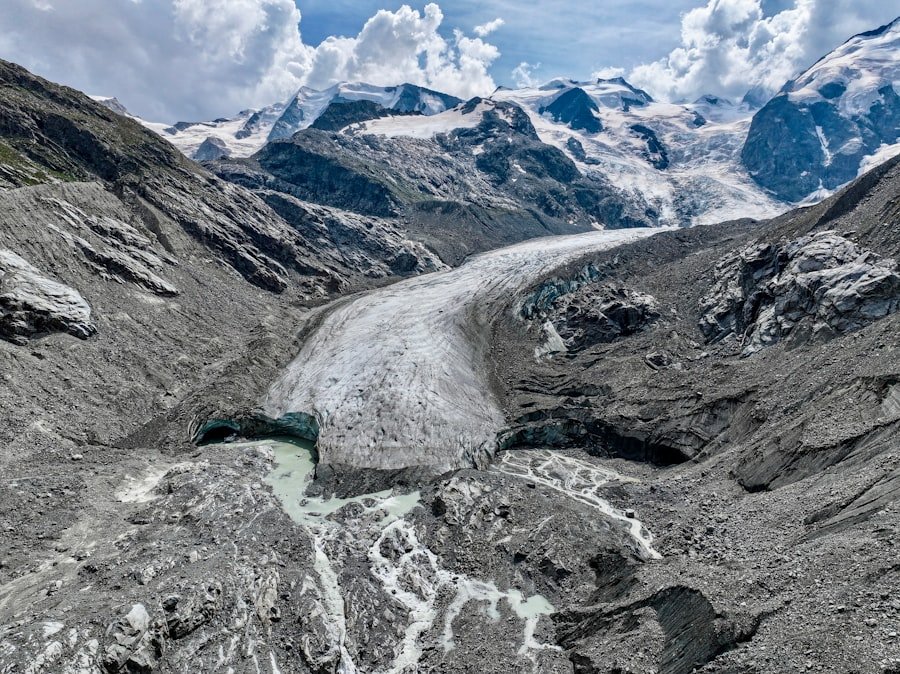
The best season depends on what you want to do. For ordinary hiking and sightseeing, summer through early autumn generally provides the widest choice of accessible high-mountain trails and operating cable cars.
June to September
June through September is the main period for hiking. Snow can still remain on high trails early in the season, while July and August normally provide the broadest selection of routes and guided excursions. Alpine flowers also add colour to meadows and slopes during summer.
Official guided glacier experiences run on selected dates rather than continuously throughout the entire hiking season. For example, the current UNESCO glacier hike from Riederalp is offered from early July into early October on specified days.
October
Early and mid-autumn can bring quieter trails and clear mountain views, but daylight becomes shorter and snow can arrive at higher elevations. For summer 2026, Aletsch Arena lists its main summer operating season through October 25, although individual facilities and routes can change because of weather or maintenance.
Winter
Winter transforms the region into a major snow-sports destination. Skiing, snowboarding, winter walking, and snowshoeing are available in the Aletsch Arena when winter facilities are operating. The published 2026/27 winter season begins in early December and runs into early April.
Winter should not be treated as an easier time to approach the glacier. Snow can conceal crevasses and other hazards, and any glacier excursion still requires appropriate alpine planning.
Activities and Hiking Trails at the Aletsch Glacier
The area has routes for casual sightseers, experienced mountain hikers, and visitors joining guided glacier excursions. Distances and difficulty vary greatly, so choose a route based on your fitness, experience, weather, and current trail conditions.
| Route or Activity | Distance / Time | Difficulty | Best For |
| Fiescheralp–Märjela–Glacier Edge | 10.6 km / about 3:05 | Moderate | Getting close to the glacier without travelling on the ice |
| Eggishorn–Märjelensee–Fiescheralp | 12.2 km / about 3:45 | Moderate | Viewpoints, lakes, and a longer mountain hike |
| Bettmerhorn–Märjelensee–Bettmeralp | 14.6 km / about 5:30 | Difficult | Experienced hikers wanting an extended glacier-view hike |
| UNESCO Ridge Trail: Bettmerhorn–Eggishorn | 3 km / about 3:00 | T4 alpine route | Experienced, sure-footed hikers comfortable with exposed alpine terrain |
| Guided UNESCO Glacier Hike | About 6 hours total, including roughly 2 hours on the glacier | Guided glacier excursion | Visitors who want to experience the glacier ice with professional support |
One of the best ways to experience the landscape is simply to stay on the established hiking network. The routes above provide a much clearer planning reference than treating the region as one single “Aletsch Panorama Trail.”
Mountain biking is also available in the wider Aletsch Arena, including demanding designated trails. Biking should remain on routes where cycling is permitted; it is not an activity for travelling across the glacier itself.
Guided glacier tours allow visitors to see crevasses, ice formations, and glacial features at close range while using appropriate equipment. On the current UNESCO glacier hike, technical equipment such as crampons is supplied as part of the organized experience.
Ice climbing and other technical glacier or mountaineering activities demand a much higher level of skill and risk management. Availability depends on conditions and guide services, so these activities should be arranged through qualified local professionals rather than attempted independently.
Wildlife and Nature at the Aletsch Glacier
The glacier is surrounded by a mixture of high-alpine terrain, meadows, forest, moraine, lakes, and newly exposed ground created by retreating ice. This range of habitats supports a variety of plants and animals.
The Aletsch Forest is particularly important. The protected forest contains ancient Swiss stone pines as well as spruce and larch. Wildlife documented in and around the forest includes red deer, chamois, nutcrackers, and birds such as the pygmy owl. Golden eagles can also be seen in the wider alpine environment, and hikers elsewhere in the Aletsch Arena may encounter ibex.
The landscape around the glacier is valuable not only for its ice but also for the succession of plants and habitats that develop as the glacier retreats.
Alpine flowers grow in suitable meadows and rocky habitats during the warmer months. Plants at these elevations must cope with cold temperatures, strong sunlight, wind, short growing seasons, and thin soils.
The official Aletsch Forest information provides more detail about the area’s protective forest and wildlife.
Safety Tips for Visiting the Aletsch Glacier
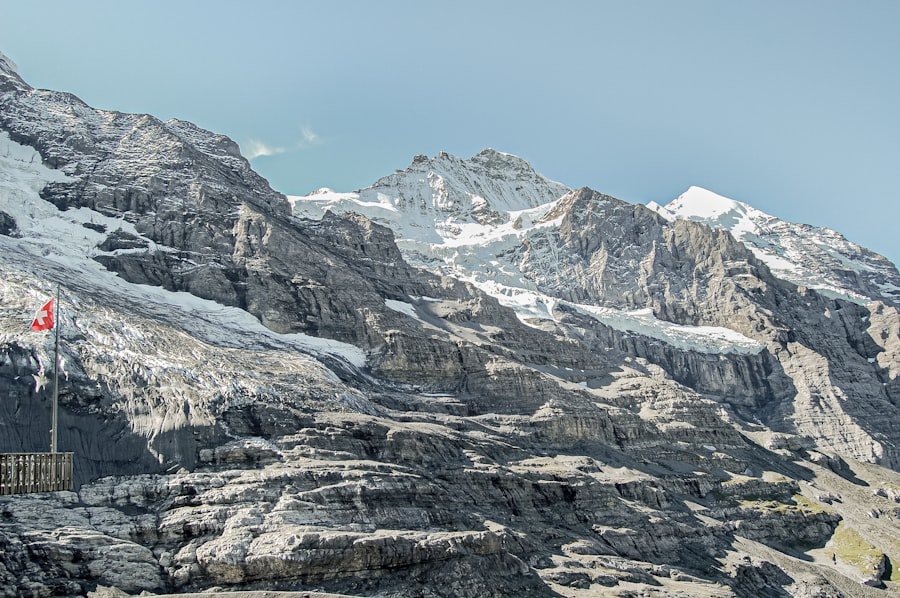
Preparation matters in the Aletsch region because even a straightforward sightseeing trip takes place in a high-alpine environment. Conditions can change quickly, and temperatures at the viewpoints may be far lower than in Fiesch or Brig.
- Check weather and trail status: Review the current mountain forecast, cable-car status, and route information before setting out.
- Stay on marked routes: Do not take shortcuts across unstable slopes, moraine, closed trails, or glacier terrain.
- Wear suitable footwear: Hiking shoes or boots with reliable grip are appropriate for mountain trails.
- Dress in layers: Carry a warm layer and rain or wind protection even on a sunny summer morning.
- Protect yourself from the sun: High altitude and reflection from ice can increase UV exposure, so sunglasses, sunscreen, and a hat are useful.
- Carry water and food: Bring enough for your planned route rather than assuming refreshments will always be available.
- Carry navigation information: Use an official route map or reliable offline map and follow posted trail signs.
- Know your limits: Turn around if weather worsens, the route becomes uncomfortable, or your group is moving much more slowly than planned.
- Use a guide on glacier terrain: Glacier travel involves crevasse and ice hazards that are not comparable with normal hiking.
Warning: Never assume visible glacier ice is safe to walk on. Crevasses may be difficult to see, and conditions at the edge can change as the glacier melts and retreats.
Best Viewpoints for the Aletsch Glacier
Aletsch Arena highlights four principal viewpoints, each showing the glacier from a different angle.
Eggishorn
Eggishorn is the highest of the four main viewpoints at about 2,869 metres. It provides an especially broad view of the glacier, Konkordiaplatz, and surrounding peaks. The viewpoint can be reached by cable car from Fiescheralp.
Visitors should note that the Eggishorn viewpoint itself is listed as not wheelchair-accessible. In addition, the short themed circular trail beside Eggishorn is closed until further notice during current construction work, although the cable car and viewpoint remain accessible.
Bettmerhorn
Bettmerhorn provides another elevated look across the glacier and is a useful starting point for several mountain hikes, including the route toward Märjelensee and Bettmeralp.
Moosfluh
Moosfluh is reached from the Riederalp side of the Aletsch Arena and provides close views across the glacier landscape. It is also used in connection with organized glacier excursions from Riederalp.
Hohfluh
Hohfluh is another Riederalp-side viewpoint and can be combined with hikes through the surrounding mountain landscape and toward the Aletsch Forest.
Pro Tip: You do not need to walk onto the glacier to appreciate its scale. For first-time visitors or families, one of the official high viewpoints is often the simplest and safest way to see the full ice stream.
Nearby Attractions and Accommodations
The communities of Riederalp, Bettmeralp, and Fiescheralp are convenient bases for exploring the Aletsch Arena. They sit on the car-free mountain plateau above the Rhône Valley and connect with the valley by cable car.
Riederalp
Riederalp offers hotels, apartments, and mountain accommodation within easy reach of hiking trails, the Aletsch Forest, and the Hohfluh and Moosfluh areas. Villa Cassel and the Pro Natura Center Aletsch add an educational element for visitors interested in the protected landscape.
Bettmeralp
Bettmeralp works well for visitors planning to combine glacier views with hiking around Bettmerhorn, Bettmersee, and the surrounding alpine plateau.
Fiescheralp and Fiesch
Fiescheralp is particularly practical for Eggishorn, Märjelensee, glacier-edge hikes, and guided glacier activities. Staying in Fiesch lower in the valley can also be convenient because the train and gondola meet at the same public-transport hub.
The Jungfrau Region
The Jungfrau region forms part of the broader high-Alpine landscape associated with the UNESCO World Heritage property. Peaks such as the Eiger, Mönch, and Jungfrau are visible from several Aletsch viewpoints.
However, the tourist areas on the Bernese Oberland side should not be treated as a simple nearby stop reached directly from the Aletsch Arena. A Jungfraujoch-to-Fiesch crossing over the glacier is a serious guided alpine itinerary, while ordinary tourists normally reach the Jungfrau attractions through the established rail network on the Bernese side.
For a deeper introduction to the UNESCO landscape, the World Nature Forum in Naters is another useful regional attraction.
Sustainable Travel Tips for the Aletsch Glacier
Glacier retreat makes the environmental context of an Aletsch visit impossible to ignore. UNESCO specifically highlights the area as an important place for observing glacial history, retreat, and the ecological succession that follows newly exposed ground.
Using public transportation is one practical way to reduce the transport footprint of a visit. Trains connect the Rhône Valley communities, while cable cars provide access to the car-free plateau at Riederalp, Bettmeralp, and Fiescheralp.
- Use trains and cable cars where practical instead of driving between destinations.
- Stay on established trails to limit erosion and disturbance to fragile alpine vegetation.
- Keep a safe distance from wildlife and never feed animals.
- Carry reusable bottles and containers and take all rubbish with you.
- Use toilets and designated facilities rather than contaminating water or sensitive ground.
- Support local accommodation, restaurants, guides, and transport services.
- Respect closures, wildlife-protection rules, and trail signs even when a shortcut appears possible.
If you’re also browsing this site’s food content while planning your wider trip, you can read the existing guide to Delicious Homemade Cottage Cheese: A Simple and Healthy Recipe.
Frequently Asked Questions
What is the Aletsch Glacier?
The Great Aletsch Glacier is the largest glacier in the Alps. It lies in Switzerland’s canton of Valais within the Swiss Alps Jungfrau-Aletsch UNESCO World Heritage Site. Current Aletsch Arena information describes it as more than 20 km long with a surface area of about 79 km².
How do I get to the Aletsch Glacier?
A convenient route is to travel by train to Fiesch, take the gondola to Fiescheralp, and continue toward Eggishorn for panoramic views. Riederalp and Bettmeralp are alternative gateways. Marked hiking routes can also take you toward the glacier edge.
Can I walk on the Aletsch Glacier without a guide?
Visitors should not treat the glacier like an ordinary hiking trail. Crevasses, unstable ice, hidden snow bridges, and changing conditions require glacier-specific skills and equipment. For most visitors, the safer choice is an organized glacier tour with a qualified guide.
What activities can I do around the Aletsch Glacier?
Popular activities include sightseeing from high viewpoints, hiking, guided glacier excursions, mountain biking on designated regional trails, winter sports, snowshoeing, and more technical alpine activities for properly equipped and experienced participants.
What are the best viewpoints for the Aletsch Glacier?
The four main Aletsch Arena viewpoints are Eggishorn, Bettmerhorn, Moosfluh, and Hohfluh. Eggishorn is the highest and provides a broad view along the glacier toward Konkordiaplatz and the Jungfrau massif.
What is the best time of year to visit the Aletsch Glacier?
Summer through early autumn is generally best for hiking and sightseeing because more high-mountain trails and cable cars are operating. Winter is better for skiing and snow activities. Exact opening dates and conditions vary, so always check current information before travelling.
Is Eggishorn open in 2026?
Yes. The Fiescheralp–Eggishorn cable car and viewpoint are scheduled to operate during the 2026 summer season despite construction work. However, the short Eggishorn themed circular trail is currently closed until further notice, so check the latest status before your trip.
Are there restrictions or safety guidelines for visiting?
Use marked hiking trails, obey temporary closures, check weather and route conditions, carry suitable mountain clothing and footwear, and avoid entering glacier terrain independently. A guided excursion is the appropriate option for most visitors who want to walk on the glacier.
Sources
- UNESCO World Heritage Centre: Swiss Alps Jungfrau-Aletsch — World Heritage status, geological significance, ecosystems, and glacier context.
- Aletsch Arena: Great Aletsch Glacier — current glacier dimensions, viewpoints, glacier features, and climate information.
- Aletsch Arena: Cable Car Timetables and Season Times — current operating seasons, travelling times, and 2026 Eggishorn service information.
- Aletsch Arena: Fiescheralp–Märjela–Glacier Edge Route — verified hiking distance, duration, difficulty, and route description.
- Aletsch Arena: UNESCO Glacier Tour — guided glacier access, duration, requirements, and equipment.
- Aletsch Arena: Aletsch Forest — protected forest, wildlife, vegetation, and ecological context.