If you’re looking for the best Instagram spots in London, the strongest photos come from mixing famous landmarks with colorful streets, modern architecture, art, and green spaces. This guide covers where to stand, when the light is usually easiest to work with, what costs money, and the photography rules that can affect your shot. The practical details below were checked against official visitor information.
Quick Answer
Start with Big Ben from the South Bank, Tower Bridge from the riverside, and Notting Hill’s pastel streets for the strongest mix of iconic views and color. Add the London Eye, Covent Garden, Tate Modern, Buckingham Palace, Shoreditch, Kew Gardens, the British Museum, and Hyde Park for architecture, street art, interiors, and greenery.
Last checked: October 1, 2026. Dates and figures were verified against official sources.
Key Takeaways
- You can photograph many of London’s most recognizable views for free from public streets and riverside paths; paid tickets are mainly for attractions such as the London Eye, Kew Gardens, and Tower Bridge’s interior.
- For cleaner street photos, arrive early. Portobello Road is busiest on Saturday, while Westminster and the South Bank become much busier later in the day.
- Indoor photography rules vary. The British Museum allows handheld personal photography in most areas, while photography is not permitted on the Big Ben tour inside Elizabeth Tower.
- Golden-hour light is flattering, but London weather changes quickly. Build your composition around the location first, then use the light you get.
Best Instagram Spots in London at a Glance
These locations give you the broadest range of classic London photos without repeating the same look. Use this table to decide which stops suit your route, budget, and preferred style.
| Spot | Best photo idea | Access | Best timing |
|---|---|---|---|
| London Eye | Wheel framed from the South Bank or skyline views from a pod | Riverside views free; ride ticketed | Late afternoon to sunset |
| Big Ben | Elizabeth Tower across the Thames with Parliament | Outdoor viewpoints free; tower tour ticketed | Early morning or blue hour |
| Notting Hill | Pastel terraces, shopfronts, and Portobello Road | Streets free | Early morning; Saturday for the fullest market |
| Tower Bridge | Full bridge from the south bank or close architectural details | Outdoor viewpoints free; interior ticketed | Twilight for bridge lights |
| Covent Garden | Market architecture, Neal’s Yard, street performers | Public areas free | Morning for space; later for atmosphere |
| Tate Modern | Turbine Hall geometry and Bankside architecture | Collection free; some exhibitions ticketed | Daylight indoors; dusk outside |
| Buckingham Palace | Palace gates, Victoria Memorial, ceremonial scenes | Exterior viewpoints free | Early morning or scheduled Guard Change |
| Shoreditch | Brick Lane murals and layered street scenes | Streets free | Daylight for color and detail |
| Kew Gardens | Palm House, Temperate House, seasonal plants | Ticketed | Morning light; season changes the look |
| British Museum | Great Court, façade, and permitted gallery details | General admission free | Opening time or Friday evening |
| Hyde Park | Serpentine, lawns, and nearby Kensington Gardens | Free | Early morning or late afternoon |
1. London Eye: Photograph the Wheel or the Skyline
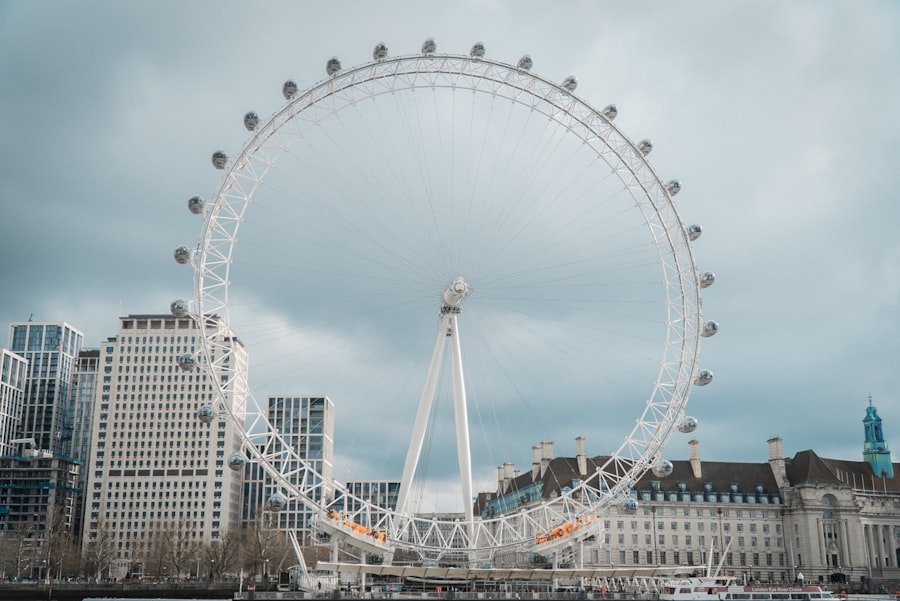
The London Eye works two ways as a photo spot: photograph the wheel itself from the South Bank, or ride it for high views over central London. Its position beside the Thames makes it especially useful when you want Westminster, the river, and the skyline in one sequence of photos.
The wheel stands 135 meters high and has 32 passenger pods, each able to carry up to 25 people, according to the official London Eye FAQ. A standard rotation takes about 30 minutes, so you have time to change compositions as the view opens up. The official London Eye ticket page lists standard adult tickets from £29 online and £39 at the attraction, with online prices varying by demand.
For a free exterior shot, step back along the South Bank so the full circle fits cleanly into the frame. Jubilee Gardens can add greenery in the foreground, while a low angle close to the wheel emphasizes its scale. From a pod, reduce reflections by placing your phone or lens close to the glass and avoiding bright clothing reflected behind you.
Golden hour can soften the skyline, but a cloudy day can work just as well because London’s overcast light reduces harsh contrast. At night, use the illuminated wheel and reflections on the Thames as the main visual elements rather than trying to brighten the whole sky.
2. Big Ben and Elizabeth Tower: Get the Classic Westminster Shot
The most reliable Big Ben photo is from across the Thames, where you can include Elizabeth Tower with the Palace of Westminster and the river. For a cleaner composition, photograph from the South Bank near Westminster Bridge rather than standing directly beneath the tower.
One naming detail matters: Big Ben is the Great Bell inside Elizabeth Tower, although the nickname is often used for the whole tower. UK Parliament’s official Big Ben tour information says the standard tour climbs 334 steps, lasts up to 90 minutes, and costs £55 for adults and £35 for ages 11–17 for tours from August 1, 2026.
For photography, the outside view is more useful than the tour. Parliament states in its Big Ben tour guidance that cameras and mobile phones are not permitted inside Elizabeth Tower, while photos are allowed in Westminster Hall before or after the tour.
Try a wide frame with Parliament, a tighter crop around the clock face and Gothic details, and a long-lens view that compresses red buses or pedestrians into the foreground. After dark, a slower shutter can turn moving buses into light trails if your camera is stable. Early morning gives you more space, while blue hour adds warm clock illumination against a darker sky; wet pavement or the Thames can also add reflections.
3. Notting Hill: Pastel Houses and Portobello Road
Notting Hill is one of the best Instagram spots in London for color, especially if you want pastel terraces, independent storefronts, and market scenes rather than monuments. Lancaster Road and the streets around Portobello Road give you the familiar painted façades, but the best results come from treating them as residential streets rather than a photo set.
Arrive early if you want uncluttered house fronts, keep entrances clear, and avoid leaning on gates or steps. If a person is clearly identifiable as the main subject, ask before taking a close portrait, and ask shopkeepers before staging photos inside a business.
Portobello Road adds antiques, vintage clothing, food stalls, and busier street scenes. According to Portobello Road Market’s visitor information, the market is open Monday through Sunday from 8:00 a.m. to 7:00 p.m., with traders usually operating from about 8:30 a.m. to 6:00 p.m. Saturday is the busiest day and offers the fullest street market.
If your priority is architecture, go on a quieter weekday morning. If your priority is market atmosphere, accept the crowds and use them as part of the frame. During the Notting Hill Carnival in late August, the area changes completely, with large crowds, costumes, music, and parade scenes replacing the usual quiet-street look.
4. Tower Bridge: Use the Thames for Stronger Compositions
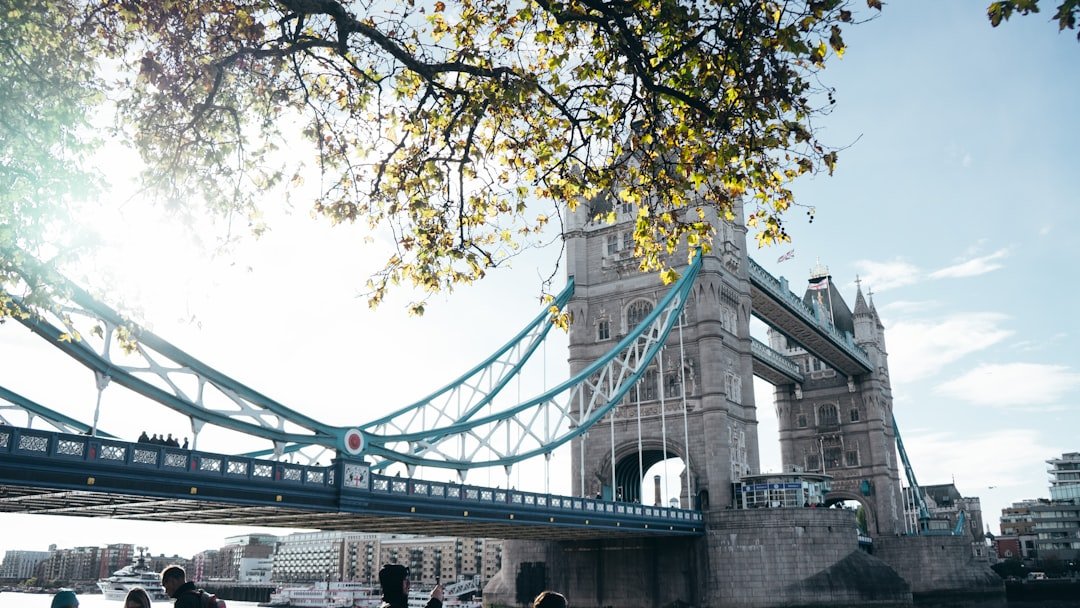
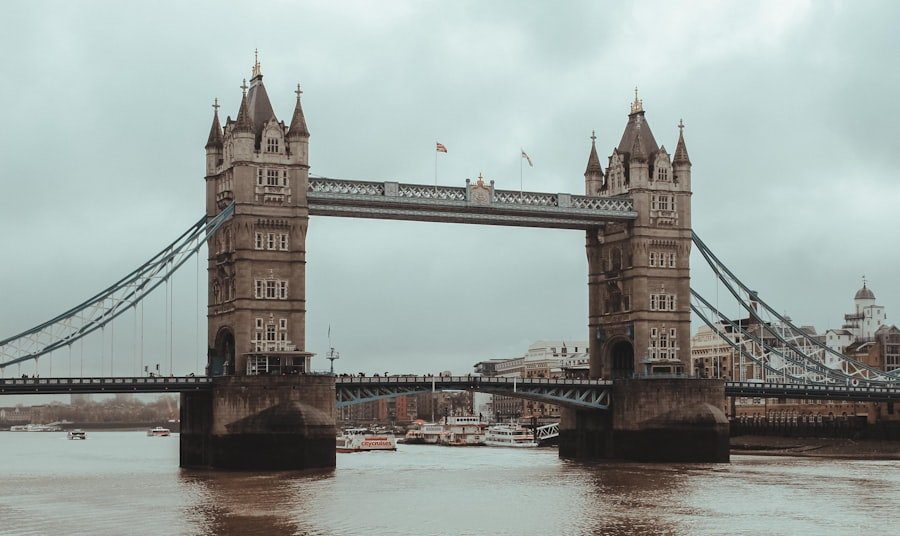
Tower Bridge is easiest to photograph from the riverbanks, where you can show both towers and the suspension elements without extreme perspective distortion. The south side around More London and the riverside toward Butler’s Wharf gives broad views, while St. Katharine Docks and the north bank offer different foregrounds. From the right angle, modern buildings such as The Shard can create a useful contrast with the Victorian bridge.
Exterior viewpoints are free, so you do not need an admission ticket for the classic shot. If you want the high-level walkways and Engine Rooms, the official Tower Bridge visitor page lists opening hours of 9:30 a.m. to 6:00 p.m. daily, with last entry at 5:00 p.m.; annual closures apply on December 24–26.
Twilight is especially effective because the bridge lighting begins to stand out while some blue remains in the sky. A tripod can help on the public riverside where permitted and where it does not obstruct other people, but a modern phone’s night mode can also handle the scene if you brace it against a fixed surface.
For a less predictable photo, move closer and isolate details such as the blue suspension elements, stone towers, or passing traffic. If the bascules lift, a wider frame that includes the river helps explain what is happening instead of showing only a cropped section of the bridge.
5. Covent Garden: Market Architecture, Neal’s Yard, and Street Performers
Covent Garden is best for lively street photography with polished architecture in the background. The covered Market Building, cobbled approaches, shopfronts, floral displays, and performers give you several visual styles within a compact area.
Start with a wide shot that uses the Market Building’s roof and columns as leading lines. Then move into the side streets for tighter details. Neal’s Yard is the obvious color stop: its small courtyard, painted façades, signs, and plants work best with a wider lens, especially when the space is busy.
Street performers add movement and expression, but avoid blocking their working space or standing directly in front of an audience for long periods. If a performer becomes the main subject of your image, a tip is a considerate gesture when you have spent time photographing the act.
Morning gives you more control over composition around the market. Later in the day, the area becomes more crowded but also more energetic, which suits candid frames better than empty architectural shots.
6. Tate Modern: Use Architecture as Part of the Photo
Tate Modern is one of the most distinctive indoor Instagram spots in London and is strongest when you use its industrial architecture, large interior volumes, and changing art displays as compositional elements. The former Bankside Power Station gives you strong lines and scale even before you focus on individual artworks.
Inside, the Turbine Hall is the natural starting point. Use people as small figures to show the size of the space, then look for stairs, balconies, windows, and repeating geometry. Olafur Eliasson’s The Weather Project was a famous 2003 Turbine Hall installation, not a permanent current display, so do not build your visit around one historical artwork being on view.
Outside, the riverfront and nearby Millennium Bridge let you connect Tate Modern with St. Paul’s Cathedral across the Thames. This is more dependable than relying on a particular upper-level terrace or balcony, whose public access and photography conditions can change.
The main collection is free to enter, while some exhibitions require tickets. Respect any no-photography signs around individual works, and avoid flash where restrictions or conservation needs require it.
7. Buckingham Palace: Frame the Palace, Gates, and Ceremony
Buckingham Palace is most photogenic from the public area around the Victoria Memorial, where you can keep the full façade straight and add the memorial or palace gates as foreground elements. Green Park and St. James’s Park also give you softer approaches with trees and seasonal color.
The Changing of the Guard can add uniforms, music, and movement, but it is not a daily event. The Household Division’s official October 2026 calendar lists Buckingham Palace Guard Changes at 11:00 a.m. on October 2, 5, 7, 9, 12, 14, 16, 19, 21, 23, 26, 28, and 30, with other ceremonial activities on several intervening dates.
If the ceremony is your priority, arrive before the crowd fills the railings and decide whether you want a close ceremonial detail or a wider scene. A position farther back around the memorial often gives you more freedom to compose than squeezing against the palace gates.
For a quieter palace photo, go early in the morning and use the symmetry of the façade. Close crops of the gates, crests, lamps, and memorial details can add variety after you have the standard wide shot.
8. Shoreditch and Brick Lane: Photograph London’s Changing Street Art
Shoreditch is the strongest choice in this list for graffiti, murals, layered shopfronts, and urban texture. Brick Lane and the surrounding streets change constantly, so the exact artwork you see may be different from photos posted only weeks or months earlier.
Use a wide frame when the mural needs its full wall to make sense, then move closer for brushwork, stencils, paste-ups, stickers, and typography. Straight-on framing works well for graphic art, while an angled street view can show how a piece fits into the neighborhood.
Daylight is usually better than late evening for accurate color. Overcast weather is useful because it reduces glare on painted walls and shop windows. Cars, bins, signs, and passersby are part of the area, so decide whether to include them as context rather than waiting for an unrealistically empty street.
Street art can be temporary and ownership of artwork does not transfer just because it is visible in public. For a personal Instagram post, keep the artist’s signature in frame when practical and credit the artist if you can identify them reliably.
9. Kew Gardens: Glasshouses, Plants, and Seasonal Color
Kew Gardens is one of the strongest nature-focused Instagram spots in London and the best stop here for botanical photography because you can combine formal landscapes with Victorian glasshouses and close-up plant details. This UNESCO World Heritage Site also holds one of the world’s largest living plant collections. The Palm House and Temperate House provide strong architectural frames, while outdoor planting changes enough by season to make repeat visits look completely different.
In spring, focus on fresh growth and flowering displays; in summer, use denser foliage; in autumn, look for warmer leaf color; and in winter, use glasshouse structure and evergreen planting. Morning light often gives you cleaner highlights on glass and leaves than the middle of a bright day.
Kew is ticketed. The official Kew Gardens ticket page lists peak adult admission from September 2 through October 31, 2026 at £25 online or £28 at the gate. It also lists a £10 Tuesday ticket promotion on selected Tuesdays from September 8 through December 29, 2026.
For close-ups, simplify the background rather than trying to include every plant around the subject. For glasshouse interiors, expose for the brightest window areas and let darker structural lines create contrast.
10. British Museum: Great Court Geometry and Historic Objects
The British Museum in Bloomsbury gives you two distinct photo styles: monumental architecture in the Great Court and close studies of collection objects where photography is permitted. Its collection contains millions of objects spanning human history, including well-known Egyptian material and Greek sculpture. The curved glass roof, pale stone, stairs, and central Reading Room exterior make the Great Court especially effective for symmetry and leading lines.
General admission is free, although some exhibitions and events are ticketed. British Museum guidance says the Museum is open daily from 10:00 a.m. to 5:00 p.m. and until 8:30 p.m. on Fridays. Its visitor photography rules allow handheld cameras for personal, non-commercial use except where signs restrict photography; selfie sticks are not permitted.
Inside galleries, do not let a photo session block cases or circulation routes. A simple approach is to take one wider image showing an object in its gallery context, then a closer image of a detail that caught your attention.
If the museum is crowded, the architecture is often easier to photograph than popular objects. Friday evening opening can also give you a different atmosphere from a daytime visit.
11. Hyde Park and Kensington Gardens: Green Space in Central London
Hyde Park, one of central London’s largest green spaces, is the easiest place on this list to add open lawns, water, trees, and everyday London life to an otherwise architecture-heavy feed. The Serpentine gives you reflections and waterside scenes, while broad paths work well for walking shots and seasonal portraits.
Kensington Gardens sits directly beside Hyde Park but is a separate Royal Park. It contains the Albert Memorial and the Italian Gardens, whose fountains and formal layout work well when you want architecture and water framed by greenery.
Early morning is best for quieter paths and softer light. Later in the day, people picnicking, cycling, rowing, or relaxing can add a natural sense of scale and activity, provided you photograph respectfully and avoid turning strangers into close-up subjects without permission.
In spring and summer, use fresh foliage and flower beds; in autumn, work with warm leaf color; and in winter, use bare branches, water, statues, and low-angle light. The parks are strongest when you let the season determine the image instead of trying to recreate the same composition year-round.
For more from this site, you can also read Exploring the Delightful World of Asian Melon, Delicious Homemade Cottage Cheese: A Simple and Healthy Recipe, and Rock Legend Ozzy Osbourne Passes Away.
Frequently Asked Questions
What are the best Instagram spots in London?
The best all-around Instagram spots in London are Big Ben and the Palace of Westminster, Tower Bridge, Notting Hill, the London Eye, and Buckingham Palace. Add Shoreditch for street art, Kew Gardens and Hyde Park for nature, and Tate Modern or the British Museum for architecture and interiors.
Are there any hidden gems for Instagram photos in London?
Yes. Neal’s Yard gives you a compact burst of color near Covent Garden, Leadenhall Market offers an ornate covered-market setting, and the streets around Primrose Hill combine colorful houses with hilltop city views. Visit residential areas quietly and keep doorways, steps, and driveways clear.
What time of day is best for taking Instagram photos in London?
Early morning is best when you want fewer people, while the hour around sunrise or sunset often gives softer, warmer light. Blue hour is especially effective for Big Ben, Tower Bridge, and the London Eye because landmark lighting stands out while the sky still holds color.
Are there any Instagrammable cafes or restaurants in London?
Yes. Sketch, Peggy Porschen Cakes, and EL&N are well-known London options for decorative interiors or storefronts. Designs, branches, and photography policies can change, so keep shoots small, avoid disrupting service, and ask staff before using extra equipment.
What are some tips for taking great Instagram photos in London?
Use natural light, change your height and angle before changing lenses, and include foreground elements such as railings, trees, reflections, or passing traffic when they improve the story. Keep edits consistent rather than extreme; apps such as VSCO or Lightroom can help with exposure, crop, and color.
Can you take photos inside Big Ben?
No. Photography and mobile-phone use are not permitted during the Big Ben tour inside Elizabeth Tower. You can take personal photos in permitted areas such as Westminster Hall, and the best unrestricted views of Elizabeth Tower are from public outdoor viewpoints around Westminster.
Can you use a tripod at London attractions?
It depends on the location. UK Parliament does not permit tripods on visitor routes, and the British Museum requires advance arrangements for stands or special equipment. On public streets and riverside paths, use a tripod only where local rules allow it and where it will not obstruct pedestrians.
Sources
- London Eye — FAQs: wheel height, pod count, and pod capacity.
- London Eye — Tickets and Prices: current standard ticket prices and rotation length.
- UK Parliament — Big Ben Tours: Big Ben naming, tour price, age limits, duration, and 334-step climb.
- UK Parliament — Getting Ready for Your Big Ben Tour: photography and mobile-phone restrictions inside Elizabeth Tower.
- Portobello Road Market — Visitor Information: market hours, trader hours, and busiest days.
- Tower Bridge — Plan Your Visit: current daily opening hours, last entry, and annual closures.
- The Household Division — Changing the Guard Calendar: October 2026 Buckingham Palace ceremony dates and times.
- Royal Botanic Gardens, Kew — Tickets: 2026 peak prices and Tuesday promotion.
- British Museum — Visitor Guidelines: admission, hours, and personal photography restrictions.