Travel pillow manufacturers are judged by more than soft fabric or memory foam. A good plane-use design has to support the head and neck while staying practical to wash, pack, and use in a confined seat. The products below are consumer-market examples rather than a verified list of OEM factories, so use them to compare design approaches before you assess a manufacturer’s materials, prototypes, quality controls, customization, and compliance.
Quick Answer
For plane use, prioritize stable head and chin support, a washable skin-contact surface, and realistic packability. The examples here cover memory-foam collars, G-shaped support, headrest-mounted systems, hooded designs, and lightweight wraps. For bulk sourcing, also verify prototypes, material claims, labeling, production consistency, and the exact scope of any certification.
Last checked: September 30, 2026. Dates and figures were verified against official sources.
Key Takeaways
- Treat retail pillows as design references, not proof that a brand owns or operates the factory that made them.
- Memory foam can provide structured support, while wrap and headrest-mounted designs may save more luggage space.
- Washability, adjustable fit, chin stability, and compression recovery matter as much as the outer fabric.
- For sourcing, verify certificates and their scope instead of accepting vague claims such as “certified,” “hypoallergenic,” or “airline approved.”
- ISO 9001:2026 is the current ISO 9001 edition; certification is optional and addresses a quality-management system rather than proving a specific pillow is safe or comfortable.
How to Use These Travel Pillow Examples
The ten products below show different ways a travel pillow can solve the same problem: keeping your head more stable while you rest upright. They are not ranked from best to worst, and this article does not claim hands-on testing. Instead, compare the support geometry, cleaning method, pack size, accessories, and seat requirements that matter for your use case.
If you are sourcing a private-label product, turn those observations into a written specification. Define the intended traveler, support style, cover fabric, closure, washable parts, compressed size, packaging, and acceptable finish before you approve a sample.
Travel Pillow Designs Compared
| Product | Support approach | Cleaning | Main trade-off |
|---|---|---|---|
| napfun | Memory foam with chin-focused support | Washable outer fabric | More structure and bulk than an inflatable pillow |
| Purroch | G-shaped 360° neck and jaw support | Removable, machine-washable cover | Full-support shape takes more space |
| SARISUN | Headrest-mounted pillow pad with eye mask | Follow the model’s care instructions | Depends on a compatible seat headrest |
| Vzpeun hooded pillow | 360° memory foam plus hood | Washable outer cover | Hood can feel warmer or bulkier |
| BCOZZY | Overlapping double support for chin, head, and neck | Fully machine washable | Fit depends on choosing the right size and position |
| Cirorld | Adjustable memory-foam collar with flatter back | Removable cover; foam itself should not be washed | Soft feel may not suit people wanting very firm support |
| Dot&Dot | Twistable roll for neck, chin, back, or legs | Machine-washable cotton cover | Longer shape is less compact than a small collar |
| XinYiSheng | Raised-lobe memory foam with adjustable rope | Removable, machine-washable velour cover | Firm contour will not suit every neck shape |
| Trtl | Internal support inside a fleece wrap | Remove support, then machine wash the wrap | Less plush than a traditional foam collar |
| Asteraty | Round 360° memory-foam support | Removable zippered cover | Structured round shape may feel restrictive to some users |
napfun Memory Foam Travel Neck Pillow for Airplane
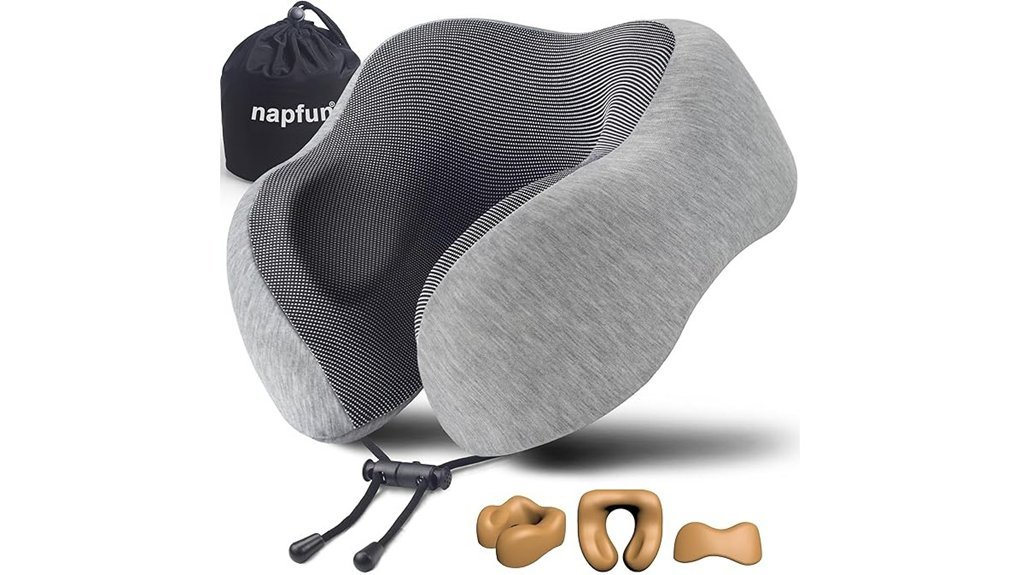
The napfun Memory Foam Travel Neck Pillow is aimed at travelers who want a structured collar rather than an inflatable cushion. The product listing describes 100% pure memory foam, a chin-support shape, raised side lobes, and an adjustable closure intended to limit forward head drop while you rest upright. Memory foam gives the pillow a more substantial feel, but it also takes more packing space than a deflatable design.
The washable outer fabric is useful for repeated trips, while the foam core should be cared for according to the product instructions. This style makes the most sense if you value firm, close-fitting support more than minimal luggage volume.
Best For: Travelers who want firm, contoured neck and chin support on long flights, car rides, train trips, or bus journeys.
Pros:
- Memory foam provides structured support and rebounds after compression.
- Chin-focused and raised-lobe shaping can help limit forward or sideways head movement.
- Adjustable fit lets you change how closely the pillow sits around the neck.
Cons:
- May feel too firm or enclosing if you prefer a soft pillow.
- Memory foam usually takes more luggage space than an inflatable pillow.
- Its main purpose is upright neck support rather than full-body cushioning.
Purroch G-Shape Memory Foam Travel Neck Pillow
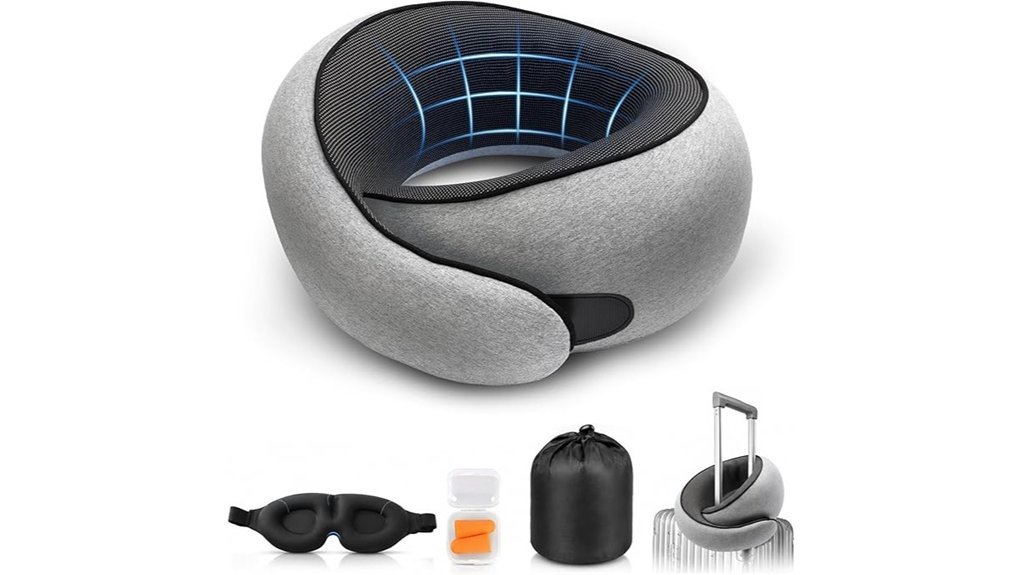
Purroch uses a G-shaped memory-foam core to support the neck, jaw, and shoulders more continuously than a basic open U-shape. The listing describes high-density slow-rebound foam, 3D honeycomb weaving for airflow, and an OEKO-TEX STANDARD 100-certified cover. A hidden zipper lets you remove the cover for machine washing.
The package also includes a storage bag, 3D eye mask, and noise-reducing earplugs. That makes it a more complete travel-rest kit, although the wraparound shape may feel bulky if you prefer a small, low-profile pillow.
Best For: Travelers who want 360° neck and jaw support, a washable cover, and included sleep accessories for long trips.
Pros:
- G-shaped construction provides support around the neck, jaw, and shoulders.
- Slow-rebound memory foam is designed to maintain shape and distribute pressure.
- Storage bag, eye mask, and earplugs create an all-in-one travel kit.
Cons:
- Full-support geometry may take more space than a simple U-shaped pillow.
- Memory foam can retain more warmth than some inflatable or open designs.
- Fit will vary with neck size, shoulder width, and sleeping position.
SARISUN Travel Pillow for Airplanes with Eye Mask

SARISUN takes a different approach from a neck collar. Its Model 001 combines a pillow pad with an eye mask and straps the pad to a seat headrest, so the system supports the head from behind and across the face rather than relying on foam around the neck. The official SARISUN Model 001 page describes the design as a headrest-mounted travel pillow developed around upright seated sleep.
This design can reduce the familiar side-to-side “bobblehead” feeling for users who like head stabilization, and it packs flatter than many bulky memory-foam collars. The limitation is important: it needs a seat or child-seat headrest that lets you mount the strap correctly.
Best For: Flyers and road passengers who want headrest-based stabilization with built-in eye coverage instead of a traditional U-shaped neck pillow.
Pros:
- Headrest-mounted design supports the head without a thick foam collar around the neck.
- Built-in 3D eye mask combines light blocking and head stabilization in one setup.
- Compact form is easier to flatten into a travel bag than many full-size foam pillows.
Cons:
- Requires a compatible seat headrest, so it will not work equally well in every seat.
- The face-and-head support style can feel unfamiliar if you prefer a conventional neck pillow.
- Its usefulness depends heavily on correct installation and strap adjustment.
Hooded Memory Foam Travel Neck Pillow with Accessories
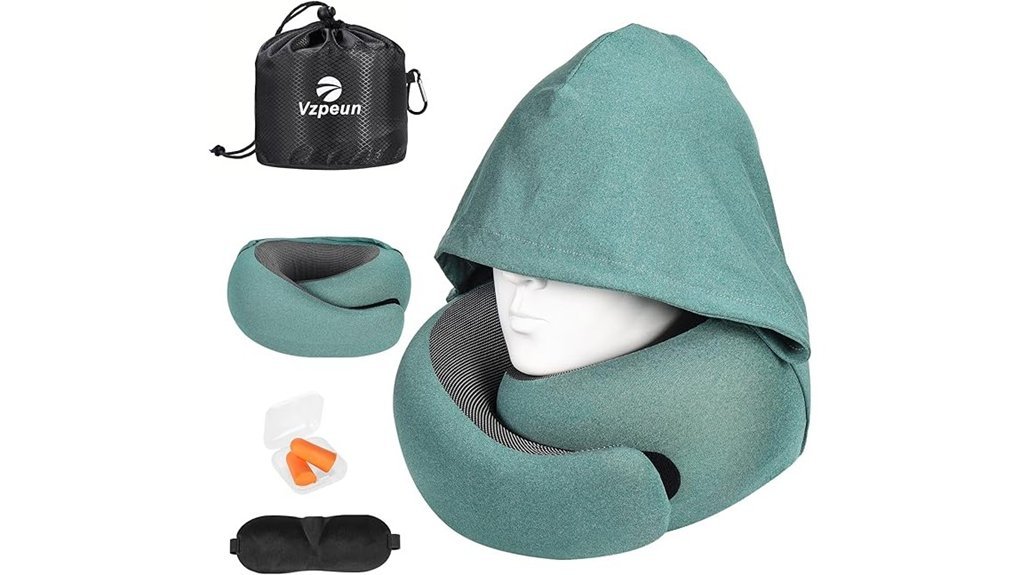
This hooded Vzpeun travel pillow combines a 360° memory-foam collar with a light-blocking hood. The listing describes an adjustable strap closure that brings the front of the pillow together to support the chin, while breathable fabric and a removable cover handle the comfort and hygiene side of long trips.
The hood can be useful if cabin lighting bothers you, and the set includes an eye mask, earplugs, and a drawstring storage sack. The trade-off is obvious: extra fabric and accessories add bulk, and the hood may feel warm in a hot cabin or car.
Best For: Light-sensitive travelers who want a structured memory-foam collar plus added privacy and sleep accessories.
Pros:
- 360° support and an adjustable closure help stabilize the chin and neck.
- Hood, eye mask, and earplugs create a darker, quieter rest setup.
- Removable washable cover and storage sack simplify care and transport.
Cons:
- The hood can add warmth and volume around the head and neck.
- Firm memory foam may feel too structured for travelers who prefer a softer pillow.
- Extra features make it less minimal than a basic neck pillow.
BCOZZY Travel Neck Pillow with Double Support

BCOZZY uses overlapping arms to create double support under the chin and around the neck. The official BCOZZY product page lists three ergonomic positions, a carry bag with snap loop, and fully machine-washable construction. That full washability is a practical difference from many memory-foam pillows, where only the cover can go in the washer.
The pillow can be overlapped in front, shifted to the side, or positioned for mixed support. Some versions also use a flatter back to reduce the feeling of the seat pushing the head forward. Correct sizing still matters because the support depends on how the arms overlap around your neck and chin.
Best For: Travelers who want adjustable chin, neck, and head support without a removable memory-foam core.
Pros:
- Overlapping design supports the chin, neck, and head in several positions.
- Fully machine-washable construction simplifies cleaning after repeated trips.
- Carry bag and snap loop make it easier to attach the pillow to luggage.
Cons:
- The fit depends on choosing a suitable size and overlap position.
- It will feel softer and less rigid than a dense memory-foam collar.
- Its wraparound shape still occupies more space than a deflated inflatable pillow.
Cirorld Memory Foam Travel Neck Pillow with Accessories
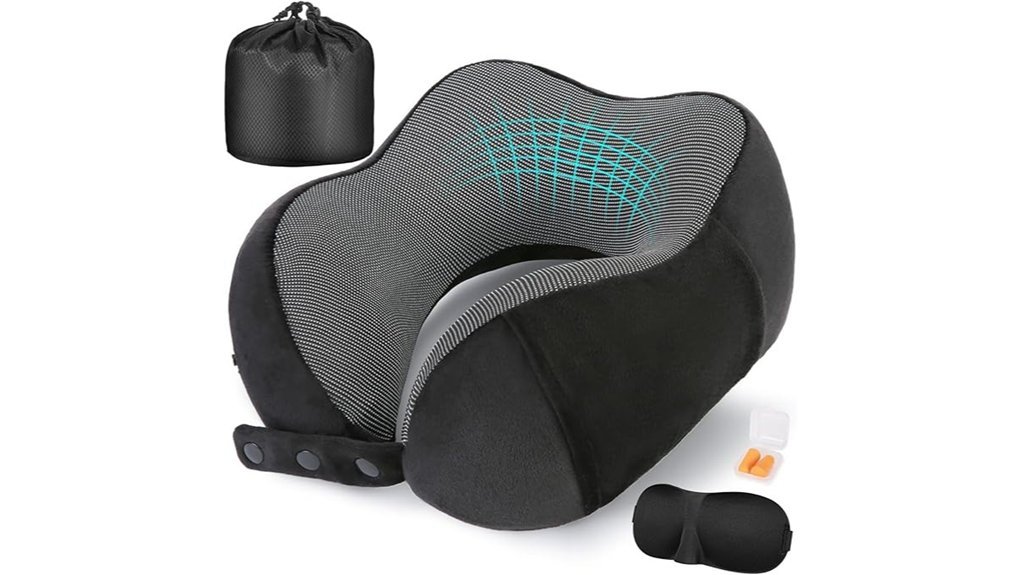
Cirorld’s travel pillow is a more conventional memory-foam collar with an adjustable front closure and a flatter back. The listing describes 100% pure memory foam, press-button adjustment, a removable washable cover, and a set that includes an eye mask, earplugs, and carrying bag.
The flatter back can be useful in upright seats because a thick rear cushion may push the head farther forward. The foam core itself should not be washed; the removable cover handles routine cleaning, while the foam should be aired and kept dry.
Best For: Adults who want an adjustable memory-foam neck pillow with a flatter rear profile and included sleep accessories.
Pros:
- Adjustable front closure helps accommodate different neck sizes.
- Flatter back reduces unnecessary bulk between your head and the seat.
- Eye mask, earplugs, storage bag, and washable cover add travel convenience.
Cons:
- The foam core needs more careful cleaning than a fully washable pillow.
- Soft memory foam may not feel firm enough for every traveler.
- Compression helps with packing, but it still occupies more space than an inflatable pillow.
Dot&Dot Twist Memory Foam Travel Pillow
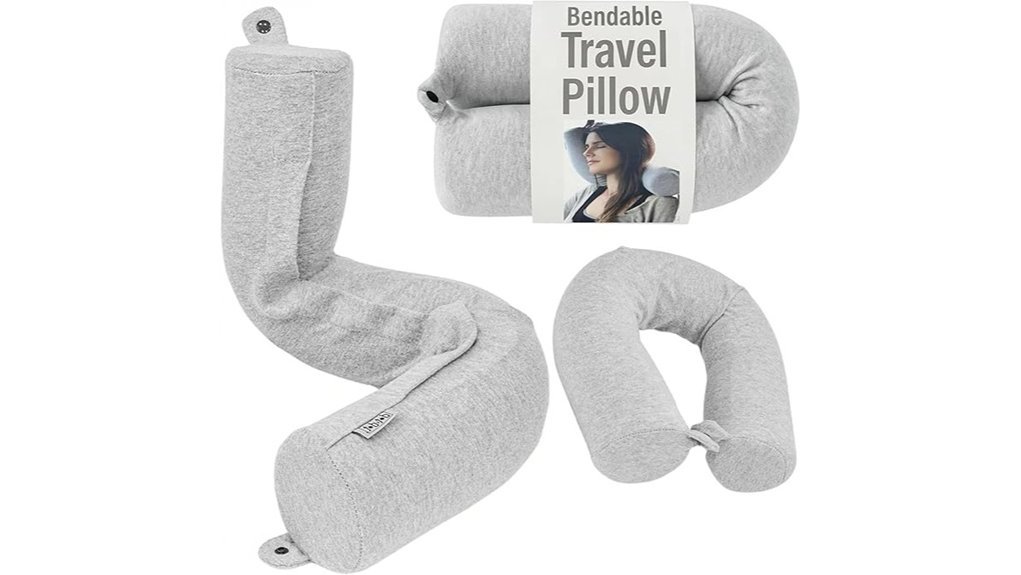
The Dot&Dot Twist Memory Foam Travel Pillow is a bendable roll rather than a fixed U-shaped collar. Its internal support can be shaped around the neck or used behind the back, under the legs, or against a shoulder, which makes it more versatile than a single-position travel pillow.
The official Dot&Dot product information describes memory-foam cushioning, a breathable machine-washable cotton cover, and a snap closure that can attach the pillow to luggage. At about 26 inches long in the listed version, the trade-off for that flexibility is a longer packed shape.
Best For: Adults who want one bendable pillow for neck, chin, lumbar, shoulder, or leg support during travel or at home.
Pros:
- Twistable design lets you change the support shape for different seating positions.
- Memory foam provides cushioning while the internal structure holds the chosen curve.
- Machine-washable cotton cover and snap closure improve cleaning and carrying.
Cons:
- The long roll can be less compact than a small wrap-style travel pillow.
- It may take a few tries to find the most comfortable shape for your seat.
- Its size and firmness may feel oversized for smaller users.
Memory Foam Neck Travel Pillow with Washable Cover
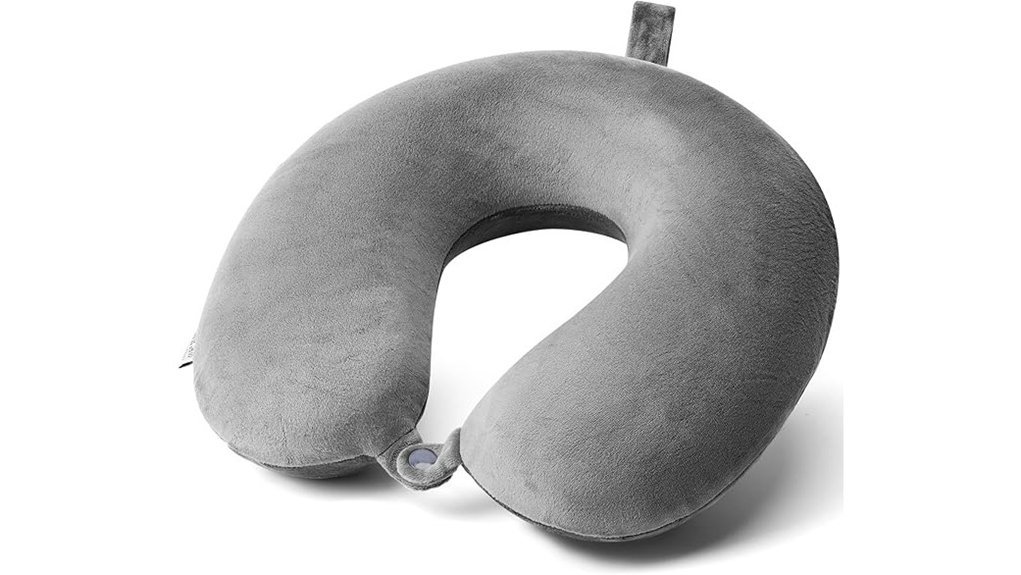
This XinYiSheng travel pillow uses a raised-lobe memory-foam shape intended to support the sides of the head and neck while you sit upright. The listing describes 100% pure memory foam, a zip-off velour cover, an adjustable rope closure, a foldable build, and an included carrying bag.
The design works like a familiar contoured U-shaped pillow, so it is easy to understand if you do not want a headrest strap or scarf-style support. As with other dense foam collars, the trade-off is that the fixed contour may not match every neck shape or preferred firmness.
Best For: Travelers and commuters who want a traditional contoured memory-foam pillow with a removable washable cover.
Pros:
- Raised-lobe memory foam provides structured side support for upright rest.
- Zip-off velour cover can be removed for machine washing.
- Adjustable rope and carrying bag make fit and transport more convenient.
Cons:
- Firm contour may feel too rigid for people who prefer softer support.
- Memory foam is bulkier than most inflatable alternatives.
- The adjustable rope may need repeated tuning to find a comfortable fit.
Trtl Neck Support Travel Pillow (Black)
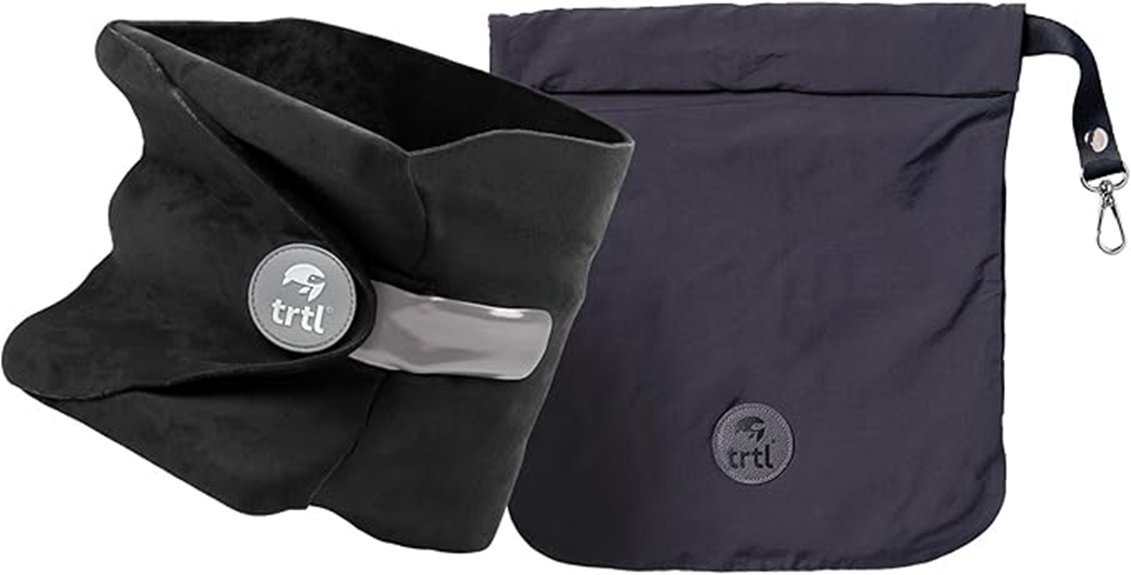
Trtl replaces the classic foam collar with a curved internal support wrapped in soft fleece. The current Trtl product page lists the pillow at 4.7 ounces (133 g) and 8.7 × 9.5 × 3.6 inches. You place the support against one side of the neck and wrap the fabric around it to hold the head more upright.
For cleaning, Trtl says to remove the internal support and machine wash the wrap on a cold cycle. The same official page currently advertises a 100-day money-back guarantee. This is a strong option when low weight and packability matter more than the plush feel of thick memory foam.
Best For: Frequent travelers who want lightweight, compact head and neck support without a bulky U-shaped pillow.
Pros:
- Internal support provides structure while the wrap stays relatively light and compact.
- At 4.7 ounces, it adds little weight to a carry-on.
- Removable support lets you machine wash the fleece wrap on a cold cycle.
Cons:
- It feels more like a supported wrap than a plush traditional pillow.
- Comfort depends on positioning the support correctly against your neck and jaw.
- Users who want equal cushioning on both sides may prefer a full collar.
Memory Foam Travel Neck Pillow with 360° Support

Asteraty’s travel pillow uses a rounded 360° memory-foam shape to surround the neck and support the chin and jaw while you sit upright. The listing describes high-density slow-rebound foam, a breathable removable cover, a zippered outer layer, and a storage bag for packing.
This is the type of design to consider if you want continuous support around the neck rather than a one-sided brace or open U-shape. The main question is fit: a round collar can feel secure to one traveler and restrictive to another, so neck circumference and preferred firmness matter.
Best For: Travelers who want a compact memory-foam collar with support around the full neck for planes, cars, trains, or office rest.
Pros:
- 360° shape supports the neck, chin, and jaw from several directions.
- Slow-rebound memory foam conforms to the neck while retaining structure.
- Removable zippered cover and storage bag simplify cleaning and packing.
Cons:
- A new memory-foam odor may be noticeable when first unpacked.
- Round construction may feel too enclosing for some sleepers.
- It remains more structured than a soft fiber-filled or inflatable pillow.
How to Choose a Travel Pillow Manufacturer for Plane-Use Products
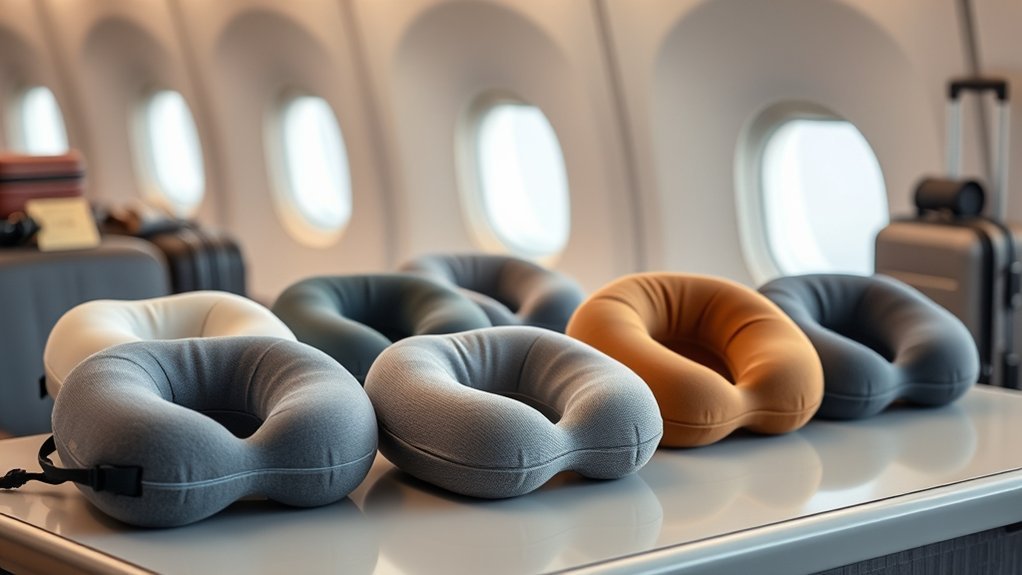
Choosing a travel pillow manufacturer starts with a clear product specification, not a catalog photo. You need to verify the materials, support geometry, cleaning method, packability, sample consistency, labeling, and quality system that apply to the exact product you plan to sell. A useful factory should be able to document those details before mass production.
Material Quality
Material quality affects skin feel, heat buildup, compression recovery, odor, cleaning, and long-term shape retention. For memory foam, ask the supplier to identify the foam type, density or firmness specification it will hold during production, and how the foam recovers after being compressed for shipping. For fabric, define fiber content, hand feel, breathability, color, zipper or closure quality, and wash instructions.
Do not accept a certification logo by itself. OEKO-TEX STANDARD 100 is a textile label based on testing for harmful substances, while CertiPUR-US applies to flexible polyurethane foam and covers content, emissions, and durability criteria. In each case, verify that the certificate or directory entry actually covers the material and supplier being quoted.
Ergonomic Support
Ergonomic support should be evaluated in the posture the pillow is meant to serve. For an airplane neck pillow, that usually means upright sitting with limited recline, different shoulder widths, and the possibility of the head falling forward or to one side. A prototype should be checked for chin clearance, side support, rear thickness, pressure points, and whether a closure stays comfortable when tightened.
For headrest-mounted designs, test more than one headrest shape and strap position. For wrap or collar designs, test more than one neck size. The goal is not to promise treatment for neck pain; it is to confirm that the geometry supports the intended posture without creating obvious pressure or interference.
Portability Features
Portability is part of the product specification, not an afterthought. Define the finished pillow weight, compressed dimensions, storage-bag size, attachment method, and how quickly the pillow must recover after being packed. A pillow can feel excellent in a sample room and still fail as a travel product if it consumes too much carry-on space or stays misshapen after compression.
If the design uses buckles, snaps, straps, or zippers, include those parts in packing and recovery tests. Compression can load seams and hardware in ways that normal use does not. A manufacturer should be able to reproduce the same packed size and recovery behavior across production lots.
Easy Maintenance
Cleaning instructions need to match the actual construction. Removable machine-washable covers are common on memory-foam pillows because the foam core itself often should not go in a washing machine. Other designs, such as BCOZZY, are sold as fully machine washable. Your care label and product listing should make that difference clear.
For U.S. consumer sales, pillows and cushions fall within the Federal Trade Commission’s textile-labeling guidance. The FTC’s textile labeling guide explains requirements involving fiber content, manufacturer or dealer identity, and country of origin for covered textile products. Confirm the rules that apply to your exact product and market before printing packaging.
Included Accessories
Eye masks, earplugs, carrying bags, hoods, and attachment straps can make a travel pillow more useful, but each extra part adds another material, supplier, inspection point, and packaging requirement. Decide whether the accessory is essential to the product concept or simply adds cost and complexity.
For a private-label order, specify accessory color, material, dimensions, logo placement, packaging position, and acceptable defects before the sample is approved. If the pillow and accessories are sold as one kit, inspect the complete kit rather than checking the pillow alone.
Quality Management, Samples, and Production Control
A strong manufacturer should be able to turn your approved sample into a repeatable production specification. Keep a signed or otherwise controlled “golden sample,” define the materials and dimensions that may not change without approval, and agree on how incoming materials, sewing, foam molding or cutting, final assembly, cleaning, and packing will be checked.
ISO 9001 can be relevant when you are assessing a supplier’s quality-management system. ISO 9001:2026, published on September 16, 2026, is the current edition. ISO also states that certification is not mandatory, so an ISO 9001 certificate should be treated as evidence about the supplier’s management system, not as a product-specific safety or comfort approval.
Customization, MOQ, and Lead Time
Manufacturers commonly offer changes to fabric, color, logo, label, closure, storage bag, packaging, and sometimes the foam or support geometry. The more structural changes you make, the more important prototype approval becomes because a small change in foam firmness, collar height, strap position, or cover tension can change how the pillow feels.
The original draft gives a typical bulk production lead time of 20 to 45 days. Treat that as a planning range, not a guaranteed industry standard. Your actual schedule depends on material availability, custom tooling or printing, sample approval, order quantity, factory capacity, inspection, packaging, and shipping terms. Put the agreed production date and what starts the clock into the purchase order.
Frequently Asked Questions
What Certifications Should a Travel Pillow Manufacturer Provide?
There is no single universal certification that makes a travel pillow acceptable for every market. Ask for documents that match the product and destination, such as textile chemical testing, applicable labeling records, foam certification when claimed, and quality-system evidence. Verify certificate numbers, scope, holder name, product coverage, and current validity before relying on them.
How Are Travel Pillows Tested for Airline Seat Compatibility?
About 70% of travelers prefer compact pillows, so compatibility starts with seat size, headrest shape, recline space, and packed volume. A useful prototype test checks economy-style and other upright seats, different body sizes, forward and side head movement, neighboring-seat clearance, strap stability, and whether the pillow remains comfortable without interfering with normal seat use.
Can Manufacturers Customize Travel Pillows With Logos?
Yes. Travel pillow manufacturers commonly offer logo embroidery, woven labels, printed patches, or printing on covers and storage bags. The available method depends on the fabric, artwork, quantity, and production process. Approve a physical or production-representative sample that shows logo size, color, placement, stitching or print quality, and packaging before mass production.
What Is the Typical Production Lead Time for Bulk Orders?
A typical production lead time is often quoted at 20 to 45 days, but it varies by factory and order. Custom fabric, foam, logos, tooling, packaging, peak-season capacity, and sample revisions can extend the schedule. Confirm when lead time begins, what approvals are required first, and the committed completion date in writing before placing the bulk order.
Which Materials Are Best for Hypoallergenic Travel Pillows?
No single fabric or foam is automatically hypoallergenic for every person. A better sourcing approach is to use washable skin-contact covers, define fiber content clearly, avoid unsupported allergy claims, and request relevant chemical or material testing. If you specify certified textiles or foam, verify that the exact material in your production order is covered by the certification.
Is OEKO-TEX or CertiPUR-US Required for a Travel Pillow?
Not automatically. OEKO-TEX STANDARD 100 is a voluntary textile certification for harmful-substance testing, while CertiPUR-US is a voluntary certification program for flexible polyurethane foam. Either can support a sourcing specification when relevant, but neither replaces market-specific labeling, chemical, consumer-product, or other legal requirements that apply to the finished item.
What Should You Approve Before Mass Production?
Approve the exact product specification and a production-representative sample before mass production. Check dimensions, support feel, foam or fill, fabric, stitching, closures, zipper quality, wash instructions, logo placement, labels, accessories, compressed pack size, storage bag, and retail packaging. Record any allowed tolerances so the factory knows what can vary and what cannot.
Sources
- SARISUN Model 001: headrest-mounted pillow and eye-mask design details.
- BCOZZY Travel Neck Pillow: double-support positions and machine-washable construction.
- Trtl Travel Pillow: current weight, dimensions, cleaning instructions, and guarantee.
- OEKO-TEX STANDARD 100: textile testing and certification scope.
- CertiPUR-US: flexible polyurethane foam certification scope.
- Federal Trade Commission textile labeling guide: U.S. labeling guidance for covered textile products, including pillows and cushions.
- ISO 9001:2026: current quality-management-system standard and certification context.