If you’re planning a visit to the Grand Canyon’s North Rim in 2026, plan for a very different experience from past years. The North Rim is open for seasonal day use, scenic drives, camping, and selected trails, but recovery from the 2025 Dragon Bravo Fire has changed lodging, water, trail access, and visitor services. This guide explains what is open, where to stay, which routes and hikes make sense now, and how to prepare for the North Rim’s remote, high-elevation conditions.
Quick Answer
The Grand Canyon North Rim is open for the 2026 season, but services are limited. There is no in-park lodging and no potable water at the rim. The campground, scenic roads, Cape Royal area, Point Imperial, and North Kaibab Trail are open, while several classic rim trails remain closed.
Key Takeaways
- 2026 access: Highway 67 and the paved scenic roads are open, but temporary weather or repair closures can still occur.
- No in-park lodging: Grand Canyon Lodge was destroyed in the 2025 Dragon Bravo Fire, so overnight lodge accommodations are outside the park.
- Bring water: potable water is not available at the North Rim in 2026; bottled and gallon water can be purchased at the General Store during operating hours.
- Trail closures matter: Bright Angel Point, Widforss, Transept, Uncle Jim, and the west section of Ken Patrick Trail are closed in 2026.
- Plan ahead for October: a section of the North Kaibab Trail is scheduled to close late on October 15, 2026, preventing traditional rim-to-rim hikes beginning October 16.
At a Glance
| Best 2026 Window | May 15 to October 15 for the main season; campground June 1 to October 15 |
| Difficulty | Easy scenic drives to strenuous inner-canyon hiking |
| Essentials | Potable water, food, layers, sun protection, offline map, full fuel tank, emergency gear |
| Entrance Cost | Standard private vehicle pass is $35 for seven days; other pass rules may apply |
North Rim Vs South Rim: Which One Is Right for You?
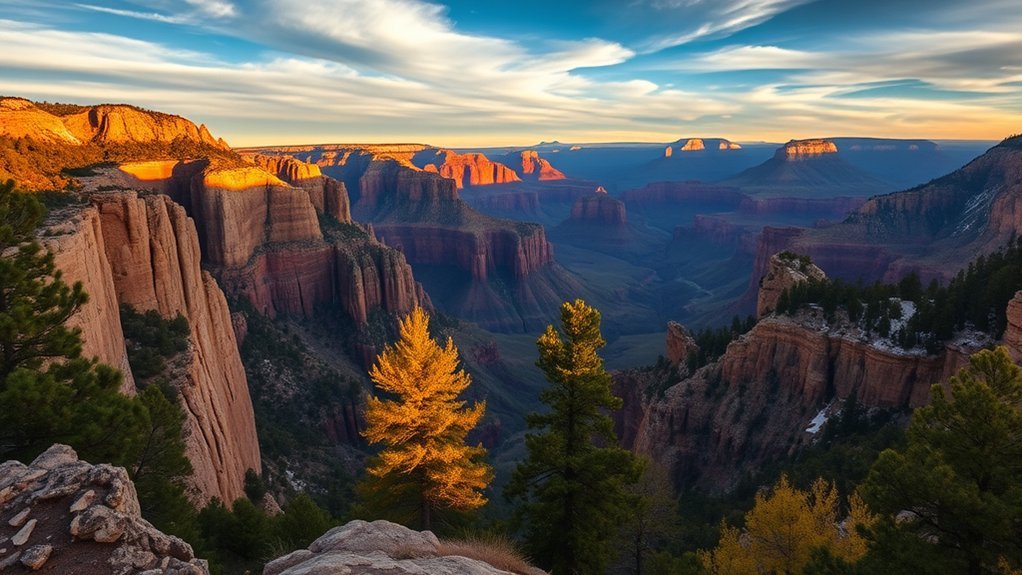
Both rims offer huge canyon views, but the experience is different. The South Rim is the easier choice for year-round access, lodging, restaurants, shuttle buses, visitor centers, and the largest range of services. The North Rim averages about 8,000 feet in elevation, roughly 1,000 feet higher than the South Rim, and receives only about 10% of Grand Canyon visitors. Its higher elevation brings cooler summer weather, forest scenery, and a quieter feel.
In 2026, the contrast is even stronger. The South Rim remains the service-heavy option, while the North Rim is operating as a remote, limited-services destination during post-fire recovery. Choose the North Rim if you are comfortable carrying your own water and food, driving longer distances, checking closures, and adapting your plans. Choose the South Rim if you need easier logistics, extensive lodging, accessible visitor services, or a trip that is less dependent on seasonal conditions.
North Rim 2026 Status: What Is Open and Closed?
The North Rim reopened for the 2026 season on May 15. According to the National Park Service North Rim status page, Highway 67, Cape Royal Road, Point Imperial Road, the North Rim Campground, and the North Kaibab Trail are open, subject to temporary closures caused by weather, repairs, fire conditions, or trail work.
The 2025 Dragon Bravo Fire caused major damage to the developed North Rim. The Grand Canyon Lodge and former North Rim Visitor Center were destroyed, and overnight lodge accommodations are not available inside the park in 2026. The General Store and gas station remain available on a limited basis.
- Open in 2026: North Kaibab Trail, Bridle Trail, Cape Royal Trail, Cliff Springs Trail, Cape Final Trail, Roosevelt Point Trail, Point Imperial Trail, and the east section of Ken Patrick Trail.
- Closed in 2026: Bright Angel Point Trail, Widforss Trail, Transept Trail, Uncle Jim Trail, the west section of Ken Patrick Trail, and a short affected section of the Arizona Trail near the developed area.
- North Rim Campground: open June 1 through October 15, 2026, with reservations and limited walk-up availability.
- Water: no potable tap water is available at the North Rim in 2026. Bring your own supply. Water is sold at the General Store during operating hours.
Warning: Do not arrive expecting the pre-2025 North Rim experience. Several famous trails and buildings are unavailable, and the lack of potable water makes self-sufficiency essential.
When to Visit: Seasons, Weather, and Crowds
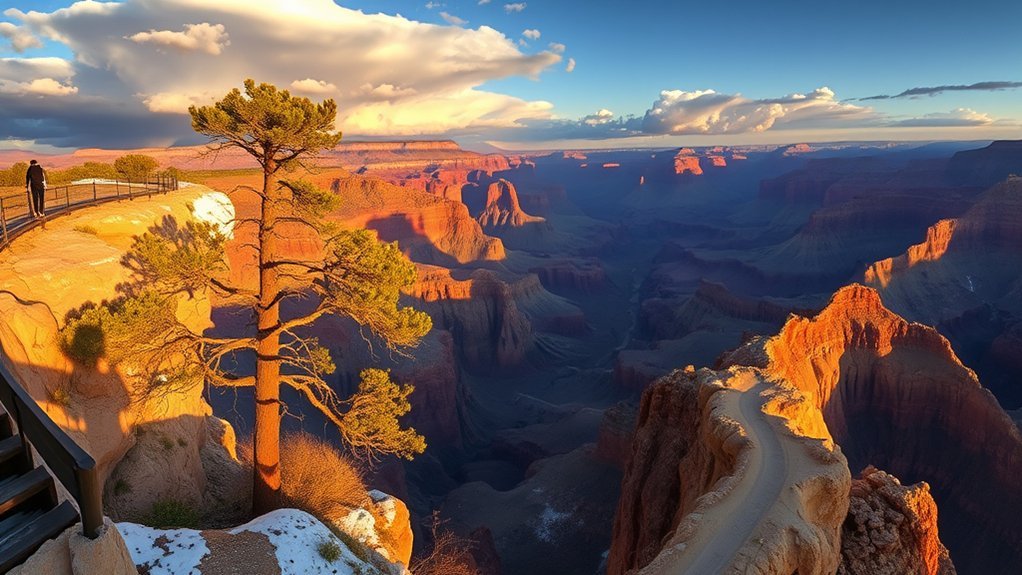
For 2026, treat May 15 through October 15 as the main North Rim visitor season. The North Rim Campground opened June 1 and is scheduled through October 15. After October 15, services become more limited and seasonal access depends heavily on weather. Vehicle access normally ends for winter after November 30, with North Rim roads closed from December 1 through May 14.
Best Months to Go
Late May through June and September through early October are strong choices if you want cooler hiking weather and fewer summer crowds. July and August offer full summer access but also bring thunderstorms, lightning, and monsoon-related flash-flood risk. Because 2026 post-fire conditions can change quickly, check the official status page shortly before leaving for the park.
If your trip depends on the North Kaibab Trail, pay special attention to October. A section between Redwall Bridge and the northern end of Cottonwood Campground is scheduled to close at 11:59 p.m. on October 15, 2026 for Transcanyon Waterline work. Traditional North Rim to South Rim and South Rim to North Rim hikes will not be possible through that section beginning October 16.
Weather and Elevation
The North Rim averages about 8,000 feet in elevation. The National Park Service weather guidance notes that summer highs are typically in the 70s°F, with much cooler nights than the inner canyon. Conditions can change quickly, and summer thunderstorms are common from July into early September.
Do not judge an inner-canyon hike by the temperature at the rim. As you descend the North Kaibab Trail, temperatures rise sharply. Carry enough water and electrolytes, protect yourself from sun exposure, and avoid committing to a long descent simply because the rim feels cool.
Crowd Levels and Timing
The North Rim receives about 10% of Grand Canyon visitors, so it generally feels quieter than the South Rim. Even so, the open 2026 viewpoints and trailheads can concentrate visitors because several traditional trails are closed. Arrive early for Cape Royal, Point Imperial, and the North Kaibab Trailhead, especially on weekends.
The North Rim is still the quieter side of Grand Canyon, but in 2026 the best trip is built around current open areas, not pre-fire itineraries.
Getting There: Driving Routes and Flying Options
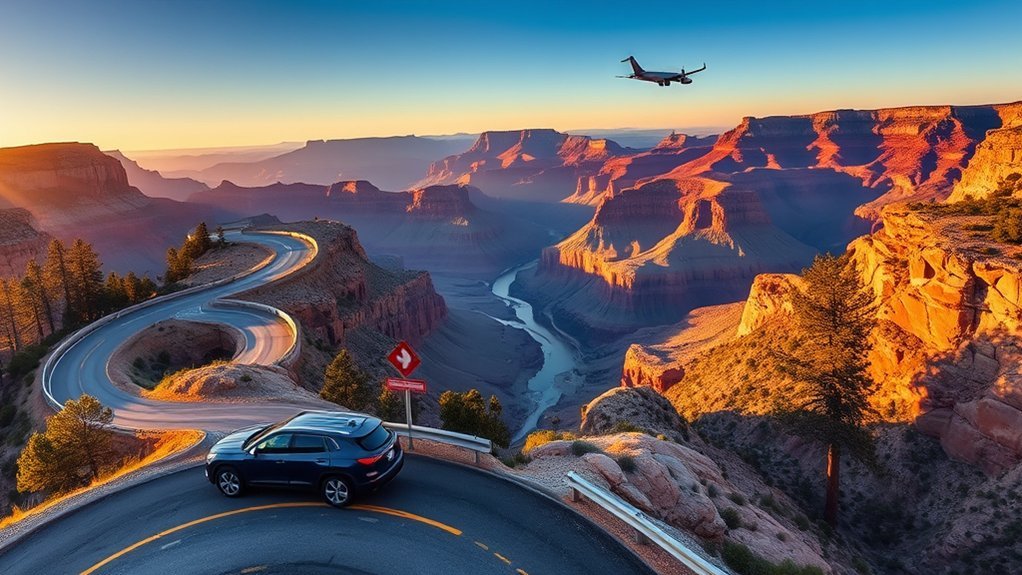
The North Rim is reached from Jacob Lake via Arizona Highway 67. The park entrance is about 30 miles south of Jacob Lake, and the developed rim area is another 14 miles beyond the entrance. The route is paved, but it is seasonal and remote.
Driving Routes and Distances
The NPS North Rim driving guide lists the drive from the South Rim at about 212 miles and the drive from Las Vegas at about 275 miles. From the South Rim, the usual route is AZ-64 to US-89, US-89A, and AZ-67. From Las Vegas, the route generally runs through southern Utah and northern Arizona before reaching US-89A and AZ-67.
Fuel is available at the North Rim gas station by pay-at-the-pump in 2026, but a remote-area trip is not the place to run low. Fill up before the final approach and carry basic vehicle emergency gear. Vehicles and vehicle-trailer combinations longer than 22 feet are restricted on Cape Royal Road and other specified North Rim roads and parking areas.
Airports and Flight Logistics
Most fly-and-drive visitors compare Las Vegas, Phoenix, Flagstaff, St. George, and Page based on airfare, rental-car availability, and the rest of their itinerary. Las Vegas has a long drive but broad flight and rental-car options. Smaller regional airports can reduce road distance but may offer fewer schedules and vehicles. Whatever airport you choose, build enough driving time for remote highways, fuel stops, weather, and daylight arrival.
Pro Tip: Download the NPS map and your driving route for offline use before leaving a town with reliable service. Cell coverage is limited across the North Rim and on many approach roads.
Park Access, Passes, and Permits
Grand Canyon National Park does not require a timed-entry reservation for general entry. A standard private-vehicle entrance pass is currently $35 and valid for seven days. Motorcycle and individual entry fees differ, and eligible annual or America the Beautiful passes may cover admission. Check the official fee page because pass rules can change.
Day hiking on ordinary park trails usually does not require a backcountry permit. Overnight backcountry use does. If you plan to camp below the rim, stay at Cottonwood Campground as part of a backcountry itinerary, or use another backcountry zone, obtain the appropriate permit in advance through the park’s backcountry system.
Tuweep/Toroweap is different. It is a remote western area, not a quick extension of the developed North Rim scenic drive. An advance day-use permit or backcountry permit, park pass, photo ID, and vehicle plate information are required. Do not drive there assuming your normal North Rim entrance alone covers the visit.
Where to Stay: In-Park Lodging and Nearby Options
The biggest 2026 lodging change is simple: there is no overnight lodge accommodation inside the North Rim developed area. Grand Canyon Lodge was destroyed by the Dragon Bravo Fire in July 2025. Your overnight choices are the North Rim Campground, permitted backcountry camping, or lodging outside the park.
In-Park Lodging Options
For 2026, the North Rim Campground is the main developed overnight option inside the park. It reopened June 1 and is scheduled through October 15. If you are backpacking, Cottonwood Campground is open for permitted backcountry itineraries along the North Kaibab Trail. There are no lodge rooms or cabins available inside the North Rim developed area this season.
Campground & Facilities
The North Rim Campground is operating with reduced facilities in 2026. There are no RV hookups or potable-water taps. Portable toilets are available, while showers and laundry facilities are closed for the season. Campers should bring all drinking and cooking water or buy packaged water from the nearby General Store during its operating hours.
Stage 2 fire restrictions are in effect for the 2026 season. Wood and charcoal fires are prohibited. Certain controllable LPG or liquid-petroleum devices may be allowed when used according to posted restrictions. Check current fire rules before cooking or setting up camp.
Nearby Town Accommodations
Outside the park, Kaibab Lodge and other seasonal services on the Kaibab Plateau are the closest options. Jacob Lake is about 45 miles north of the developed North Rim and provides year-round lodging, food, and fuel. Kanab, Utah is farther away but offers a larger selection of hotels, restaurants, and services for travelers combining Grand Canyon with Zion, Bryce Canyon, or other southern Utah destinations.
- In-park: North Rim Campground, June 1 to October 15, 2026
- Backcountry: Cottonwood Campground and other permitted zones where open
- Kaibab Plateau: seasonal lodge and food options outside the park
- Jacob Lake, Arizona: lodging, food, fuel, and supplies
- Kanab, Utah: widest nearby range of lodging and restaurants
Best Scenic Drives and Overlooks: Cape Royal, Point Imperial, and Toroweap
For a 2026 North Rim visit, Cape Royal Road and Point Imperial Road are the core scenic drives. Cape Royal gives you broad canyon views, Angels Window, and strong sunset potential. Point Imperial, at 8,803 feet, is the highest viewpoint on the North Rim and looks toward the eastern Grand Canyon and Painted Desert. Roosevelt Point and Walhalla Overlook add shorter stops along the scenic-road system.
The roads are paved, but they are narrow and winding. Vehicles or vehicle-trailer combinations over 22 feet are restricted on the scenic roads. Allow more time than the mileage suggests, especially if you stop for short walks and photography.
Toroweap/Tuweep should be treated as a separate expedition. The NPS Tuweep guidance requires an advance permit and describes difficult high-clearance dirt-road access from the AZ-389 area. There is no water, fuel, food, lodging, Wi-Fi, or cell service at Tuweep. The overlook drops roughly 3,000 feet to the Colorado River, and the exposed cliff edge has no standard developed-rim safety experience.
Note: Do not combine Toroweap with Cape Royal and Point Imperial as if they are stops on one North Rim loop. They use completely different access routes and require very different preparation.
Top Hikes and Backcountry Routes: Day Hikes to Multi-Day Trips
Many older North Rim itineraries recommend Bright Angel Point and Widforss Trail. Those routes are closed in 2026, so build your hiking day around trails currently listed open on the NPS North Rim day-hiking page.
- Cape Royal Trail: about 0.6 mile round trip; easy paved walk with canyon, Angels Window, and Colorado River views.
- Roosevelt Point Trail: about 0.2 mile round trip; short woodland loop with viewpoints and benches.
- Cape Final Trail: about 4 miles round trip; a moderate forest walk to an expansive rim viewpoint.
- Point Imperial Trail: about 4 miles round trip; generally easy terrain through a high-elevation landscape.
- Cliff Springs Trail: about 1 mile round trip; short forested route near Cape Royal Road. Do not drink untreated spring water.
- North Kaibab Trail: the only maintained trail descending into the canyon from the North Rim. A short turnaround at Coconino Overlook or Supai Tunnel is far more realistic for most day hikers than a deep-canyon objective.
The North Kaibab Trail drops almost 6,000 feet from rim to river. Roaring Springs is roughly 9.4 miles round trip with about 3,050 feet of elevation change and can take a full day. The Colorado River is about 14 miles one way from the North Rim, so a rim-to-river-to-rim day hike is not recommended.
Post-fire hazards add another layer in 2026. The upper North Kaibab Trail passes through the Dragon Bravo burn scar, where rain and wind can increase the risk of rockfall, flash flooding, debris flows, and falling trees. Trail work may also create temporary delays or closures.
Choose anything from short paved walks to strenuous inner-canyon descents, but in 2026 your first filter should be current trail status, then fitness, weather, water, and turnaround time.
- Cape Royal Trail for an easy viewpoint walk
- Roosevelt Point Trail for a very short scenic stop
- Cape Final Trail for a moderate half-day hike
- North Kaibab to Coconino Overlook or Supai Tunnel for a below-rim experience
- Overnight North Kaibab itineraries only with the required permit and current water/closure checks
Photography Tips: Sunrise, Sunset, and Low-Crowd Spots
For sunrise and sunset in 2026, focus on Point Imperial, Cape Royal, Roosevelt Point, and Walhalla-area viewpoints that are open. Bright Angel Point and the former Grand Canyon Lodge veranda should not be treated as normal photo stops this season because the Bright Angel Point Trail is closed and the lodge was destroyed.
Arrive 30 to 60 minutes before the best light so you can park, walk safely, and choose a composition before darkness. Bring a headlamp and warm layer for dawn or dusk. A wide-angle lens works well for broad canyon scenes, while a telephoto lens can isolate distant temples, cliffs, and changing light. Bracketing exposures can help when the canyon floor is dark but the rim is brightly lit.
Stay behind barriers and away from unstable edges. At Tuweep, the cliff environment is much more exposed and requires a separate permit and remote-area plan.
Safety, Road Conditions, and Wilderness Preparation
The North Rim’s elevation, limited services, and post-fire recovery make conservative planning especially important in 2026. Before departure, check the NPS status page for road, trail, water, fire, and weather updates. Carry more water than you expect to need, plus food, layers, sun protection, a headlamp, offline maps, a spare tire, and basic emergency supplies.
- Bring your own potable water for the rim; do not depend on taps in 2026.
- Keep your fuel tank well above empty on remote approach roads.
- Check Stage 2 fire restrictions before camping or cooking.
- Stay out of burn-scar drainages when storms threaten.
- Turn around early on inner-canyon hikes if heat, fatigue, storms, or water use are worse than planned.
- Leave your itinerary with someone who will notice if you do not return.
Cell service is limited. In an emergency, call 911 where service is available. Wildlife, including bison and deer, should be given plenty of space. Pets are restricted on most park trails; the Bridle Trail and Arizona Trail have different rules than many other North Rim trails, so check the current pet guidance before bringing a dog.
Warning: Summer rim temperatures can feel comfortable while the inner canyon is dangerously hot. A cool start at 8,000 feet does not make a deep North Kaibab hike safe in the middle of the day.
Dining, Ranger Programs, Mule Rides, and Visitor Services
Visitor services are much more limited than they were before the 2025 fire. The Grand Canyon Lodge dining room is not operating because the lodge was destroyed. In 2026, the North Rim General Store near the campground sells dry goods, grab-and-go food, and packaged water, and the gas station provides pay-at-the-pump unleaded and diesel fuel.
The former North Rim Visitor Center was also destroyed. The North Rim Backcountry Information Center operates on a limited daily schedule near the campground. Ranger-program schedules are not comparable to the pre-fire lodge-and-visitor-center season, so use current NPS listings rather than assuming daily nature walks or evening talks will be offered.
Traditional North Rim mule-ride descriptions are also outdated for 2026. NPS states that stock use on the North Kaibab Trail is suspended for the season. Do not build a North Rim itinerary around the older one-hour or Supai Tunnel mule rides unless the park or authorized concessioner publishes a current reopening.
A Practical One-Day North Rim Itinerary for 2026
If you have one full day, keep the plan simple and use open areas:
- Morning: arrive early with a full water supply and drive to Point Imperial for cooler temperatures and clearer early light.
- Late morning: continue along the scenic-road system, stopping at Roosevelt Point and Walhalla-area overlooks.
- Midday: eat your own packed lunch. Do not rely on a full-service restaurant at the rim.
- Afternoon: choose an open hike such as Cape Final, Cliff Springs, or the short Cape Royal Trail based on heat, storms, and your fitness.
- Evening: watch sunset at Cape Royal if weather and road conditions are safe, then drive carefully after dark.
If your main goal is the North Kaibab Trail, make that the focus of the day instead of combining it with a full scenic-road itinerary. Deep descents take longer to climb out than many first-time visitors expect.
Frequently Asked Questions
How Much Time Do You Need to See the Grand Canyon North Rim?
Allow at least half a day for one or two viewpoints and a short walk. A full day is better for Point Imperial, Cape Royal Road, several overlooks, and an open trail. Two days gives you more flexibility for weather, photography, and a longer hike.
Is It Worth Going to the North Rim of the Grand Canyon?
Yes, especially if you value quieter viewpoints, cooler high-elevation forest, and scenic driving. In 2026, however, you should be comfortable with limited services, no in-park lodge, no potable rim water, and several trail closures.
What Can You Do at the North Rim of the Grand Canyon in 2026?
Drive to Point Imperial and Cape Royal, stop at Roosevelt Point and Walhalla-area viewpoints, hike open trails such as Cape Royal, Cape Final, Point Imperial, or part of North Kaibab, camp at the North Rim Campground, and photograph sunrise or sunset from open viewpoints.
Why Does the Grand Canyon North Rim Close in Winter?
The North Rim receives heavy winter snow, and Highway 67 and park roads are not maintained for normal visitor traffic during the winter closure. Roads are generally closed to vehicles from December 1 through May 14, with seasonal reopening dependent on conditions.
Is Grand Canyon Lodge Open in 2026?
No. Grand Canyon Lodge was destroyed during the Dragon Bravo Fire in July 2025. The National Park Service says overnight lodging is not available inside the North Rim developed area during the 2026 season.
Is Drinking Water Available at the North Rim in 2026?
Potable tap water is not available at the North Rim in 2026. Bring enough water for your visit. The General Store sells single bottles and gallon containers during operating hours, but you should not rely on store inventory as your only water plan.
Conclusion
The Grand Canyon North Rim is still worth the drive in 2026, but the trip now rewards visitors who plan around current conditions rather than old guidebooks. Visit during the main seasonal window, bring your own potable water and food, use open trails and viewpoints, reserve camping or outside lodging early, and check the latest NPS status before leaving. With realistic expectations, Cape Royal, Point Imperial, the open North Rim trails, and the quieter forest setting can still deliver an unforgettable Grand Canyon experience.
Sources
- National Park Service: Status of the North Rim — 2026 reopening, trail closures, lodging loss, water, fire restrictions, campground, and services
- National Park Service: Travel to the North Rim — seasonal access, road closures, and driving distances
- National Park Service: Day Hiking — current North Rim trail status, distances, and difficulty
- National Park Service: Fees & Passes — entrance fees and pass rules
- National Park Service: Weather and Climate — North Rim elevation, temperatures, storms, and seasonal conditions
- National Park Service: Tuweep — advance permits, remote-road requirements, services, and Toroweap safety