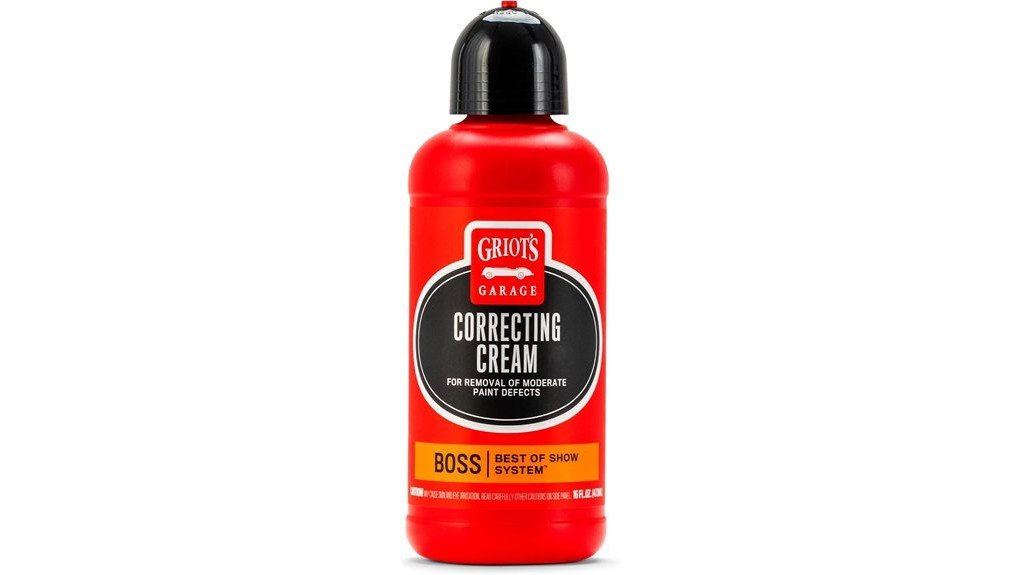
Swirl marks, light scratches, water spots, and mild oxidation can make otherwise healthy paint look flat and neglected. Griot’s Garage BOSS Correcting Cream is designed for this middle ground, where a finishing polish may be too mild but a heavy-cut compound may remove more clear coat than you need. This review explains its correction range, pad options, working method, and limits so you can decide whether it suits your paint and skill level. Its long working cycle and clean wipe-off are major strengths, but results still depend on surface preparation, pad choice, and technique.
Quick Verdict
Rating: 8.5/10
Best For: DIY detailers and professionals correcting moderate clear-coat defects with a dual-action or compatible orbital polisher.
Bottom Line: BOSS Correcting Cream offers useful cut, long working time, low dust, and an easy wipe-off. It is less suitable for deep scratches, failing clear coat, or users who want a simple wipe-on product.
Key Specifications
| Specification | Detail |
|---|---|
| Brand | Griot’s Garage |
| Product | BOSS Correcting Cream |
| Amazon model | B120P |
| Manufacturer item number | B120 |
| ASIN | B0102R8430 |
| Amazon package | 16 fl oz, pack of 1 |
| Manufacturer sizes | 16 ounces and gallon |
| Product type | Medium-cut automotive paint correcting cream |
| Target defects | Heavy swirls, light clear-coat scratches, water spots, and oxidation in the moderate correction range |
| Formula behavior | High lubricity, extended buffing cycle, low dust, and easy wipe-off |
| Compatible tools | Hand use and compatible orbital polishers, including Griot’s G8, G9, G15, and G21 systems |
| Recommended pad approach | BOSS Correcting Foam Pad, with firmer or softer pads used to adjust cut and finish |
| Finish | Wax-ready on many paints, though a finishing step may still be needed |
What Is Griot’s Garage BOSS Correcting Cream?
Griot’s Garage BOSS Correcting Cream is a medium-cut polish for removing or reducing defects in automotive clear coat. It sits between the brand’s more aggressive Fast Correcting Cream and its finer Perfecting Cream. The formula uses fine abrasives and high lubrication to keep the pad moving smoothly through a longer polishing cycle.
The product is designed for moderate correction rather than body repair. It can improve heavy wash swirls, light scratches, water spots, oxidation, haze, and lost clarity when those defects remain within the polishable portion of the clear coat. It cannot rebuild missing paint, repair peeling clear coat, or safely erase every scratch that reaches the color coat, primer, or metal.
Who Should Buy It?
Best For
- DIY detailers correcting visible swirls and light clear-coat scratches.
- Owners who want a cleaner, longer-working alternative to a dusty heavy compound.
- Professional detailers who adjust cut and finish through pad selection.
Skip If
- Your paint only needs a wax, sealant, or very light finishing polish.
- The clear coat is peeling, badly thinned, or damaged by deep scratches.
- You are not prepared to wash, decontaminate, test, and polish in controlled sections.
Before You Buy: This is an abrasive paint-correction product, not a scratch-filling glaze or quick-detail spray. A deep scratch that catches your fingernail may only become less noticeable, and damaged clear coat may require professional refinishing.
Feature-by-Feature Review
Correction Ability and Finish Quality
The main reason to choose BOSS Correcting Cream is its moderate correction range. Griot’s positions it for heavy swirls, light scratches, water spots, and oxidation. On paint that responds well to a medium-cut foam pad, it can restore clarity without forcing you to start with the brand’s most aggressive cream.
The final appearance depends on paint hardness, pad type, machine movement, pressure, and how clean the pad stays. On many finishes, the product can leave a wax-ready surface. Softer or darker paint may show fine haze under inspection lighting, so you may need a second pass with BOSS Perfecting Cream and a softer pad.
High-Lubricity Formula and Working Time
The rich, high-lubricity formula gives you an extended buffing cycle. That extra working time helps you complete several controlled passes before the residue becomes difficult to manage. It also reduces the tendency to dry-buff the surface when you use the recommended amount and avoid hot panels.
Long working time does not mean you should keep polishing indefinitely. Stop when the section is corrected, the polish film changes, or the pad begins to load with residue. Continuing after the useful cycle adds heat and may reduce finish quality.
Low Dust and Easy Wipe-Off
Dust control is one of this cream’s strongest practical advantages. The formula is designed not to dust out during normal buffing, which can reduce cleanup around panel gaps, trim, glass, and badges. Residue should wipe away with a clean microfiber towel soon after you finish the section.
You can still create smearing or difficult wipe-off by using too much product, polishing a hot surface, or allowing residue to sit too long. A clean towel and a thin, controlled product film make the removal step easier.
Pad Flexibility and Tool Compatibility
Griot’s BOSS system lets you change the correction level through pad choice. The Correcting Foam Pad is the balanced starting point for moderate defects. A firmer pad can increase cut, while a softer pad can lower aggressiveness and improve finish quality on paint that marks easily.
The manufacturer’s polishing guide lists hand use as well as the G8, G9, G15, and G21 orbital polishers. A machine gives you more consistent correction across a full vehicle, but hand use can help on small or tight areas. Whatever tool you choose, follow its instructions and keep the pad flat on the surface.
One-Step Potential and Its Limits
This cream may serve as a one-step correction product when the paint has moderate defects and finishes clearly after the test section. That can save time because you correct the paint and prepare it for protection in one polishing stage.
It is not a guaranteed one-step solution for every vehicle. Soft paint may need refining, hard paint may need a more aggressive first step, and deep defects may remain visible. The test spot determines the process, not the product label alone.
How to Use It Correctly
- Wash and inspect the paint. Remove loose dirt, road film, and old residue. Dry the vehicle fully.
- Decontaminate when needed. Use suitable chemical and mechanical decontamination if the surface feels rough or contains bonded particles.
- Work in shade on cool paint. Avoid direct sun and hot panels because heat shortens working time and makes residue harder to remove.
- Shake the bottle well. Select a pad that matches the defect level and the sensitivity of the paint.
- Prime the pad. The label directs you to cover the full face of a fresh pad before the first section.
- Polish a small test section. Work about a 2-foot by 2-foot area with moderate pressure and slow arm speed for three to four passes.
- Wipe promptly. Remove residue with a clean microfiber towel and inspect the section under strong lighting.
- Use less on later sections. Add three or four drops for subsequent sections instead of repeatedly saturating the pad.
- Keep the pad clean. Brush or blow residue from the pad face regularly. The label also recommends switching to a fresh pad after roughly two to three panels to maintain performance.
- Protect the corrected paint. Apply wax, sealant, or a compatible coating after the finish meets your standard.
Pro Tip: Start with the least aggressive pad and cream combination likely to work. Inspect your test spot after wiping the residue, then increase pad firmness only if the defects remain and the paint condition allows it.
Compatibility and Paint Safety
BOSS Correcting Cream is intended for automotive paint surfaces. Mask delicate trim, sharp edges, textured plastic, emblems, and areas where the pad may catch. Edges and raised body lines may have less paint coverage, so reduce pressure and avoid unnecessary polishing in those areas.
Do not polish dirty paint or use a contaminated pad. Trapped grit can create new scratches while you are trying to remove old ones. If the vehicle has been repainted, if the clear coat is failing, or if you are unsure how much paint remains, ask a qualified detailer or body shop to inspect it before aggressive correction.
How It Performs in Real Use
For Wash-Induced Swirls
On a daily-driven vehicle with visible circular wash marks, a correcting foam pad gives this cream a practical balance of cut and finish. A test section should show whether one stage is enough or whether a finer polish is needed for maximum clarity.
For Water Spots and Mild Oxidation
The cream can improve etched-looking water spots and mild oxidation when the damage remains within the workable clear coat. Mineral deposits should be removed before polishing, and severe etching may need a different process or professional evaluation.
For a One-Step Daily-Driver Detail
Owners who want a clear improvement without chasing every isolated defect may get the most value from a one-step approach. Correct the larger panels, inspect the finish, then protect the paint. This approach favors a strong visual improvement over maximum defect removal.
For Soft or Dark Paint
Soft and dark paint can reveal micro-marring more easily under direct light. Use a less aggressive pad, reduce pressure, keep the pad clean, and check the finish after each section. A finishing polish may be necessary even when the cream removes the original defects.
Buyer Feedback Themes
Feedback described in the original review and current retailer comments points to the same strengths: useful correction on light-to-moderate defects, long working time, little dust, and manageable wipe-off. Users also note that pad choice changes the result, which supports the manufacturer’s system-based approach.
The most important limitation is consistency. A combination that finishes well on one clear coat may haze another. You should treat buyer feedback as a guide, then confirm the process on your own test section.
Pros and Cons
Pros
- Targets heavy swirls, light scratches, water spots, and moderate oxidation.
- Long working cycle gives you time for controlled polishing passes.
- Low-dust behavior reduces cleanup around trim and panel gaps.
- Easy wipe-off helps speed up section-by-section inspection.
- Pad flexibility lets you adjust cut and finish for different paint conditions.
Cons
- Results require correct preparation, pad choice, machine control, and inspection.
- Deep scratches and failing clear coat remain outside its safe correction range.
- Some paint finishes may need a second refining step after correction.
Is It Worth the Price?
BOSS Correcting Cream fits the mid-range to premium part of the enthusiast polishing market. Its value comes from the combination of moderate cut, extended working time, low dust, and pad-based flexibility rather than from being the cheapest bottle on the shelf.
It offers the best value when you already own a suitable polisher, several clean pads, microfiber towels, and paint-protection products. It is less economical for someone who only wants to hide light swirls temporarily or who must buy a complete machine-polishing setup for one small repair.
How It Compares to Alternatives
Griot’s BOSS Fast Correcting Cream is the stronger option for severe defects, while BOSS Perfecting Cream is better for fine defect removal and final gloss. BOSS Correcting Cream sits between them and makes the most sense when your paint needs more than finishing polish but does not justify starting with the most aggressive liquid.
Products such as 3D ONE, Meguiar’s M105, and Chemical Guys VSS are also common comparison points. The useful buying difference is process: choose the product whose cut, finishing ability, pad system, and working behavior match your paint and the number of polishing stages you are willing to complete.
Frequently Asked Questions
Can BOSS Correcting Cream remove deep scratches?
It is designed for light scratches and moderate clear-coat defects, not deep damage. A scratch that catches your fingernail may only become less visible, and damage through the clear coat may require professional refinishing.
Can you use it with a dual-action polisher?
Yes. It works with compatible orbital polishers, and the manufacturer lists the G8, G9, G15, and G21 systems. Match the pad to the defect level and follow the polisher’s safety instructions.
Can you apply it by hand?
The manufacturer’s guide includes hand use. Hand polishing is practical for small areas, but a compatible machine usually produces faster and more even correction across large panels.
Which pad should you use first?
A BOSS Correcting Foam Pad is the balanced starting point for moderate defects. Use a firmer pad only when the test section needs more cut, or a softer pad when finish quality matters more than maximum correction.
Does it leave protection behind?
Treat it as a correction step, not the final protection layer. After polishing and wiping the paint clean, apply wax, sealant, or a compatible coating.
How much product should you use?
Prime the face of a fresh pad for the first section. The label directs you to use three or four drops for later sections, which helps prevent oversaturation and difficult wipe-off.
Will it finish well enough as a one-step polish?
It can leave a wax-ready finish on many paints when the pad and technique are well matched. Soft, dark, or sensitive paint may still need a finishing polish to remove fine haze.
What common mistakes should you avoid?
Avoid polishing dirty or hot paint, using too much product, tilting the pad, or working with a clogged pad. Also avoid chasing deep defects without measuring paint condition or understanding the risk.
The Bottom Line
Griot’s Garage BOSS Correcting Cream is a strong choice for owners and detailers who need moderate correction, long working time, low dust, and flexible pad pairing. Buy it for swirl marks, light scratches, water spots, oxidation, and dull paint that remain within the clear coat. Skip it when you only need light finishing or when the paint has deep scratches, peeling clear coat, or damage that calls for body repair.